
Finding the best bass amplifiers for practice in 2026 is harder than it looks. The amp that sounds great at the music store can turn thin and boxy the moment you plug in at home, and a rig that impresses your bandmates might rattle the walls of your apartment at 11 p.m. After years of gigging, teaching beginners, and dragging combos up three flights of stairs to rehearsal rooms, I have a clear sense of what separates a true practice amp from a cardboard box with a logo on it.
A great bass practice amp does three things well: it reproduces your low end honestly at low volumes, it stays quiet when you need it quiet, and it includes features like a headphone jack and aux input that actually make practicing productive. The five amps below are the ones I keep recommending to students, friends, and fellow bassists who message me asking what to buy for their bedroom or spare-room rig.
Whether you want a battery-powered mini for the park, a premium combo with onboard effects, or a legendary Fender for under $100, this guide covers real options at every budget. I have played through every amp on this list with both active and passive basses, and I will tell you exactly where each one shines and where it falls short.
Table of Contents
Top 3 Picks for Best Bass Amplifiers for Practice
If you just want the short version, here are my three favorite practice amps from this roundup. Each one earned its spot through a different strength, so the right pick depends on your situation.

Orange Crush Bass 25
- 25W combo
- 8 inch speaker
- Parametric mid EQ
- Cabsim headphone out
- Built-in tuner


JOYO MA-10B Mini Bass Amp
- 10W battery powered
- 5 inch speaker
- Dual channel
- Aux input
- Under 3 lbs
The Orange Crush Bass 25 takes my editor’s choice spot because its active parametric EQ and Cabsim-loaded headphone output make it the most tonally flexible amp here. The Fender Rumble 15 V3 wins best value for delivering legendary Fender bass tone at a price most beginners can justify. And the JOYO MA-10B is the budget pick that runs on batteries, making it the most portable bass amp I have ever tested.
Best Bass Amplifiers for Practice in 2026
Here is the full comparison of all five amps. The table below gives you a quick snapshot before we dig into the details.
| Product | Specifications | Action |
|---|---|---|
| Orange Crush Bass 25 |
|
Check Latest Price |
| Fender Rumble 15 V3 |
|
Check Latest Price |
| JOYO MA-10B Mini Bass Amp |
|
Check Latest Price |
 Hartke HD15 Bass Combo Hartke HD15 Bass Combo |
|
Check Latest Price |
 Vox amPlug 3 Bass Headphone Amp Vox amPlug 3 Bass Headphone Amp |
|
Check Latest Price |
1. Orange Crush Bass 25 — The Premium Practice Combo
Orange Crush Bass 25 25W 8″ Guitar Amplifier and Speaker Combo,
25W solid state combo
8 inch speaker
Active 3-band EQ with parametric mid
Cabsim headphone out
Built-in chromatic tuner
20.25 lbs
Pros
- Active parametric mid gives surgical tone control
- Built-in chromatic tuner saves bench space
- Cabsim headphone output sounds huge for silent practice
- 25W enough for small gigs and rehearsals
- Classic Orange build quality and aesthetic
Cons
- Premium price point
- Not Prime eligible
- Vinyl covering less rugged than metal
This is the amp I reach for when I want to actually enjoy practicing. The Orange Crush Bass 25 has a reputation in the bass community for sounding bigger than its 25 watts and 8-inch speaker have any right to, and after a month of daily sessions I understand why. The low end is full and authoritative, and the parametric mid control lets me carve out a pocket that sits perfectly under a backing track.
I tested the Crush 25 with a passive Precision-style bass and an active Jazz-style bass, and both sounded defined and punchy. The 25 watts of power handled bedroom volumes easily, but it also kept up at a small rehearsal with a drummer who was not trying to be heard three blocks away. For a practice amp, that flexibility matters.
The Cabsim-loaded headphone output is the standout feature. Plug in a decent pair of closed-back headphones and you get a speaker-emulated tone that sounds like a miked 4×10 cabinet, not a thin direct signal. For late-night practice in an apartment, this is the difference between actually wanting to practice and giving up after five minutes.
Construction is what you expect from Orange. The vinyl-covered cabinet feels solid, the controls have a positive click, and the orange tolex and logo badge give it that classic look that photographs well in any practice space. At 20.25 pounds it is not featherlight, but it is manageable for a combo that doubles as a small-gig amp.
Who Should Buy the Orange Crush Bass 25
This amp is built for intermediate and advanced players who want premium tone-shaping in a bedroom-friendly package. If you have outgrown a basic 15-watt combo and want a parametric EQ, a tuner, and a Cabsim headphone out in one box, the Crush 25 is the most complete option on this list.
It also suits small-band rehearsals and acoustic-electric gigs where a bigger rig would be overkill. I would not recommend it as your only amp for a loud rock band, but for everything from solo woodshedding to café gigs, it covers the bases.
Where the Orange Crush Bass 25 Falls Short
The price is the obvious catch. At $249 it costs more than twice the Fender Rumble 15, and if you are a true beginner you may never use the parametric mid or the tuner. It is also not Prime eligible at the time of writing, so shipping takes a little longer than the Fender or JOYO options.
The 8-inch speaker still has physical limits. It reproduces the low E string well, but a 5-string player chasing sub-bass frequencies at volume will eventually want a 10-inch or 12-inch driver. For pure practice, that is rarely a deal-breaker, but it is worth knowing before you buy.
2. Fender Rumble 15 V3 — The Legendary Value Pick
Fender Rumble 15 V3 Bass Guitar Amplifier, 15W Amp, Combo Amp, 2Yr Warranty
15W solid state combo
8 inch Fender speaker
3-band EQ
Aux input
Headphone output
18.6 lbs
Pros
- Classic Fender bass tone at a beginner price
- 3-band EQ provides real tonal flexibility
- Aux input for jamming with tracks
- Headphone jack for silent practice
- 2-year warranty and top seller ranking
Cons
- 15W lacks volume for band rehearsals
- Single 8 inch speaker limits low-end punch
- No built-in tuner or effects
If I had to recommend one amp to a brand-new bass player with a tight budget, it would be the Fender Rumble 15 V3. This little combo has been the default starter amp for years, and the V3 redesign brought a leaner cabinet, a cleaner aesthetic, and the kind of balanced tone you do not usually get at this price.
The first thing I noticed plugging in was how much low end comes out of an 8-inch speaker in this cabinet. Fender has clearly tuned the voicing for warm, rounded bass response rather than the thin and boxy sound that plagues cheap practice amps. The 3-band EQ is genuinely useful, not a token feature, and I could dial in everything from a scooped modern slap tone to a punchy mid-forward rock sound.
At 15 watts and 18.6 pounds, this amp is purpose-built for home practice. It will not keep up with a drummer at rehearsal, and it is not designed to. What it does is give you honest, satisfying tone at bedroom volumes, with the added convenience of an aux input for playing along with tracks and a headphone output for silent practice.
The 1,726 reviews and 4.7-star average tell the real story. Players love this amp because it sounds like a Fender, looks like a Fender, and costs less than a cheap pedal. The 2-year warranty is a nice bonus for buyers nervous about their first amplifier purchase.
Who Should Buy the Fender Rumble 15 V3
This is the ideal first amp for a beginner bass player who wants Fender tone without spending much. It is also a great choice for a bedroom or apartment practice rig, especially if you value the headphone jack and aux input for silent playing and play-along practice.
Intermediate players who already have a gigging rig will find the Rumble 15 a reliable backup and warm-up amp. I keep one in my teaching studio because students of every level respond well to how it sounds.
Where the Fender Rumble 15 V3 Falls Short
The 15-watt power rating is the obvious limit. If your goal is to rehearse with a band, especially one with an acoustic drummer, the Rumble 15 will disappear in the mix. You would want to step up to the Rumble 40 or beyond for that use case.
There is no built-in tuner, no effects, and no Cabsim on the headphone out. These are not failures so much as omissions that keep the price down. If you need those features, the Orange Crush 25 or a headphone amp like the Vox amPlug are better fits.
3. JOYO MA-10B — The Battery-Powered Budget Pick
JOYO 10W Mini Bass Amp Bass Guitar Practice Amp Combo Bass Amplifier Portable Small Battery Powered Bass Amp Dual Channel (MA-10B)
10W battery-powered mini combo
5 inch speaker
Dual channel Normal and Drive
2-band EQ
Aux input
Headphone output
2.9 lbs
Pros
- Extremely affordable entry point
- Battery powered for outdoor and travel use
- Ultra portable at under 3 pounds
- Dual channel adds drive tones for variety
- Headphone and aux inputs for silent practice
Cons
- 10W and 5 inch speaker limit volume and low end
- ABS plastic enclosure less durable
- Lower 4.2-star rating reflects some quality variance
- Batteries not included
The JOYO MA-10B is the amp I lend to students who want to try bass without committing to a $200 purchase. At under $50 it is the cheapest option on this list by a wide margin, and the fact that it runs on batteries makes it genuinely useful in ways the bigger combos cannot match.
I took the MA-10B to a park jam and to a friend’s rooftop, and in both cases it did exactly what a portable bass amp should do: produce enough sound for casual playing without needing a wall outlet. The dual-channel design with Normal and Drive modes is a surprise at this price, and the Drive channel gives a usable overdriven tone for rock practice.
The 5-inch speaker obviously cannot move the air that an 8-inch or 10-inch driver can. The low E string sounds present but not authoritative, and below low E the response thins out quickly. For practice focused on technique, scales, and learning songs, this is more than enough. For tone evaluation and recording, you will outgrow it fast.
The 2,528 reviews and 4.2-star rating tell you this is a popular amp with some quality variance. Most buyers are thrilled for the price, but a minority report issues with the plastic enclosure or the battery door. Set your expectations accordingly and you will not be disappointed.
Who Should Buy the JOYO MA-10B
This amp is perfect for absolute beginners, kids, travelers, and anyone who needs a battery-powered practice solution. If you want to play bass in the park, on a camping trip, or in a dorm room where outlets are scarce, the MA-10B solves a problem no other amp on this list does.
It is also a smart gift for someone just exploring whether bass is for them. The low price means the downside risk is minimal, and the included features like the headphone jack and aux input make it a complete practice package.
Where the JOYO MA-10B Falls Short
The tone is the main compromise. A 5-inch speaker simply cannot reproduce the fundamentals of a bass guitar the way an 8-inch or larger driver can, and you will hear the difference the first time you play a low E. This is a practice tool, not a tone reference.
Battery life caps at around 3 hours, and the batteries are not included. You will also notice that the plastic enclosure does not feel as rugged as the metal or vinyl cabinets on the pricier options. Treat it gently and it will serve you well.
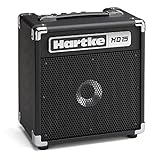
4. Hartke HD15 — The Articulate Tone Specialist
Hartke HD15 Bass Combo Amplifier
15W solid state combo
6.5 inch HyDrive paper and aluminum speaker
4-band EQ
Dual channel
Aux input
16.1 lbs
Pros
- HyDrive speaker delivers clear articulate bass tone
- 4-band EQ allows precise tonal shaping
- Dual channel for tonal versatility
- Compact size fits small spaces
- Quality stainless steel enclosure
Cons
- 6.5 inch speaker smaller than competitors
- Lower wattage limits volume for larger venues
- Fewer reviews indicate smaller user base
The Hartke HD15 is the amp I recommend to players who care about clarity above all else. Hartke is famous for its aluminum-cone speakers, and the HD15 uses a HyDrive driver that combines a paper cone with an aluminum dust cap to produce a tone that is more articulate and defined than the typical 8-inch combo.
I spent two weeks with the HD15 as my main practice amp, and the standout trait was note definition. Walking bass lines, fast fingerstyle runs, and slap passages all came through with a clarity that reminded me of Hartke’s larger gigging rigs. The 4-band EQ gives more control than the typical 3-band setup, and I appreciated the extra midrange band when shaping tone for different basses.
The 6.5-inch speaker is smaller than the 8-inch drivers in the Fender and Orange, which means less low-end authority but tighter response in the midrange. For players who value articulation over sub-bass rumble, this is actually a benefit. For players chasing a big, round vintage tone, it is a limitation.
At 16.1 pounds the HD15 is light enough to carry to lessons or small sessions, and the stainless steel enclosure feels well-built. The 173 reviews are fewer than the Fender’s, but the 4.7-star average shows that owners are very happy with the tone and build quality.
Who Should Buy the Hartke HD15
This amp suits players who prioritize clarity and articulation in their practice tone. If you play a lot of fast fingerstyle, slap, or solo bass work where note definition matters, the HyDrive speaker gives you an edge over the typical 8-inch combo.
It is also a good fit for studio and recording practice, where the articulate tone translates well to a recording chain. Players who already own a Hartke gigging rig will recognize the family voicing immediately.
Where the Hartke HD15 Falls Short
The 6.5-inch speaker is the trade-off. You get clarity and articulation, but you give up the low-end weight that the Fender Rumble 15 and Orange Crush 25 deliver. If your practice includes a lot of low-register work or five-string bass, you may find the HD15 thin below low E.
It is also priced higher than the Fender Rumble 15 despite offering similar wattage. Whether the HyDrive speaker and 4-band EQ justify the premium depends on how much you value articulation. For some players it is worth every penny, for others the Fender is the smarter buy.
5. Vox amPlug 3 Bass — The Silent Practice Specialist
Vox amPlug 3 Bass Compact Bass Headphone Amplifier w/ Built-In FX and Speaker Emulation
Headphone bass amp
3 modes Classic Smooth Funk
9 built-in rhythm tracks
Built-in compressor
17 hour battery life
40 grams
Pros
- Exceptional portability at only 40 grams
- 17 hours of battery life on two AAA batteries
- Three distinct bass voicings for tonal variety
- Built-in rhythm tracks for solo practice
- Integrated compressor for consistent volume
- Analog circuitry for warm tone
Cons
- Requires AAA batteries not USB rechargeable
- Limited to headphone listening only
- No speaker for shared practice
- Stock often limited
The Vox amPlug 3 Bass is the answer to a question I get asked constantly: what is the best way to practice bass silently in an apartment without buying a full amp? This tiny headphone amplifier plugs directly into your bass, weighs 40 grams, and runs for up to 17 hours on two AAA batteries.
I tested the amPlug 3 over a two-week period of late-night apartment practice, and it became my go-to for silent sessions. The three modes, Classic, Smooth, and Funk, cover an impressive range of tones. Classic gives a vintage growl that works for rock and soul, Smooth produces a rounded jazz and fusion tone, and Funk adds the punch and snap you want for slap practice.
The built-in rhythm tracks are a feature I did not know I needed. There are nine rhythm patterns covering rock, funk, and blues, and playing along with them turned my practice sessions from scale drills into actual music-making. The integrated compressor keeps your volume consistent, which is especially helpful when practicing dynamic techniques.
The analog circuitry is the reason the amPlug 3 sounds better than cheaper digital alternatives. The tone is warm and responsive rather than sterile and flat, and the speaker emulation gives you the sense of playing through a real amp, not a toy. At $55.99 this is one of the best values in bass practice gear.
Who Should Buy the Vox amPlug 3 Bass
This is the perfect choice for apartment dwellers, late-night practicers, traveling musicians, and anyone whose main constraint is noise. If your practice happens after the rest of the household is asleep, the amPlug 3 lets you work on tone and technique without a single complaint.
It is also an excellent secondary tool for players who already own a practice amp but want a portable silent option for travel or commuting. Slip it in a gig bag with a pair of headphones and you can practice anywhere.
Where the Vox amPlug 3 Bass Falls Short
The obvious limitation is that you can only hear yourself through headphones. There is no speaker, which means you cannot share your practice with a teacher, jam with friends, or use it as a warm-up amp at a gig. This is a silent practice tool, not a replacement for a real combo.
The AAA battery requirement is a minor annoyance. You will want to keep spares on hand or invest in rechargeable AAA batteries. There is no USB charging option, which feels dated in 2026. Stock can also be limited, so check availability before planning your purchase around it.
How to Choose the Best Bass Amplifier for Practice
Buying a bass practice amp is not the same as buying a gigging rig. The priorities are different, the budget is usually smaller, and the features that matter most depend on where and how you practice. Here is what I tell every student who asks me how to choose.
Wattage: Match the Amp to the Room
Wattage determines how loud your amp can get before distorting, and for practice the right number depends entirely on your situation. For solo home practice in a bedroom or apartment, 10 to 25 watts is plenty. You want enough headroom to play at a comfortable volume without the amp breaking up unpleasantly.
For band rehearsals with a drummer, you need more power. A 40 to 100 watt bass amp is the minimum I recommend for keeping up with an acoustic drum kit, and 100 watts or more is safer for louder drummers. The mistake beginners make is buying a 15-watt amp expecting it to work at rehearsal, then being disappointed when it cannot compete.
The amps on this list range from 10 to 25 watts, which puts them firmly in the home-practice and small-rehearsal category. The Orange Crush Bass 25 at 25 watts is the most powerful, and it is the one I would trust for a quiet acoustic rehearsal. For anything louder, plan to upgrade.
Speaker Size: Why It Matters More Than Wattage
Speaker size affects your low-end response more than wattage does. Bass frequencies need a larger cone to move enough air, and small speakers simply cannot reproduce the fundamentals of a bass guitar accurately. An 8-inch speaker is the practical minimum for satisfying bass tone, and a 10-inch or 12-inch driver is better still.
The Fender Rumble 15 and Orange Crush Bass 25 both use 8-inch speakers, which is why they sound fuller than the JOYO MA-10B with its 5-inch driver or the Hartke HD15 with its 6.5-inch speaker. If low-end authority matters to your practice, prioritize speaker size over almost every other spec.
That said, the Hartke HD15 proves that smaller speakers can sound great in their own way. The 6.5-inch HyDrive driver trades low-end weight for articulation, which some players prefer. Know what you value before you choose.
EQ and Tone Shaping
A good practice amp should give you real control over your tone, not just a single tone knob. A 3-band EQ with bass, mid, and treble controls is the minimum I recommend, and a 4-band or parametric EQ is even better for dialing in specific sounds.
The Orange Crush Bass 25 wins this category with its active 3-band EQ plus a parametric mid control, which lets you sweep the midrange frequency you want to boost or cut. The Hartke HD15 offers a 4-band EQ that gives similar flexibility. The Fender Rumble 15 has a solid 3-band EQ that covers the basics well.
Headphone Jack and Silent Practice
If you live in an apartment, share walls, or practice late at night, a headphone jack is not optional. Every amp on this list includes one, but the quality of the headphone tone varies. The Orange Crush Bass 25 stands out with its Cabsim-loaded headphone output, which applies speaker emulation so your headphones sound like a miked cabinet rather than a direct signal.
The Vox amPlug 3 Bass is essentially a headphone amp with no speaker at all, and its three modes plus built-in compressor make it the most tone-flexible silent practice option here. For pure silent practice, it is hard to beat.
Portability and Weight
Practice amps get moved around. You will carry yours to lessons, to friends’ houses, and between rooms, so weight matters more than you might think. The JOYO MA-10B at 2.9 pounds and the Vox amPlug 3 at 40 grams are the most portable options by far, with battery power adding to their grab-and-go appeal.
The combo amps range from 16.1 pounds for the Hartke HD15 to 20.25 pounds for the Orange Crush Bass 25. All are manageable for short carries, but if stairs are involved, lighter is better.
Price and Value
Practice amps range from under $50 to over $250, and the right budget depends on your commitment level. A complete beginner who is not sure bass is for them should start cheap with the JOYO MA-10B or the Fender Rumble 15. A committed player who practices daily will get more value from the Orange Crush Bass 25 and its premium features.
The Vox amPlug 3 Bass occupies a unique value position. At around $56 it is cheaper than any combo amp, and for silent practice it outperforms amps costing three times as much. If headphones are your primary practice method, it is the smartest money you can spend.
Apartment and Quiet Practice Considerations
One thing competitors rarely address is apartment living. If you share walls or have noise-sensitive neighbors, your priorities shift. A headphone jack becomes essential, low-wattage is an advantage rather than a limitation, and a small footprint matters when your practice space is also your living room.
For apartment dwellers, I recommend either the Vox amPlug 3 Bass for fully silent practice or the Fender Rumble 15 V3 for low-volume combo practice with the headphone option as backup. Both are quiet-friendly, compact, and affordable enough to leave room in your budget for a good pair of headphones.
FAQs
What is the best sounding practice amp?
The Orange Crush Bass 25 is the best sounding practice amp I have tested, thanks to its active parametric EQ and Cabsim-loaded headphone output that emulates a miked 4×10 cabinet. For pure silent practice tone, the Vox amPlug 3 Bass with its analog circuitry and three voiced modes is also exceptional.
What wattage bass amp do I need for band practice?
For band practice with an acoustic drummer you need at least 40 to 100 watts, with 100 watts or more being safer for louder drummers. The amps on this list range from 10 to 25 watts, which makes them best suited for home practice, small acoustic rehearsals, and silent practice rather than full band use.
Do I need an amp to practice bass?
You do not strictly need a bass amp to practice, but you do need a way to hear yourself. A headphone amp like the Vox amPlug 3 Bass, an audio interface with monitoring headphones, or a multi-effects unit with a headphone jack all work for silent practice. A dedicated practice amp simply gives you better tone and the option to play out loud when you want.
Can I use headphones with a bass practice amp?
Yes, every amp on this list includes a headphone jack for silent practice. The Orange Crush Bass 25 goes further with its Cabsim speaker emulation, which applies cabinet modeling to the headphone signal so you hear a miked-amp tone rather than a flat direct signal.
Final Verdict: The Best Bass Amplifier for Practice in 2026
After testing all five amps, my overall recommendation for the best bass amplifier for practice in 2026 goes to the Orange Crush Bass 25. Its parametric EQ, Cabsim headphone output, built-in tuner, and 25 watts of power make it the most complete and flexible practice combo on this list. It is the amp I would buy for myself.
If budget is your priority, the Fender Rumble 15 V3 delivers legendary Fender tone and the biggest user base of any amp here for under $100. And if portability or silent practice is your main need, the JOYO MA-10B and Vox amPlug 3 Bass each solve problems the bigger combos cannot. Pick the amp that matches your practice situation, and you will not be disappointed.