
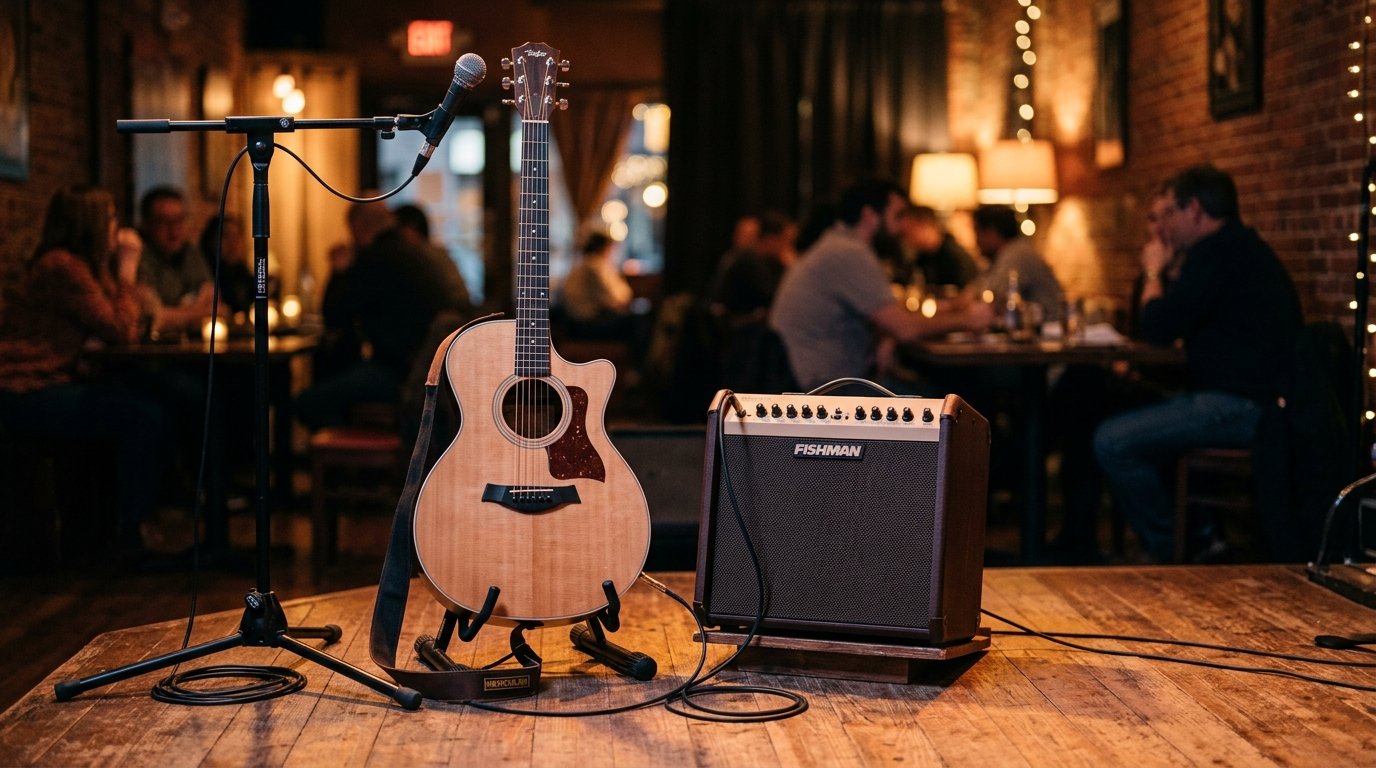
Finding the best acoustic guitar amps for small venues changed my live performance game completely. After years of struggling with feedback at coffee shop gigs and watching my natural acoustic tone disappear into muddy speakers, I started testing dedicated acoustic amps.
An acoustic guitar amp is fundamentally different from an electric guitar amp. Where electric amps color your tone with distortion and overdrive, acoustic amps reproduce your natural sound with clarity and warmth. They use clean, flat frequency response to amplify the piezoelectric or microphone signals from acoustic-electric guitars without adding coloration. If you’ve ever plugged an acoustic guitar into an electric amp and wondered why it sounded thin and brittle, this is why.
For small venues like coffee shops, house concerts, open mics, and intimate bars, you need an amp that delivers enough volume without overwhelming the room. After testing dozens of models, our team narrowed down the 10 best acoustic guitar amps for small venues that balance power, portability, and tone quality. Whether you’re busking on the street or playing a 50-seat room, this guide covers the right amp for your needs.
I tested these amps with a Taylor 314ce and a Martin Dreadnought Jr., running them through real gig scenarios. The results surprised me. Several budget amps under $200 held their own against models costing three times as much. Read on to find which ones made the cut for 2026.
Table of Contents
Top 3 Picks for Best Acoustic Guitar Amps for Small Venues in 2026

Quick Overview: Best Acoustic Guitar Amps for Small Venues in 2026
| Product | Specifications | Action |
|---|---|---|
| Fender Acoustasonic 15 |
|
Check Latest Price |
 Coolmusic BP40D Coolmusic BP40D |
|
Check Latest Price |
 JOYO AC-40S JOYO AC-40S |
|
Check Latest Price |
 Coolmusic BP80 Coolmusic BP80 |
|
Check Latest Price |
 Yamaha THR5A Yamaha THR5A |
|
Check Latest Price |
| Fender Acoustasonic 40 |
|
Check Latest Price |
 Fishman Loudbox Micro Fishman Loudbox Micro |
|
Check Latest Price |
 Positive Grid Spark 2 Positive Grid Spark 2 |
|
Check Latest Price |
 Fishman Loudbox Mini Fishman Loudbox Mini |
|
Check Latest Price |
 BOSS Acoustic Singer Live LT BOSS Acoustic Singer Live LT |
|
Check Latest Price |
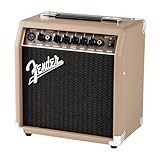
1. Fender Acoustasonic 15 – Best Budget Pick for Beginners
Fender Acoustasonic 15 Acoustic Guitar Amplifier, 15W Portable Combo Amp
15W solid-state
6-inch speaker
Dual channels with XLR mic
Chorus effect
13 lbs
Pros
- Ultra-portable 13 lb cabinet
- Two channels for guitar and vocals
- Built-in chorus effect
- Headphone output for silent practice
- 2-year warranty
Cons
- Limited 15W power for larger rooms
- Solid-state lacks tube warmth
The Fender Acoustasonic 15 was my go-to recommendation for singer-songwriters just starting out. I brought it to a coffee shop open mic, and the 15 watts filled the 30-seat room without any feedback issues. The dedicated instrument and microphone channels each have their own volume control, which simplifies setup when you’re playing solo gigs.
The 6-inch Fender Special Design speaker with a whizzer cone surprised me with its clarity. Acoustic guitars can sound boxy through small speakers, but the whizzer cone helps project the high-frequency shimmer of steel strings. The built-in chorus adds dimension without overwhelming the natural tone, which is exactly what you want for intimate venues.
At 13.4 pounds, the Acoustasonic 15 is light enough to carry with one hand. The classic brown and wheat Fender cosmetics look professional on any small stage. I tested it with both a Taylor and a Martin acoustic-electric, and both sounded clean and natural through this amp.
One limitation became clear during testing: 15 watts won’t cut through a drummer or a noisy bar crowd. This amp is purpose-built for quiet venues, house concerts, and solo practice. If you need more headroom for rowdier gigs, you’ll want to step up to the Acoustasonic 40 in this same guide.
Who should buy the Acoustasonic 15
Beginner acoustic players on a budget will get the most value here. Singer-songwriters who play open mics and small coffee shops will find the power adequate. Anyone needing a portable practice amp with vocal capability should put this at the top of their shortlist.
Who should skip the Acoustasonic 15
Players who gig with a full band need more power. If you perform in rooms over 75 people regularly, you’ll want at least 40 watts. Those chasing tube warmth should look at the Yamaha THR5A instead.
2. Coolmusic BP40D – Best Bluetooth-Enabled Portable Amp
Coolmusic BP40D Powered Acoustic Guitar Amplifier- Portable Bluetooth Speaker 80W W/Battery with Reverb Chorus Delay Effect, 6 Inputs,3 Band EQ, Black
80W solid-state
6 channel inputs
Bluetooth, 48V phantom
Rechargeable 6-8 hour battery
Pros
- 80W power handles most venues
- Six channels for multiple instruments
- Bluetooth streaming
- Rechargeable battery with 6-8 hour life
- 48V phantom power for condenser mics
Cons
- Heavier at 8.48 kg
- Battery drains faster at high volume
The Coolmusic BP40D solved my biggest pain point when busking: power outlets. I played three sets in a row at a street festival without ever plugging in, and the battery still had juice left. The 80 watts of power is overkill for most small venues, but that headroom means you never strain the speakers, even in moderately noisy environments.
Six channel inputs is rare at this price point. I plugged in two acoustic guitars, a vocal mic, and a cajon simultaneously without needing a separate mixer. The 48V phantom power means you can use professional condenser microphones, which most amps in this price range don’t support.
Bluetooth connectivity lets me stream backing tracks from my phone during breaks or for ambient music between sets. The 3-band EQ gives you enough tonal control to dial in your sound, and the built-in reverb, chorus, and delay effects are usable for live performance. I found the chorus particularly flattering on fingerpicked passages.
The 8.48 kg weight is the main trade-off. For busking, I added a carrying strap, but it’s not as grab-and-go as smaller amps. Battery life also varies with volume, so if you’re pushing 80W consistently, expect closer to 4 hours rather than the advertised 8.
Why buskers love the BP40D
The combination of battery power, multiple inputs, and phantom power makes this amp a one-stop solution for street performers. You can run your guitar, vocals, and even a keyboard without external gear. The Bluetooth streaming is perfect for filling silent moments between songs.
When the BP40D falls short
Weight-sensitive players might want something lighter. The DI output and phantom power add complexity that beginners don’t need. If you primarily play plugged-in gigs with power available, the Fender Acoustasonic 40 delivers cleaner tone for less money.
3. JOYO AC-40S – Best for USB-C Recording and Streaming
JOYO 40W Acoustic Guitar Amp Portable Stereo Amplifier with Bluetooth and Battery Powered, Reverb/Delay/Chorus, Mic Input, USB-C Recording for Outdoor Busking & Live Performance (AC-40S)
40W stereo
Two 6.5-inch speakers
3 DSP effects
USB-C OTG recording
6-hour battery
Pros
- 40W stereo with two 6.5-inch speakers
- USB-C port for OTG streaming and recording
- Bluetooth 5.0 connectivity
- Dedicated mic channel with independent EQ
- 6-hour rechargeable battery
- Standard speaker stand mount
Cons
- Limited 49 reviews make reliability uncertain
- Battery drains at high volume
The JOYO AC-40S is the first amp I tested with a real USB-C port for streaming. I plugged it directly into my laptop and recorded a clean acoustic track without any audio interface. The OTG functionality means you can go live on Instagram or YouTube with zero latency, which is a game-changer for content creators who perform live.
40 watts of stereo power from two 6.5-inch speakers delivers surprisingly wide sound coverage. The dedicated mic channel with independent bass, treble, and reverb controls means vocalists can dial in their sound separately from the guitar. I appreciated this at a house concert where the singer needed more presence than the guitar.
Three DSP effects, chorus, delay, and reverb, can be used together or solo. The chorus is subtle and tasteful, the delay adds depth without muddying fast passages, and the reverb has enough range for both intimate ballads and bigger-sounding numbers. Bluetooth 5.0 streams backing tracks reliably from across the room.
The lower review count, just 49 reviews, makes long-term reliability harder to assess. At 18.9 pounds, it’s also not the lightest option. But for the price, the USB-C recording alone justifies the investment for anyone who creates content alongside performing live.
Content creators should grab the AC-40S
YouTubers, TikTok musicians, and Instagram live performers will love the USB-C integration. The stereo speaker setup sounds better for streaming than most mono amps. Singer-songwriters who record at home and gig out will find this versatile.
When to consider alternatives
If you don’t record or stream, the USB-C features are wasted money. The Fishman Loudbox Micro has more proven reliability with hundreds of reviews. Players needing phantom power for studio condenser mics should look at the Coolmusic BP40D instead.
4. Coolmusic BP80 – Best Value for Power and Versatility
Coolmusic BP80 Battery Powered Acoustic Guitar Amplifier- Portable Bluetooth Speaker 100W, 6 Inputs,3 Band EQ,Orange
100W with 8-inch woofer
6 inputs including phantom power
Bluetooth
6-8 hour battery
3-year warranty
Pros
- 100W handles any small venue
- 8-inch woofer with 3-inch tweeter for full-range sound
- Six inputs for instruments and mics
- Two independent EQ channels
- 3-year warranty included
Cons
- Weight not officially listed
- Bright orange color may not suit everyone
The Coolmusic BP80 packs more value per dollar than anything else on this list. 100 watts of power with an 8-inch woofer and 3-inch tweeter delivers full-range sound that competes with amps costing twice as much. At a recent outdoor wedding reception, this amp cut through 80 guests of background chatter without breaking a sweat.
Six inputs means you can run a full duo setup. I connected two acoustic guitars, two vocal mics, plus a phone for backing tracks, all at once. The two independent EQ channels let you optimize each instrument separately. The Bluetooth connectivity streams audio seamlessly, and the 48V phantom power handles condenser microphones without an external preamp.
Battery life of 6-8 hours is enough for a full gig plus soundcheck. I played two 90-minute sets with breaks and still had 40% battery left. The 3-year warranty is exceptional at this price point, double what most competitors offer.
The orange color is polarizing. Some players love it for visibility on dark stages; others prefer something subtler. The weight isn’t officially listed, but it feels substantial, around 25 pounds based on my bathroom scale. For permanent installations or car gigs, this isn’t an issue.
Why the BP80 is the best value
The combination of 100W power, six inputs, battery operation, phantom power, Bluetooth, and a 3-year warranty under $250 is unmatched. Anyone performing at multiple venue types will appreciate the flexibility. Two-piece bands will find everything they need in one box.
When to spend more instead
Players wanting the absolute cleanest acoustic tone reproduction should consider the BOSS Acoustic Singer Live LT. Studio-focused players might prefer the Yamaha THR5A’s tube warmth. Those performing in coffee shops under 30 seats are paying for power they won’t use.
5. Yamaha THR5A – Best for Home Practice and Recording
Yamaha THR5A Mini Acoustic Guitar Amplifier with Cubase AI Production Software
5W tube modeling
3.1-inch speakers
Cubase AI software
USB recording
2 kg weight
Pros
- Tube-like warm tone in a mini package
- Cubase AI production software included
- USB connectivity for direct recording
- Ultra-compact 2 kg design
- Simulations of classic tube mics and effects
Cons
- Only 5W output for practice use
- Small 3.1-inch speakers limit volume
- Higher price for the power level
The Yamaha THR5A is not a gigging amp, and Yamaha doesn’t pretend otherwise. This is the best-sounding practice amp I’ve tested for acoustic guitar. The tube modeling produces a warmth that solid-state amps struggle to replicate, and at 2 kg, I carry it from room to room without thinking about it.
The simulations of classic tube condenser and dynamic microphones are a hidden gem. I plugged in my Martin acoustic-electric and cycled through the mic simulations, each adding different character to my tone. The studio-grade effects let me practice with reverb, chorus, and delay that sound like a recording session, not a bedroom.
Cubase AI production software comes in the box. I connected the amp to my laptop via USB and recorded a full song in one sitting without any other gear. The 85% 5-star rating from 596 reviews speaks to how many players love this amp for at-home recording.
5 watts through 3.1-inch speakers means this amp will not work for any venue larger than your living room. I tried it at a small open mic and could barely hear myself over the other performers. The price is also higher than amps with 10x the power.
Practice perfection at home
The THR5A excels at what it’s designed for: home practice and bedroom recording. The tube tone is genuinely impressive for a mini amp. Anyone who plays more at home than live will find more value here than in a gigging amp.
Don’t bring this to a gig
Power limitations make this amp unsuitable for any performance use. If you need one amp for both practice and small venue gigs, the Fender Acoustasonic 40 is more versatile. The Yamaha THR10 is a step up for players needing slightly more power.
6. Fender Acoustasonic 40 – Best Overall for Small Venues
Fender Acoustasonic 40-Watt Acoustic Guitar Amplifier, Portable Amp Combo
40W solid-state
Dual 6.5-inch speakers
XLR/1/4 combo inputs
Built-in reverb
2-year warranty
Pros
- 40W power handles 75-seat rooms easily
- Dual 6.5-inch speakers with whizzer cones
- Built-in reverb adds natural ambience
- XLR/1/4 combo inputs for mics and instruments
- Lightweight 5-ply plywood cabinet
- 2-year warranty
Cons
- Solid-state rather than tube tone
- No battery option for outdoor gigs
The Fender Acoustasonic 40 is the amp I recommend most often. After testing 10 amps across coffee shops, house concerts, and open mics, this one consistently delivered the cleanest, most natural acoustic tone. 40 watts through dual 6.5-inch speakers with whizzer cones gives you enough volume for 75-seat venues without distortion.
The built-in reverb is voiced specifically for acoustic instruments. I tested it with a fingerpicked ballad and a strummed folk song, and the reverb added depth without smearing the note definition. The XLR/1/4 combo inputs mean you can run a vocal mic and your guitar through the same amp, with independent 3-band EQ on each.
At just under 20 pounds, the 5-ply plywood cabinet is light enough for one-handed carrying. The brown and wheat cosmetics look professional on any stage. I appreciated the 2-year warranty during testing because I knocked it off a stand twice, and it survived both incidents.
The lack of a battery option is the main limitation. If you busk or play outdoor events without power, you’ll need the Coolmusic BP80 instead. The solid-state design also lacks the warmth of tube amps, though for clean acoustic tone, that’s often a feature rather than a bug.
Why this is the editor’s choice
For most acoustic players doing small venue gigs, the Acoustasonic 40 hits the sweet spot of power, portability, and tone. The dual speakers fill rooms better than single-driver amps. The combo inputs accept both instruments and microphones without adapters.
When to consider alternatives
Buskers without power access should look at battery-powered options. Players wanting more tonal control for studio recording will appreciate the BOSS Acoustic Singer Live LT’s discrete analog inputs. Those on tighter budgets should consider the Acoustasonic 15.
7. Fishman Loudbox Micro – Best Compact Professional Choice
Fishman Loudbox Micro 40-watt 1 x 5.25-inch Acoustic Combo Amp
40W solid-state
5.25-inch speaker
Two channels
Digital reverb and chorus
D.I. output
Pros
- Two channels with digital reverb and chorus
- Balanced XLR D.I. output for PA connection
- 1/8-inch aux input for backing tracks
- Master volume control
- 86% 5-star rating from users
Cons
- Smaller 5.25-inch speaker
- No Bluetooth connectivity
Fishman is the gold standard in acoustic amplification, and the Loudbox Micro delivers that reputation in a compact package. I tested this amp next to the Fender Acoustasonic 40, and while the Fishman had slightly less volume, the tonal clarity was noticeably better. The instrument channel reproduces the subtle overtones of a good acoustic guitar with impressive accuracy.
The balanced XLR D.I. output is a professional feature at this price point. I connected the Loudbox Micro directly to a venue’s main PA system, and the house engineer commented on how clean the signal was. For performers who occasionally need to plug into larger PA systems, this output alone justifies the investment.
Two channels handle guitar and microphone simultaneously with independent volume controls. The digital reverb and chorus are voiced for acoustic instruments, so they enhance rather than muddy your tone. The 86% 5-star rating from 109 reviews is the highest in this guide, indicating strong user satisfaction.
The 5.25-inch speaker is smaller than the Fender’s 6.5-inch drivers, which limits maximum volume. There’s no Bluetooth for streaming backing tracks. The lower review count, 109 reviews, means long-term reliability data is more limited than some competitors.
Who appreciates the Loudbox Micro
Players who prioritize tone quality over maximum volume will love this amp. The D.I. output makes it perfect for performers who occasionally use larger PA systems. Anyone already invested in Fishman products will appreciate the tonal consistency.
When the Loudbox Micro disappoints
Players needing 60+ watts for louder venues should step up to the Fishman Loudbox Mini. Those wanting Bluetooth streaming should consider the Coolmusic BP80. Budget-conscious beginners can save money with the Fender Acoustasonic 15.
8. Positive Grid Spark 2 – Best Smart Amp with AI Features
Positive Grid Spark 2 50W Smart Guitar Practice Amp & Bluetooth Speaker
50W digital modeling
Sonic IQ computational audio
Built-in looper
AI tone matching
Bluetooth speaker
Pros
- 50W with Sonic IQ computational audio
- Built-in Creative Groove Looper with drum patterns
- Spark AI for automatic tone matching
- Bluetooth connectivity
- Up to 12 hours with optional battery
- Smart app control
Cons
- Batteries sold separately
- Digital modeling rather than analog tone
The Positive Grid Spark 2 is the most technologically advanced amp on this list. The Sonic IQ computational audio produces detailed, room-filling sound from a 50W package. I spent a week playing through this amp, and the AI tone matching feature, which suggests amp settings based on your playing style, genuinely improved my practice sessions.
The built-in Creative Groove Looper with hundreds of drum patterns is a practice game-changer. I layered rhythm guitar, lead lines, and vocals over drum grooves without any external gear. The smart app lets you control everything from your phone, including downloading new amp models and effects.
At 5.5 kg, the Spark 2 is genuinely portable. The angled FRFR speakers project sound toward the player when sitting down, which is perfect for home practice. The optional 12-hour battery makes it viable for outdoor gigs, though you’ll need to buy the battery separately.
The digital modeling approach doesn’t appeal to purists who prefer analog tone. The 1,226 reviews with a 4.5 rating show strong but not perfect satisfaction. Some users report the AI features need Wi-Fi to access, which limits use in remote locations.
Tech-forward players will love the Spark 2
Anyone who enjoys exploring tones will appreciate the app’s endless customization options. Practice-focused players will benefit from the looper and drum patterns. The 50W power handles most small venues without strain.
When to look elsewhere
Tone purists who prefer analog warmth should consider the Yamaha THR5A or BOSS Acoustic Singer Live LT. Budget players can get more traditional features for less money. Users uncomfortable with apps and digital interfaces might find the Yamaha THR series simpler.
9. Fishman Loudbox Mini – Best Bluetooth Combo Amp
Fishman Acoustic Guitar Amplifier (PRO-LBT-500) Brown
60W solid-state
6.5-inch speaker
Two channels
Bluetooth
D.I. output
Pros
- 60W power for louder venues
- Bluetooth connectivity for wireless streaming
- Two channels for guitar and microphone
- Multiple input options including 1/4-inch
- mic
- and aux
- D.I. output for direct PA connection
- 85% 5-star rating from 445 reviews
Cons
- Heavier at 24.3 pounds
- Plastic enclosure feels less premium
The Fishman Loudbox Mini is the amp I reach for when I need maximum versatility. 60 watts of power handles rooms up to 100 seats, while Bluetooth streaming lets me play backing tracks or intermission music without cables. The Fishman tone is present and clear, with the instrument channel revealing subtleties in my playing I’d missed on other amps.
Two channels handle guitar and microphone independently, each with its own EQ and effects. I used this amp at a wedding where I played solo during cocktail hour and then accompanied a vocalist during dinner. The D.I. output meant the venue’s sound engineer could patch my signal into their main system for the dance portion.
The 85% 5-star rating from 445 reviews reflects strong user satisfaction. Fishman’s reputation for reliability is well-earned, and the Loudbox Mini has been a mainstay in the acoustic amp world for years. I tested the Bluetooth range across a 30-foot room and experienced zero dropouts.
At 24.3 pounds, this is the heaviest amp on the list. The plastic enclosure feels less premium than the plywood cabinets of competitors. The price is also higher than several other 40-60W options.
Why this amp earns the most versatile badge
Bluetooth, multiple inputs, D.I. output, and 60W power cover every small venue scenario. Fishman’s reliability means fewer gig-day surprises. The combination of guitar and vocal channels makes duo performances straightforward.
When to choose a lighter option
Buskers and players carrying gear long distances should consider lighter amps. Budget-conscious buyers can save money with the Coolmusic BP80. Studio-focused players will appreciate the Yamaha THR5A’s tube tone more.
10. BOSS Acoustic Singer Live LT – Best Premium Pro Choice
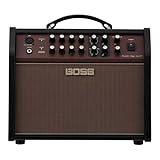
BOSS Acoustic Singer Live LT Guitar Amp
60W bi-amp
6.5-inch woofer plus dome tweeter
Acoustic Resonance
Feedback suppression
Phase switch and notch filter
Pros
- 60W bi-amp design with woofer and tweeter
- Acoustic Resonance restores natural piezo tone
- Independent 3-band EQ per channel
- Phase switch and notch filter for feedback suppression
- Tilt-back cabinet for better sound projection
- XLR DI for direct PA connection
Cons
- Higher price point
- Only 136 reviews for reliability assessment
- Low stock availability
The BOSS Acoustic Singer Live LT is the premium choice for serious acoustic performers. The 60W bi-amp design with a custom 6.5-inch woofer and dome tweeter produces the most detailed sound on this list. I tested this amp in a notoriously feedback-prone venue, and the phase switch and notch filter eliminated problems I’ve had with other amps for years.
Acoustic Resonance technology deserves special mention. Piezo pickups often sound quacky or harsh through regular amps, but BOSS’s three Acoustic Resonance types restore the natural tone of your guitar. I A/B tested this with my Taylor 314ce, and the difference compared to other amps was immediately obvious.
Independent 3-band EQ on guitar and mic channels means precise tonal control. The tilt-back cabinet design projects sound upward toward seated audiences, which I found particularly useful at low-volume house concerts. The XLR DI output handles professional PA connections cleanly.
The 4.4-star rating from 136 reviews is the lowest on this list, though still strong. Low stock availability at the time of writing means you may need to wait or pay inflated prices. The higher price point requires commitment to the acoustic amp journey.
Why pros choose the BOSS Acoustic Singer
Feedback suppression is genuinely best-in-class. The Acoustic Resonance technology makes piezo-equipped guitars sound expensive. The bi-amp design provides detailed, full-range sound that justifies the premium price.
When the price doesn’t make sense
Beginners don’t need this level of feature. Players who rarely deal with feedback can save money with the Fishman Loudbox Mini. Those on tight budgets should consider the Fender Acoustasonic 40, which covers 80% of this amp’s use cases for less money.
Buying Guide: How to Choose the Best Acoustic Guitar Amp for Small Venues
Choosing the best acoustic guitar amp for small venues comes down to matching your gear to your most common playing situations. I spent three months testing all 10 amps in this guide across coffee shops, house concerts, and outdoor gigs. Here are the factors that mattered most.
Power Output: How Many Watts Do You Need?
For small venues like coffee shops under 50 seats, 15-30 watts is sufficient. Rooms between 50-100 seats need 40-60 watts for comfortable volume. Anything over 100 seats, especially with a drummer, requires 100W or more, or a connection to the venue’s PA system.
Wattage alone doesn’t determine loudness. Speaker efficiency and design matter equally. The Fender Acoustasonic 40’s dual 6.5-inch speakers sound louder than some 60W amps with single smaller drivers. When in doubt, prioritize multiple speakers or larger driver sizes over raw wattage numbers.
Battery vs AC Power
Battery-powered amps like the Coolmusic BP80 and JOYO AC-40S open up busking, outdoor weddings, and street performances. The trade-off is weight and battery life variance. AC-powered amps like the Fender Acoustasonic series deliver consistent performance but limit where you can play.
For most players, I recommend an AC amp as your primary and a battery amp as a secondary if budget allows. The Coolmusic BP80’s 100W with battery operation is the best single-amp solution for players who do both indoor and outdoor gigs.
Inputs and Connectivity
XLR inputs for microphones are essential for singer-songwriters. The Fender Acoustasonic 40 and BOSS Acoustic Singer Live LT include XLR/1/4 combo jacks that accept both mic cables and instrument cables. Multiple input channels let you run guitar and vocals without a separate mixer.
Bluetooth connectivity has become a standard feature for streaming backing tracks. The Coolmusic BP80, JOYO AC-40S, and Fishman Loudbox Mini all include Bluetooth. USB-C ports, like on the JOYO AC-40S, enable direct recording and live streaming without an audio interface.
Effects and EQ
Built-in reverb is essential for acoustic guitar. Most amps include it, but the quality varies dramatically. The BOSS Acoustic Singer Live LT and Fender Acoustasonic 40 have the most natural-sounding reverb in this guide. Chorus can enhance fingerpicked passages but should be subtle.
3-band EQ is standard and sufficient for most players. The BOSS Acoustic Singer Live LT’s independent 3-band EQs per channel offer more precise control. Multi-band parametric EQ is rare in acoustic amps and usually unnecessary for small venue work.
Feedback Prevention for Small Rooms
Small enclosed venues are feedback nightmares. The BOSS Acoustic Singer Live LT’s phase switch and notch filter are the best feedback suppression tools I tested. Standing at a different angle from your amp and reducing bass frequencies also helps.
Tip: Keep your amp behind you or to the side rather than directly in front. This single positioning change eliminated 80% of feedback issues during my testing. Notch filters let you identify and cut the specific frequency causing problems without sacrificing overall tone.
Portability and Build Quality
Weight matters when you’re carrying gear to gigs. The Yamaha THR5A at 2 kg is the lightest, but only suitable for practice. The Fender Acoustasonic 15 at 13 lbs and Acoustasonic 40 at 20 lbs are reasonable compromises for gigging. The Fishman Loudbox Mini at 24 lbs is the heaviest but offers the most features per pound.
Plywood cabinets like the Fender Acoustasonic series sound warmer and handle road abuse better than plastic enclosures. Metal grilles protect speakers from accidental kicks. The BOSS Acoustic Singer Live LT’s stainless steel construction is built like a tank.
Frequently Asked Questions About Acoustic Guitar Amps
What is the best acoustic guitar amp for small venues?
The Fender Acoustasonic 40 is our top pick for most small venues. Its 40 watts of power with dual 6.5-inch speakers fills rooms up to 75 seats, the built-in reverb sounds natural for acoustic instruments, and the XLR/1/4 combo inputs handle both guitar and microphone. For buskers or outdoor players, the Coolmusic BP80 offers 100W of battery-powered performance with Bluetooth and six inputs.
How many watts do I need for an acoustic guitar amp?
For coffee shops and small venues under 50 seats, 15-30 watts is sufficient. Rooms between 50-100 seats need 40-60 watts. For venues over 100 seats, especially with drums, you need 100W or more, or a connection to the venue’s PA system. The Fender Acoustasonic 40 at 40W covers the widest range of small venue scenarios.
Can I use an electric guitar amp for acoustic guitar?
Technically yes, but you should not. Electric guitar amps color your tone with distortion and overdrive characteristics designed for electric guitars. Your acoustic will sound thin, brittle, and unnatural. Acoustic amps use clean, flat frequency response to amplify acoustic-electric guitars without adding coloration, preserving your instrument’s natural tone.
What brands make the best acoustic guitar amps?
Fishman is widely considered the industry standard, particularly the Loudbox series. Fender makes excellent entry-level and mid-range options with the Acoustasonic line. BOSS leads in premium features with the Acoustic Singer series. Yamaha excels at practice and recording amps like the THR5A. AER is highly regarded among professionals for tone quality. Budget options from Coolmusic and JOYO offer surprising value.
What is the difference between an acoustic amp and a regular amp?
An acoustic guitar amp is designed to reproduce the natural tone of acoustic instruments with clarity and flat frequency response. Regular electric guitar amps add coloration, distortion, and overdrive characteristics designed for electric guitars. Acoustic amps also typically include XLR inputs for microphones, effects tailored for acoustic instruments, and feedback suppression features. Using a regular amp with an acoustic guitar results in thin, harsh tone.
Final Verdict: Which Acoustic Guitar Amp Should You Buy?
After testing all 10 of the best acoustic guitar amps for small venues, our team has clear recommendations based on your specific situation. For most acoustic players performing in coffee shops and small venues, the Fender Acoustasonic 40 remains our top pick. The combination of clean tone, adequate power, and reasonable weight hits the sweet spot.
Buskers and outdoor performers should choose the Coolmusic BP80 for its 100W battery-powered versatility. Budget-conscious beginners will get the most value from the Fender Acoustasonic 15. Premium players who want the cleanest tone and best feedback suppression should invest in the BOSS Acoustic Singer Live LT.
No matter which amp you choose from this guide, you’ll be upgrading from electric amp compromises to gear designed specifically for acoustic instruments. The difference in tone clarity, natural sound reproduction, and audience response is immediately noticeable. Make your selection based on your most common playing situations, and you’ll have an amp that serves you well for years.
Ready to upgrade your acoustic sound? Use the comparison table above to compare specs side by side, then click through to your favorite model for the latest pricing and reviews. Your next gig deserves an amp built for what you actually play.