
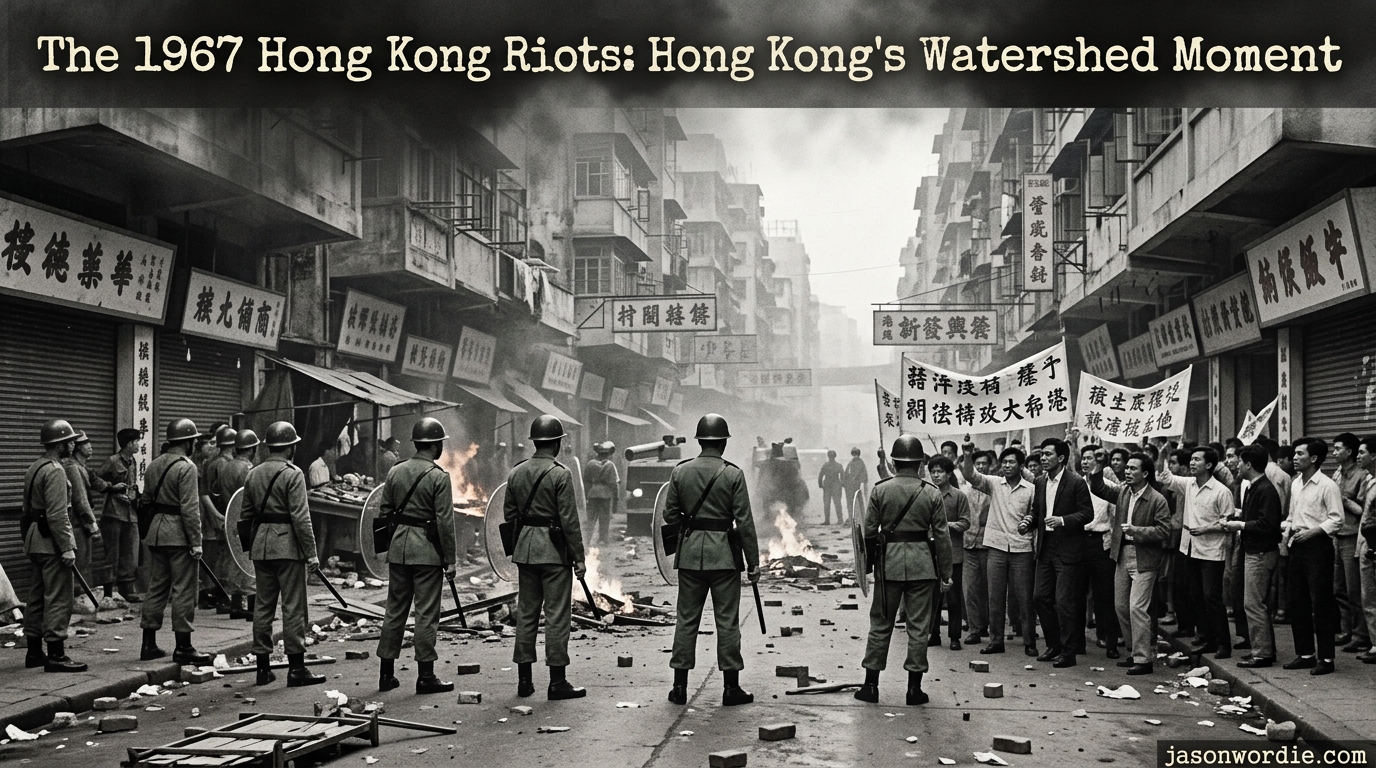
The 1967 Hong Kong riots became a turning point in Hong Kong’s history because they shattered the colonial government’s hands-off approach to governance and forced a radical rethink of how Britain ruled its Crown Colony. When pro-communist demonstrators staged eight months of protests, strikes, and bombings that killed 51 people, the administration realized it could no longer ignore the daily lives of its subjects. The reforms that followed under Governor Murray MacLehose in the 1970s built the modern Hong Kong we know today.
As I dug into the archival records, newspaper accounts, and the definitive work by Gary Cheung (Hong Kong’s Watershed: The 1967 Riots, HKU Press, 2009), one fact became unmistakably clear. The violence itself failed to end British rule, but it terrified the colonial administration into something it had never done before: actually listening to the people it governed.
This article traces how a factory-floor labour dispute spiralled into the most serious crisis of Hong Kong’s colonial era, and why historians nearly universally describe those eight months in 1967 as the dividing line between old colonial Hong Kong and the city that would become one of the Four Asian Tigers. We will walk through the causes, the escalation, the human cost, and the extraordinary wave of reforms that turned a failed uprising into the catalyst for Hong Kong’s golden age.
Table of Contents
Quick Facts: The 1967 Hong Kong Riots at a Glance
Before diving into the narrative, here are the essential facts about the 1967 riots that historians and students should know. These figures come from British colonial government records and the research compiled by Gary Cheung.
- Duration: May 6 to December 1967 (approximately 8 months)
- Trigger: Labour dispute at the Hong Kong Artificial Flower Works in San Po Kong
- Casualties: 51 people killed, including 10 police officers and 1 British soldier
- Injured: 832 people wounded
- Arrests: 4,979 people detained
- Convictions: 1,936 people formally convicted of offences
- Bombings: Over 8,000 suspected explosive devices planted (around 1,167 genuine bombs among thousands of fakes)
- Key Figures: Governor David Trench, Deputy Colonial Secretary Jack Cater, HKFTU Chairman Yeung Kwong, radio broadcaster Lam Bun
- External Influence: Mao Zedong’s Cultural Revolution in mainland China; the 12-3 anti-colonial victory in Portuguese Macau
- Outcome: Colonial government suppressed the riots but implemented sweeping social reforms in the 1970s under Governor Murray MacLehose
The single most important takeaway: the riots failed as a revolution but succeeded as a catalyst. The British colonial system that had governed Hong Kong with studied indifference for over a century was forced to change course completely. That change is why we call 1967 a watershed.
Hong Kong Before 1967: A Colony Ripe for Unrest
To understand why the 1967 riots became a turning point in Hong Kong’s history, we first need to grasp what the colony was like before the storm hit. Pre-1967 Hong Kong was a place of jarring contrasts. The economy was growing rapidly, fueled by textile manufacturing and light industry, but the fruits of that growth were distributed with staggering inequality.
The British colonial administration operated on a philosophy of positive non-interventionism. In practice, this meant the government provided minimal social services, no public housing worth speaking of, no free education, and virtually no labour protections. Workers routinely put in 10 to 12 hour days, six days a week, with no minimum wage, no paid leave, and no right to organize collectively.
Corruption was endemic at every level. The Royal Hong Kong Police Force ran syndicated corruption rackets, with officers collecting regular bribes from businesses, hawkers, and even ordinary residents seeking basic services. The triads operated with near-impunity, often in collusion with corrupt officers. An ordinary citizen trying to get a business license, report a crime, or secure a hospital bed was expected to pay a bribe first.
Housing conditions were equally dire. Hundreds of thousands of refugees from mainland China, fleeing the civil war and then the famine of the Great Leap Forward, crammed into squatter settlements and rooftop shanties. The 1953 Shek Kip Mei fire, which left 53,000 people homeless, had forced the government to build its first public housing estates, but these were designed as minimal resettlement blocks, not real homes. People lived in 120 square foot rooms shared by entire families.
This deep inequality existed alongside a total absence of political representation. Hong Kong had no elected legislature and no democratic institutions whatsoever. The Governor, appointed by London, ruled with near-absolute authority. Chinese residents had no say in how they were governed, and the colonial administration made little effort to communicate with or understand the needs of the Chinese population.
Two earlier riots had already exposed the fragility of this system. The 1956 Double Ten riots, sparked by political tensions between pro-Nationalist and pro-Communist factions in the resettlement estates, left 59 dead. The 1966 Star Ferry riots, triggered by a modest fare increase, revealed how quickly ordinary citizens could erupt in fury at a government they viewed as remote and unresponsive. Both were warnings that the colonial administration largely ignored.
Then came the Macao precedent. In December 1966, pro-communist demonstrators in the neighbouring Portuguese colony of Macao clashed with authorities in what became known as the 12-3 incident. The Portuguese administration capitulated completely, agreeing to crack down on Nationalist sympathizers and effectively conceding that the pro-CCP unions could operate freely. For Hong Kong’s leftist organizations, Macao proved that colonial governments could be humbled through street pressure.
The final ingredient was the Cultural Revolution sweeping across mainland China. Beginning in 1966, Mao Zedong’s campaign to purge bourgeois elements mobilized millions of Red Guards and unleashed a wave of revolutionary fervour. Across the border in Guangdong, the Cultural Revolution was in full swing by early 1967, and its ultra-leftist ideology rippled directly into Hong Kong through family ties, trade union networks, and Communist Party propaganda channels. Hong Kong’s pro-CCP organizations were watching, waiting, and preparing.
The Spark: How a Labour Dispute Became an Uprising
The 1967 riots did not begin with grand political demands or a coordinated revolutionary plan. They started with a wage cut at a plastic flower factory. This mundane origin is itself part of why the 1967 riots became a turning point in Hong Kong’s history, because it revealed how disconnected the colonial government was from the daily frustrations of working people.
In April 1967, management at the Hong Kong Artificial Flower Works in San Po Kong, an industrial district in Kowloon, implemented new regulations that effectively reduced worker pay. The factory, which produced artificial flowers for export, was part of the booming manufacturing sector that was enriching factory owners while workers struggled to survive. When workers protested the changes, the company responded by firing 174 employees who belonged to a pro-communist trade union.
This was not an unusual event in 1960s Hong Kong. Labour disputes were common, and the government’s standard response was to treat them as private matters between employers and workers. What made this case different was timing and context. The Cultural Revolution was radicalizing Hong Kong’s leftist organizations, the Macao victory was fresh in everyone’s mind, and the Hong Kong Federation of Trade Unions (HKFTU), the territory’s largest pro-CCP labour federation, was looking for an opportunity to test the colonial government’s resolve.
The HKFTU, led by Chairman Yeung Kwong, mobilized support for the fired workers. On May 4, demonstrators gathered outside the factory. On May 6, when workers attempted a sympathy strike and picket, the Royal Hong Kong Police Force moved in to break it up. Twenty-one people were arrested, and clashes between police and workers erupted across San Po Kong.
Governor David Trench, a former colonial intelligence officer known for his hardline approach, responded by deploying riot police and declaring emergency regulations. Rather than defusing the situation, the police crackdown inflamed it. Pro-communist newspapers denounced the government in language borrowed directly from the Cultural Revolution, framing the labour dispute as a patriotic anti-colonial struggle.
On May 11, the conflict escalated dramatically. Demonstrators marched on Government House, the Governor’s residence, and clashed with riot police along the way. By mid-May, the protests had spread beyond San Po Kong to working-class neighbourhoods across Kowloon and Hong Kong Island. Leftist organizations began organizing general strikes, and sympathetic workers from utilities, transport, and textile factories walked off the job.
The formation of the Anti-British Struggle Committee on May 16 marked the moment when a factory dispute transformed into a political movement. The committee, composed of leaders from the HKFTU and other pro-CCP organizations, declared its aim to overthrow British colonial rule. They adopted the rhetoric and tactics of the Cultural Revolution, distributing the Little Red Book, organizing study sessions, and staging mass rallies with revolutionary songs and slogans.
This is where the question of why the riots happened becomes complex. The immediate trigger was a labour dispute, but the underlying causes ran much deeper. Workers were genuinely exploited, housing was genuinely appalling, and the colonial government was genuinely unresponsive. The pro-CCP organizations did not create these grievances; they channelled them. But they channelled them through the lens of Maoist revolutionary ideology, which would ultimately alienate the broader population and doom the movement to failure.
Eight Months of Violence: The Escalation
What began as a factory strike entered a far darker phase in the summer of 1967. The escalation from protest to organized violence is what made the 1967 riots the most serious crisis in Hong Kong’s colonial history, and it is what ultimately convinced the British that the status quo was unsustainable.
The first major flashpoint came on July 8 at Sha Tau Kok, a border village where Hong Kong meets mainland China. Pro-communist demonstrators crossed into the restricted border zone and clashed with police. In the confusion, Chinese People’s Liberation Army forces from across the border opened fire on Hong Kong police. Five officers were killed, and the incident sent shockwaves through the colonial administration. For the first time, it seemed possible that Beijing might use military force to take Hong Kong.
That fear was not paranoid. Unknown to the public at the time, General Huang Yongsheng, commander of the PLA’s Guangzhou Military Region, had drawn up plans for a military invasion of Hong Kong. The plan called for PLA forces to cross the border and seize the colony by force, capitalizing on the unrest to end British rule permanently. What stopped it was not British military strength but a direct order from Premier Zhou Enlai in Beijing. Zhou, who oversaw China’s foreign policy, understood that seizing Hong Kong would provoke a catastrophic confrontation with Britain and possibly the United States. He overruled the hawks and ordered the PLA to stand down.
This detail, documented in Gary Cheung’s research using opened Chinese archives, shows just how close Hong Kong came to a military takeover in 1967. It also explains why the British took the reforms that followed so seriously. They had stared into the abyss of losing the colony entirely.
Through July and August, the violence intensified. Leftist demonstrators adopted a campaign of urban terrorism that would define the riots in public memory. They planted homemade bombs, known colloquially as pineapples, across the city. Some were genuine explosive devices packed with nails and shrapnel. Others were fakes designed to create chaos and stretch police resources. By the end of the crisis, over 8,000 suspected bombs had been reported, with approximately 1,167 confirmed as real.
The bombing campaign was not discriminate. Bombs were placed in streets, outside schools, near markets, and at bus stops. Ordinary Hong Kong residents going about their daily lives were killed and maimed. Children were among the victims. The randomness of the violence is what turned public opinion decisively against the leftist movement.
The most notorious incident came on August 24, when anti-communist radio broadcaster Lam Bun was murdered. Lam Bun hosted a popular radio program on Commercial Radio Hong Kong in which he sharply criticized the leftist rioters and mocked their tactics. That morning, as he drove to work, his car was blocked by a group of men posing as road repair workers. They doused his vehicle in petrol and set it alight with Lam Bun and his cousin still inside. Lam Bun died of severe burns the following day. His cousin survived but was permanently disfigured.
The Lam Bun murder remains one of the most notorious unsolved killings in Hong Kong history. No one was ever convicted. But its impact on public opinion was immediate and devastating. The Working Class History podcast, which interviewed three participants decades later, revealed new information about the case, but it has never been officially resolved. For the general public, the murder confirmed that the leftist movement had degenerated into naked terrorism.
The government responded with overwhelming force. Emergency regulations gave police sweeping powers of arrest, detention, and censorship. The government shut down leftist newspapers, closed schools with pro-communist ties, and arrested thousands of suspected sympathizers. The Kiu Kwan Mansion raid in August, where police stormed a building used as a leftist headquarters, netted weapons caches and propaganda materials. Curfews were imposed in affected districts, and the British military was placed on standby.
By October, the tide had turned decisively. The bombing campaign was alienating the very working-class population the leftists claimed to represent. Beijing, distracted by its own internal Cultural Revolution chaos, was providing rhetoric but not material support. And the Hong Kong police, strengthened by emergency powers and reinforcements, were methodically dismantling the movement’s infrastructure.
The riots sputtered to an end by December 1967. There was no formal surrender or peace agreement. The movement simply collapsed under the weight of public hostility, police pressure, and the withdrawal of tacit Beijing support. By the time the last bombs were defused, 51 people were dead, 832 were injured, and nearly 5,000 had been arrested.
Why the 1967 Riots Became a Turning Point in Hong Kong’s History
Here is where we reach the heart of this story. The riots failed as a revolution. British colonial rule survived, the pro-CCP leftists were defeated, and Hong Kong remained a British Crown Colony for another 30 years. So why do historians universally describe 1967 as the most important turning point in Hong Kong’s post-war history?
The answer lies in a single piece of testimony from someone who was in the room when the colonial government reassessed everything. Jack Cater, who served as Deputy Colonial Secretary during the riots and would later become Chief Secretary, the second-highest position in the colonial government, gave this assessment of what changed:
Before 1967, there was no real channel of contact between the government and the people. After the riots, we set up district offices to improve communication with the people. I don’t think there would have been any reform at all without the riots.
— Jack Cater, Deputy Colonial Secretary of Hong Kong
That quote, cited by the 8964 Museum and drawn from the archival record, is the clearest and most authoritative statement of why 1967 was a watershed. It comes from a man who was not a reformer or a critic of colonialism. He was a senior official inside the system, and he was saying, on the record, that without the riots, nothing would have changed.
To appreciate the magnitude of this admission, consider what the colonial governance model looked like before 1967. The British administration governed Hong Kong from the top down with almost zero input from the Chinese population. There were no elected representatives, no community consultation processes, no district-level engagement. The government issued edicts, collected taxes, maintained order, and otherwise left the population to fend for itself. As Cater himself acknowledged, there was no mechanism for the government to know what its own people were thinking, feeling, or needing.
The riots shattered that complacency. For eight months, the colonial administration faced an existential threat. The fact that ordinary workers could be mobilized into a violent anti-government movement revealed that the hands-off approach was not just unfair, it was dangerous. If the government continued to ignore the population, the population could be radicalized against it again, and next time Beijing might not hold back the PLA.
The reforms began almost immediately. In 1968, the government established the City District Officer scheme, a network of district offices designed to create, for the first time, a direct channel of communication between officials and local communities. These officers were tasked with understanding grassroots concerns, mediating disputes, and reporting public sentiment back to the administration. It was a basic function of governance that Hong Kong had never had before.
Labour laws were overhauled. The Employment Ordinance of 1968 introduced statutory protections for workers that had been entirely absent before the riots, including rest days, sick leave provisions, and limits on arbitrary dismissal. The Labour Relations Service was created to mediate disputes before they escalated into strikes. These were not revolutionary changes, but they were a fundamental departure from the laissez-faire indifference that had defined colonial economic policy.
The economic dimension of the turning point is often overlooked, but it was significant. During the riots, capital flight surged as wealthy residents and foreign investors moved money offshore. The Bank of England grew alarmed at the financial stability of the colony, and tensions arose between the British government in London, the Bank of England, and the British business community in Hong Kong over the devaluation of sterling and its impact on the Hong Kong dollar. A ResearchGate academic study on 1967 as the turning point in Hong Kong-British-PRC economic relations documents how the crisis forced a fundamental reconsideration of the colony’s economic relationship with Britain and its future financial independence.
The fear of communism was perhaps the most powerful driver of reform. The colonial government realized that the best defense against another leftist uprising was not just police repression but genuine social improvement. If Hong Kong’s working class had decent housing, good schools, reliable healthcare, and fair working conditions, they would have something to lose. They would not be easily radicalized. This logic, born directly from the trauma of 1967, drove every major reform of the 1970s.
Consider the contrast between before and after 1967:
Before 1967: No elected representation. No community consultation. No district offices. No statutory labour protections. Minimal public housing. No free education. No comprehensive healthcare. Endemic police corruption. A government that governed without communicating.
After 1967: District offices connecting government to communities. Employment Ordinance protecting workers. Massive public housing expansion. Free compulsory education. Universal healthcare system. Independent Commission Against Corruption. A government that understood it had to earn the loyalty of its people.
That transformation is the turning point. It did not happen overnight, and it took the appointment of a very specific governor to fully realize it. But the catalyst was 1967, and everyone who lived through it understood that.
The MacLehose Era: Reforms That Reshaped Hong Kong
If 1967 was the spark, the 1970s were the fire. The reforms that Jack Cater described did not reach their full expression until the arrival of a governor who understood instinctively that the old way of governing was dead.
Murray MacLehose arrived as Governor of Hong Kong in November 1971. A career diplomat with a background in the British Foreign Service, MacLehose was not the typical colonial administrator. He was fluent in Mandarin, had served in the British Embassy in Beijing, and brought a reformist energy that the colony had never seen in its chief executive. He would serve for over ten years, the longest governorship in Hong Kong’s history, and the period of his tenure is still remembered as the golden era of colonial governance.
MacLehose is still known affectionately in Hong Kong as the Good Governor, and the reforms he implemented were directly traceable to the trauma of 1967. His Ten-Year Housing Programme, announced in 1972, aimed to provide decent public housing for 1.8 million people. This was not the minimal resettlement blocks of the 1950s but properly designed estates with self-contained flats, running water, and sanitation. By the end of the decade, the percentage of the population living in adequate public housing had transformed the physical landscape of Hong Kong.
Education was the next frontier. Before 1967, the colonial government provided almost no free schooling. Children whose families could not afford fees simply did not get educated. In 1971, the government introduced six years of free primary education for all children. By 1978, this was expanded to nine years of free and compulsory education, covering both primary and junior secondary school. This single reform created the literate, skilled workforce that would power Hong Kong’s economic miracle in the decades that followed.
Healthcare underwent a similar revolution. MacLehose oversaw the expansion of public hospitals and clinics, bringing modern medical care within reach of ordinary residents for the first time. The government invested heavily in public health infrastructure, disease prevention, and maternal care. Life expectancy in Hong Kong, already among the highest in Asia, continued to climb.
Perhaps the most symbolically important reform was the establishment of the Independent Commission Against Corruption (ICAC) in 1974. Corruption had been so embedded in the colonial system that it was considered a fact of life. The ICAC, reporting directly to the Governor rather than the police, was given sweeping powers to investigate and prosecute graft at every level. The early years were contentious, with mass protests by police officers who faced prosecution for the bribe-taking that had been their standard income. But MacLehose stood firm, issuing amnesty for past offences while drawing a hard line going forward, and within a decade Hong Kong transformed from one of the most corrupt cities in Asia to one of the cleanest.
Labour protections continued to expand under MacLehose. Working hours were regulated, occupational safety standards were introduced, and workers gained rights to paid holidays, maternity leave, and severance pay. The conditions that had driven workers at the Hong Kong Artificial Flower Works to strike in 1967 were systematically addressed through legislation.
The economic results were staggering. Hong Kong’s GDP grew at an average annual rate of roughly 8 to 9 percent through the 1970s. The city joined Singapore, South Korea, and Taiwan as the Four Asian Tigers, economies that transformed from impoverished post-war societies into high-income industrial powerhouses within a single generation. The foundations of that transformation were laid in the reform wave that followed 1967.
None of this would have happened without the riots. That is not a speculative claim. It is the testimony of the officials who were there. Jack Cater, David Trench’s own policy reviews, and the internal colonial government assessments all pointed to the same conclusion. The violence of 1967 broke the inertia of a colonial system that had been content to let sleeping dogs lie. The system could no longer afford that luxury, and the reforms that resulted built the Hong Kong that the world admires today.
The Human Cost: Casualties and Trauma
The progress that followed 1967 came at a terrible price. The official casualty figures, drawn from British colonial records, tell a grim story.
Fifty-one people lost their lives during the eight-month crisis. Among the dead were 10 police officers, 1 British military serviceman, and 40 civilians. The civilians included innocent bystanders killed by bombs, workers killed in clashes with police, a child who picked up a fake bomb that turned out to be real, and Lam Bun, the radio broadcaster murdered in his car.
Eight hundred and thirty-two people were injured. Many of the injuries were severe, caused by explosions, beatings, and burns. Hospitals were overwhelmed at the peak of the crisis, and some victims were permanently disabled.
Nearly 5,000 people were arrested. The colonial government used emergency regulations to detain suspects without trial, and some were held for months before being charged. Of those arrested, 1,936 were formally convicted of criminal offences ranging from unlawful assembly to possession of explosives and murder.
Beyond the raw numbers, the human impact rippled outward in ways that statistics cannot capture. An emigration wave began as frightened residents, particularly the wealthy and the middle class, moved their families and assets to safer jurisdictions. Canada, Australia, and the United States saw increased arrivals from Hong Kong in the years following 1967. The fear that the colony might be seized by communist China at any moment never fully disappeared, and it would surge again during the 1984 Sino-British Joint Declaration negotiations over the 1997 handover.
The psychological trauma was profound. For a generation of Hong Kong residents, the sound of a bomb scare or the sight of a suspicious package on the street triggered memories of the pineapples. The riots left a scar on the collective consciousness that would shape the city’s political culture for decades.
The 2019 Parallels: What 1967 Tells Us About Modern Hong Kong
No discussion of the 1967 riots would be complete without addressing the question that dominates online forums and Reddit discussions to this day. How do the 1967 riots compare to the 2019 Hong Kong protests?
The parallels are striking on the surface. Both involved months of sustained street protests against a government that large segments of the population viewed as illegitimate. Both featured escalating violence, police confrontations, and international media attention. Both exposed deep social fault lines within Hong Kong society.
But the differences are more instructive than the similarities, and they reveal something important about why 1967 was a turning point while 2019 produced a very different outcome.
The most fundamental difference is ideological. The 1967 rioters were pro-communist, pro-Beijing, and anti-British. They wanted Hong Kong to be absorbed into the People’s Republic of China. The 2019 protesters were pro-democracy, anti-Beijing, and pro-autonomy. They wanted Hong Kong to maintain its separation from mainland China and resist the Communist Party’s growing influence. The two movements were mirror images of each other, with entirely opposite political goals.
This ideological reversal has a bitter irony. As the New York Times noted in 2019, the Communist Party of China quietly supported the 1967 rioters who were bombing Hong Kong and murdering its citizens. In 2019, that same Party denounced the pro-democracy protesters as violent criminals and imposed the National Security Law to crush them. The same tactics that were praised as patriotic resistance in 1967 were condemned as terrorism in 2019.
The level of violence was also dramatically different. As one Reddit user observed in a discussion that captures a widely held view, the 1967 riots were far more violent than the 2019 protests. In 1967, bombings, shootings, and lethal beatings were routine. Over 8,000 explosive devices were planted. In 2019, by contrast, extreme violence was comparatively rare, which is precisely why individual incidents, such as tragic deaths during the protests, became iconic symbols. The baseline of acceptable violence had shifted dramatically between the two eras.
The outcomes diverge as well. The 1967 riots, despite their failure to end British rule, produced the reform wave that built modern Hong Kong. The colonial government was terrified into action. The 2019 protests, despite their scale and international visibility, did not produce reforms. They produced the National Security Law of 2020, which criminalized the very act of dissent that the protests represented, and a sweeping crackdown on civil society, independent media, and political opposition.
Why the difference? In 1967, the government that faced the protests was a colonial power that could be pressured into reform because it had something to lose. Britain wanted to keep Hong Kong prosperous and stable, and it had the institutional flexibility to implement changes. In 2019, the sovereign power was Beijing, which viewed the protests not as a signal to reform but as a direct threat to its authority that had to be eliminated.
This contrast is itself part of the 1967 turning point legacy. The reforms that followed 1967 created a Hong Kong with a strong civic identity, an independent judiciary, a free press, and a politically engaged population. Those institutions persisted for decades and made the 2019 protests possible. The fact that those institutions have since been dramatically curtailed is a story that is still being written in 2026.
Legacy: A Localist Consciousness is Born
Perhaps the most enduring legacy of the 1967 riots is one that no government policy could have engineered. The crisis birthed a distinctly Hong Kong identity.
Before 1967, the Chinese population of Hong Kong largely thought of itself as sojourners, temporary residents who would eventually return to their ancestral homes in Guangdong or elsewhere on the mainland. The colonial government did nothing to discourage this transience. If residents saw themselves as temporary, they would not demand permanent rights, representation, or investment in their future.
The riots shattered that orientation. When pro-communist demonstrators planted bombs in the streets and murdered a radio host for criticizing them, ordinary Hong Kong residents were forced to choose sides. And the side most of them chose was neither the colonial government nor the communist leftists. They chose Hong Kong.
The fear of communism that gripped the city in the summer of 1967 was not abstract. It was the visceral fear of Cultural Revolution violence crossing the border and destroying the relative stability of Hong Kong life. That fear drove residents to identify not with Beijing, despite shared ethnicity and language, but with Hong Kong as a distinct place with its own values, its own way of life, and its own future separate from the mainland.
This localist consciousness, as scholars have termed it, was the psychological turning point that paralleled the political one. For the first time, a critical mass of Hong Kong residents began to think of themselves as Hong Kong people first and Chinese second. That identity would deepen over the following decades through Cantonese popular culture, the Cantonese film industry, Cantopop music, and the shared experience of living in a city that was neither fully British nor fully Chinese but something unique.
The cultural memory of 1967 has been kept alive in unexpected ways. Hong Kong cinema has revisited the era repeatedly, with filmmakers like John Woo and Wong Kar-wai drawing on the atmosphere of fear and uncertainty that defined the period. The 2015 police website revisionism controversy, in which the Hong Kong Police Force was caught quietly editing its own history pages to remove references to the communist nature of the 1967 rioters, revealed how politically sensitive those events remain. The fact that someone in the police force felt the need to sanitize the historical record decades later shows that the legacy of 1967 is still contested territory.
For younger generations of Hong Kong people in 2026, the 1967 riots are often a distant and poorly understood chapter of history. The events are politically sensitive under the current political environment, making open discussion and education about them challenging. But the reforms those riots produced, the housing estates, the schools, the hospitals, the anti-corruption framework, are the daily reality of every person living in Hong Kong. The turning point may be forgotten by many, but its effects are everywhere.
Frequently Asked Questions
Why did the Hong Kong riots start?
The 1967 Hong Kong riots started from a labour dispute at the Hong Kong Artificial Flower Works in San Po Kong in April 1967. Workers were angered by harsh new regulations and effective wage cuts, and when 174 unionized workers were fired for striking, demonstrations erupted on May 6. Inspired by the Cultural Revolution in mainland China and the recent anti-colonial victory in Portuguese Macau, the protests rapidly escalated from a factory dispute into an anti-British colonial uprising led by pro-CCP leftist groups including the Hong Kong Federation of Trade Unions.
What were the 1967 Hong Kong riots about?
The 1967 Hong Kong riots were large-scale anti-government protests that began as a minor labour dispute in May 1967 and escalated into a sustained campaign of strikes, demonstrations, and bombings against British colonial rule. Inspired by the Cultural Revolution and successful anti-colonial protests in Macau, pro-CCP leftist groups sought to end British authority in the colony. Over eight months, 51 people were killed, 832 injured, and nearly 5,000 arrested before the riots ended in December 1967. The crisis forced the colonial government to implement sweeping social reforms in the 1970s.
Why did the 1967 riots happen?
The 1967 riots happened due to a combination of deep-rooted factors: long-standing social inequality and lack of labour protections in colonial Hong Kong, inspiration from Mao Zedong’s Cultural Revolution sweeping across mainland China, and the successful anti-colonial uprising in Portuguese Macau earlier that year known as the 12-3 incident. The immediate trigger was the firing of striking workers from the Hong Kong Artificial Flower Works in San Po Kong. Pro-CCP unions led by the HKFTU mobilized these grievances into a broader anti-British movement that spiraled into violence.
Did the Hong Kong protests achieve anything?
Although the 1967 riots were militarily suppressed and failed to end British colonial rule, they achieved significant social and political reforms. As Deputy Colonial Secretary Jack Cater stated, the riots created the first real channel of communication between the Hong Kong government and its people. In the 1970s, Governor Murray MacLehose implemented sweeping reforms including a massive public housing program, free compulsory education, universal healthcare, the Independent Commission Against Corruption, and stronger labour laws. The riots also awakened a local Hong Kong identity and fear of communism that shaped the territory’s politics for decades.
Conclusion: The Watershed That Defined Modern Hong Kong
The 1967 riots occupy a unique place in Hong Kong’s history because they are the rare event that changed everything without succeeding at anything. The pro-communist leftists failed to end British rule. They failed to build a revolutionary movement. They failed to win popular support, and their bombing campaign turned the city against them. By every measure of revolutionary success, 1967 was a defeat.
But the reforms that followed, the district offices, the labour laws, the public housing, the schools, the hospitals, the anti-corruption agency, the birth of a local Hong Kong identity, those successes reshaped the city more profoundly than any revolution could have. As Jack Cater put it with the authority of someone who watched it happen from inside the system, without the riots, there would have been no reform at all.
That is why the 1967 riots became a turning point in Hong Kong’s history. Not because of what the rioters accomplished, but because of what their failure forced the colonial government to confront. The old Hong Kong, indifferent, detached, and laissez-faire to the point of neglect, died in the violence of 1967. The new Hong Kong, with its welfare state, its civic institutions, and its distinct identity, was born in the reforms that followed.
When Hong Kong was handed back to China in 1997, it inherited a city that had been built in the shadow of 1967. The prosperity, the rule of law, the civil society, and the sense of being a place apart, all of it traced back to those eight months of crisis. Understanding the 1967 riots is essential to understanding how modern Hong Kong came to be, and why its people have fought so hard, in every generation since, to preserve what those reforms created.