
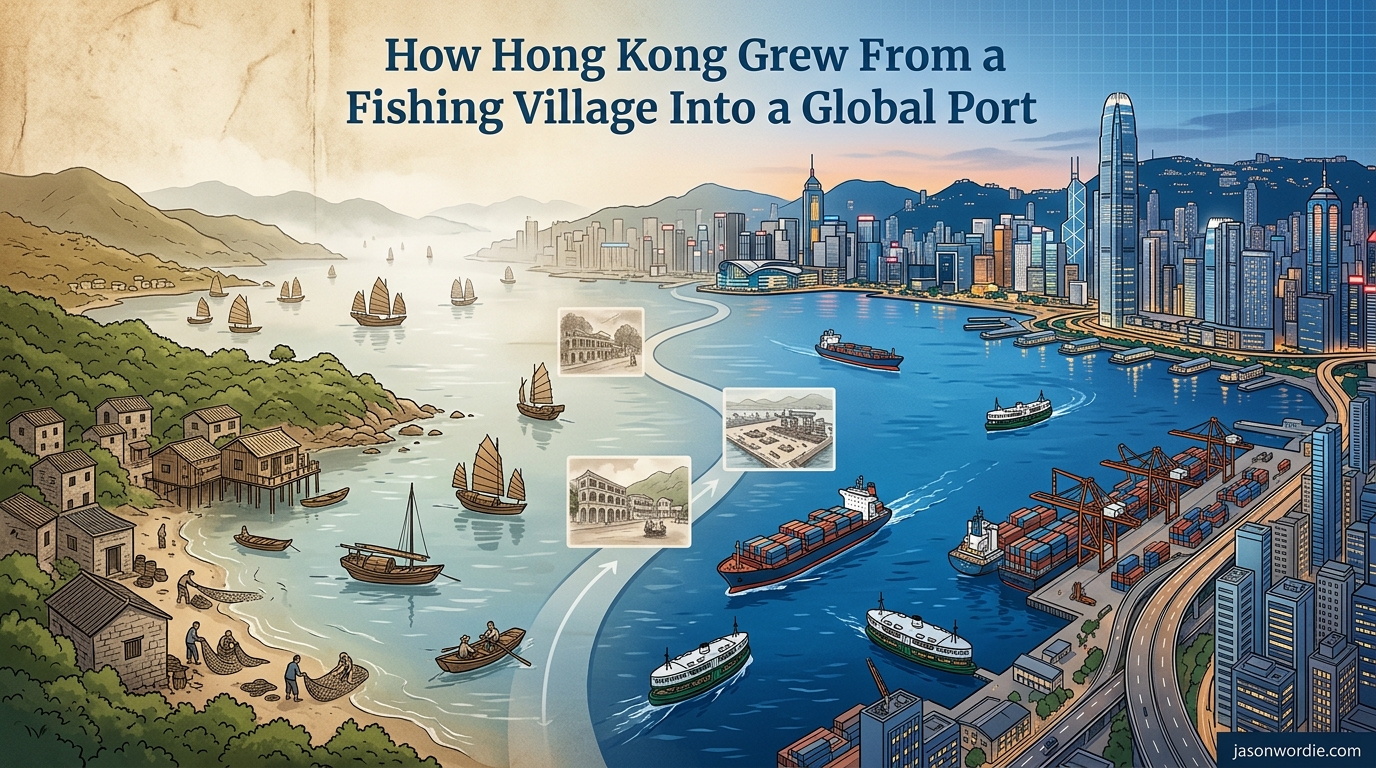
Yes, Hong Kong was once a small fishing village. In the early 1800s, fewer than 5,000 people lived across its rocky islands and coastal settlements, surviving on fishing, salt production, and subsistence farming. Today, over 7.5 million people call Hong Kong home, and it ranks among the busiest container ports and most powerful financial centers on the planet.
The story of how Hong Kong grew from a fishing village into a global port spans roughly 180 years. It is a tale shaped by war, trade, geography, waves of immigration, and political maneuvering between two of the world’s great powers. No other city on Earth made this journey so far, so fast.
In this article, I will walk you through every major phase of that transformation. You will learn what life looked like before the British arrived, how the Opium Wars changed everything, why Hong Kong became a free port, and how it evolved into the Pearl of the Orient we recognize today.
Table of Contents
How Hong Kong Grew From a Fishing Village Into a Global Port: A Quick Timeline
If you want the short version, here are the milestones that defined the transformation from fishing village to global port:
- Pre-1840: Hong Kong is a cluster of fishing villages with roughly 5,000 inhabitants, mostly Tanka and Hakka communities.
- 1841: Britain declares Hong Kong a free port, opening it to international trade without tariffs.
- 1842: The Treaty of Nanking formally cedes Hong Kong Island to Britain after the First Opium War.
- 1860: The Convention of Beijing adds the Kowloon Peninsula to British control after the Second Opium War.
- 1898: Britain secures a 99-year lease on the New Territories, completing the territorial footprint.
- 1941 to 1945: Japan occupies Hong Kong during World War II, devastating the population and economy.
- 1950s to 1980s: A post-war economic miracle turns Hong Kong into a manufacturing and trading powerhouse.
- 1997: Sovereignty transfers from Britain to China under the One Country Two Systems framework.
- 2026: Hong Kong remains one of the world’s top financial centers and busiest container ports.
Now let us dig into each of these eras in detail.
Pre-Colonial Roots: Life in a Fishing Village
Long before skyscrapers lined Victoria Harbour, the land we now call Hong Kong was home to scattered fishing communities. Archaeological evidence dates human settlement in the region back to the fourth millennium BC, with stone tools and pottery fragments found on Lantau Island and along the Deep Bay coastline.
The name “Hong Kong” itself is widely believed to mean “fragrant harbour.” One popular theory traces it to the sweet-smelling incense trees (Aquilaria sinensis) that once grew abundantly in the region and were exported from local ports. Another explanation points to the fresh water streams that emptied into the harbor, giving the waterway a reputation for cleanliness that attracted early settlers.
The dominant communities in pre-colonial Hong Kong were the Tanka (also spelled Danjia) and the Hakka. The Tanka were a boat-dwelling people who lived on junks and sampans in the harbor, fishing for grouper, croaker, and shrimp. They were considered outsiders by mainland Chinese society and rarely settled on shore. The Hakka, meaning “guest families,” were inland farmers who cultivated rice and vegetables in the New Territories’ narrow valleys.
Daily life revolved around the tides and the seasons. Fishermen went out at dawn, returned by midday to sell their catch at waterfront markets, and spent evenings repairing nets and caulking boats. Salt production was another key industry. Salt fields along the western coast supplied neighboring Guangdong province and generated modest tax revenue for the Qing dynasty administrators who nominally governed the area.
If you want to see what this era looked like, you can still visit Tai O Fishing Village on the western edge of Lantau Island. Often called the “Venice of Hong Kong,” Tai O preserves stilt houses, traditional dried seafood shops, and a community of Tanka descendants who continue to fish using methods passed down for generations. It offers a starkly different perspective from the glittering towers of Central District.
Geographically, the region possessed something that would prove decisive in the centuries ahead: Victoria Harbour. This deep-water natural harbor, sheltered by mountains on both sides, could accommodate the largest ships of any era. It was this geographic gift that would eventually catch the eye of a growing empire.
The Opium Wars and British Acquisition (1840 to 1860)
The transformation from fishing village to global port began with conflict. In the early 1800s, Britain was buying enormous quantities of tea, silk, and porcelain from China through the single port of Canton (modern-day Guangzhou). The problem was that China wanted little from Britain in return. This trade imbalance drained silver from British coffers.
British merchants found a solution in opium, grown in British-controlled India. They began shipping the drug to China in growing quantities, creating millions of addicts and reversing the silver flow. The Qing dynasty, alarmed at the social and economic damage, sent Commissioner Lin Zexu to Canton in 1839 to destroy over 20,000 chests of seized opium. Britain responded with military force.
The First Opium War (1839 to 1842) exposed the vast gap between British naval power and Qing military capabilities. British warships sailed up the Yangtze, threatened Nanjing, and forced the Qing government to negotiate. The resulting Treaty of Nanking, signed on August 29, 1842, was the first of what China would later call its “unequal treaties.” Among its terms, China ceded Hong Kong Island to Britain in perpetuity.
Why did Britain want Hong Kong specifically? The answer comes down to geography and strategy. Captain Charles Elliot, the British Superintendent of Trade, had argued for Hong Kong Island as early as 1841. He recognized that its deep-water harbor could serve as a year-round naval base and trading post, unlike other Chinese ports that suffered from silting or lacked natural protection from typhoons. The island’s mountainous terrain also made it defensible.
Not everyone in London agreed. Some politicians thought Hong Kong was a barren rock with no value. Foreign Secretary Lord Palmerston famously complained that Elliot had chosen “a barren island with hardly a house upon it.” But the traders on the ground, including the powerful Jardine Matheson company, pushed hard for Hong Kong. They saw what others could not: a natural gateway to the China trade.
Britain wasted no time. On June 26, 1843, Hong Kong was formally proclaimed a Crown Colony. The colonial government established courts, a police force, and a civil administration modeled on British institutions. More importantly, in a decision that would define the territory’s economic identity for the next century and a half, Hong Kong was declared a free port.
The Second Opium War (1856 to 1860) expanded British holdings further. The Convention of Beijing, signed in 1860, ceded the Kowloon Peninsula, the strip of mainland directly across from Hong Kong Island, to Britain. This gave the colony room to expand beyond the confines of the island and secure the southern shore of the harbor.
The Free Port Era and Entrepot Trade (1860 to 1941)
Hong Kong’s declaration as a free port in 1841 was arguably the single most important economic decision in its history. Unlike other colonial possessions that were taxed heavily, Hong Kong imposed virtually no tariffs on imported or exported goods. This made it instantly attractive to merchants from every trading nation.
The territory’s economic model became that of an entrepot. An entrepot is a trading center where goods are imported, stored, and re-exported without significant processing. Hong Kong sat perfectly between the producers of East Asia (China, Japan, Southeast Asia) and the consumers of the West (Britain, Europe, and later the United States). Opium came in from India. Tea and silk went out to London and New York. Rice moved through from Southeast Asia to feed southern China.
The 1898 Convention for the Extension of Hong Kong Territory completed the colonial map. Britain leased the New Territories, a large area north of Kowloon extending to the Shenzhen River, plus 235 surrounding islands, for 99 years. This lease, set to expire in 1997, would eventually become the central issue in handover negotiations nearly a century later.
Population growth during this era was remarkable. In 1841, Hong Kong had roughly 5,000 to 7,000 residents. By 1860, that number reached about 120,000 as Chinese laborers, merchants, and refugees flooded in seeking economic opportunity or fleeing turmoil on the mainland. By 1900, the population exceeded 300,000. By 1941, on the eve of the Japanese invasion, it had surpassed 1.6 million.
Each wave of immigration brought new energy. The Taiping Rebellion (1850 to 1864) drove merchants from Guangdong to the safety of British Hong Kong. The collapse of the Qing dynasty in 1912 brought another surge. These immigrants brought capital, labor, and Cantonese commercial traditions that would define the territory’s culture for generations.
Community institutions grew alongside the population. The Tung Wah Hospital, established in 1870, became more than a medical facility. It served as the de facto governing body for the Chinese community, mediating disputes, running schools, and even handling repatriation of remains for families who could not afford to send deceased relatives back to ancestral villages in China.
Hong Kong also served as a critical China-watching post during the turbulent decades of the late Qing and early Republican eras. Western journalists, diplomats, and intelligence agents used the territory as a base to monitor events across the border. Chinese political exiles, including a young Sun Yat-sen, used Hong Kong as a platform to organize revolutionary activities that would eventually topple the Qing dynasty in 1911.
By the 1930s, Hong Kong had firmly established itself as the premier trading port of southern China. Its harbor bustled with steamships, junks, and sampans. Its banks handled growing volumes of international finance. Its godowns (warehouses) along the waterfront stored cotton, sugar, flour, and manufactured goods bound for destinations across the globe.
War, Occupation, and the Refugee Influx (1941 to 1950s)
World War II brought Hong Kong’s rapid ascent to a violent halt. On December 8, 1941, hours after attacking Pearl Harbor, Japanese forces invaded Hong Kong. The Battle of Hong Kong lasted just 18 days. British, Canadian, and Indian troops fought bravely but were overwhelmed. On Christmas Day, 1941, the colonial government surrendered.
The Japanese occupation lasted three years and eight months, and it was devastating. Food shortages became critical as rice imports from Southeast Asia were cut off. The population, which had stood at 1.6 million in 1941, collapsed to roughly 600,000 by 1945 as people fled to mainland China or perished from starvation and disease. The harbor fell silent. Trade ceased entirely.
When Japan surrendered in August 1945, British forces returned and reestablished colonial administration. But Hong Kong faced a new challenge. The Chinese Civil War between the Nationalists and the Communists was intensifying, and its effects rippled southward. As Communist forces advanced toward victory in 1949, a massive wave of refugees poured across the border into Hong Kong.
These refugees changed everything. They included industrialists from Shanghai who brought textile machinery and manufacturing expertise, merchants from Guangzhou with trading connections, and ordinary people fleeing the chaos of war. Between 1945 and 1950, Hong Kong’s population more than doubled, surging past 2 million.
This population explosion created enormous strain. Housing was desperately short, leading to sprawling squatter settlements that climbed up the hillsides. But it also provided something that would prove economically transformative: a massive, motivated, low-cost labor force.
At the same time, the new Communist government in Beijing adopted policies that inadvertently benefited Hong Kong. When the United Nations imposed a trade embargo on China during the Korean War (1950 to 1953), Hong Kong’s traditional entrepot trade with the mainland was severely disrupted. Necessity forced a pivot. Hong Kong manufacturers began producing goods directly: textiles, plastic flowers, electronics, flashlights, wigs, and toys.
This shift from trade to manufacturing marked the beginning of Hong Kong’s economic miracle.
The Economic Miracle: Manufacturing to Financial Powerhouse (1960s to 1990s)
The 1960s and 1970s were the decades that defined modern Hong Kong. Factory floors hummed with activity in Kowloon and the New Territories. “Made in Hong Kong” labels appeared on garments, clocks, radios, and toys in department stores from London to New York. The territory became one of the so-called “Four Asian Tigers,” alongside Singapore, South Korea, and Taiwan.
Several factors converged to drive this boom. The free port policy kept costs low. The rule of law, inherited from British colonial administration, gave investors confidence that contracts would be honored and property rights protected. Taxation was light. Labor was abundant and hardworking. And Hong Kong’s location at the center of Asian shipping lanes meant goods could move in and out with remarkable efficiency.
As wealth accumulated, the economy began to climb the value chain. Banking expanded rapidly. The Hong Kong dollar, pegged to the US dollar since 1983, provided currency stability that attracted international finance. By the 1980s, Hong Kong was home to dozens of international banks, insurance companies, and investment houses. The towers of Central District rose higher and higher, literally building a new skyline that announced the city’s arrival as a global financial centre.
The stock exchange, formally established in its modern form in 1986, became one of the world’s largest by market capitalization. Property development became a dominant industry, with companies like Sun Hung Kai and Cheung Kong (founded by Li Ka-shing) reshaping the urban landscape through massive residential and commercial developments.
Infrastructure investment kept pace with growth. The Cross-Harbour Tunnel opened in 1972, connecting Hong Kong Island to Kowloon by road for the first time. The Mass Transit Railway (MTR), launched in 1979, created one of the world’s most efficient urban transit systems. Kai Tak Airport, despite its famously dramatic approach through apartment blocks, handled millions of passengers annually until it was replaced by the current Hong Kong International Airport at Chek Lap Kok in 1998.
China’s economic reforms, launched by Deng Xiaoping in 1978, created another transformative opportunity. Hong Kong manufacturers moved their factories across the border to Guangdong province, where labor was even cheaper. Hong Kong itself shifted toward services: finance, logistics, legal services, and professional consulting. It became the gateway through which Western companies entered China, and through which Chinese companies reached the world.
Culturally, Hong Kong became a true fusion of East and West. Cantonese cuisine flourished alongside British high tea. English and Cantonese operated side by side in business and government. Bruce Lee and the Hong Kong film industry captured global attention. The territory earned its nickname, the “Pearl of the Orient,” as a glittering symbol of prosperity and cosmopolitan energy.
By the mid-1990s, Hong Kong’s GDP per capita exceeded that of its former colonial ruler, Britain. It was one of the wealthiest places in Asia, a city of skyscrapers, luxury boutiques, and one of the world’s deepest container ports. The transformation from fishing village to global metropolis was complete.
The 1997 Handover and One Country Two Systems
As the 99-year lease on the New Territories approached its expiration date, Britain and China faced a question neither could avoid: what would happen to Hong Kong after 1997?
Negotiations began in 1982 when British Prime Minister Margaret Thatcher visited Beijing. The talks were difficult. Britain initially hoped to extend the lease or maintain some form of continued administration. China, under Deng Xiaoping, insisted on full sovereignty recovery. The result was a diplomatic compromise unlike anything attempted before.
The Sino-British Joint Declaration, signed on December 19, 1984, established the framework for the handover. China would resume sovereignty over all of Hong Kong (not just the leased New Territories) on July 1, 1997. In return, Hong Kong would become a Special Administrative Region of China with a “high degree of autonomy” for 50 years, until at least 2047.
This arrangement was given a name that would echo through the following decades: “One Country, Two Systems.” Under this formula, Hong Kong would retain its capitalist economic system, its independent judiciary, its own currency (the Hong Kong dollar), its separate immigration controls, and its common law legal framework. The Basic Law, adopted in 1990, served as Hong Kong’s mini-constitution and codified these guarantees.
On the rainy night of June 30, 1997, the Union Jack was lowered at the Hong Kong Convention and Exhibition Centre. At midnight, the Chinese flag was raised. The handover ceremony, attended by Prince Charles and Chinese President Jiang Zemin, marked the end of 156 years of British colonial rule.
The transition itself was smoother than many feared. The economy continued to function. The legal system continued to operate under the Basic Law. The Hong Kong dollar remained pegged to the US dollar. But the years since 1997 have seen growing tensions over the interpretation and implementation of One Country Two Systems, debates that continue to shape Hong Kong’s trajectory today.
What Made Hong Kong a Global Port? Key Factors
If you strip away the dates and treaties, what actually drove Hong Kong’s rise? Five factors stand out above all others.
1. A world-class natural harbor. Victoria Harbour is one of the finest deep-water ports on Earth. Sheltered by mountains, deep enough for the largest vessels, and located at the junction of major Pacific shipping routes, it was a geographic gift that made Hong Kong a natural choice for maritime trade.
2. Free port status from day one. By declaring Hong Kong a free port in 1841, Britain ensured that goods could flow through the territory without the tariff barriers that choked trade in other ports. This attracted merchants from every nation and established Hong Kong’s identity as a place where business could be done freely.
3. Political stability and the rule of law. British colonial institutions provided something that much of the surrounding region lacked: predictability. Courts enforced contracts. Property rights were protected. Regulations were (relatively) transparent. This gave international investors and local entrepreneurs the confidence to build long-term businesses.
4. A strategic position as China’s gateway. Hong Kong sat at the perfect vantage point between China and the rest of the world. During the Cold War, when China was largely closed, Hong Kong served as the primary window through which Western businesses could observe and access the Chinese market. When China opened up after 1978, Hong Kong became the indispensable middleman.
5. Human capital from immigration waves. Every major upheaval in China sent people, capital, and skills to Hong Kong. The Taiping Rebellion, the fall of the Qing dynasty, the Sino-Japanese War, the Chinese Civil War, and the Cultural Revolution all contributed waves of ambitious immigrants who built businesses, worked factory floors, and accumulated wealth. Hong Kong’s success was built on their labor and ingenuity.
FAQs
Did Hong Kong used to be a fishing village?
Yes. Before British colonization in the 1840s, Hong Kong was a collection of small fishing villages with roughly 5,000 inhabitants, primarily Tanka boat people and Hakka farmers. The area had no major urban center and little economic significance beyond local fishing and salt production.
How did Hong Kong develop so quickly?
Hong Kong developed quickly due to a combination of factors: its natural deep-water harbor made it ideal for maritime trade, free port status attracted international commerce, British legal institutions provided stability, successive waves of immigration brought labor and capital, and its position as China’s gateway to the West created enormous economic demand. The post-war manufacturing boom and later rise as a financial center accelerated growth dramatically.
When did Hong Kong become a free port?
Hong Kong was declared a free port in 1841, shortly after British forces occupied the island during the First Opium War. This status was formally maintained when Hong Kong became a Crown Colony in 1843 and has remained a cornerstone of its economic policy ever since.
What happens after 2047 in Hong Kong?
The year 2047 marks the end of the 50-year period of autonomy promised under the One Country Two Systems framework established by the Sino-British Joint Declaration and the Basic Law. What happens after 2047 is not yet definitively determined. The Chinese government has indicated its intention to integrate Hong Kong more closely with the mainland, but the specific arrangements remain a subject of ongoing political discussion and uncertainty.
Conclusion: From Fishing Boats to Skyscrapers
The story of how Hong Kong grew from a fishing village into a global port is one of the most remarkable urban transformations in human history. In less than two centuries, a cluster of coastal settlements with 5,000 residents became a metropolis of over 7.5 million people, a top-ten container port, and one of the world’s four leading financial centers.
Every phase of that journey left its mark. The Tanka fishermen’s junks gave way to clipper ships, then to steamships, then to the massive container vessels that call at Kwai Tsing Container Terminals today. The name “fragrant harbour” survived even as the incense trees disappeared beneath concrete. The free port declared in 1841 remains free in 2026, still drawing traders and investors from every corner of the globe.
What makes this story so compelling is not just the speed of change but the layers of history still visible beneath the surface. You can ride the MTR from Central to Lantau, step off at Tung Chung, take a short bus ride to Tai O, and find yourself watching an elderly fisherman mend nets beside a stilt house, just as his ancestors did 200 years ago. The fishing village never disappeared entirely. It just got surrounded by a city.
Hong Kong’s transformation from fishing village to global port was never inevitable. It depended on geography, timing, and the ambitions of people who saw potential where others saw only a barren rock. Whether you approach it as a student of history, a traveler, or simply someone curious about how great cities are made, the arc of Hong Kong’s rise offers lessons that resonate far beyond its harbor.