
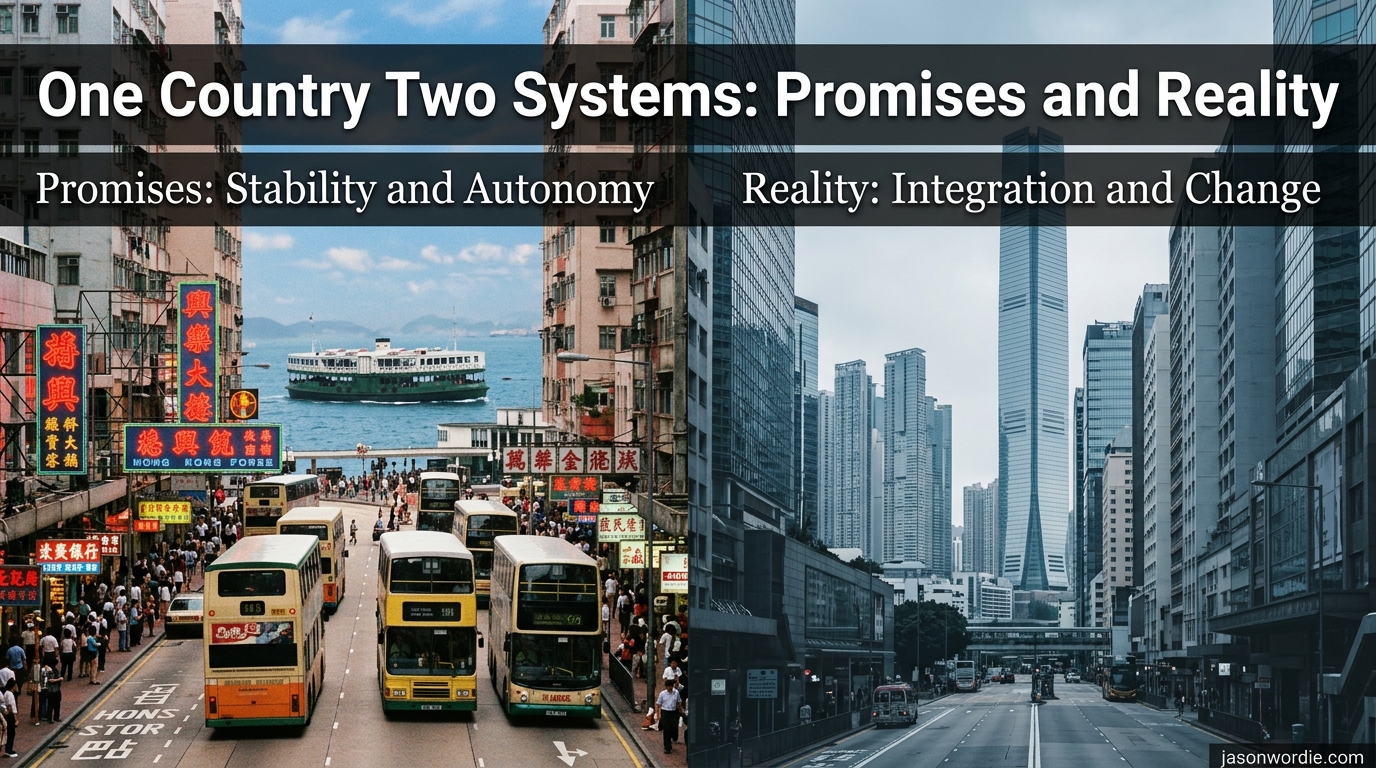
When the British and Chinese flags were lowered and raised at the Hong Kong Convention and Exhibition Centre on July 1, 1997, the world watched a grand experiment begin. The handover ceremony was not just a transfer of sovereignty. It was the launch of “One Country, Two Systems,” a constitutional framework unlike anything attempted before in modern geopolitics.
One Country, Two Systems is a constitutional principle developed by Chinese leader Deng Xiaoping in the early 1980s. It proposed that Hong Kong, Macau, and potentially Taiwan could retain their own capitalist economies, legal systems, and civil liberties for 50 years after reunification with mainland China, while remaining under Chinese sovereignty. The framework was negotiated between Britain and China through the Sino-British Joint Declaration of 1984 and enshrined in Hong Kong’s Basic Law.
I have spent years studying this policy, and what strikes me most is how few people actually understand what was negotiated, what was promised, and how dramatically those promises have shifted. Whether you are a student of international relations, a business professional evaluating Hong Kong’s stability, or simply someone trying to make sense of the headlines, this guide breaks down everything you need to know.
This article covers the complete history of One Country, Two Systems, from its colonial origins through Deng Xiaoping’s strategic vision, the specific promises made in the 1984 Joint Declaration, the divergent implementations in Hong Kong and Macau, the application (and rejection) of the framework for Taiwan, and what the approaching 2047 deadline means for the future. I also address a frequently overlooked precursor: the Seventeen Point Agreement with Tibet in 1951, which served as an early blueprint for the policy.
Table of Contents
In Simple Terms: What Is One Country, Two Systems?
Before diving into the history, here is the plain-language explanation that most articles skip. Imagine you own a large house, and a family member moves in with you. They have their own room, their own rules for that room, and their own way of doing things. You control the front door, the security system, and who is allowed to visit. But inside their room, they keep their own lifestyle. That is essentially what One Country, Two Systems means.
Under this arrangement, China is the sovereign power. China controls defense, foreign affairs, and territorial integrity. But the Special Administrative Regions, Hong Kong and Macau, get to keep their own economic systems, legal frameworks, currencies, immigration policies, and civil liberties for a guaranteed period of 50 years. For Hong Kong, that means British common law, a capitalist economy, freedom of speech, and an independent judiciary. For Macau, it means Portuguese civil law and its own gambling-driven economy.
The key promise was that these regions would operate with a “high degree of autonomy” and that their “capitalist system and way of life” would remain “unchanged for 50 years.” For Hong Kong, that means until 2047. For Macau, until 2049. Whether those promises have been kept is the central question of this article.
Quick Summary: What Was Promised vs. What Happened
One of the most common questions I encounter is a simple one: what was actually promised to Hong Kong, and how does that compare to what happened? The gap between the two tells the story of One Country, Two Systems more clearly than any political analysis.
Here is a direct comparison of the key promises made in the Sino-British Joint Declaration and the Basic Law, contrasted with the reality on the ground in 2026.
Promise 1: High degree of autonomy for 50 years (until 2047). The Joint Declaration guaranteed that Hong Kong would “enjoy a high degree of autonomy” for 50 years after the 1997 handover. In practice, Beijing has increasingly asserted authority over Hong Kong’s governance, particularly after the 2020 National Security Law and the 2024 enactment of Article 23 legislation. The Standing Committee of the National People’s Congress has issued multiple interpretations of the Basic Law that overrode Hong Kong’s own judicial decisions.
Promise 2: Protection of rights and freedoms. The Basic Law and the International Covenant on Civil and Political Rights were supposed to safeguard freedom of speech, press, assembly, and association. Today, Hong Kong has a significantly contracted civic space. Pro-democracy activists face prosecution, civil society organizations have disbanded, and media outlets like Apple Daily have been shuttered.
Promise 3: Independent judiciary. Hong Kong’s courts were meant to operate independently under British common law. While the judiciary still functions, the National Security Law allows for cases to be transferred to mainland Chinese courts, and Beijing retains the power of final interpretation of the Basic Law.
Promise 4: Universal suffrage as an “ultimate aim.” The Basic Law stated that the election of the Chief Executive and the Legislative Council by universal suffrage was the “ultimate aim.” This goal has not been achieved. The electoral system was overhauled in 2021 to ensure that only “patriots” approved by Beijing can hold office.
Promise 5: Capitalist system unchanged. Hong Kong’s economy remains capitalist and globally connected. The stock exchange operates, foreign investment flows, and the city remains a financial hub. However, increasing integration with the Greater Bay Area and the political climate have altered the business environment.
Historical Background: From Colonial Rule to Deng Xiaoping’s Vision
The Opium Wars and the Birth of British Hong Kong
To understand why One Country, Two Systems was necessary, you have to go back to how these territories left Chinese control in the first place. Hong Kong became a British colony through a series of events rooted in the First Opium War (1839-1842). The Qing dynasty, weakened by internal rebellions and foreign pressure, ceded Hong Kong Island to Britain under the Treaty of Nanjing in 1842.
The Kowloon Peninsula was added in 1860 after the Second Opium War. Then in 1898, Britain negotiated a 99-year lease on the New Territories, the large landmass north of Kowloon. This lease was the ticking clock that eventually forced the handover negotiations. When the lease was set to expire in 1997, Britain had to address the future of all of Hong Kong, not just the New Territories.
Under British rule, Hong Kong developed into a thriving commercial port and, eventually, one of the world’s leading financial centers. It adopted British common law, a free press, and a relatively open political system by the late colonial period, though full democracy was never achieved under British governance either. The city’s 6.5 million residents (as of 1997) had built a way of life fundamentally different from mainland China’s.
Macau and the Portuguese Era
Macau’s story is older but quieter. Portuguese merchants settled in Macau in the 1550s, and Portugal gradually established colonial administration over the territory. Unlike Hong Kong’s dramatic wartime origins, Macau’s transfer to Portuguese control happened through gradual commercial presence and treaties. China formally ceded Macau to Portugal in 1887.
Macau operated under Portuguese civil law, not British common law. Its population was smaller (about 430,000 at the 1999 handover) and its economy centered on gambling, tourism, and light manufacturing rather than global finance. The legal, cultural, and political differences between Hong Kong and Macau would prove significant when both territories were returned to China under the One Country, Two Systems framework.
Deng Xiaoping and the Birth of One Country, Two Systems
The architect of One Country, Two Systems was Deng Xiaoping, the paramount leader who launched China’s economic reforms in 1978. By the early 1980s, Deng faced two territorial problems: the approaching expiration of the New Territories lease in 1997 and his broader goal of “national reunification” with Taiwan.
Deng needed a formula that would allow China to reclaim sovereignty over territories with vastly different economic and legal systems without destroying their prosperity. A straightforward takeover with immediate imposition of China’s socialist system would have triggered capital flight, panic among residents, and likely international condemnation. Deng recognized that Hong Kong’s economic value to China, as a gateway for foreign investment and trade, depended on preserving its distinct system.
The solution Deng proposed was elegant in its simplicity: one country, two systems. China would assert sovereignty but allow these territories to keep their existing systems for a defined period. This was not a concession born of weakness. It was a strategic calculation designed to achieve reunification while preserving economic value and creating a model that might attract Taiwan.
Deng reportedly first articulated the concept in 1979 during discussions with Hong Kong governor Murray MacLehose. The idea was formally developed over the next several years and became the foundation for negotiations with Britain. Deng’s strategic vision extended beyond Hong Kong. He believed that if One Country, Two Systems worked for Hong Kong, it could serve as a template for bringing Taiwan into the fold. This was always the larger prize. Taiwan represented the unfinished business of the Chinese Civil War, and Deng saw Hong Kong as a demonstration project.
The Negotiation Process: 1982 to 1984
The formal negotiations between Britain and China began in 1982 when British Prime Minister Margaret Thatcher visited Beijing. Thatcher initially hoped to retain British administration of Hong Kong beyond 1997, perhaps through a continued lease or joint administration. Deng rejected this firmly, insisting on full sovereignty.
The negotiations were tense. Thatcher’s position was weakened by the recent Falklands War and the reality that Britain had no military means to hold Hong Kong against Chinese wishes. Deng made clear that China could simply walk in and take Hong Kong if negotiations failed. The leverage was entirely on Beijing’s side.
After two years of difficult talks, the two sides reached agreement. The Sino-British Joint Declaration on the Question of Hong Kong was signed on December 19, 1984, in Beijing. It was registered at the United Nations as an international treaty. The declaration laid out China’s fundamental policies toward Hong Kong and committed both nations to the handover set for July 1, 1997.
The Joint Declaration was significant because it was not merely a bilateral agreement. It was a legally binding international treaty registered with the UN. Britain and China both committed to its terms, and the international community treated it as the framework for Hong Kong’s future. China would later argue that the Joint Declaration was a historical document with no continuing legal force, a position Britain and many other nations reject.
The Tibet Precedent: Seventeen Point Agreement 1951-1959
Long before Deng Xiaoping proposed One Country, Two Systems for Hong Kong, the Chinese Communist Party experimented with a strikingly similar framework in Tibet. The Seventeen Point Agreement, signed in 1951 between the central government and representatives of the Dalai Lama, was effectively the first iteration of “one country, two systems” in practice. This historical precedent is almost entirely absent from mainstream articles about the policy, yet it provides critical context for understanding Beijing’s approach.
In 1951, the People’s Liberation Army had entered Tibet after military confrontation. Rather than imposing immediate full control, Beijing signed the Agreement of the Central People’s Government and the Local Government of Tibet on Measures for the Peaceful Liberation of Tibet. This document, known as the Seventeen Point Agreement, promised that Tibet’s existing political system would remain unchanged. The Dalai Lama’s government would continue to administer Tibet. The central government would handle defense and foreign affairs, echoing the exact division of powers later proposed for Hong Kong.
The agreement explicitly guaranteed that the religious beliefs, customs, and habits of the Tibetan people would be respected. It promised that the central government would not alter the existing status, functions, and powers of the Dalai Lama. It even pledged that Tibet’s own military forces would be reorganized rather than disbanded.
This arrangement lasted approximately eight years. By 1956, land reforms in neighboring Chinese provinces with Tibetan populations began to undermine the agreement. Tensions escalated, and in March 1959, the Lhasa Uprising erupted. The Dalai Lama fled to India, and the Seventeen Point Agreement effectively collapsed. China dissolved the Tibetan government and imposed direct administration.
The Tibet precedent raises uncomfortable questions about One Country, Two Systems. The Seventeen Point Agreement was presented as a lasting guarantee of autonomy, yet it was abandoned when Beijing’s strategic priorities shifted. Critics of China’s Hong Kong policy frequently point to Tibet as evidence that the CCP has a pattern of offering autonomy arrangements that serve as transitional measures rather than permanent commitments. Supporters of the Hong Kong framework argue that the situations are fundamentally different, pointing to the binding international treaty status of the Joint Declaration versus the domestic nature of the Tibet agreement.
Regardless of which interpretation you accept, the Tibet precedent reveals the deeper strategic logic that informs Beijing’s approach to frontier and reunified territories. The pattern suggests a stepwise absorption strategy: offer autonomy to reduce resistance during the transition, then gradually integrate when the territory is sufficiently stabilized. Understanding this history helps explain why many Hong Kongers viewed the 50-year promise with skepticism from the beginning.
What Was Promised: The Sino-British Joint Declaration
The Core Guarantees
The Sino-British Joint Declaration, signed in December 1984 and registered with the United Nations, established the specific promises China made regarding Hong Kong’s future. These promises were not vague aspirations. They were detailed in Annex I of the declaration, which ran to 14 sections covering every aspect of Hong Kong’s governance.
The fundamental promise was stated in Article 3 of the declaration: “The Hong Kong Special Administrative Region will be directly under the authority of the Central People’s Government of the People’s Republic of China and will enjoy a high degree of autonomy, except in foreign and defence affairs which are the responsibilities of the Central People’s Government.” This single sentence defined the entire structure of One Country, Two Systems for Hong Kong.
China committed to 12 specific policies in the Joint Declaration. These included the preservation of Hong Kong’s capitalist economic and trade system for 50 years. Hong Kong would retain its status as a free port, a separate customs territory, and an international financial center. It would maintain its own currency, the Hong Kong dollar, backed by foreign exchange reserves. It would keep its own immigration controls, with mainland Chinese citizens requiring permits to enter.
The declaration guaranteed the protection of rights and freedoms. Hong Kong residents would continue to enjoy the rights and freedoms guaranteed under the International Covenant on Civil and Political Rights and the International Covenant on Economic, Social and Cultural Rights. These included freedom of the press, freedom of speech, freedom of assembly, freedom of association, and freedom of religious belief.
The judiciary was guaranteed independence. Hong Kong courts would have jurisdiction over all cases except those involving defense and foreign affairs. The power of final adjudication would rest with Hong Kong’s Court of Final Appeal, not with courts in Beijing. This was a particularly important guarantee, as the independence of the judiciary has always been central to Hong Kong’s success as a global financial center.
The Basic Law: Hong Kong’s Mini-Constitution
The promises in the Joint Declaration were given domestic legal force through the Basic Law of the Hong Kong Special Administrative Region. Drafted over five years by a committee of both mainland Chinese and Hong Kong members, the Basic Law was adopted by the National People’s Congress in April 1990 and took effect on July 1, 1997, the day of the handover.
The Basic Law is often called Hong Kong’s mini-constitution because it serves as the territory’s highest legal authority, subordinate only to China’s constitution. It contains 160 articles organized into nine chapters covering general principles, the relationship between the central government and the SAR, fundamental rights and duties, political structure, economy, and external affairs.
Article 5 of the Basic Law contains the most frequently cited guarantee: “The socialist system and policies shall not be practised in the Hong Kong Special Administrative Region, and the previous capitalist system and way of life shall remain unchanged for 50 years.” This is the “50-year promise” that has become the shorthand for One Country, Two Systems.
The Basic Law also established Hong Kong’s governmental structure. The Chief Executive would serve as head of the SAR, elected by an Election Committee rather than by direct popular vote (though the Basic Law stated that universal suffrage was the “ultimate aim”). The Legislative Council would be the lawmaking body, with its membership evolving over time from partially appointed to fully elected, though through functional constituencies and geographic constituencies rather than straightforward proportional representation.
What Britain Got and What China Conceded
From Britain’s perspective, the Joint Declaration was a negotiated achievement given China’s overwhelming leverage. Britain secured written guarantees for Hong Kong’s way of life, an international treaty registered at the UN, and a transition period that allowed for orderly handover arrangements. Britain also secured agreement that the Sino-British Joint Liaison Group would operate during the transition to monitor implementation.
From China’s perspective, the concessions were manageable. China regained full sovereignty over Hong Kong after 155 years of British rule. The 50-year guarantee aligned with Deng’s timeline for China’s own modernization. Deng reportedly believed that by 2047, China’s economy would have developed sufficiently that the two systems would naturally converge, making the formal distinction unnecessary. In this view, One Country, Two Systems was never meant to be permanent. It was a bridge to eventual integration.
This is a point that many discussions of the policy miss. Deng Xiaoping did not necessarily envision two permanently different systems operating within one country forever. He saw the framework as a transitional arrangement that would last long enough for China to develop and for the territories to become comfortable under Chinese sovereignty. The 50-year period was chosen because it spanned roughly two generations, enough time for demographics, economics, and politics to shift.
Hong Kong Implementation: From 1997 Handover to Today
The Early Years: 1997 to 2003
The handover on July 1, 1997, went smoothly. The Provisional Legislative Council, established by China after the elected council was dissolved, was sworn in. Tung Chee-hwa became the first Chief Executive of the Hong Kong SAR. For the first several years, the One Country, Two Systems formula appeared to be working largely as promised.
Hong Kong’s economy weathered the 1997 Asian Financial Crisis, though not without difficulty. The stock market experienced significant volatility, and property prices collapsed, but the linked exchange rate system held firm. International confidence in Hong Kong’s autonomy remained relatively high through the late 1990s.
The first serious test came in 2003 when the Hong Kong government attempted to enact national security legislation under Article 23 of the Basic Law. Article 23 requires Hong Kong to pass laws prohibiting treason, secession, sedition, and subversion against the central government. The proposed legislation was widely seen as threatening civil liberties. On July 1, 2003, the sixth anniversary of the handover, approximately 500,000 people marched in protest.
The protest forced the government to withdraw the legislation. This was a moment when One Country, Two Systems functioned as intended. The people of Hong Kong exercised their right to peaceful assembly and expression, and their voices influenced government policy. The 2003 episode would later be contrasted with the very different outcomes of 2019 and 2020.
Growing Tensions: 2003 to 2014
After 2003, tensions between Hong Kong’s desire for greater democracy and Beijing’s control gradually increased. The debate over universal suffrage became the central political fault line. The Basic Law had promised that the election of the Chief Executive by universal suffrage was the “ultimate aim,” but Beijing resisted setting a specific timeline.
In 2007, the National People’s Congress Standing Committee ruled that the Chief Executive could be elected by universal suffrage “in 2017 and thereafter,” and the Legislative Council could follow “thereafter.” This was seen as a tentative commitment, but the details of what “universal suffrage” would mean became the source of intense dispute.
Relations between Hong Kong and the mainland were also strained by social and cultural factors. Large numbers of mainland visitors to Hong Kong created friction over resources, behavior, and identity. Parallel trading in goods across the border caused shortages of daily necessities in Hong Kong border towns. Many Hong Kong residents began to develop a stronger sense of distinct local identity, particularly among younger generations.
The Umbrella Movement: 2014
The tensions culminated in the Umbrella Movement of 2014. On August 31, 2014, the NPC Standing Committee issued a decision on the 2017 Chief Executive election. While allowing universal suffrage in name, the decision required that all candidates be nominated by a pro-Beijing Election Committee. This meant that Hong Kong residents could vote, but only for candidates pre-approved by Beijing.
Pro-democracy activists and legislators rejected this framework as a sham. Student groups began protesting in late September 2014, and the demonstrations quickly grew. Police used tear gas against peaceful protesters, which only galvanized public support. The protests became known as the Umbrella Movement because demonstrators used umbrellas to shield themselves from pepper spray and tear gas.
For 79 days, major roads in Hong Kong’s business and government districts were occupied. The movement ultimately ended without achieving its goals. No concessions were made on the electoral framework. The Umbrella Movement was a pivotal moment because it demonstrated both the depth of pro-democracy sentiment in Hong Kong and Beijing’s unwillingness to compromise on its control of the electoral process.
The 2019 Protests and Extradition Bill
The most dramatic challenge to One Country, Two Systems came in 2019. In February 2019, the Hong Kong government proposed amendments to the Fugitive Offenders Ordinance that would allow criminal suspects to be extradited to mainland China, Taiwan, and other jurisdictions with which Hong Kong lacked extradition treaties. The proposal was triggered by a murder case involving a Hong Kong man who killed his girlfriend in Taiwan.
The extradition bill was widely seen as a threat to Hong Kong’s judicial independence and the safety of anyone critical of Beijing. Critics feared that the law could be used to send political dissidents, journalists, and activists to face prosecution in mainland China’s opaque legal system. The concern was not hypothetical. Many Hong Kong residents remembered the disappearances of booksellers in 2015 who sold publications critical of Chinese leaders.
Protests began in June 2019 and escalated dramatically over the following months. An estimated two million people, roughly a quarter of Hong Kong’s population, participated in a single march. The protests evolved from peaceful mass demonstrations into increasingly confrontational actions. Police response was heavy-handed, with widespread use of tear gas, rubber bullets, and arrests.
The extradition bill was formally withdrawn in October 2019, but the protests had already expanded to encompass broader demands: independent inquiry into police conduct, democratic reforms, and protection of Hong Kong’s autonomy. The protests continued through the end of 2019 and into early 2020, only subsiding with the outbreak of the COVID-19 pandemic.
The National Security Law: 2020
The events of 2019 prompted Beijing to take decisive action. On June 30, 2020, the NPC Standing Committee imposed the Law of the People’s Republic of China on Safeguarding National Security in the Hong Kong Special Administrative Region. Known universally as the National Security Law, this legislation fundamentally altered the landscape of One Country, Two Systems.
The law was enacted by bypassing Hong Kong’s own Legislative Council entirely. It criminalized four categories of conduct: secession, subversion, terrorism, and collusion with foreign forces. The definitions of these offenses are broad and have been applied to activities that were previously legal in Hong Kong, including peaceful political advocacy, organizing primaries for legislative elections, and communicating with foreign governments or organizations.
The National Security Law created a new security apparatus in Hong Kong, including a Committee for Safeguarding National Security staffed by senior officials and a dedicated Office for Safeguarding National Security operated by mainland personnel. The law grants sweeping surveillance powers, allows for trials without juries in national security cases, and permits the transfer of certain cases to mainland courts.
The impact was immediate and dramatic. Pro-democracy political parties disbanded. Civil society organizations dissolved. Dozens of activists and former lawmakers were arrested. Media outlets closed, including Apple Daily, the pro-democracy newspaper founded by Jimmy Lai. The National Security Law effectively ended the era of open political dissent in Hong Kong.
Jimmy Lai and the Crackdown on Media
The prosecution of Jimmy Lai has become emblematic of the transformation of Hong Kong under the National Security Law. Lai, a media tycoon and outspoken pro-democracy advocate, was arrested in August 2020. His newspaper, Apple Daily, was forced to cease publication in June 2021 after its assets were frozen under the security law.
Lai faced multiple charges, including conspiracy to commit collusion with foreign forces under the National Security Law. His trial, which began in December 2023, has been widely condemned by international human rights organizations and foreign governments as politically motivated. The verdict, delivered in 2026, resulted in convictions that underscored the reach of the security law over previously protected speech and publishing activities.
The Lai case is significant not just for its impact on press freedom. It demonstrates how One Country, Two Systems has been reinterpreted. Activities that were legal when the Basic Law was drafted, such as publishing newspapers critical of the government and advocating for international support of Hong Kong’s autonomy, are now treated as criminal offenses threatening national security.
Article 23 and the 2024 Security Legislation
In March 2024, Hong Kong enacted the Safeguarding National Security Ordinance under Article 23 of the Basic Law. This was the legislation that had triggered the massive 2003 protests when it was first attempted. Twenty-one years later, it passed with no meaningful opposition in a Legislative Council that had been reconstituted to exclude pro-democracy voices.
The Article 23 legislation expanded the scope of national security offenses beyond the 2020 law. It added crimes including external interference, insurrection, and sabotage. The law introduces new penalties, including life imprisonment for serious offenses, and grants expanded powers to law enforcement, including the ability to restrict the movement of individuals under investigation.
The combined effect of the 2020 National Security Law and the 2024 Article 23 legislation is a comprehensive security architecture that fundamentally reshapes Hong Kong’s legal landscape. Civil liberties that were guaranteed under the Basic Law are now subject to broad national security restrictions. The “high degree of autonomy” promised in 1984 has been significantly diminished.
The Electoral Overhaul of 2021
In 2021, Beijing overhauled Hong Kong’s electoral system to ensure that only “patriots” could hold office. The changes reduced the number of directly elected seats in the Legislative Council and introduced a candidate vetting system administered by a committee that reports to the central government. The Election Committee that chooses the Chief Executive was expanded and reconstituted to ensure pro-Beijing dominance.
The practical effect was the complete removal of the pro-democracy camp from formal political power. In the December 2021 Legislative Council elections, voter turnout hit a historic low of 30.2 percent, as many residents chose to boycott what they viewed as a rigged process. The “ultimate aim” of universal suffrage enshrined in the Basic Law has been effectively abandoned in favor of a “patriots-only” system.
Macau: The Other Implementation
While Hong Kong’s experience with One Country, Two Systems has been marked by conflict and erosion, Macau’s has been remarkably smooth by comparison. Macau was returned to Chinese sovereignty on December 20, 1999, two years after Hong Kong. It operates under its own Basic Law, which contains the same fundamental guarantees: capitalist system unchanged for 50 years (until 2049), high degree of autonomy, and its own legal system based on Portuguese civil law.
The differences between Hong Kong and Macau’s experiences are striking and worth understanding. Macau never experienced the kind of mass pro-democracy protests that convulsed Hong Kong. The territory has a much smaller population, a less politically active civil society, and an economy dominated by casino gaming that creates close ties with mainland tourism and investment. Macau enacted its own Article 23 national security legislation in 2009, with minimal controversy.
Macau’s legal system operates under Portuguese civil law rather than British common law. This means a codified legal system with different procedural traditions from Hong Kong’s common law courts. The distinction matters for understanding why the two SARs have developed differently. Macau’s judiciary operates within a legal tradition that is less adversarial and less politically contested than Hong Kong’s.
Macau’s Chief Executives have consistently been pro-Beijing figures. Edmund Ho served from 1999 to 2009, Fernando Chui from 2009 to 2019, and Ho Iat Seng from 2019 onward. None faced the kind of political crises that Hong Kong’s leaders confronted. Beijing frequently cites Macau as the “successful model” of One Country, Two Systems, implicitly contrasting it with Hong Kong’s troubles.
However, Macau’s apparent success comes with caveats that are often overlooked. The territory has a less diverse economy, heavily dependent on gambling revenue from mainland visitors. Political freedoms are more constrained than Hong Kong’s ever were, even before the National Security Law. The lack of political activism in Macau may reflect genuine satisfaction, but it may also reflect a political culture where dissent is less tolerated and less likely to emerge.
Taiwan: The Intended Target That Rejected the Offer
One of the most important but least understood aspects of One Country, Two Systems is that it was originally designed for Taiwan, not Hong Kong. Deng Xiaoping’s primary goal was national reunification, and Taiwan was the bigger prize. Hong Kong and Macau were meant to serve as demonstration projects, proving that the framework could work and thereby encouraging Taiwan to accept a similar arrangement.
The strategy has failed completely. Taiwan has rejected One Country, Two Systems with near-total unanimity across the political spectrum. The reasons for this rejection are both historical and contemporary. Taiwan, officially the Republic of China, has been governed separately from the mainland since 1949, when the Nationalist government retreated to the island after losing the Chinese Civil War. Taiwan has its own constitution, military, democratic institutions, and a population of 23 million that overwhelmingly identifies as Taiwanese.
The concept of the “1992 Consensus” plays a central role in this story. The 1992 Consensus refers to a purported understanding between representatives of Beijing and Taipei that there is “one China,” with each side free to interpret what that means. Beijing interprets it as the People’s Republic of China being the sole legitimate government of all China, including Taiwan. Taiwan’s interpretation has historically been more flexible, acknowledging “one China” without conceding that it means the PRC.
In practice, the 1992 Consensus has become increasingly untenable. Taiwan’s current political landscape, led by the Democratic Progressive Party, explicitly rejects the 1992 Consensus and any framework that implies Taiwan is part of the PRC. Taiwan President Tsai Ing-wen and her successor have made clear that Taiwan will not accept One Country, Two Systems under any circumstances.
Hong Kong’s experience has been the definitive argument against acceptance. Every time Beijing tightens its grip on Hong Kong, support for any arrangement with the mainland collapses further in Taiwan. The 2020 National Security Law was particularly devastating. Polls in Taiwan consistently show that over 80 percent of the population opposes One Country, Two Systems. The framework that was supposed to attract Taiwan has instead driven it further away.
Beijing continues to offer One Country, Two Systems to Taiwan, periodically releasing proposals for how it might work. These proposals typically offer Taiwan more autonomy than Hong Kong received, including the right to maintain its own military. But given what has happened in Hong Kong, these offers carry no credibility among Taiwan’s population or political leadership.
Timeline of Key Events: 1980 to 2026
Here is a chronological timeline of the major events in the history of One Country, Two Systems, from its conception to the present day.
1979: Deng Xiaoping first discusses the concept with Hong Kong Governor Murray MacLehose during a visit to Beijing.
1982: British Prime Minister Margaret Thatcher visits Beijing. Formal negotiations on Hong Kong’s future begin. Deng Xiaoping publicly articulates the One Country, Two Systems concept.
1984: The Sino-British Joint Declaration is signed on December 19. It is registered at the United Nations as an international treaty.
1987: China and Portugal sign the Joint Declaration on the Question of Macau, establishing the framework for Macau’s return in 1999.
1990: The Basic Law of the Hong Kong SAR is adopted by the National People’s Congress on April 4.
1997: Hong Kong is returned to Chinese sovereignty on July 1. Tung Chee-hwa becomes the first Chief Executive. The Basic Law takes effect.
1999: Macau is returned to Chinese sovereignty on December 20.
2003: Hong Kong government attempts to enact Article 23 security legislation. 500,000 people protest on July 1. The bill is withdrawn.
2007: The NPC Standing Committee rules that universal suffrage for the Chief Executive election may occur in 2017 and thereafter.
2014: The Umbrella Movement erupts after Beijing rules that Chief Executive candidates must be pre-screened. 79 days of protests occupy central Hong Kong.
2019: The extradition bill proposal triggers months of massive protests. The bill is withdrawn in October, but protests continue demanding broader reforms.
2020: The National Security Law is imposed on Hong Kong on June 30, criminalizing secession, subversion, terrorism, and collusion with foreign forces.
2021: Beijing overhauls Hong Kong’s electoral system to require “patriots-only” governance. Legislative Council elections are held with record-low turnout.
2024: Hong Kong enacts Article 23 security legislation in March, expanding national security offenses and penalties.
2026: The Jimmy Lai trial concludes with convictions, underscoring the reach of the National Security Law over press freedom and political speech.
The 2047 Question: What Happens When the 50-Year Promise Ends
The Basic Law guarantees that Hong Kong’s capitalist system and way of life will remain “unchanged for 50 years.” For Hong Kong, that period runs from 1997 to 2047. As that date approaches, the question of what happens next has become increasingly urgent for Hong Kong residents, businesses, and the international community.
The first thing to understand is that the Basic Law does not specify what happens after 2047. Article 5 states that the previous capitalist system shall remain unchanged for 50 years, but it does not say what occurs on the 51st year. This ambiguity has created anxiety because it leaves the future entirely to Beijing’s discretion.
Several scenarios have been discussed by experts and observers. The first is full integration, where Hong Kong is absorbed into China’s standard administrative system, losing its Special Administrative Region status. Property rights, business contracts, and legal arrangements that were structured around the 2047 deadline would need to be addressed. This scenario would represent the formal end of One Country, Two Systems for Hong Kong.
The second scenario is a renewal or extension of the current arrangement. Beijing could announce that the framework will continue beyond 2047, providing certainty for businesses and residents. This would be politically beneficial for China’s international image and would help maintain Hong Kong’s role as a global financial center. However, given the direction of the past several years, any extension would likely come with tightened political controls.
The third scenario is a middle path, where the economic and legal framework continues but political autonomy is further reduced. Hong Kong might retain its common law system, currency, and free market while becoming politically indistinguishable from any other Chinese city. This is arguably the trajectory that has already been set in motion.
The Greater Bay Area initiative provides a clue to Beijing’s thinking. This ambitious plan aims to integrate Hong Kong, Macau, and nine cities in Guangdong Province into a single economic powerhouse rivaling Tokyo and Silicon Valley. The initiative envisions free movement of people, goods, capital, and information across what are currently internal barriers. While presented as an economic development strategy, the Greater Bay Area also serves as a vehicle for gradual integration that could make the formal distinction between systems less relevant by 2047.
For businesses and residents, the practical concern is what happens to contracts, property rights, and legal guarantees that extend beyond 2047. The Hong Kong government has stated that the Basic Law will continue to apply, and many legal scholars argue that the framework does not have an automatic expiration date. But without explicit confirmation from Beijing, uncertainty persists.
The reality is that for many Hong Kong residents, 2047 has already arrived. The political changes of 2020 and 2024 have already brought about the integration that the 50-year promise was supposed to delay. The question of what happens after 2047 may be less about a dramatic shift and more about the formalization of changes that have already taken place.
International Response to the Erosion of Promises
The international community has responded to the erosion of One Country, Two Systems with varying degrees of concern and action. Britain, as the co-signatory of the Joint Declaration, has been the most vocal. British officials have repeatedly stated that China is in a “state of ongoing non-compliance” with the Joint Declaration. Britain has also offered a path to citizenship for British National (Overseas) passport holders and their dependents, allowing hundreds of thousands of Hong Kong residents to relocate.
The United States responded to the National Security Law by revoking Hong Kong’s special trade status in 2020. Previously, Hong Kong was treated as a separate customs and trade entity from mainland China under the Hong Kong Policy Act of 1992. The loss of this status means that Hong Kong is now subject to the same tariffs, export controls, and trade restrictions as the rest of China. The U.S. has also imposed sanctions on Chinese and Hong Kong officials responsible for implementing the National Security Law.
The European Union has expressed concern and suspended its extradition treaty with Hong Kong. Canada and Australia took similar steps. These measures signal diplomatic disapproval but have limited practical impact on Beijing’s approach. China has consistently maintained that Hong Kong affairs are an internal matter and that foreign criticism constitutes interference in Chinese sovereignty.
The United Nations Human Rights Council has been a forum for both criticism and defense of China’s Hong Kong policy. In July 2020, an unprecedented 27 countries signed a joint statement at the UN Human Rights Council expressing concern about the National Security Law and its impact on Hong Kong’s autonomy. China countered with a statement signed by 53 countries supporting the law as necessary for national security.
For businesses, the practical implications of the political changes are mixed. Hong Kong remains a functioning financial center with rule of law in commercial matters. Foreign companies continue to operate there, and the stock exchange remains active. But the overall trend has been toward reduced confidence. Surveys of foreign businesses in Hong Kong have shown increasing concern about the operating environment, and some companies have relocated regional headquarters to Singapore or Tokyo.
The tension at the heart of the international response is this: Hong Kong’s value to the world depended on its autonomy and distinct system. As those erode, the case for treating Hong Kong as different from mainland China weakens. The international community supported One Country, Two Systems because it served their interests. Its erosion forces a recalibration of how the world engages with Hong Kong.
FAQs
What did the one country, two systems Agreement promise?
The Sino-British Joint Declaration of 1984 promised Hong Kong a high degree of autonomy for 50 years (until 2047), preservation of its capitalist system and way of life, an independent judiciary under British common law, protection of civil rights and freedoms including freedom of speech and press, control over its own currency and immigration, and the ultimate aim of electing the Chief Executive and Legislative Council through universal suffrage.
What is the history of one country and two systems?
One Country, Two Systems was developed by Chinese leader Deng Xiaoping in the early 1980s during negotiations with Britain over Hong Kong’s future. The concept was formally established in the Sino-British Joint Declaration of 1984, applied first to Hong Kong in the 1997 handover, then to Macau in the 1999 handover, and was originally intended as a model for reunification with Taiwan.
What happens after 2047 in Hong Kong?
The Basic Law does not specify what happens after the 50-year period ends in 2047. Possible scenarios include full integration into China’s standard administrative system, a renewal or extension of the current arrangement, or a middle path where Hong Kong retains its economic and legal system while political autonomy is further reduced. Beijing has not made a definitive announcement, but current trends suggest gradual integration will continue through the Greater Bay Area initiative.
How has the one country, two systems policy been different between Hong Kong and Macau?
Hong Kong operates under British common law while Macau uses Portuguese civil law. Hong Kong experienced significant political activism including the 2014 Umbrella Movement and 2019 protests, while Macau has remained politically stable. Macau enacted its own Article 23 security legislation in 2009 without controversy, whereas Hong Kong’s attempt sparked massive protests in 2003. Macau’s economy centers on casino gaming, while Hong Kong is a global financial center.
Does one country, two systems apply to Taiwan?
China has offered One Country, Two Systems to Taiwan, but Taiwan has overwhelmingly rejected it. The framework was originally designed with Taiwan in mind, but Hong Kong’s experience, particularly after the 2020 National Security Law, has made the offer unacceptable to Taiwan’s population and political leadership. Polls consistently show over 80 percent of Taiwanese oppose the arrangement.
Why did China divide into two countries?
China did not divide into two countries. One Country, Two Systems is a framework for governing territories that returned to Chinese sovereignty after periods of colonial rule. Hong Kong was under British administration from 1842 to 1997, and Macau was under Portuguese administration until 1999. The policy allows these regions to maintain their distinct economic and legal systems within a single Chinese state.
Are Hong Kong and Macau two countries?
No, Hong Kong and Macau are not countries. They are Special Administrative Regions of the People’s Republic of China. Under the One Country, Two Systems framework, they operate with a high degree of autonomy, maintaining their own legal systems, currencies, and immigration policies, but they are part of China. China handles their defense and foreign affairs.
Conclusion
One Country, Two Systems was conceived as a pragmatic solution to an impossible problem: how to reunify territories with fundamentally different political, legal, and economic systems without destroying their value. Deng Xiaoping’s formula was innovative, and for a time, it functioned largely as designed. Hong Kong thrived as a global financial center with a distinct identity, and Macau developed into the world’s largest gambling market.
But the gap between what was promised and what has been delivered tells a sobering story. The high degree of autonomy guaranteed in 1984 has been steadily eroded, particularly since the 2020 National Security Law and the 2024 Article 23 legislation. Civil liberties have contracted dramatically, the electoral system has been reconstituted to eliminate opposition, and the independent judiciary has been compromised by national security overrides. Whether One Country, Two Systems can still be said to exist in any meaningful form is a question that increasingly answers itself.
Understanding how One Country, Two Systems was negotiated and what it promised is essential for making sense of East Asian geopolitics in 2026 and beyond. The policy’s trajectory offers lessons about the limits of autonomy arrangements, the gap between international agreements and political reality, and the challenges of governing diverse territories within a single state. As 2047 approaches, these questions will only become more urgent, not just for Hong Kong, but for Taiwan, for international businesses, and for the global order that has long relied on Hong Kong as a bridge between East and West.