
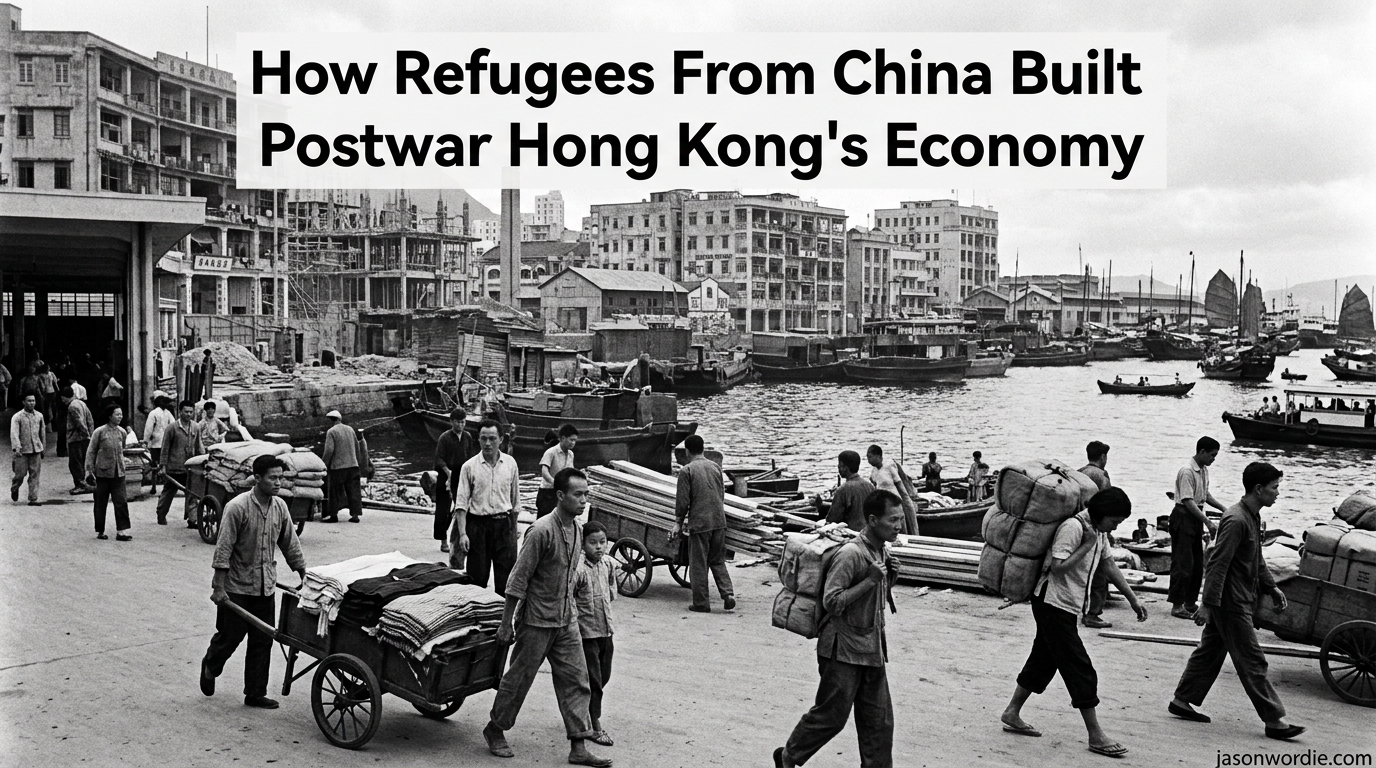
By 1956, just over a decade after World War II ended, one-third of Hong Kong’s 2.5 million residents were refugees who had crossed the border from mainland China. These were not wealthy colonizers or government-planned relocations. They were ordinary people fleeing war, revolution, and economic collapse, carrying whatever they could on their backs. Yet within two decades, this displaced population helped transform a depleted colonial port into one of the wealthiest economies on earth.
The story of how refugees from China built postwar Hong Kong’s economy is one of the most remarkable cases of migration-driven economic development in modern history. It is a story that historians, economists, and the descendants of those refugees are still unpacking today. On forums like Reddit’s r/HongKong, users frequently share stories of grandparents who arrived with nothing, lived in squatter camps, and went on to build textile factories, small shops, and eventually entire industries. Nearly every Hong Kong family has a refugee story in its past, though many rarely discuss it openly.
In this article, we trace the full arc of that transformation. We begin with the devastation of World War II, move through the waves of migration that followed the Chinese Civil War and the Maoist era, and examine the specific economic mechanisms through which refugees built industries from scratch. We also explore how the British colonial government’s hands-off approach, combined with ambitious public housing programs, created the conditions for explosive growth. And we connect this history to the identity of modern Hong Kong itself.
This is not just an economic story. It is a human story about what displaced people can build when they arrive in a place that lets them work, trade, and dream. Understanding how refugees from China built postwar Hong Kong’s economy offers lessons that remain deeply relevant for our 2026 world, where migration continues to reshape economies and societies across the globe.
Table of Contents
A City Emptied: Hong Kong After World War II
To understand how refugees rebuilt Hong Kong, we first need to understand what they were rebuilding from. The answer is shocking: by the end of World War II, Hong Kong was practically a ghost town.
Before the war, Hong Kong had grown into a thriving British colonial entrepot with a population of approximately 1.6 million people. It served as a critical trading hub between China and the world, handling goods flowing in and out of the mainland through its deep-water port. The colony had a functioning economy built around trade, shipping, and light services. It was not a manufacturing center, but it was a stable, prosperous commercial port.
That changed on December 8, 1941, when Japanese forces invaded Hong Kong just hours after attacking Pearl Harbor. The British defenders held out for less than three weeks. What followed was three years and eight months of brutal Japanese occupation that devastated the colony’s population and economy.
The occupation was catastrophic. Food shortages became so severe that the Japanese military government encouraged, and at times forced, mass deportation of residents to the mainland. By the time Japan surrendered in August 1945, Hong Kong’s population had plummeted to roughly 600,000, a staggering drop of nearly one million people from its pre-war peak. The port facilities were damaged, infrastructure was in ruins, and the commercial networks that had sustained the colony were completely shattered.
When British forces returned to reclaim the colony in late 1945, they inherited a city that was barely functional. British military administrators set about restoring basic governance, repairing the port, and re-establishing trade routes. But the population remained far below pre-war levels. The economy that had existed before 1941 was effectively gone, and it would take an enormous influx of people and energy to bring the colony back to life.
That energy came from an unexpected source. Beginning almost immediately after liberation, people started returning to Hong Kong. Some were former residents coming back to reclaim homes and businesses they had been forced to abandon. Others were new arrivals from neighboring Guangdong province, drawn by the relative stability of British colonial rule compared to the chaos consuming mainland China.
The British colonial administration maintained a remarkably open border policy in these early postwar years. Unlike many colonial powers that tightly controlled immigration, Hong Kong’s government allowed virtually unrestricted entry from the mainland. This was partly practical: they needed labor to rebuild the colony, and they lacked the resources to police a long, porous land border. It was also partly strategic: a growing population meant a growing tax base and a more viable colony.
Between 1945 and 1947, Hong Kong’s population rebounded rapidly. Former residents returned from inland China, where they had fled during the occupation. New migrants arrived from Guangdong seeking work and stability. The population climbed past one million, then continued rising. The colony was recovering, but the real transformation was still to come. The forces that would send hundreds of thousands more refugees pouring across the border were already gathering strength on the mainland.
The Refugee Waves That Reshaped Postwar Hong Kong
The story of how refugees from China built postwar Hong Kong’s economy centers on two major waves of migration that fundamentally changed the colony’s demographics and economic potential. Each wave brought different people with different resources, skills, and networks, but together they created the human foundation for Hong Kong’s economic miracle.
The First Wave: Civil War Refugees (1945-1949)
The first major wave began even before World War II had fully ended and accelerated dramatically as the Chinese Civil War intensified. The conflict between the Nationalist government under Chiang Kai-shek and the Communist forces led by Mao Zedong had been raging intermittently since the late 1920s. After Japan’s defeat in 1945, the civil war resumed with full ferocity.
As Communist forces advanced across northern and central China in the late 1940s, civilians fled south in growing numbers. Many headed for Hong Kong because it was the nearest territory outside the zone of fighting and under a stable, non-Chinese government. The British colony offered something the mainland could not: physical safety and the rule of law.
This first wave was remarkably diverse. It included poor farmers and laborers from Guangdong province, but it also included a significant number of wealthy and middle-class refugees from Shanghai and other major cities. These urban refugees included industrialists, merchants, bankers, and skilled workers who brought something invaluable with them: capital, technical expertise, and business networks.
The Shanghai contingent was especially significant. Shanghai had been China’s most industrialized and cosmopolitan city before the war, with a thriving textile industry, a sophisticated financial sector, and deep connections to international markets. As Communist forces approached Shanghai in 1948 and 1949, many of the city’s industrial and commercial elite made the decision to leave. They moved their families, their equipment, and their liquid assets to Hong Kong.
When Mao Zedong proclaimed the founding of the People’s Republic of China on October 1, 1949, the exodus intensified. Nationalist government officials, Kuomintang party members, military personnel, and anyone associated with the old regime feared persecution under the new Communist government. Large numbers of Kuomintang members and their families crossed the border into Hong Kong, forming what would become a significant pro-KMT community in the colony.
By the end of 1950, Hong Kong’s population had swelled to approximately 2.2 million, up from the 600,000 at the end of the war. The colony was absorbing an extraordinary number of people in an extraordinarily short time. Housing was completely inadequate. Squatter settlements sprang up on hillsides throughout the colony, built from scrap wood, corrugated metal, and whatever materials people could find. Conditions were harsh, but the refugees kept coming.
The Second Wave: The Maoist Era Exodus (1950s-1960s)
The second wave of refugees came in a slower but steady stream throughout the 1950s and 1960s, driven by the harsh realities of life under Maoist rule. The Communist government’s policies, including land reform, the campaign against counter-revolutionaries, and the beginning of agricultural collectivization, created ongoing hardship and fear among many segments of the population.
Unlike the dramatic surge of the late 1940s, this second wave was a persistent trickle. People continued to cross the border illegally, often at great personal risk, throughout the decade. Some came because they had been targeted in political campaigns. Others came simply because economic conditions on the mainland were dire and Hong Kong, despite its overcrowding and poverty, offered better prospects.
The situation reached a crisis point in 1962, when a massive surge of refugees, estimated at the time to include tens of thousands of people in a matter of weeks, overwhelmed the border. The colonial government was forced to begin tightening immigration controls, reversing the relatively open policy that had defined the early postwar years. Even so, people continued to find ways across.
By the mid-1950s, as JSTOR Daily has documented, approximately one-third of Hong Kong’s 2.5 million residents were classified as refugees. The total number of mainland refugees who entered Hong Kong between 1945 and the early 1960s is estimated at roughly 1.5 million people. This was a population transfer of staggering scale for a territory of Hong Kong’s size.
These refugees were overwhelmingly young. The median age was low, which meant the influx created a massive, energetic labor force exactly when the colony needed one. Women made up a substantial portion of the refugee workforce, and their labor in factories and workshops became a driving force behind Hong Kong’s industrial takeoff. Reddit users whose grandparents lived through this era frequently describe family stories where grandmothers and great-aunts worked long hours in textile mills while also managing households in cramped squatter housing.
The colonial government’s initial response to the refugee crisis was largely reactive and minimal. Officials hoped the situation was temporary and that many refugees would eventually return to the mainland. They were reluctant to invest heavily in permanent infrastructure for people they expected to leave. This stance would change dramatically after a single, devastating event that forced a complete rethink of housing policy.
How Chinese Refugees Built Hong Kong’s Industrial Economy
The question at the heart of this story is simple but profound: how exactly did refugees from China build postwar Hong Kong’s economy? The answer involves several interconnected mechanisms that together created the conditions for an economic transformation unprecedented in speed and scale.
The Shanghai Entrepreneurs: Capital, Expertise, and Networks
The most immediate catalyst was the arrival of industrialists and entrepreneurs from Shanghai. These were not destitute peasants. They were experienced manufacturers who had built and run successful textile mills, garment factories, and other light industries in one of Asia’s most advanced industrial cities. When they fled to Hong Kong, they brought three critical assets.
First, they brought capital. Many Shanghai industrialists managed to transfer significant financial assets out of China before and during the Communist takeover. Some moved physical assets, including industrial equipment and machinery. Others brought liquid capital that could be used to set up new operations. This money fleeing Red China, as the Foundation for Economic Education described it, provided the seed investment for Hong Kong’s manufacturing sector.
Second, they brought technical expertise. Textile manufacturing requires specialized knowledge: how to operate spinning and weaving machinery, how to manage a production line, how to source raw cotton, how to quality-control finished fabric. The Shanghai refugees possessed this knowledge because they had been running these exact operations in Shanghai for decades. They could set up a working textile mill from scratch because they had done it before.
Third, they brought business networks. The Shanghai entrepreneurs had established relationships with cotton suppliers, international buyers, shipping companies, and financial institutions. These networks were portable. When they relocated to Hong Kong, they could quickly re-establish supply chains and marketing channels. They knew which international markets wanted textiles, and they knew how to reach them.
Within a few years of arriving in Hong Kong, Shanghai entrepreneurs had established dozens of cotton-spinning mills and textile factories. These operations produced cotton yarn, woven fabric, and finished garments for export to markets in Southeast Asia, Europe, and North America. The Library of Congress has documented how this influx of entrepreneurial talent from Shanghai in the late 1940s directly spurred the colony’s industrial development, creating an entirely new economic base that had not existed before.
The Refugee Labor Force: Numbers, Cost, and Drive
The Shanghai entrepreneurs provided capital and expertise, but factories need workers. This is where the broader refugee population became essential. The hundreds of thousands of refugees who arrived in Hong Kong during the late 1940s and 1950s constituted an enormous pool of labor that was available, affordable, and highly motivated.
Refugee workers were willing to accept low wages by international standards, which gave Hong Kong’s manufacturers a significant cost advantage. They were willing to work long hours in demanding factory conditions. And because they had few alternatives, they were a stable workforce that allowed factories to operate at full capacity.
The role of women in this labor force cannot be overstated. Women made up a large percentage of the textile and garment manufacturing workforce in Hong Kong’s early industrial era. They operated sewing machines, managed looms, and performed the detailed handwork required for garment production. Their wages, though low, were often the primary income for refugee families, and their labor was the backbone of the manufacturing export economy that drove Hong Kong’s growth.
Reddit discussions about Hong Kong family histories are filled with accounts of this exact experience. Users describe grandmothers who worked 12-hour shifts in textile mills, then went home to cramped quarters in public housing estates or squatter settlements to cook and care for children. These personal testimonies, shared across generations, confirm what economic data shows: refugee labor, particularly women’s labor, was the engine of Hong Kong’s industrial revolution.
From Squatter Settlements to Factory Floors
The connection between housing and industry in early postwar Hong Kong was tighter than it might appear. Many of the industries that refugees built started not in purpose-built factories but in the squatter settlements themselves. These hillside shantytowns, home to hundreds of thousands of refugees, became informal production centers where families manufactured goods in their homes and small workshops.
Garment production was particularly suited to this model. A family could set up a few sewing machines in a small shack and produce finished clothing on a piecework basis for larger manufacturers. Wigs, plastic flowers, electronics components, and toys were also produced in squatter settlement workshops. This cottage industry model allowed refugee entrepreneurs to start businesses with minimal capital, using their own living space as a factory.
Over time, successful operations grew out of the squatter settlements and into proper factory buildings. Entrepreneurs who started with a single sewing machine in a shack could, after years of reinvesting profits, lease space in one of the multi-story industrial buildings that began rising in areas like San Po Kong, Kwun Tong, and Tsuen Wan. These districts became the industrial heartland of Hong Kong, and their growth was driven almost entirely by refugee-owned and refugee-staffed businesses.
The transition from squatter camp to factory floor was not smooth or easy. Fire was a constant danger in the densely packed, makeshift structures. The Christmas Day fire of 1953 at the Shek Kip Mei squatter settlement left approximately 53,000 people homeless in a single night. This disaster became a turning point in Hong Kong’s housing policy, but it also underscored the precariousness of the industrial activity taking place in these settlements. Despite these risks, the squatter-to-factory pipeline was a real and important pathway through which refugee entrepreneurship took root and grew.
The Korean War Embargo: The Catalyst for Manufacturing
One geopolitical event more than any other forced Hong Kong to become a manufacturing economy: the Korean War and the resulting trade embargo on China. Before 1950, Hong Kong’s economy was still largely based on entrepot trade, serving as the middleman for goods moving in and out of mainland China. This was how the colony had functioned for over a century, and many expected it to return to that role after the war.
When the Korean War broke out in June 1950, the United Nations, led by the United States, imposed a trade embargo on Communist China. Hong Kong, as a British territory, was obligated to comply. Almost overnight, the entrepot trade that had been the foundation of Hong Kong’s economy was severely restricted. Goods could no longer flow freely through Hong Kong to and from the mainland.
This could have been devastating. Instead, it became the decisive catalyst for industrialization. With entrepot trade cut off, Hong Kong had to produce its own goods for export. The capital, expertise, and labor that the refugees had brought were suddenly channeled into manufacturing rather than trade. The textile mills that Shanghai entrepreneurs had begun establishing found a ready export market, as international buyers who had previously sourced goods through China now looked to Hong Kong as an alternative supplier.
The embargo effectively forced Hong Kong to pivot from being a trading post to being a manufacturing economy. This pivot would not have been possible without the refugees. The entrepot traders who had dominated the pre-war economy did not have the skills or inclination to build factories. It was the Shanghai industrialists and the broader refugee workforce who possessed exactly the capabilities needed for this economic transformation. The trade embargo created the necessity, and the refugees provided the means.
By the mid-1950s, textiles and garments had become Hong Kong’s leading export industries. The colony was producing cotton yarn, woven fabrics, shirts, underwear, and other garments for markets around the world. From there, manufacturing diversified into plastics, electronics, watches, toys, and other light industrial products. Each of these industries was built on the same foundation: refugee entrepreneurship, refugee labor, and the export opportunities created by the embargo.
Government Policy: Enabling Growth Without Directing It
The British colonial government did not plan Hong Kong’s industrial transformation. In fact, for much of the early postwar period, officials were reacting to events rather than shaping them. But the policies they adopted, sometimes reluctantly and sometimes by accident, created an environment in which refugee entrepreneurship could flourish.
The colony’s economic philosophy was fundamentally laissez-faire. The government maintained low taxes, minimal business regulation, free trade (with the exception of the embargo restrictions), and open capital markets. There were no industrial planning boards telling factories what to produce, no import substitution policies protecting domestic markets, no government-directed credit allocation. Businesses were largely free to start, operate, and compete as they saw fit.
This hands-off approach suited the refugee population perfectly. Refugees who had fled a country where the government was increasingly controlling every aspect of economic life found in Hong Kong a place where they could start a business with minimal interference. A refugee with a sewing machine and some fabric could begin producing garments without needing permits, licenses, or government approval. The freedom to operate was itself a powerful economic stimulus.
But the government was not purely passive. Its most significant intervention was in housing, and this is where the connection between public policy and industrial growth becomes clear. The Shek Kip Mei fire of 1953 shocked the colonial administration into action. The existing policy of ignoring the squatter settlements was clearly untenable, and officials began building public housing estates to provide safe, permanent shelter for the refugee population.
This public housing program was, as the Economic History Association has documented, effectively an indirect subsidy to industry. By providing affordable housing for workers, the government reduced the wage levels that factories needed to pay. Workers who had subsidized rent could afford to accept lower wages than they would have needed in a free-market housing environment. This kept Hong Kong’s manufacturing costs low and its exports competitive on world markets.
The government also developed new industrial towns. Areas like Kwun Tong, Tsuen Wan, and Tuen Mun were planned as mixed residential-industrial developments, with public housing estates built alongside factory zones. Workers could walk from their apartments to their factory jobs, reducing transportation costs and time. These new towns concentrated industrial activity and labor supply in the same locations, creating efficient production ecosystems.
Immigration policy evolved as well. The relatively open border of the immediate postwar years gave way to progressively tighter controls as the population grew and pressure on housing and services increased. The Touch Base Policy, eventually formalized in later decades, created rules about which arrivals could stay and which would be repatriated. But even as formal controls tightened, the reality was that the refugee population was already there, already working, and already building the economy. Policy was catching up to demographics, not the other way around.
The government also invested in the infrastructure that industry needed: roads, port facilities, water supply, and later, public transport. These investments were not glamorous, but they were essential. Factories need reliable water for textile processing, roads for moving raw materials and finished goods, and port facilities for exporting products. The colonial administration provided these public goods while leaving private enterprise to do the rest.
This combination of economic freedom, indirect industrial subsidies through housing, infrastructure investment, and a hands-off regulatory approach was not the result of a master plan. It was the result of a colonial government responding pragmatically to circumstances, guided by a philosophy that favored minimal intervention. The refugees did the rest.
From Refugee Camps to Global Financial Center: The Transformation
By the 1970s, the economy that refugees from China had built in postwar Hong Kong was producing remarkable results. Manufacturing exports were booming. The colony had become one of the world’s leading producers of textiles, garments, electronics, toys, and watches. GDP per capita was rising rapidly. The economic miracle was real and visible in the factories, the public housing estates, and the increasingly prosperous streets of Kowloon and Hong Kong Island.
But the transformation did not stop with manufacturing. Beginning in the 1970s and accelerating through the 1980s, Hong Kong’s economy shifted from light manufacturing to services and finance. Several factors drove this transition. Rising wages made labor-intensive manufacturing less competitive. China’s economic reforms under Deng Xiaoping, beginning in 1978, opened the mainland to foreign investment and allowed Hong Kong manufacturers to move production across the border to Guangdong province, where labor was cheaper.
This shift could have hollowed out the economy. Instead, it catalyzed the next stage of growth. Hong Kong manufacturers who moved production to China needed financing, legal services, logistics management, and marketing expertise. The entrepreneurial skills and international business networks that refugees had built over three decades were redirected from making things to servicing the making of things. Hong Kong became the financial and professional services hub for all of southern China’s manufacturing boom.
The banking sector, which had roots in the refugee era’s need for trade finance and working capital, expanded dramatically. Insurance, shipping, legal services, accounting, and management consulting all grew to serve the cross-border economy. By the 1990s, Hong Kong had transformed from a manufacturing center into one of the world’s leading financial centers, a status it maintains into 2026.
The legacy of the refugee era extends beyond economics. It shaped Hong Kong’s cultural identity. The colony’s population was overwhelmingly made up of refugees and their children, people who had chosen to leave everything behind and start over. This created a distinctive culture of resilience, adaptability, and entrepreneurial drive. Hong Kong’s famous work ethic, its can-do spirit, and its appetite for risk-taking all have roots in the refugee experience.
However, the transformation also came with significant social costs that are often overlooked. The rapid industrialization created extreme inequality. Factory owners and entrepreneurs accumulated wealth while their workers lived in cramped public housing and worked long hours for modest pay. The squatter settlements that had been the first home for so many refugees were eventually cleared, but the memory of that poverty remained.
The pressure of rapid population growth also strained every aspect of civic life. Schools, hospitals, water supply, and transportation systems were all overwhelmed by the sheer number of people. The colonial government struggled to keep up, and quality of life for many residents remained low well into the 1970s. The anti-corruption reforms of the 1970s, which established the Independent Commission Against Corruption, were in part a response to the systemic failures that rapid growth had exposed.
Many refugees also lived with a persistent sense of impermanence. They had arrived expecting to return to the mainland someday, and for years the situation remained fluid. Some maintained family connections across the border and sent remittances to relatives in China. Others cut ties entirely and built new lives focused entirely on Hong Kong. This tension between temporary exile and permanent settlement shaped the psychology of an entire generation.
Today, the descendants of those refugees make up the majority of Hong Kong’s population. The textile mills and toy factories have largely closed or moved across the border, but the entrepreneurial culture they created endures. Every time a Hong Kong startup raises capital, every time a small business opens in Mong Kok or Causeway Bay, it echoes the spirit of those refugees who arrived with nothing and built an economy from scratch.
FAQs
Why did people flee from China to Hong Kong?
People fled from China to Hong Kong primarily to escape the Chinese Civil War (1945-1949), the Communist takeover in 1949, and the economic hardships and political repression of the Maoist era. Hong Kong’s status as a British colony with relatively open borders made it an accessible refuge. Key groups included Nationalist officials, Shanghai industrialists, and ordinary civilians fleeing violence, land reform, and political campaigns.
How did Hong Kong become an economic powerhouse?
Hong Kong became an economic powerhouse through three interconnected factors driven by Chinese refugees: first, an influx of entrepreneurial talent and capital from Shanghai textile industrialists; second, a massive supply of motivated, low-cost refugee labor; and third, a free-market colonial government that enabled growth through minimal regulation, low taxes, and indirect industrial subsidies via public housing. The Korean War trade embargo of 1950 further accelerated the shift from entrepot trade to manufacturing.
How did Hong Kong get so wealthy?
Hong Kong grew wealthy by leveraging its refugee population to build a world-leading manufacturing sector, starting with textiles and light industries in the 1950s. Free-market policies, low taxation, and strategic positioning as a trading hub attracted capital and talent. By the 1970s and 1980s, the economy shifted from manufacturing to financial and professional services, establishing Hong Kong as a global financial center with one of the highest per capita GDP levels in the world.
Conclusion
The story of how refugees from China built postwar Hong Kong’s economy is ultimately a story about the transformative power of human migration. Nearly 1.5 million refugees arrived in a devastated colonial port over two decades, bringing nothing but their skills, their determination, and whatever resources they could carry. Within a generation, they had built one of the most dynamic manufacturing economies in Asia. Within two generations, their descendants had transformed that economy into a global financial powerhouse.
This history challenges common assumptions about refugees as economic burdens. In Hong Kong’s case, refugees were the economy’s foundation, not a drain on it. The Shanghai entrepreneurs who built textile mills, the women who staffed factory floors, the families who started businesses in squatter settlements, and the workers who labored for low wages in difficult conditions, these people created the prosperity that Hong Kong enjoys today.
As we navigate 2026‘s global debates about migration, displacement, and economic development, the Hong Kong experience offers a powerful reminder. When displaced people arrive in a place that allows them to work, trade, and build, the results can exceed anything that planners or policymakers could have designed. The refugees who built Hong Kong’s economy did not need a master plan. They needed opportunity, and they created the rest themselves.