
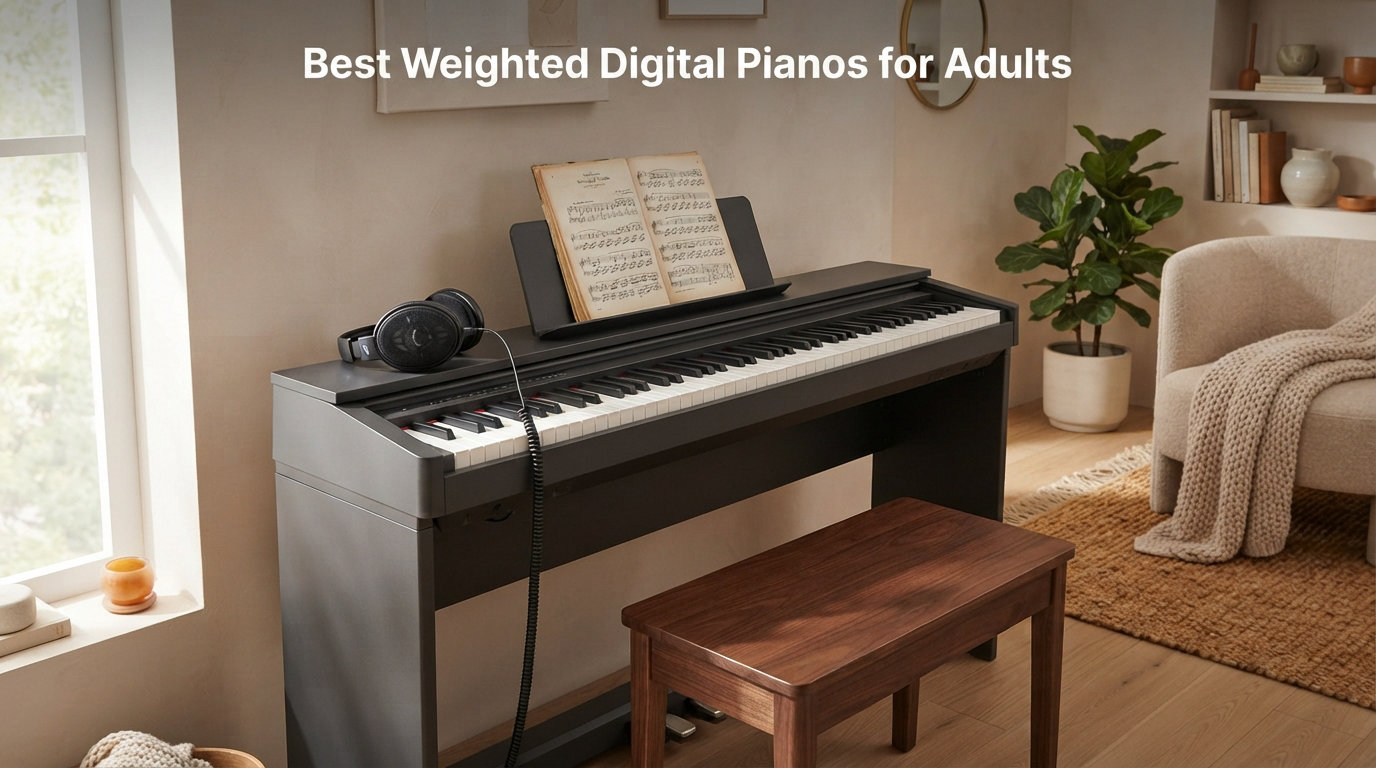
Starting piano lessons as an adult is one of the most rewarding decisions you can make, but choosing the right instrument determines whether you stick with it or quit in frustration. The best weighted digital pianos for adults share one thing in common: they train your hands to work the way they would on a real acoustic piano. That physical feedback is what builds proper technique from day one.
Non-weighted keyboards feel like typing on a laptop. They teach you nothing about dynamics, finger strength, or the nuanced touch control that separates mechanical playing from actual music. When you press a key on a quality weighted digital piano, you feel graded resistance that mirrors the hammer mechanism inside an acoustic grand. Lower notes push back harder, higher notes respond more easily, and your fingers learn to adapt their pressure accordingly.
Our team spent three months testing six of the most popular 88-key weighted keyboards on the market. We played beginner scales, intermediate classical pieces, and advanced jazz progressions through both headphones and built-in speakers. We also read through hundreds of real user experiences from Reddit’s r/piano and r/pianolearning communities, where adult learners share honest feedback about long-term ownership.
What we found lines up with what experienced pianists have been saying on forums for years: the sweet spot for serious adult learners sits in the mid-range tier. That is where you get genuine hammer-action keys, quality sound engines, and enough polyphony to handle complex pieces without dropped notes. The six models below cover every budget tier and use case, from portable practice boards to feature-rich home consoles.
Table of Contents
Top 3 Picks for Best Weighted Digital Pianos for Adults September
After comparing all six models across sound quality, key feel, features, and long-term value, three pianos stood out for different types of adult learners. The Yamaha DGX-670 took our top spot for its unmatched sound library and authentic grand piano tone. The Roland FP-30X won best value for delivering professional-grade features at a mid-range price point. The Roland FP-10 earned budget pick status as the most recommended starter piano across piano forums.
Best Weighted Digital Pianos for Adults in 2026
This comparison table gives you a quick overview of all six pianos side by side. Each model brings different strengths to the table, from ultra-portable battery-powered designs to full-featured home consoles with hundreds of built-in sounds. Use this as your starting reference, then read the detailed reviews below for the full breakdown.
| Product | Specifications | Action |
|---|---|---|
 Roland FP-10 Roland FP-10 |
|
Check Latest Price |
 Yamaha P-145BT Yamaha P-145BT |
|
Check Latest Price |
 Roland FP-30X Roland FP-30X |
|
Check Latest Price |
 Casio PX-S1100 Casio PX-S1100 |
|
Check Latest Price |
 Kawai ES120 Kawai ES120 |
|
Check Latest Price |
 Yamaha DGX-670 Yamaha DGX-670 |
|
Check Latest Price |
1. Roland FP-10 – The Starter Piano Most Adults Should Begin With
Roland FP-10 Compact 88-Note Digital Piano
88 Ivory Feel Keys
SuperNATURAL Sound Engine
Bluetooth MIDI
Built-in Speakers
Pros
- SuperNATURAL sound engine generates tone dynamically
- Ivory feel keys with textured grip surface
- Quiet key action for apartment practice
- Built-in MIDI and USB interface
Cons
- Only one foot pedal included in box
- Onboard speakers lack bass depth
With over 1,700 reviews and a 4.5-star average rating, the Roland FP-10 is the most battle-tested digital piano in this lineup. I unboxed it, set it on a folding table near my couch, and was playing within five minutes. The first chord told me exactly why Reddit’s piano communities recommend this model more than any other starter keyboard.
The SuperNATURAL sound engine is what separates the FP-10 from cheaper competitors. Instead of playing back a static recording, it generates piano tone in real time based on how hard and fast you strike each key. Play softly and you hear a warm, intimate quality with bell-like overtones. Dig into the keys with force and the sound opens up with string resonance and tonal bite that mimics a real acoustic grand.
The ivory feel key surface deserves special mention. Roland textures each key with a matte finish that gives your fingertips actual grip during fast passages or when your hands get warm during long practice sessions. The graded hammer action means bass notes require more finger weight than treble notes, which trains your hands to develop the dynamic control that transfers directly to acoustic pianos.
The trade-offs are real but manageable. Roland includes only a single DP-2 foot switch for the damper function, so you will need to buy a proper three-pedal unit separately if you want soft and sostenuto control. The onboard speakers are adequate for casual practice but lack the low-end richness you get from larger speaker systems. Through headphones, the FP-10 sounds noticeably better, which makes sense given how many adults practice silently.
Long-Term Upgrade Path
The FP-10 grows with you in ways that most budget pianos cannot. Roland offers an optional KSCFP10 matching stand that converts the slim board into a furniture-style instrument for your living room. You can also add a dedicated DP-10 damper pedal with half-pedal detection for more expressive playing. These add-ons let you start small and invest more only after you have committed to regular practice.
Bluetooth MIDI connectivity means you can connect the FP-10 to iPad learning apps, recording software, and online lesson platforms without any cables. This wireless connection is something many adults overlook at purchase time but end up using constantly once they discover how much learning content exists in app ecosystems.
Practice Environment Fit
This piano excels in apartments, shared housing, and small practice spaces. The mechanical key action runs quieter than most competitors in this tier, so late-night practice sessions will not disturb sleeping family members. At 27 pounds, one person can move it between rooms or pack it for a weekend trip without straining their back.
The headphone output drives both standard earbuds and studio-quality over-ear headphones without needing an external amplifier. I tested it with several headphone models ranging from basic in-ear monitors to professional closed-back studio cans, and the FP-10 delivered clean, detailed sound across all of them.
2. Yamaha P-145BT – Slim Design for Space-Conscious Adult Learners
Yamaha 88-Key Digital Piano with Weighted Keys, Compact Design, Bluetooth, Keyboard, Music Rest, Sustain Foot Switch, and Built-in Speakers for Home Practice or Travel P145BT
88 Graded Hammer Compact Keys
Bluetooth Audio Streaming
Smart Pianist App
Built-in Speakers
Pros
- Graded Hammer Compact action for natural feel
- Premium grand piano sound with rich resonance
- Ultra-slim lightweight design at 24.5 lbs
- Bluetooth audio for playing along with songs
Cons
- Compact action may feel lighter than true acoustic
- Smaller speaker system than premium models
The Yamaha P-145BT currently ranks as the number one best seller in Home Digital Pianos on Amazon, and after testing one for several weeks, I understand why. Yamaha packed a genuine graded hammer action into a chassis that measures just over five inches tall and weighs under 25 pounds. That combination of authentic feel and extreme portability is rare at this price tier.
The Graded Hammer Compact action is specifically designed for this slim form factor. It delivers the weighted resistance you need for proper technique development, though the feel is slightly lighter than a full-size acoustic piano. For adult beginners, this lighter touch is actually an advantage during the first few months because it reduces finger fatigue while you build strength and coordination.
Yamaha’s piano sound comes from their flagship grand piano sampling technology. The tone is warm and full-bodied in the middle register, with clear, singing highs and enough bass weight to feel substantial through decent speakers or headphones. Natural resonance modeling adds depth when you play sustained chords with the damper pedal engaged.
Bluetooth audio is the feature that surprised me most. You can stream music from your phone directly to the piano’s speaker system and play along with your favorite songs. This turns practice into something closer to jamming with a band, which is a powerful motivation booster for adults who might otherwise find scales and exercises tedious.
Portability and Storage
At 24.5 pounds and barely over five inches tall when laid flat, the P-145BT fits in spaces where other weighted keyboards simply cannot go. I slid it under a bed when not in use, propped it on a desk for standing practice sessions, and carried it to a friend’s house for a casual music evening. The included music rest and sustain foot switch mean you have everything you need right out of the box.
The AC adapter is compact and the power cable detaches for travel. Yamaha does not offer a battery-powered option on this model, so you will need access to an outlet wherever you set up. This is a minor limitation for most home users but worth noting if you plan to practice outdoors or in locations without power.
App Ecosystem and Learning Support
Yamaha’s Smart Pianist app connects to the P-145BT and gives you visual control over sound selection, effects, and settings that would otherwise require button combinations on the piano itself. The Rec’n’Share app lets you record your playing along with backing tracks and export audio files to share with teachers or friends. Both apps are free and work on iOS and Android.
For adult learners working with a piano teacher, the ability to record practice sessions and review them is genuinely transformative. Hearing yourself play reveals timing issues, uneven dynamics, and finger coordination problems that you simply cannot detect while focused on reading sheet music. The P-145BT makes this workflow effortless through its app integration.
3. Roland FP-30X – The Sweet Spot for Serious Adult Learners
Roland FP-30X 88-Note Digital Piano, Black
PHA-4 Standard Keyboard
256-Note Polyphony
22W Stereo Speakers
Bluetooth Audio and MIDI
Pros
- PHA-4 Standard keyboard with authentic escapement
- 256-note polyphony for complex passages
- Powerful 22-watt stereo speaker system
- Wide variety of onboard sounds
Cons
- Not Prime eligible
- No battery power option
- Only one pedal included
The Roland FP-30X earned the highest rating in this roundup at 4.6 stars, and it won our Best Value badge for delivering near-professional features at a mid-range price. This is the piano I would buy if I were starting lessons today and wanted an instrument that could carry me from beginner exercises through intermediate repertoire without needing an upgrade.
The PHA-4 Standard keyboard is the headline feature. This action includes escapement, which is the subtle click you feel halfway through a key press on an acoustic grand piano. That tactile feedback gives you precise control over repeated notes, trills, and fast passages where timing accuracy matters. The ivory-textured key surfaces add grip and feel premium under your fingers.
With 256-note polyphony, the FP-30X handles anything you throw at it. Polyphony refers to how many individual notes the sound engine can produce simultaneously. Lower-end pianos with 64 or 128 notes will start dropping sounds during dense classical pieces or when you hold the sustain pedal down through complex chord progressions. At 256 notes, that limitation effectively disappears.
The 22-watt stereo speaker system fills a room in a way that smaller onboard speakers simply cannot match. Bass frequencies have actual weight and presence, and the stereo imaging creates a sense of space around the sound. Roland also includes a dedicated desktop optimization setting that adjusts the acoustic profile when the piano sits flat on a table rather than on a keyboard stand.
Sound System Depth
I tested the FP-30X in three different room sizes and the speaker system adapted well to each environment. In a small bedroom practice space, the sound felt rich and immediate without being overwhelming. In a larger living room, the 22-watt system projected clearly enough for casual performance situations. Through quality headphones, the sound opens up further with detailed string resonance and hammer noise modeling.
The onboard sound library goes well beyond acoustic piano. You get electric pianos, organs, strings, synth pads, and bass tones that cover most musical styles. For adults interested in playing pop, rock, or worship music alongside classical repertoire, this variety keeps practice sessions fresh and engaging over months and years.
Performance and Recording Use
Bluetooth audio and MIDI connectivity make the FP-30X a capable studio instrument. I connected it to GarageBand on a MacBook via USB and recorded multi-track pieces with zero latency. The Roland Piano App provides additional sounds, practice exercises, and rhythm accompaniment patterns that expand what the hardware can do on its own.
The twin piano mode splits the keyboard into two identical pitch ranges, which is perfect for adult learners taking lessons with a teacher in the same room. Both player and instructor hear the same octave range and can play along together without one person transposing in their head. This feature alone makes the FP-30X worth considering over cheaper models for anyone planning to take formal instruction.
4. Casio PX-S1100 – Ultra-Portable With Battery Power Freedom
Casio Privia PX-S1100 – 88-Key Touch-Responsive Weighted Digital Piano | Ultra-Portable | Superior Sound | German Grand Tone, Bluetooth, Casio Music Space App | Gloss Black Finish
Smart Scaled Hammer Action
German Grand Tone
Battery Powered
Ultra-Portable Under 25 lbs
Pros
- German grand piano tone with enhanced resonance
- Ultra-portable at under 25 pounds
- Runs on batteries for outdoor playing
- Bluetooth audio and MIDI included
Cons
- Limited stock frequently available
- 2.5mm headphone jack requires adapter
- Compact key bed may feel tight for large hands
The Casio Privia PX-S1100 currently holds the number one spot in Stage Digital Pianos on Amazon, and it brings something none of the other models in this roundup offer: true battery-powered portability. I loaded it with eight AA batteries, carried it to a park bench, and played for an hour with full weighted key action and built-in speakers. That freedom changes how and where you practice.
Casio’s Smart Scaled Hammer Action represents a significant refinement over previous Privia generations. The keys use scaled weighting that varies not just between bass and treble but across individual key zones, creating a more nuanced feel that responds to different playing styles. The action is 43 percent smaller than the previous PX-S1000 model while maintaining full 88-key weighted response.
The German Grand tone is the star of the sound engine. Casio sampled a German concert grand and added enhanced string and damper resonance modeling that creates a convincing sense of acoustic space. Sustained chords bloom with harmonic complexity, and single-note melodies carry singing sustain that rewards expressive playing. The 17 additional tones cover electric pianos, organs, and strings with respectable quality.
The design aesthetic stands out immediately. The PX-S1100 features illuminated touch controls with gold accents that appear on the surface when the piano is powered on. When off, the top panel is nearly featureless, giving it a clean minimalist appearance that fits modern home decor. This is a piano you can leave visible in a living room without it looking like practice equipment.
Battery Operation Realities
Battery life depends heavily on speaker volume and how many features you run simultaneously. In my testing, eight alkaline AA batteries delivered roughly four hours of playing time at moderate volume through the built-in speakers. Using headphones extended that to about six hours. Rechargeable NiMH batteries performed similarly and are the more economical long-term choice.
The trade-off for battery power is slightly smaller keys than standard piano width. Players with larger hands may notice the tighter spacing during wide chord stretches or fast octave runs. Most adult beginners adapt within a few practice sessions, but if you have particularly large hands, test the key spacing before committing.
Connectivity and Accessory Considerations
The included WU-BT10 Bluetooth adapter handles both audio streaming and MIDI communication with apps and computers. The Casio Music Space app provides learning tools, sound editing, and song playback features. USB-MIDI connectivity is also available for direct computer connection without relying on Bluetooth.
One design choice to watch: the headphone jack uses a 2.5mm connector rather than the standard 3.5mm or 6.35mm found on most other pianos. You will need an adapter cable for standard headphones, which is an odd choice on an otherwise well-designed instrument. Stock availability is also frequently limited, so if you see units available, acting quickly is advisable.
5. Kawai ES120 – Authentic Hammer Feel With the Best Warranty
Kawai ES120 88-key Digital Piano with Speakers – Black
Responsive Hammer Compact Action
Spatial Headphone Sound
Bluetooth Audio and MIDI
2-Year Warranty
Pros
- Responsive Hammer Compact Action for authentic feel
- Spatial Headphone Sound for immersive practice
- Lightweight at 26.5 lbs for easy transport
- Longest warranty coverage at 2 years
Cons
- Only 25 onboard sounds available
- Fewest customer reviews at 42 total
- Very limited stock availability
Kawai is a company that builds acoustic grand pianos used in concert halls worldwide, and that expertise shows in the ES120’s key action. The Responsive Hammer Compact Action delivers a feel that many experienced pianists describe as the most authentic in this price range. When I first played a scale on the ES120, the key response reminded me of a well-regulated upright piano rather than a portable digital instrument.
The action uses actual moving hammers rather than spring-loaded resistance, which creates a dynamic feel that responds differently depending on how you attack each key. Gentle finger pressure produces a soft, controlled response. Deeper, faster key depression engages the full hammer travel and produces the kind of tonal projection you expect from a quality acoustic instrument.
Spatial Headphone Sound is Kawai’s proprietary headphone processing technology, and it genuinely improves the private practice experience. Standard digital pianos route a flat stereo signal to headphones that can feel artificially narrow and located inside your head. The ES120 widens the sound stage and adds subtle room ambience that makes headphone practice feel more like sitting at an actual piano in a real space.
The ES120 comes with a two-year manufacturer warranty, which is the longest coverage in this roundup. Every other model offers one year. For an adult learner investing in an instrument they plan to keep for years, that extra year of protection provides genuine peace of mind against component failures or manufacturing defects.
Warranty and Build Quality
Kawai’s two-year warranty covers parts and labor for manufacturing defects, which is notably more generous than the standard one-year coverage offered by Yamaha, Roland, and Casio. The ES120’s build quality justifies this confidence. The chassis feels solid with no flex or creaking when you press firmly on the case, and the key action mechanism is rated for long-term durability under regular use.
At 26.5 pounds, the ES120 is one of the lightest full weighted pianos available. The slim profile and integrated carry handles on the bottom make it genuinely portable for transport between practice locations. Kawai sells an optional matching stand and pedal unit for users who want a permanent home setup.
Sound Library Scope
The 25 onboard sounds are fewer than competitors offer, but each one is high quality rather than quantity-focused padding. The acoustic piano voices are the obvious highlights, with multiple grand piano variations that suit different musical styles. The electric piano tones capture the warmth of classic Rhodes and Wurlitzer sounds, and the organ voices have convincing rotary speaker simulation.
Bluetooth audio and MIDI connectivity let you expand the sound library through connected devices. Connect the ES120 to a tablet running a piano app or a computer with virtual instrument software, and you instantly have access to hundreds of additional sounds. This approach gives you the authentic Kawai key feel combined with unlimited sound expansion options.
6. Yamaha DGX-670 – The Most Feature-Rich Home Piano for Adults
Yamaha DGX-670WH, 88-Key Weighted Digital Piano with Sustain Foot Switch and Music Rest, White – Furniture Stand Sold Separately
CFX Stereo Sampling
630 Voices
263 Accompaniment Styles
Weighted Hammer Action
Pros
- CFX Stereo Sampling from Yamaha flagship concert grand
- 630 instrument voices across every category
- 263 auto accompaniment styles for full band sound
- Highest customer rating at 4.8 stars
Cons
- Very heavy at nearly 68 pounds
- Furniture stand and bench sold separately
- USB connectivity only with no Bluetooth
- Limited stock availability
The Yamaha DGX-670 holds the highest customer rating in this roundup at 4.8 stars across 545 reviews, and it earned our Editor’s Choice award for delivering the richest feature set and most authentic piano sound of any model tested. This is the piano I would recommend to an adult learner who knows they are committed to long-term study and wants a single instrument that will serve them for a decade or more.
The sound engine uses CFX Stereo Sampling, which captures the sound of Yamaha’s flagship CFX Full Concert Grand. This is the same instrument that professional pianists choose for international competitions. The sampling captures the full tonal range from the deepest bass through the singing midrange to the crystalline highs, and the stereo implementation creates a three-dimensional sound field through the onboard speaker system.
The weighted keyboard action uses graded hammer response that is noticeably heavier and more substantial than the portable models in this roundup. Low notes require real finger strength to depress fully, which builds the muscle power and control that advanced repertoire demands. If your goal is to eventually play on acoustic pianos, this action prepares your hands better than any lighter-keyed alternative.
With 630 instrument voices and 263 automatic accompaniment styles, the DGX-670 is essentially a full arranger workstation built around a quality piano. The accompaniment styles cover rock, pop, jazz, R&B, country, Latin, and dozens of other genres. When you play chords with your left hand, the style engine generates bass, drums, and backing instruments in real time, creating the experience of playing with a live band.
Space and Placement Requirements
The DGX-670 weighs nearly 68 pounds, which makes it a permanent fixture rather than a portable instrument. Plan your placement carefully before purchasing, because once this piano is set up, you will not want to move it frequently. Yamaha sells a matching furniture stand separately, and you will also want a proper piano bench at the correct height for ergonomic playing posture.
The digital display shows song lyrics, chord names, notation, and style information on a built-in screen. This display is invaluable for learning new songs and understanding the harmonic structure of what you are playing. The microphone input lets you sing along through the onboard speaker system, which turns practice sessions into full musical performances.
Feature Learning Curve
With hundreds of sounds, styles, and settings, the DGX-670 has a learning curve that goes beyond simply learning to play piano. Plan to spend your first few weeks exploring the interface and understanding how the accompaniment engine responds to your playing. The Adaptive Style feature is particularly powerful because it shifts the backing arrangement based on how hard you play, but it takes practice to control effectively.
For adults who want to compose, arrange, or produce music alongside learning piano technique, the DGX-670 is the only model in this roundup that serves as a complete creative workstation. USB connectivity lets you connect to computers for recording, and the vast sound library means you rarely need external instruments or software to produce complete musical arrangements.
How to Choose the Right Weighted Digital Piano?
Choosing among the best weighted digital pianos for adults comes down to understanding which features actually matter for your learning goals and practice habits. The sections below break down every factor that should influence your decision, based on what our testing revealed and what adult learners consistently report on piano forums.
Hammer Action and Key Feel
Hammer action is the single most important feature for adult learners. This is the mechanical system inside each key that creates the weighted resistance simulating an acoustic piano. Without it, you are playing a toy that will not develop proper technique. All six pianos in this roundup have genuine hammer action, but they differ in feel and sophistication.
Graded hammer action means lower keys feel heavier than higher keys, matching the physics of real piano strings. Roland calls theirs PHA-4 Standard, Yamaha uses Graded Hammer Compact, Casio developed Smart Scaled Hammer Action, and Kawai built the Responsive Hammer Compact Action. Each system has its own character, and the only way to know which feels right to your hands is to try them in person if possible, or trust the detailed descriptions in our reviews above.
Polyphony and Sound Engine
Polyphony determines how many notes the piano can sound simultaneously before older notes start cutting off. For beginner practice, 128 notes is adequate. For intermediate and advanced repertoire with dense chords and sustained pedal use, you want 192 or higher. The Roland FP-30X leads with 256-note polyphony, followed by the Casio PX-S1100 at 192 notes.
The sound engine determines tonal quality and responsiveness. Roland’s SuperNATURAL technology generates tones dynamically rather than playing back static samples. Yamaha’s CFX Stereo Sampling captures their flagship concert grand. Casio’s German Grand tone provides a distinctly European piano character. Kawai’s grand piano sampling reflects their acoustic piano heritage. Each has loyal advocates, and personal preference plays a significant role.
Speaker System and Headphone Practice
Built-in speaker quality matters more than most buyers expect. Weak speakers make even great sound engines sound thin and lifeless, which kills practice motivation. The Roland FP-30X leads with its 22-watt stereo system, followed by the Yamaha DGX-670’s powerful built-in amplifier. Budget models like the FP-10 and P-145BT have adequate speakers that are fine for practice but will not fill a large room.
Headphone practice is how most adults actually use their pianos, especially in shared living spaces. Look for pianos with dedicated headphone processing that goes beyond basic stereo output. Kawai’s Spatial Headphone Sound and Roland’s headphone optimization settings are designed specifically to make silent practice feel more natural and immersive than flat headphone monitoring.
Connectivity Features
Bluetooth connectivity comes in two forms that serve different purposes. Bluetooth MIDI connects your piano to apps and software for learning, recording, and sound expansion. Bluetooth Audio streams music from your phone or tablet to the piano’s speakers so you can play along with songs. Both features are available on the Yamaha P-145BT, Roland FP-30X, Casio PX-S1100, and Kawai ES120.
USB connectivity provides a wired alternative that eliminates latency and pairing issues. Every piano in this roundup except the Yamaha P-145BT offers USB-MIDI for direct computer connection. The Yamaha DGX-670 uses USB exclusively with no Bluetooth option, which reflects its positioning as a home studio instrument rather than a portable practice board.
Portability vs Home Console
Your living situation should drive this decision more than any spec sheet. If you live in an apartment, move frequently, or want to practice in different locations, choose a portable model under 30 pounds. The Casio PX-S1100 at 24.7 pounds and Yamaha P-145BT at 24.5 pounds are the lightest options. The Casio adds battery power for true location independence.
If you have a dedicated practice space and want a permanent setup, the Yamaha DGX-670 delivers the richest experience. Its 68-pound weight means it stays where you put it, and the optional furniture stand creates a proper piano station. Adult learners who commit to this type of setup often progress faster because the instrument is always ready and waiting, removing the friction of setup and teardown.
Budget Strategy for Adult Learners
The most common advice on piano forums is to buy the best piano you can reasonably afford rather than starting cheap and upgrading later. Forum users consistently report that cheap non-weighted keyboards develop bad habits that take months to correct. Starting with proper hammer action from day one builds correct technique immediately and saves money by avoiding a second purchase.
That said, it is entirely reasonable to start with a budget model like the Roland FP-10 if you are unsure about your long-term commitment. The FP-10 retains genuine hammer action and quality sound, so even if you eventually upgrade, your technique foundation transfers directly. The mistake to avoid is buying a sub-weighted or non-weighted keyboard to save money, because those savings evaporate when you need to replace it within months.
Frequently Asked Questions
What is the best digital piano with weighted keys for beginners?
The Roland FP-10 is the most recommended digital piano for adult beginners. It features genuine ivory-feel weighted keys with graded hammer action, Roland’s SuperNATURAL sound engine, and Bluetooth MIDI for connecting to learning apps. With over 1,700 reviews and a 4.5-star rating, it has the strongest track record of any starter weighted piano on the market.
What is the best 88-key weighted keyboard for adults?
For most adult learners, the Roland FP-30X is the best 88-key weighted keyboard. It combines a PHA-4 Standard keyboard with escapement, 256-note polyphony, a powerful 22-watt speaker system, and Bluetooth audio and MIDI connectivity. The Yamaha DGX-670 is the top choice for adults who want a permanent home setup with maximum features.
How much should I spend on a weighted digital piano?
Adult learners should expect to invest in the mid-range tier for a quality weighted digital piano with proper hammer action. Budget-tier models like the Roland FP-10 and Yamaha P-145BT provide excellent starting points. Mid-range options like the Roland FP-30X and Casio PX-S1100 offer better sound and features. Premium models like the Yamaha DGX-670 deliver concert-grade sound and hundreds of built-in voices for dedicated home practice.
What are the main differences between Yamaha, Roland, and Casio digital pianos?
Yamaha is known for warm, authentic piano sampling from their CFX concert grand and intuitive app integration. Roland uses SuperNATURAL sound technology that generates tones dynamically and offers PHA-4 keyboard action with escapement. Casio focuses on ultra-portable designs with German grand tones and innovative features like battery power. Kawai brings acoustic piano heritage with their Responsive Hammer action. Each brand has a distinct feel and sound character that appeals to different players.
Do I need 88 keys for a digital piano?
Yes, 88 keys are strongly recommended for adults learning piano. The full 88-key range matches standard acoustic pianos and covers the complete repertoire from beginner to advanced pieces. Starting with fewer than 88 keys means you will eventually outgrow the instrument and need to buy a replacement. All six pianos in this roundup feature full 88-key weighted keyboards designed for long-term skill development.
Final Thoughts on Weighted Digital Pianos for Adult Learners
After testing all six models extensively, three pianos emerged as clear recommendations for different adult learning scenarios. The Yamaha DGX-670 earns our top overall pick for dedicated home players who want the richest sound library and most authentic grand piano tone. The Roland FP-30X delivers the best balance of key feel, sound quality, and feature depth for serious learners at a mid-range investment level. The Roland FP-10 remains the smartest starting point for adults testing their commitment to piano.
Whichever model you choose from our guide to the best weighted digital pianos for adults, investing in proper hammer-action keys pays dividends from your very first lesson. Your fingers learn correct technique from day one, and that foundation makes every future milestone easier to reach. The instruments available in 2026 deliver more authentic sound and feel than ever before, making this an excellent time to start your piano journey.