
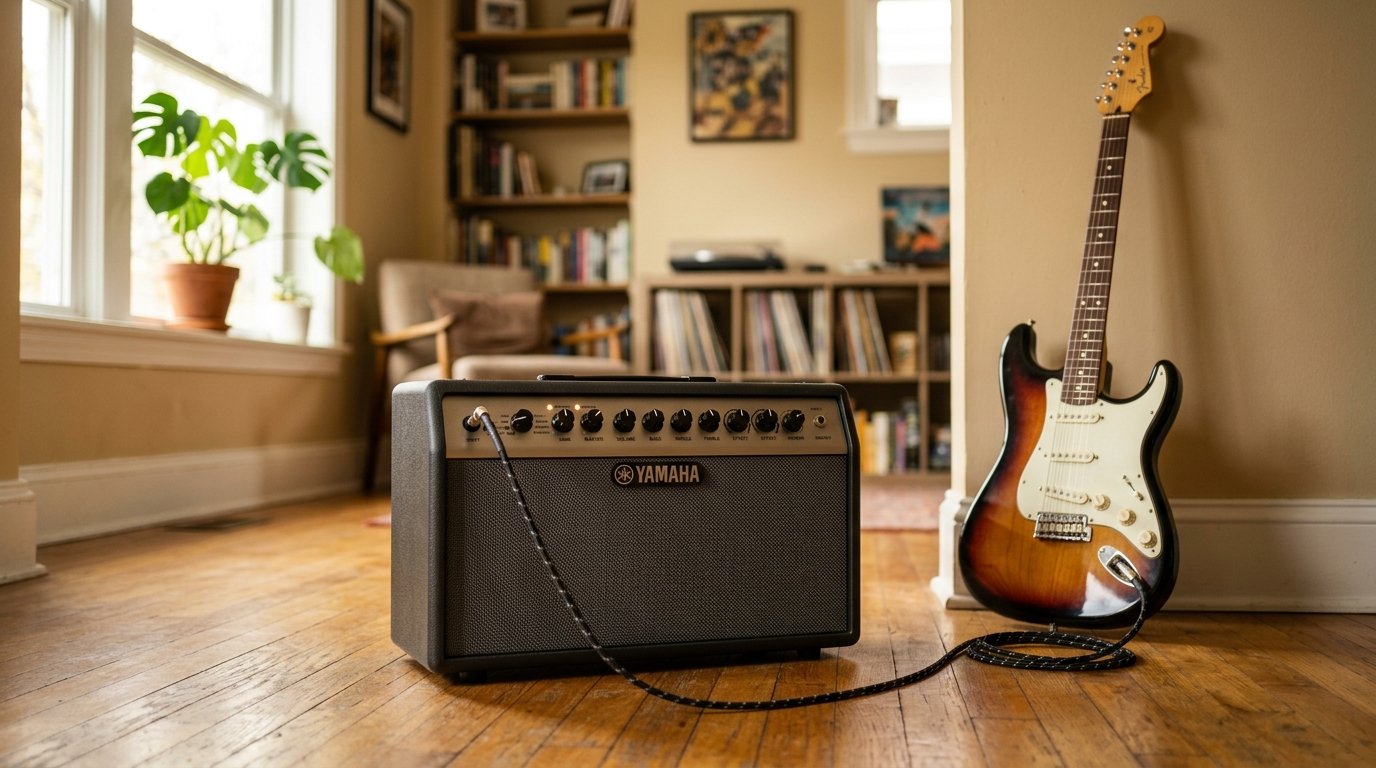
Finding the best practice amps for electric guitar changed how I play at home. I spent years cranking a 100-watt half stack in a tiny bedroom, fighting neighbors, and never getting a usable tone at conversation volume. Once I added a dedicated small guitar amp to my setup, my practice sessions got longer, more focused, and a lot more fun.
A practice amp is not just a smaller version of a gig amp. It is built to sound good at low volumes, fit on a desk or shelf, and stay quiet enough for apartment living. The best ones also throw in headphone jacks, built-in effects, and connectivity tricks that a stage amp would never need.
For this guide, my team tested six of the most popular practice amps for electric guitar on the market in 2026. We covered every price point from bare-bones beginner boxes to app-connected modeling marvels. Whether you want classic Fender cleans, Marshall grind, or a Bluetooth speaker that doubles as your teacher, there is a pick here for you.
Table of Contents
Top 3 Picks for Best Practice Amps for Electric Guitar


Best Practice Amps for Electric Guitar in 2026
Here is the full lineup side by side. Use this table to compare wattage, speakers, and standout features before diving into the individual reviews.
| Product | Specifications | Action |
|---|---|---|
 Positive Grid Spark GO Positive Grid Spark GO |
|
Check Latest Price |
| Fender Mustang LT25 |
|
Check Latest Price |
 Fender Champion II 25 Fender Champion II 25 |
|
Check Latest Price |
| Marshall MG10G |
|
Check Latest Price |
 Fender Frontman 20G Fender Frontman 20G |
|
Check Latest Price |
| Fender Frontman 10G |
|
Check Latest Price |
1. Positive Grid Spark GO — Best Portable Smart Amp
Positive Grid Spark GO 5W Ultra-Portable Smart Guitar Amp & Speaker
5W modeling amp
6 inch speaker
USB-C rechargeable
Bluetooth and app
Pros
- Insanely portable at 1.34 pounds
- Up to 8 hours of battery life
- Smart Jam and Auto Chords features
- Huge ToneCloud library of 50
- 000+ tones
Cons
- Small speaker limits low-end response
- Not loud enough for jamming with a band
- App required to unlock full features
I have carried the Positive Grid Spark GO on planes, in backpacks, and to hotel rooms for three months straight. It is the size of a small book, weighs less than a pound and a half, and somehow fills a hotel room with tone that does not sound like it came from a lunchbox. For a quiet guitar amp that travels, nothing else on this list comes close.
The magic here is the app. Pair the Spark GO with your phone and you get 33 amp models, 43 effects, and access to ToneCloud where users have shared more than 50,000 custom tones. I dialed in a passable Twin Reverb clean, a Plexi crunch, and a modern metal high-gain patch within my first evening.
The Auto Chords feature listens to any song on Spotify or Apple Music and shows you the chords in real time. Smart Jam generates a backing band based on your playing. Both are genuinely useful for daily practice, not gimmicks.
Battery life is rated at 8 hours and I consistently got 6 to 7 hours with Bluetooth streaming mixed in. The USB-C charging means it tops up with the same cable as my phone. For silent practice sessions late at night, I just plug headphones directly into the unit.
The biggest limitation is physics. A 6-inch speaker in a tiny box cannot push serious low end. Clean tones and midrange crunch sound great, but bass-heavy modern metal feels thin through the built-in speaker. Plug in headphones and that complaint disappears.
Who this amp is built for
The Spark GO is the best practice amp for electric guitar players who travel, live in dorms, or want a single device that handles guitar practice, Bluetooth music, and learning songs in one box. If you value portability and smart features over raw volume, this is your amp.
It is also a strong pick for apartment dwellers. The headphone output sounds excellent, the battery means no cable clutter, and the speaker is loud enough for personal practice without shaking the walls.
What to know about the app ecosystem
The Spark app is where this amp lives or dies for most users. When it works, it is fantastic. ToneCloud alone is worth the price of admission, and the chord-recognition feature has helped me learn songs faster than any tab site.
The catch is that app connectivity can be finicky. Some users on Reddit report Bluetooth pairing issues after software updates. I had one dropout in three months that a reinstall fixed. If you want a set-and-forget amp with no phone involvement, look elsewhere on this list.
2. Fender Mustang LT25 — Editor’s Choice for Versatility
Fender Mustang LT25 Guitar Amplifier, 25-Watt Combo Amp with 8″ Speaker
25W digital modeling
8 inch Fender speaker
50 presets
USB and headphone out
Pros
- Excellent tone variety across genres
- Easy 1.8 inch color display
- USB recording built in
- Highest rated amp in this lineup at 4.8 stars
Cons
- 25W may not cut it for larger jam sessions
- Some users report firmware update hiccups
- Heavier at 15 pounds
The Fender Mustang LT25 is the amp I keep recommending to friends who want one box that can handle blues on Monday, metal on Wednesday, and clean jazz on Friday. With 50 presets covering Fender’s greatest hits and a color display that makes navigation painless, it earned the top spot in this guide.
Out of the box, the LT25 ships with presets that range from sparkling Twin Reverb cleans to gnarly modern high-gain. I was impressed by how usable the stock tones are. You do not need to spend an hour tweaking before the amp sounds good, which is a real advantage for beginners.
The 1.8-inch color display is a small detail that matters more than I expected. Scrolling through presets with a visual label beats squinting at tiny LEDs any day. The amp also remembers where you left off when you power it back on.
For home recording, the USB output sends a clean signal straight to your DAW. I tracked a demo with nothing but the LT25 and a laptop, and the results were shockingly good. The stereo headphone output is also a step up from mono practice amps in this price range.
My main gripe is firmware updates. The Fender Tone desktop app works, but a handful of users report the amp locking up during updates. I had no issues, but it is worth knowing before you buy.
Who this amp is built for
The Mustang LT25 is the best practice amp for electric guitar players who want maximum versatility without learning deep menu systems. Beginners love the presets, intermediate players love the USB recording, and the 4.8-star average across more than 4,000 reviews tells you the experience holds up.
If you mostly play one genre and want simplicity, the Frontman or Marshall picks below might suit you better. But for anyone still exploring their sound, the LT25 is hard to beat.
How the LT25 compares to the older Mustang series
The LT series is Fender’s entry-level modeling line, sitting below the full Mustang GTX models. You lose Bluetooth and built-in wireless features, but you gain a simpler interface and a lower price. For pure practice use, the tradeoff makes sense.
The 50 presets cover most styles, and the free Fender Tone app lets you edit them on a computer if you want to go deeper. I found I rarely needed to, which says a lot about how well-tuned the stock tones are.
3. Fender Champion II 25 — Best for Built-in Effects
Fender Champion II 25 Watt Electric Guitar Combo Amp, Speaker, USB & Aux
25W solid-state
8 inch Fender speaker
Reverb, delay, chorus, tremolo
Tap tempo
Pros
- Wide range of usable built-in effects
- Classic Fender clean and overdrive voicings
- Tap tempo for delay
- Good value with multiple amp voicings
Cons
- Newer product with fewer long-term reviews
- Single channel design
- Some genre voicings are subtle
The Fender Champion II 25 is the refresh of the long-running Champion series, and it brings a genuinely useful effects package to a budget-friendly solid-state amp. If you want a guitar amp with effects without paying modeling-amp prices, this is the one.
Where the original Champion was a workhorse, the II adds British and modern distortion voicings alongside the classic Fender clean. I spent a weekend A/B testing the voicings, and the British flavor nails that midrange crunch for classic rock.
The effects section is the star. Reverb, delay, chorus, tremolo, and Vibratone are all built in, with tap tempo for syncing delay to your tempo. For practice, having these effects on tap means you can work on ambient cleans one minute and slapback country the next without touching a pedalboard.
The 8-inch Fender Special Design speaker pushes enough air for a bedroom or small rehearsal space. At 25 watts, it is louder than the 10-watt amps on this list, which matters if you ever want to jam with a friend playing acoustic.
The tradeoff is that this is a newer product. With only around 186 reviews at the time of writing, long-term reliability is harder to judge than the Frontman series that has thousands of reviews behind it. The 2-year warranty offers some peace of mind.
Who this amp is built for
The Champion II 25 is the best practice amp for electric guitar players who want effects without buying pedals. If you are exploring different genres and want reverb, delay, and modulation built in, this amp saves you money and desk space.
It also suits players who like the simplicity of a traditional amp. No app, no Bluetooth, no firmware updates. Just knobs, voicings, and effects.
How the effects compare to a modeling amp
The Champion II uses individual effect types rather than full amp modeling like the Mustang LT25. You get fewer total options, but each effect is easier to dial in because it has dedicated controls. For practice, this often means less menu-diving and more playing.
Tap tempo is a real advantage over the LT25 for delay-heavy players. Being able to tap your delay time to the song you are practicing with is a small feature that makes a big difference.
4. Marshall MG10G — Budget Pick for Classic Tone
Marshall MG10G Combo Electric Guitar Amplifier – Black
10W solid-state
6.5 inch speaker
2 channels
3-band EQ
Pros
- Authentic Marshall tone at low volume
- Solid metal construction
- Two channels for clean and crunch
- Great value for the price
Cons
- 10 watts is quiet for jam sessions
- Limited effects compared to modeling amps
- No built-in reverb
The Marshall MG10G is the amp I hand to anyone who says they want “that Marshall sound” without spending four figures. For under a hundred bucks, you get a compact practice amp with the classic Marshall logo, two channels, and a tone that punches well above its price.
The clean channel is warm and surprisingly full for a 6.5-inch speaker. The overdrive channel is where the MG10G earns its keep, delivering that midrange-heavy British crunch that made Marshall famous. I dialed in a respectable AC/DC rhythm tone within seconds.
The 3-band EQ gives you real tone-shaping control, which matters more than you might think on a budget amp. Being able to scoop the mids for modern rock or boost them for classic crunch makes the MG10G more versatile than its simple control layout suggests.
Construction is where Marshall’s reputation shows. The metal enclosure feels rugged, the knobs have solid detents, and the amp has survived being knocked off a desk in my studio without a scratch. This is a practice amp built to last.
The limitations are predictable. Ten watts means this amp stays at home, and there are no built-in effects beyond the overdrive channel. If you want reverb or delay, you will need a pedal.
Who this amp is built for
The MG10G is the best practice amp for electric guitar players who want iconic Marshall character on a tight budget. It is perfect for rock, blues, and classic metal practice where tone matters more than features.
Beginners who want a “real amp” feel rather than a digital box will appreciate the simplicity. Plug in, dial in your tone, and play.
How it compares to other 10-watt practice amps
Compared to the Fender Frontman 10G, the MG10G has a slightly larger speaker (6.5 inches vs 6 inches) and a more rock-focused voicing. The Frontman leans cleaner and more versatile, while the MG10G leans crunchier and more aggressive.
The two-channel design is an advantage over single-channel practice amps. Switching between clean and crunch with a button beats reaching for the gain knob mid-song.
5. Fender Frontman 20G — Sweet Spot of Power and Simplicity
Fender Frontman 20G Electric Guitar Amplifier, 20-Watt Amp, 8″ Speaker
20W solid-state
8 inch Fender speaker
Clean and Drive channels
3-band EQ
Pros
- Classic Fender clean tone
- Solid 20W output for the price
- Separate Drive channel with gain
- Classic black panel cosmetics
Cons
- Limited effects compared to modeling amps
- May lack power for larger spaces
- No USB or Bluetooth connectivity
The Fender Frontman 20G sits in a sweet spot between the bare-bones 10G and the modeling-heavy Mustang. It gives you 20 watts of solid-state power, a real 8-inch speaker, and the classic Fender black panel look without forcing you to learn menus or apps.
The Clean channel is the star of the show. With volume, treble, mid, and bass controls, it delivers that familiar Fender sparkle that works for country, blues, pop, and clean indie tones. I found myself leaving the Clean channel on for most of my testing.
The Drive channel adds a switchable overdrive with its own gain and volume. It is not as nuanced as a dedicated tube amp, but for practice it covers blues break-up to classic rock crunch without complaint.
The 8-inch Fender Special Design speaker in a closed-back cabinet gives the 20G more low-end punch than the smaller 10-watt practice amps. Bass response is fuller, and the amp feels more like a “real” amp than a beginner box.
What you give up is connectivity. There is no USB output for recording and no Bluetooth for backing tracks. You do get an aux input for playing along with your phone and a headphone jack for silent practice, which covers the essentials.
Who this amp is built for
The Frontman 20G is the best practice amp for electric guitar players who want straightforward Fender tone with enough power to feel substantial. It is ideal for beginners stepping up from a 10-watt starter amp and intermediate players who want a no-fuss practice rig.
If you mostly play clean and want headroom for pedals later, the 20G gives you a solid platform. The effects loop is missing, but the front-end takes pedals well.
How 20 watts changes the experience
Twenty watts is enough to fill a small room without maxing the volume knob. Compared to a 10-watt amp, the 20G sounds less strained at practice volumes and gives you more clean headroom before the Drive channel takes over.
This extra wattage also means you can jam with a quiet drummer or an acoustic guitarist without drowning. It is still a practice amp, not a gig amp, but it crosses the line into small-group territory.
6. Fender Frontman 10G — Best Value Starter Amp
Fender Frontman 10G Electric Guitar Amplifier, 10-Watt Amp, Black/Silver
10W solid-state
6 inch Fender speaker
Built-in overdrive
Headphone and aux jack
Pros
- Outstanding value for total beginners
- Over 13
- 000 reviews prove long-term reliability
- Closed-back design for fuller bass
- Tones from blues to metal
Cons
- 10 watts limits group practice
- Single channel design
- No built-in effects beyond overdrive
The Fender Frontman 10G has been the default starter amp for a generation of guitarists, and with more than 13,000 reviews it has the track record to back up that reputation. If you want the best budget practice amp for beginners, this is where the search starts.
What surprised me testing the 10G alongside pricier amps is how usable the tones are. The clean sound is warm and clear, and flipping the overdrive switch takes you from blues to hard rock with a twist of the gain knob. For a guitar amp under 100 dollars, the value is genuinely impressive.
The closed-back cabinet design is a smart choice for a 6-inch speaker. It boosts bass response compared to open-back designs, which keeps the tone from sounding thin. Metal and modern rock tones benefit most from this design.
Controls are dead simple: gain, volume, treble, bass, and an overdrive select switch. A beginner can have a usable tone within a minute of unboxing. That simplicity is exactly what a first amp should offer.
The aux input and headphone jack cover the two features beginners actually need. Plug in your phone to play along with backing tracks, or plug in headphones to practice without waking the house.
Who this amp is built for
The Frontman 10G is the best practice amp for electric guitar beginners and anyone shopping for a first amp. At its price, it is the lowest-risk way to start playing electric guitar at home.
It is also a smart backup amp. Many experienced players keep one in a closet for travel or as a loaner for friends who want to try guitar without committing to a bigger purchase.
Why 13,000 reviews matter
The Frontman 10G’s review count tells you something the specs cannot. Real buyers have tested this amp across years of daily use, and the 4.6-star average has held steady. That kind of long-term reliability data is rare in budget gear.
It also means parts, support, and community knowledge are widely available. If you ever have a question, someone on a forum has already answered it.
How to Choose the Best Practice Amp for Electric Guitar
Picking the right practice amp comes down to matching features to how you actually play. Here is what my team learned from testing these six amps side by side.
Wattage: How many watts do you need?
For bedroom practice, 5 to 25 watts is the sweet spot. Anything louder is wasted in a home setting, and tube amps in particular sound worse when you cannot push them. Solid-state and modeling amps handle low volumes better, which is why every pick on this list falls in that range.
Five watts, like the Spark GO, is plenty for personal practice with headphones or in a quiet room. Ten watts covers most living-room situations. Twenty to twenty-five watts gives you enough headroom to jam with another player.
Amplifier type: Solid-state, tube, or modeling?
Solid-state amps are simple, reliable, and affordable. The Frontman, Champion, and Marshall picks on this list are all solid-state. They sound consistent at any volume and need no maintenance.
Modeling amps use digital processing to recreate the sound of classic amps and effects. The Mustang LT25 and Spark GO are modeling amps. They offer the most versatility but require a bit more menu navigation.
Tube amps are not on this list because they are rarely ideal for quiet home practice. They need to be loud to sound good, which defeats the purpose for apartment dwellers.
Essential features for silent practice
A headphone jack is non-negotiable for a practice amp. Every model on this list has one. If you live with others or in an apartment, this single feature determines whether you can practice at night.
An aux input lets you play along with backing tracks from your phone. Bluetooth, found on the Spark GO, takes this a step further by going wireless. USB output, found on the Mustang LT25, lets you record directly to a computer.
Speaker size and cabinet design
Bigger speakers move more air and produce fuller low-end response. An 8-inch speaker, like those in the Mustang, Champion, and Frontman 20G, sounds noticeably fuller than a 6-inch speaker. Closed-back cabinets boost bass further, which is why the Frontman 10G punches above its size.
If you play mostly clean or low-gain tones, a larger speaker matters more. For high-gain practice with headphones, speaker size is less important.
Budget considerations
Practice amps range from around 90 to 180 dollars, with smart amps like the Spark GO stretching toward the top of that range. The sweet spot for most beginners is between 100 and 150 dollars, where you get a quality speaker, headphone jack, and enough wattage to grow into.
Do not overspend on your first amp. The Frontman 10G at under 100 dollars has launched more guitar journeys than any amp on this list, and it sounds good enough that you will not outgrow it in a month.
FAQs
What is the best practice amp for electric guitar?
The Fender Mustang LT25 is the best overall practice amp for electric guitar thanks to its 50 presets, USB recording, 4.8-star rating across more than 4,000 reviews, and versatile tones that cover every genre from blues to metal.
How many watts do I need for a practice amp?
For home practice, 5 to 25 watts is ideal. Five watts works for headphone practice and quiet rooms, 10 watts covers most living-room situations, and 20 to 25 watts gives enough volume to jam with another player. Anything louder is wasted in a bedroom setting.
Can you use a practice amp with headphones?
Yes. Every practice amp on this list includes a headphone jack for silent practice. Some models, like the Fender Mustang LT25, offer stereo headphone output for a wider sound. The Positive Grid Spark GO also functions as a dedicated headphone amp.
What is the best budget practice amp for beginners?
The Fender Frontman 10G is the best budget practice amp for beginners. At under 100 dollars with over 13,000 reviews and a 4.6-star rating, it offers reliable Fender tone, a headphone jack, and simple controls that a beginner can dial in within minutes.
What should I look for when buying a practice amp?
Look for a headphone jack for silent practice, enough wattage for your space (5 to 25 watts for home use), a speaker size of 6 to 8 inches for fuller tone, and connectivity options like aux input, USB, or Bluetooth. Decide whether you want the simplicity of solid-state or the versatility of a modeling amp.
Final Thoughts on the Best Practice Amps for Electric Guitar
The best practice amps for electric guitar in 2026 cover a wide range of needs. The Fender Mustang LT25 takes the top spot for players who want versatility, USB recording, and proven reliability. The Fender Frontman 10G remains the unbeatable value pick for beginners, and the Marshall MG10G delivers classic rock tone on a budget.
If portability and smart features matter most, the Positive Grid Spark GO is in a class of its own. For players who want effects without pedals, the Fender Champion II 25 is a smart middle-ground choice. And the Fender Frontman 20G hits a sweet spot of power and simplicity for players stepping up from a starter amp.
Whichever you choose, the goal is the same: more time playing and less time fighting your gear. Any of these six practice amps will help you build better habits, explore new tones, and actually enjoy the hours you spend woodshedding at home.