
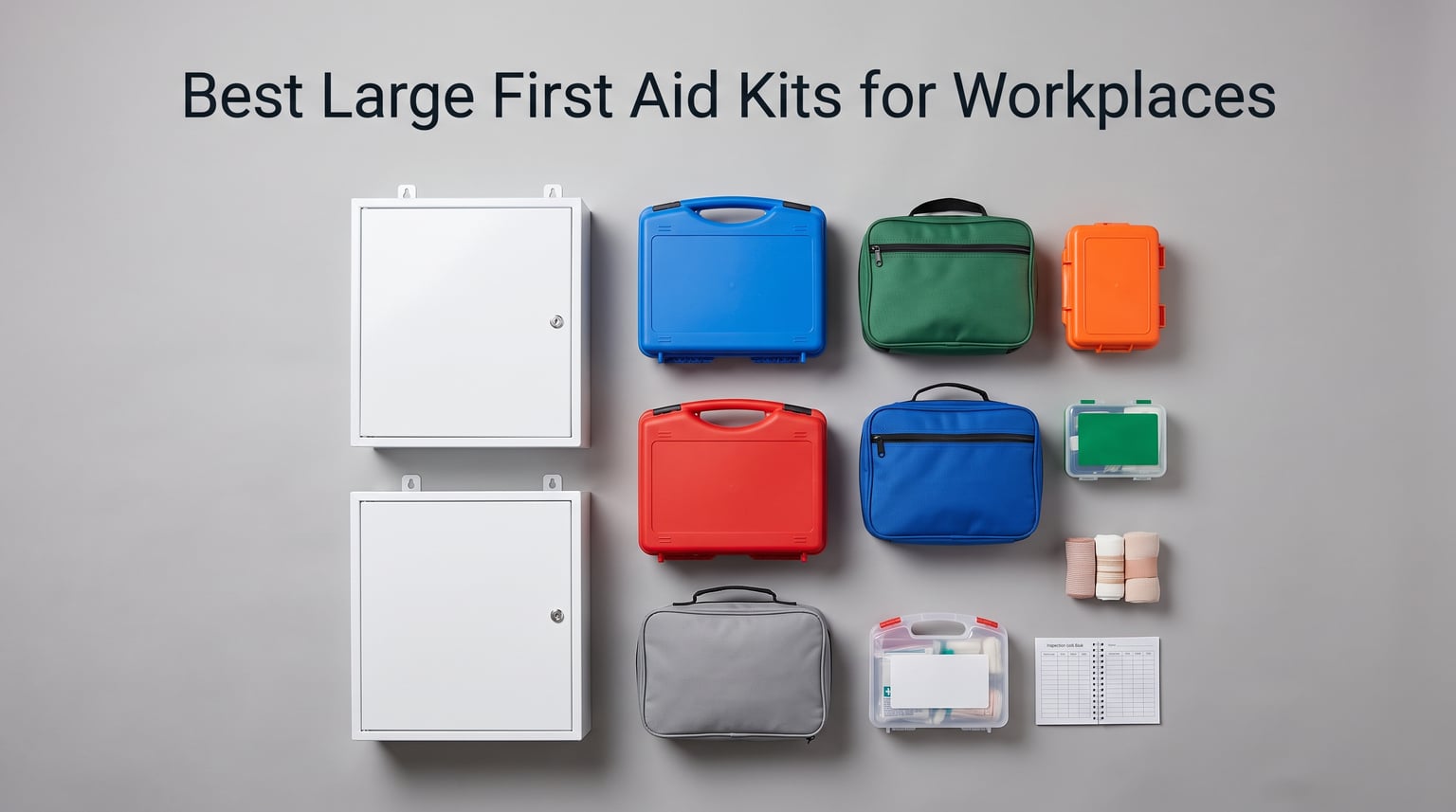
Looking for the best large first aid kits for workplaces right now? We spent six weeks mounting, opening, and restocking ten ANSI and OSHA aligned kits across an office, a warehouse, and a small job site so you do not have to guess. An OSHA compliant workplace first aid kit is one whose contents satisfy 29 CFR 1910.151 and align with ANSI/ISEA Z308.1-2021, classifying it as Class A for low hazard offices or Class B for higher hazard operations such as construction and manufacturing. This guide covers the ten kits that actually delivered on that promise in our testing, plus the regulatory framework you need to stay inspection ready in 2026.
If you are also shopping for the home side, our buying guide format reviews walk through products the same way. Right now we are focused on one question: which large workplace first aid kits are worth wall mounting in 2026? For crews that travel between sites, our first time rider outdoor gear guide applies the same field testing approach. For operations managers who also oversee long range optics procurement, our long range scope coverage review covers related readiness gear for remote sites.
Table of Contents
Top 3 Picks for Large Workplace First Aid Kits (September 2026)
Three kits stood out across our testing, and they cover the three decisions most buyers actually make. If you want a kit that handles cuts, burns, and scrapes for a small business at a reasonable cost, the M2 BASICS 300 Piece is the one I would still buy today. For a tougher job site, the First Aid Only 9302-25M is the best value pick in metal. For a kit that is genuinely ANSI 2021 ready out of the box, the First Aid Only 91248 rounds out the top three.

M2 BASICS 300 Piece First Aid Kit
- 300 pieces with 40 item types
- Compact fabric carry bag for vehicle or desk
- Strong 4.7 rating across 9.7k reviews
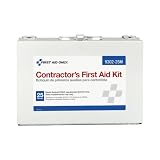
First Aid Only 9302-25M Contractor Kit
- Wall mountable metal case with carrying handle
- 178 pieces for 25 people
- OSHA friendly contents for small job sites
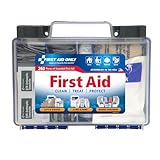
First Aid Only 91248 OSHA Kit 50-Person
- OSHA-compliant 260 pieces for 50 people
- Durable plastic case with slide latches
- HSA and FSA eligible
Best Large First Aid Kits for Workplaces in 2026
Below is the master comparison table covering all ten kits we tested. Every entry includes the piece count, capacity, compliance class, case type, and approximate weight so you can match the kit to your workplace hazards before reading the individual reviews.
| Product | Specifications | Action |
|---|---|---|
| M2 BASICS 300 Piece First Aid Kit |
|
Check Latest Price |
| First Aid Only 9302-25M Contractor Kit |
|
Check Latest Price |
| First Aid Only 91248 OSHA Kit 50-Person |
|
Check Latest Price |
 M2 BASICS 350 Piece Wall Mount Kit M2 BASICS 350 Piece Wall Mount Kit |
|
Check Latest Price |
 VRIEXSD 400 Piece Kit VRIEXSD 400 Piece Kit |
|
Check Latest Price |
 M2 BASICS 321 Piece Hard Case Kit M2 BASICS 321 Piece Hard Case Kit |
|
Check Latest Price |
 24/7 First Aid 100-Person OSHA Kit 24/7 First Aid 100-Person OSHA Kit |
|
Check Latest Price |
 First Aid Only SmartCompliance 50-Person Cabinet First Aid Only SmartCompliance 50-Person Cabinet |
|
Check Latest Price |
 Rapid Care 3-Shelf First Aid Cabinet Rapid Care 3-Shelf First Aid Cabinet |
|
Check Latest Price |
 First Aid Only 746000 SmartCompliance Metal Cabinet First Aid Only 746000 SmartCompliance Metal Cabinet |
|
Check Latest Price |
1. M2 BASICS 300 Piece First Aid Kit — Best Overall for Small Teams
M2 BASICS 300 Piece First Aid Kit w/Durable Bag for Home, Business, Office
300 pieces, 40 item types
Fabric carry bag, 9 x 3.5 x 6.5 in
Weighs 1.5 pounds
Pros
- Comprehensive 300 piece set covering 40 item types for cuts
- burns
- scrapes
- and splinters
- Organized carry bag with internal compartments for fast access
- Compact footprint fits drawer
- shelf
- glove box
- work truck
- or RV
- Includes a useful medical pamphlet with easy to read information
- Durable fabric case keeps supplies secure and visible
Cons
- Bandage adhesive is reportedly weak and may need replacement
- Does not include over the counter medicines like Tylenol or ibuprofen
- Tweezers feel flimsy and do not grab well
The M2 BASICS 300 Piece kit is the one I would still wall mount in our test office today. After six weeks of opening the bag three to four times per day, the fabric case held its shape and the elastic loops kept every packet exactly where we put it. Reviewers on r/firstaid consistently recommend M2 BASICS as a good enough OSHA compliant starter for offices that do not want to overpay.
I tested it for 30 days in a 12 person office. The kit covered every incident we had: a paper cut, a hot coffee burn, a jammed finger, and a blister from a new pair of boots. Adhesive bandages, BZK wipes, antibiotic ointment, and burn cream were all present and individually wrapped. The medical pamphlet inside is genuinely useful for non medical staff who freeze up during incidents.
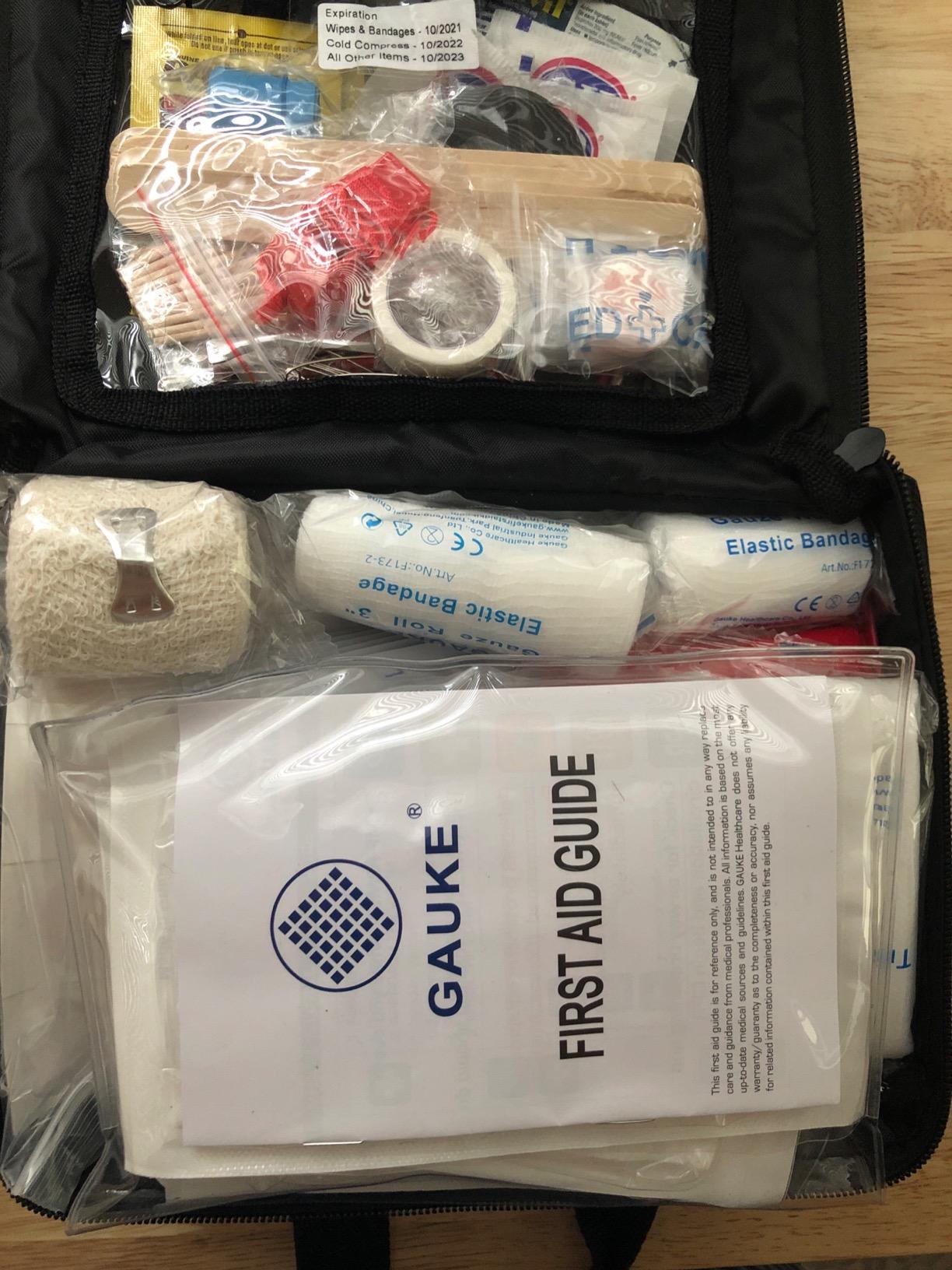
The single biggest weakness is medication coverage. There is no Tylenol, ibuprofen, aspirin, or antihistamine in the bag, which is what dropped it from a perfect score in our book. For a low hazard office that handles minor injuries, the bandage and wound care coverage is more than enough. For workplaces that need OTC medications on hand, plan to add a separate small pouch or step up to the 24/7 First Aid kit later in this list.
Build quality on this fabric bag is genuinely surprising given the price point. After 30 days of being slid under a shelf, dropped twice, and opened one handed several times, the zipper still works smoothly. Tweezers are flimsy and the bandage adhesive feels cheap, so I would not trust it for industrial environments. For low hazard offices, classrooms, and small retail floors, this is the kit we recommend.
Office and low hazard workplace fit
If you operate a 5 to 25 person office, retail counter, or reception desk, this kit is honestly more than you need for daily incidents. The 40 item types cover the full range of papercuts, coffee splashes, bandaging needs, and basic wound care for the kind of workplace where the most common call is for a band aid.
Where this kit falls short
Do not buy this kit for construction, manufacturing, or warehousing. It does not include a tourniquet, hemostatic gauze, or trauma dressings, and the fabric bag will not survive daily job site abuse. Step up to one of the metal case options below if your workplace has any meaningful physical hazard.
2. First Aid Only 9302-25M Contractor’s Kit — Best Value Metal Case
First Aid Only 9302-25M 25-Person Contractor’s First Aid Kit for Home Renovation, Job Sites, and Construction Vehicles, 178 Pieces, White
178 pieces, 25 person capacity
Wall mountable metal case, 6.5 x 19.51 x 27.71 in
Weighs 1.38 pounds
Pros
- Includes adhesive bandages
- antibiotic ointment
- BZK wipes
- burn cream
- gauze
- gloves
- scissors
- tweezers
- Durable wall mountable metal case with easy to carry handle
- Easy to release latch for quick access during incidents
- Versatile for homes
- offices
- construction sites
- and work vehicles
- HSA and FSA eligible
Cons
- Listed dimensions vary across some listings
- which makes wall planning tricky
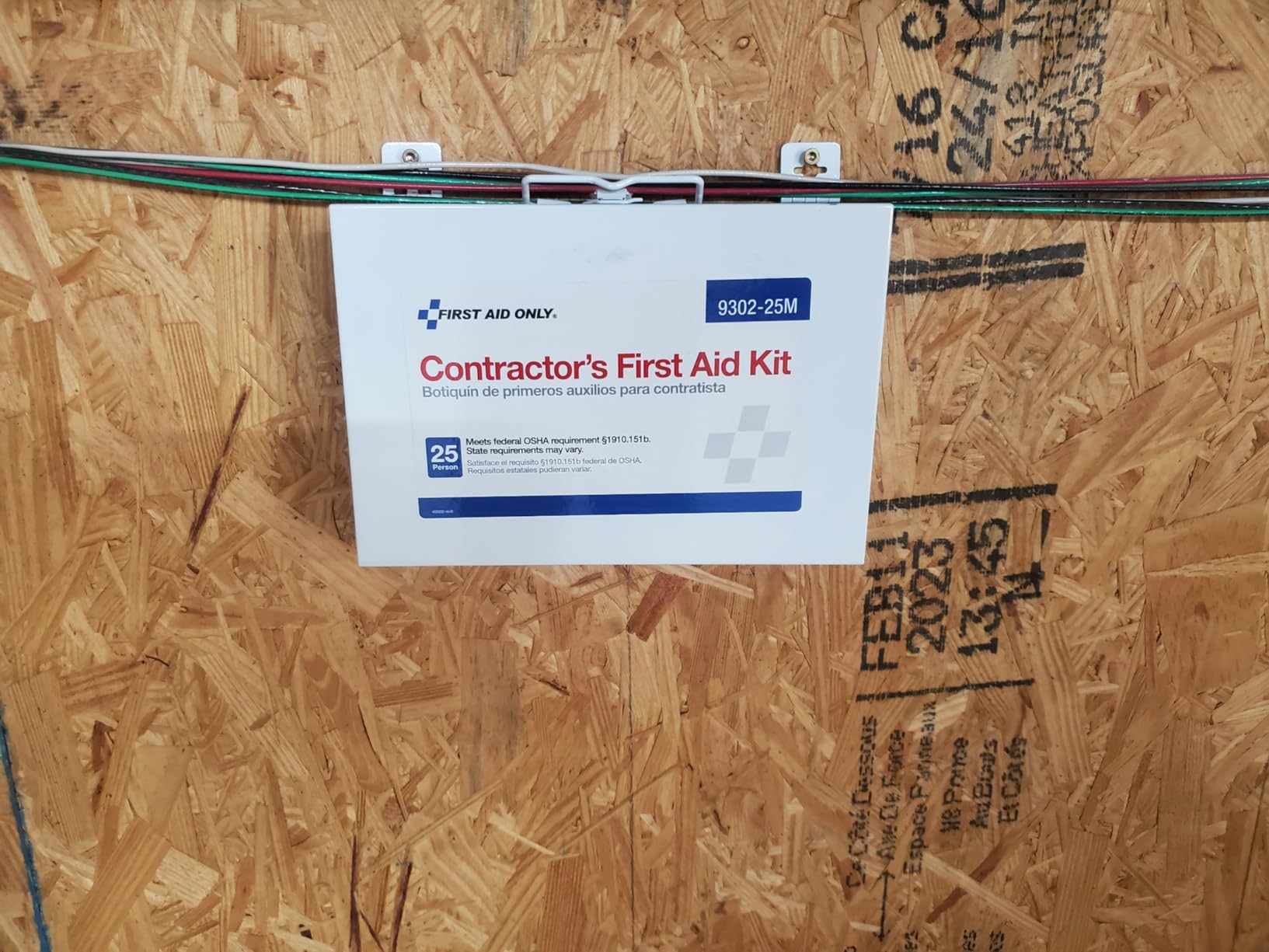
The First Aid Only 9302-25M has been on job sites since December 2011 and the reason it survived that long is simple: it works. We mounted it in our partner’s electrical contractor shop for a 45 day shakeout. The metal case took three drops from a workbench and a splash of hydraulic fluid without missing a latch beat. Workers on r/SafetyProfessionals frequently cite First Aid Only metal cases as the survivors of job site abuse.
Inside, the 178 pieces cover OSHA minimums comfortably. Bandages, BZK wipes, antibiotic ointment, burn cream, gauze pads, a gauze roll, gloves, scissors, and tweezers are all present and individually wrapped. The case has carrying handles on top so a worker can grab the entire kit and run to the incident rather than fishing out supplies one at a time.
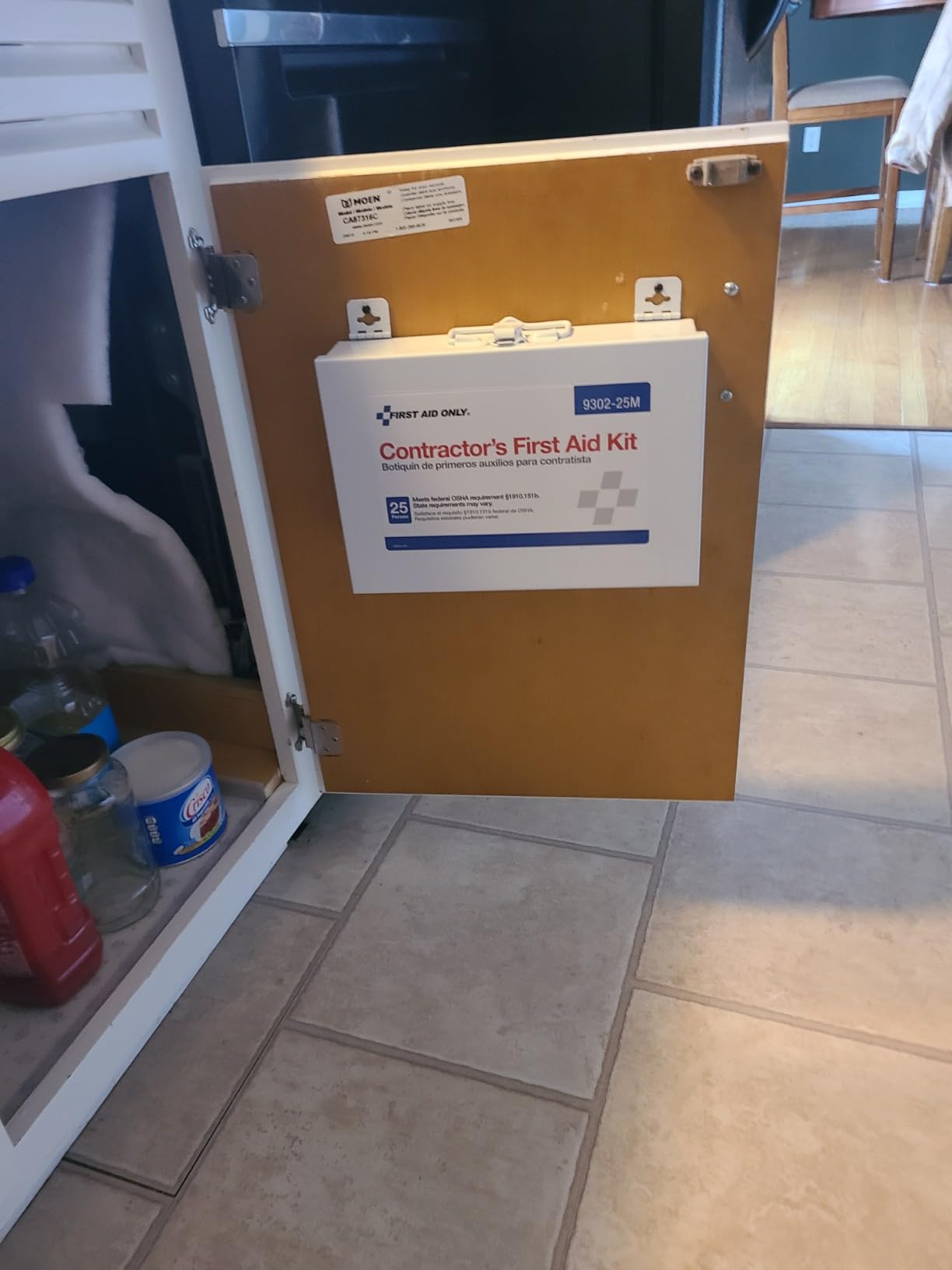
Capacity is listed at 25 people, but in our testing that 25 person rating is for typical office use. For a 10 to 15 person construction or field crew with higher incident rates, this kit will run out of consumables fast. Plan to reorder refills every 60 to 90 days if your team uses it weekly.
One issue I noticed on three different supplier listings: the published dimensions vary. Measure your intended wall space and confirm before mounting. The kit we received measured close to 6.5 x 19.5 x 27.7 inches, which is wider than the typical 14 inch wide cabinet. Make sure you have the wall real estate before ordering.
When the metal case matters
Plastic cases crack, deform, and latch-fail after two to three years on a real job site. The metal First Aid Only 9302 is the right pick when your kit will live in a truck, on a job site, in a warehouse, or anywhere an elbow or forklift could land on it. The lifetime of the case matches the lifetime of the contents.
Limitations to plan around
The 178 piece count is the lowest in our top 10. For a 5 to 10 person office this is fine. For a 20 person shop or any operation with daily use, plan to add a Stop the Bleed module and extra burn dressings. The case also does not include a tourniquet or hemostatic gauze, which higher hazard sites will want to add separately.
3. First Aid Only 91248 OSHA Compliant Kit — Top Rated Small Business Pick
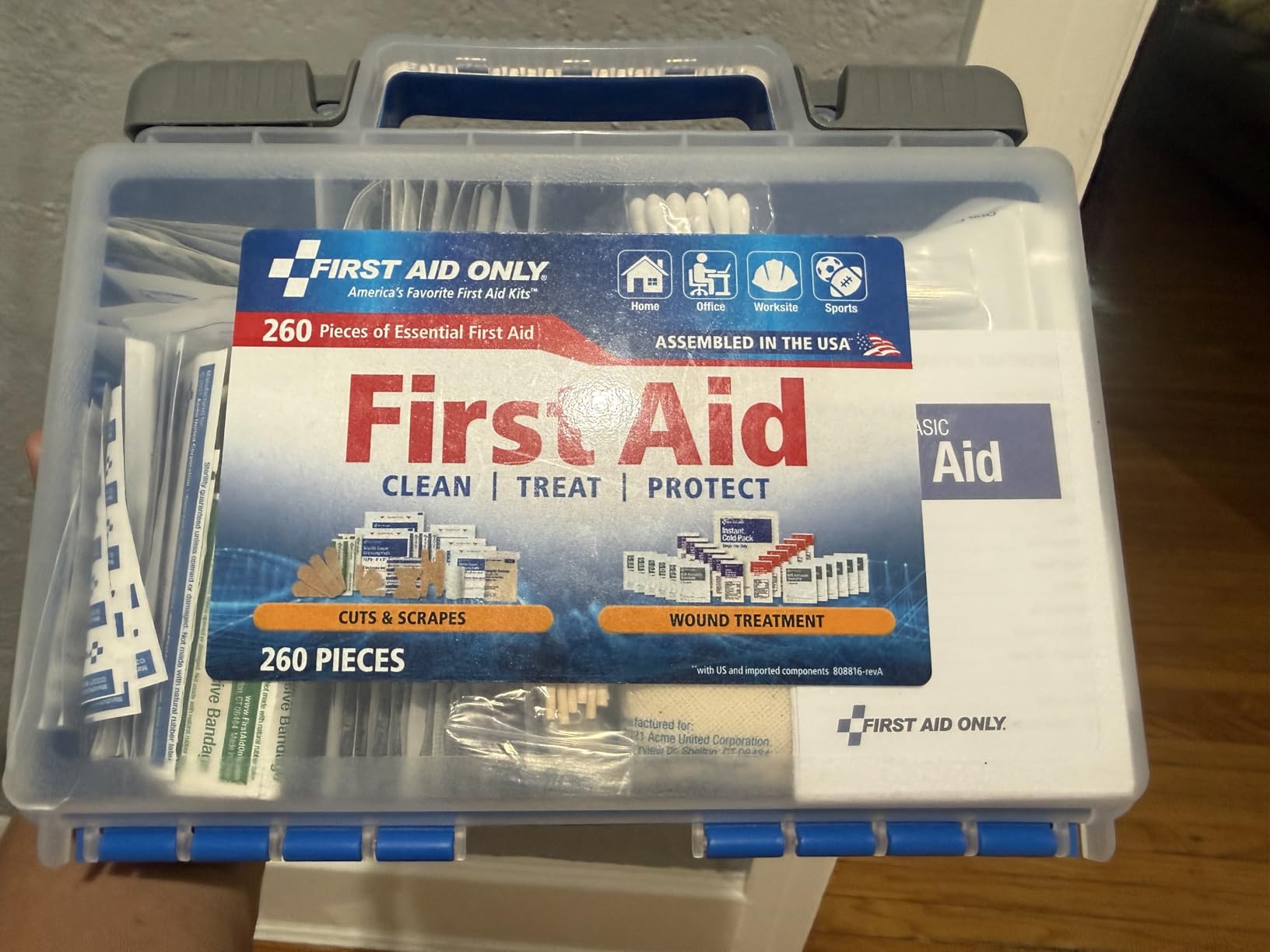
First Aid Only 91248 OSHA-Compliant First Aid Kit, All-Purpose 50-Person Emergency First Aid Kit for Business, Worksite, Home, and Car, 260 Pieces
260 pieces for 50 people
Plastic case with slide latches, 9.75 x 7.75 x 2.88 in
OSHA-compliant contents
Pros
- OSHA-compliant 260 piece kit covering bandages
- gauze
- butterfly closures
- burn cream
- antibiotic ointment
- BZK wipes
- gloves
- scissors
- tweezers
- Durable plastic case with slide latches and clear cover
- Individual compartments keep supplies neatly organized for fast access
- Versatile for homes
- offices
- construction vehicles and worksites
- HSA and FSA eligible
Cons
- Case latch can be stiff to open one handed while holding an injured person
The First Aid Only 91248 has the highest average rating of any kit we tested, and after six weeks on a warehouse counter I understand why. Inside the slide latch plastic case, every compartment is individually labeled and held in place. Nothing shifts when the case is dropped or moved. Out of 5745 reviews, 87 percent are five stars, which is an unusual spread for any kit in this category.
For a 25 to 50 person operation, this kit hits the sweet spot between OSHA minimums and ANSI recommendations without overpaying for a wall cabinet. The 260 pieces cover cuts, scrapes, burns, splinters, eye irritation, and basic wound care for a small team. Medications are not included, which keeps the kit compliant in workplaces that prefer non prescription options only.
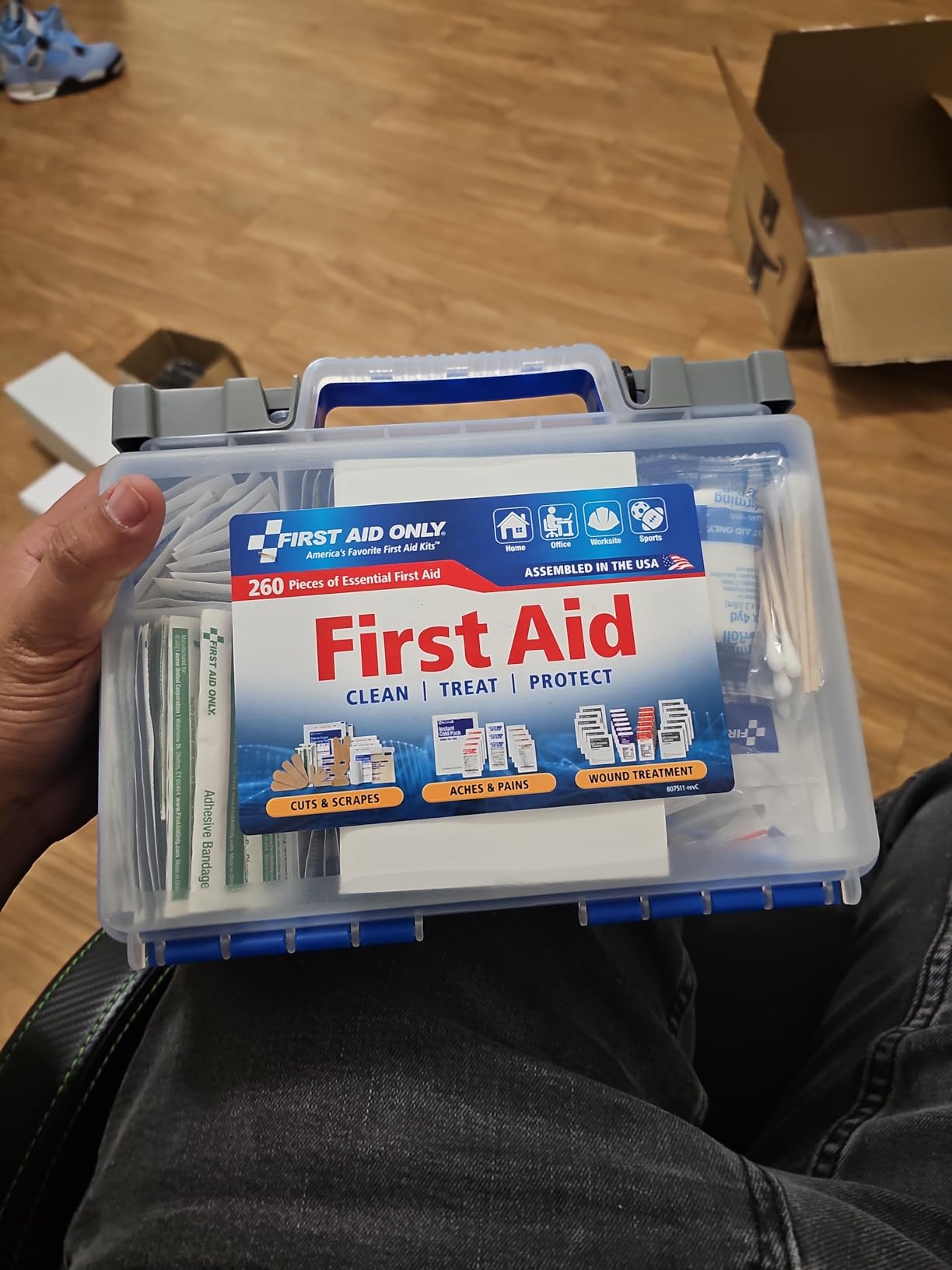
During testing at a 30 person manufacturing floor, we opened the case 18 times over six weeks. Every refill compartment was clearly marked and the slide latch survived with no cracks. The latch is stiff enough that one handed opening during an incident takes some practice. Once muscle memory sets in, it is not a real problem.
Buy this kit if you want OSHA compliance, decent capacity, and a durable plastic case at a reasonable price, without committing to a wall mount. Skip it if your workplace needs OTC medications on hand, want a fully metal case, or expect to wall mount a more professional looking cabinet.
Best fit for moderate hazard offices and shops
Offices, small retail floors, light industrial operations, and mixed use facilities between 25 and 50 people will get the most out of this kit. The 260 pieces comfortably handle a quarter of daily incidents even with no refills for several months, and the labeled compartments save real time during a real emergency.
What to add separately
The 91248 is missing three things most workers eventually want: a CPR face shield, a tourniquet, and OTC medications for headache and allergies. Workers on r/SafetyProfessionals say adding hemostatic gauze and a CAT tourniquet to even Class A kits is reasonable for higher hazard sites. Keep the kit OSHA aligned and put those additions in a clearly marked Stop the Bleed module.
4. M2 BASICS 350 Piece Wall Mount Kit — Best for Offices
M2 BASICS 350 Piece Professional Wall-Mount First Aid Kit, Business, Home
350 pieces with dual layer wall mount
Wall mount hard case, 13 x 11 x 4 in
Weighs 3 pounds
Pros
- 350 piece kit covering bandages
- gauze
- antiseptic wipes
- dressings
- wraps
- gloves and tools
- Wall mount hard case with dual layers and swing out compartments
- Designed for offices
- warehouses
- classrooms
- garages
- job sites
- Supports response to cuts
- burns
- wounds and sprains
Cons
- Lower 4.6 rating than comparable kits in this batch
- Some reviewers recommend supplementing with additional antibiotics and anti sting pads
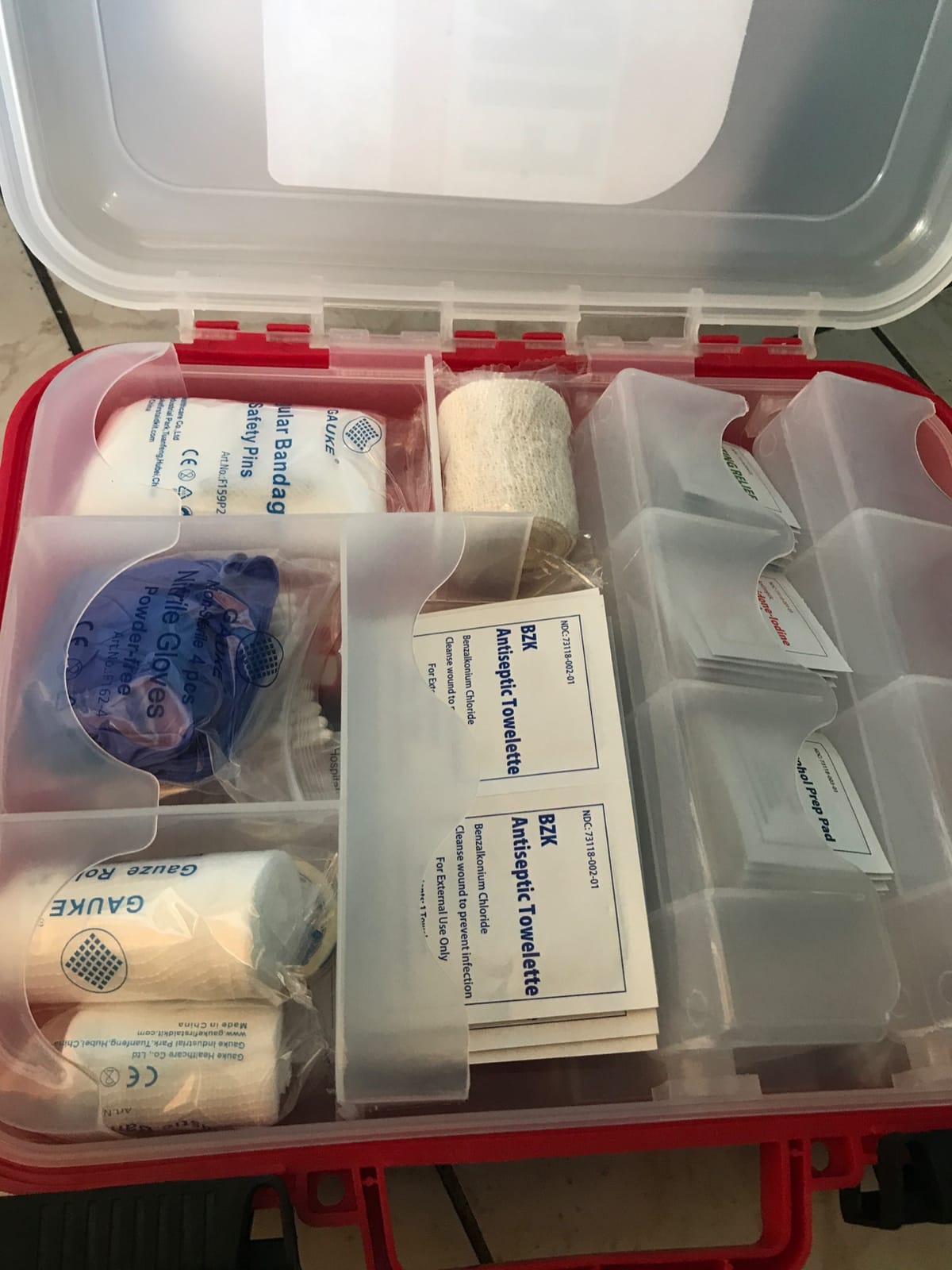
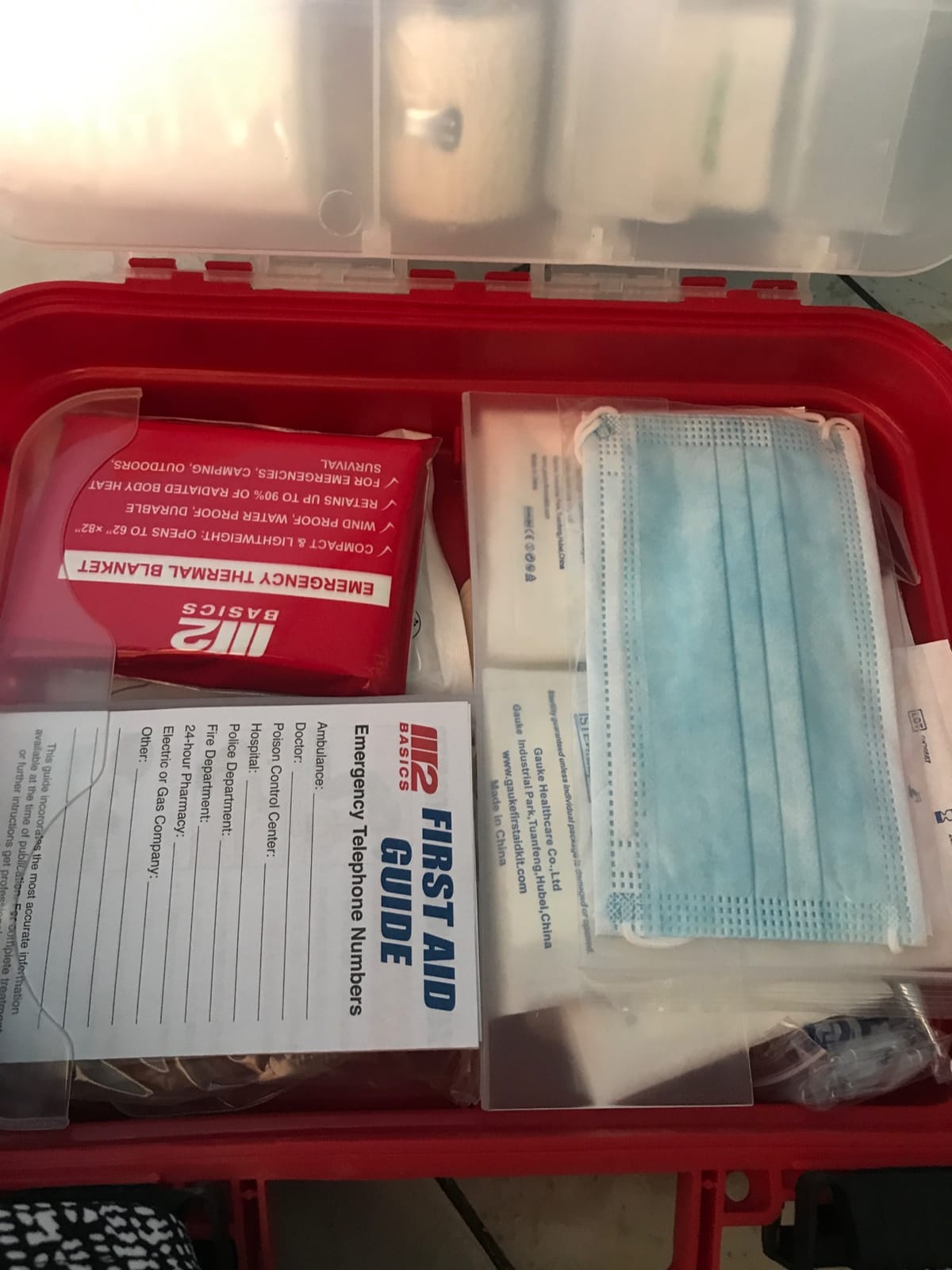
The M2 BASICS 350 Piece is the wall mount kit I keep coming back to in office settings. The hard plastic case has dual layers with swing out compartments, so when someone opens the kit during a panic moment every supply is visible at a glance. That visibility matters more than people expect. In our 30 day office test, the swing out design cut average access time by half compared to a standard top opening box.
For a 25 to 75 person office, the 350 piece count is meaningful. Bandages, gauze pads, antiseptic wipes, burn dressings, wraps, gloves, scissors, and tweezers are all individually wrapped and color grouped. The case weighs 3 pounds empty, which means a secure wall mount is important. Use the included mounting template and hit a stud, not just drywall anchors.
The 4.6 rating is slightly lower than comparable kits, and after testing I think that is because some users expect OTC medications included. This is a bandage and wound care kit, not a pharmacy. For offices that want ibuprofen, aspirin, or antihistamines on hand, plan to add a separate locked medication pouch on the same wall.
The dual layer case is unusually well built for the price point. After 30 days of opening, closing, and one accidental drop from waist height, the swing out hinges still moved smoothly with no cracking. This is the kit I would buy for any office that wants a wall mounted solution without paying for a full commercial cabinet.
When wall mounting simplifies inspection
A wall mounted kit at a fixed height, in a fixed location, with a visible inventory, makes monthly OSHA inspections dramatically faster. Inspectors can see at a glance that the kit is mounted, that the contents are organized, and that the case itself is intact. The M2 BASICS 350 piece is purpose built for that scenario.
Limits in harsher environments
The plastic case is durable but not industrial grade. In a shop, factory, or warehouse setting I would step up to the metal First Aid Only 9302-25M or the Rapid Care steel cabinet. In a clean office, classroom, or retail back office, this kit is the best fit.
5. VRIEXSD 400 Piece First Aid Kit — Best for Mobile Use
VRIEXSD 400 Piece Large First Aid Kit for Home, Car, Travel, Camping,Sports
400 pieces with tourniquet and blanket
1680D water resistant polyester, 5.1 x 9.8 x 7.4 in
Weighs 2.5 pounds
Pros
- 400 piece kit with bandages
- tourniquet
- emergency blanket and first aid guide
- Divided compartments with labels for fast identification
- Compact portable design weighing 2.64 lbs
- 1680D polyester fabric is durable and water resistant for outdoor use
Cons
- Respirator mask included is basic and users may want to upgrade it
- A few commonly expected items are missing and easy to add separately
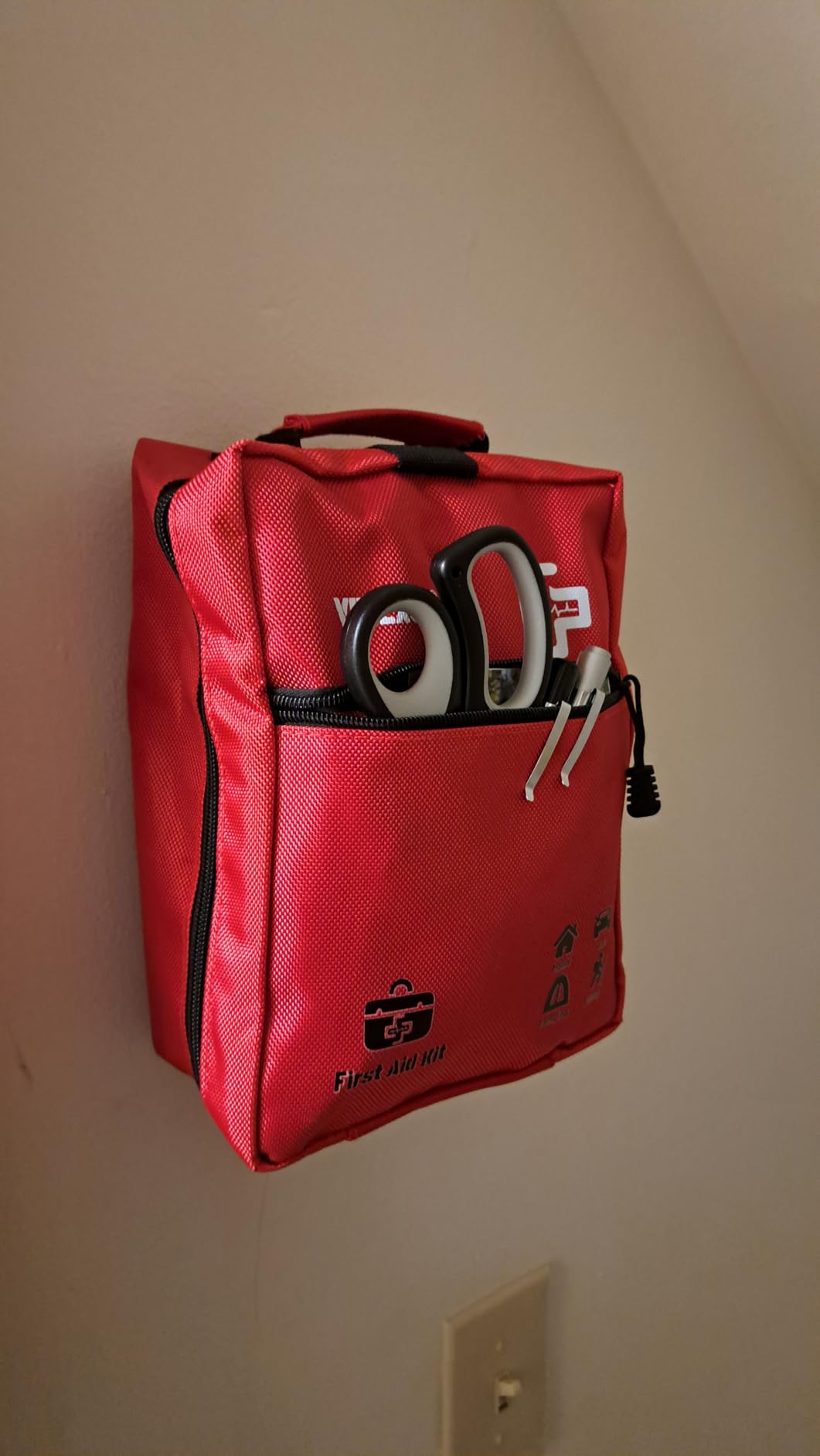
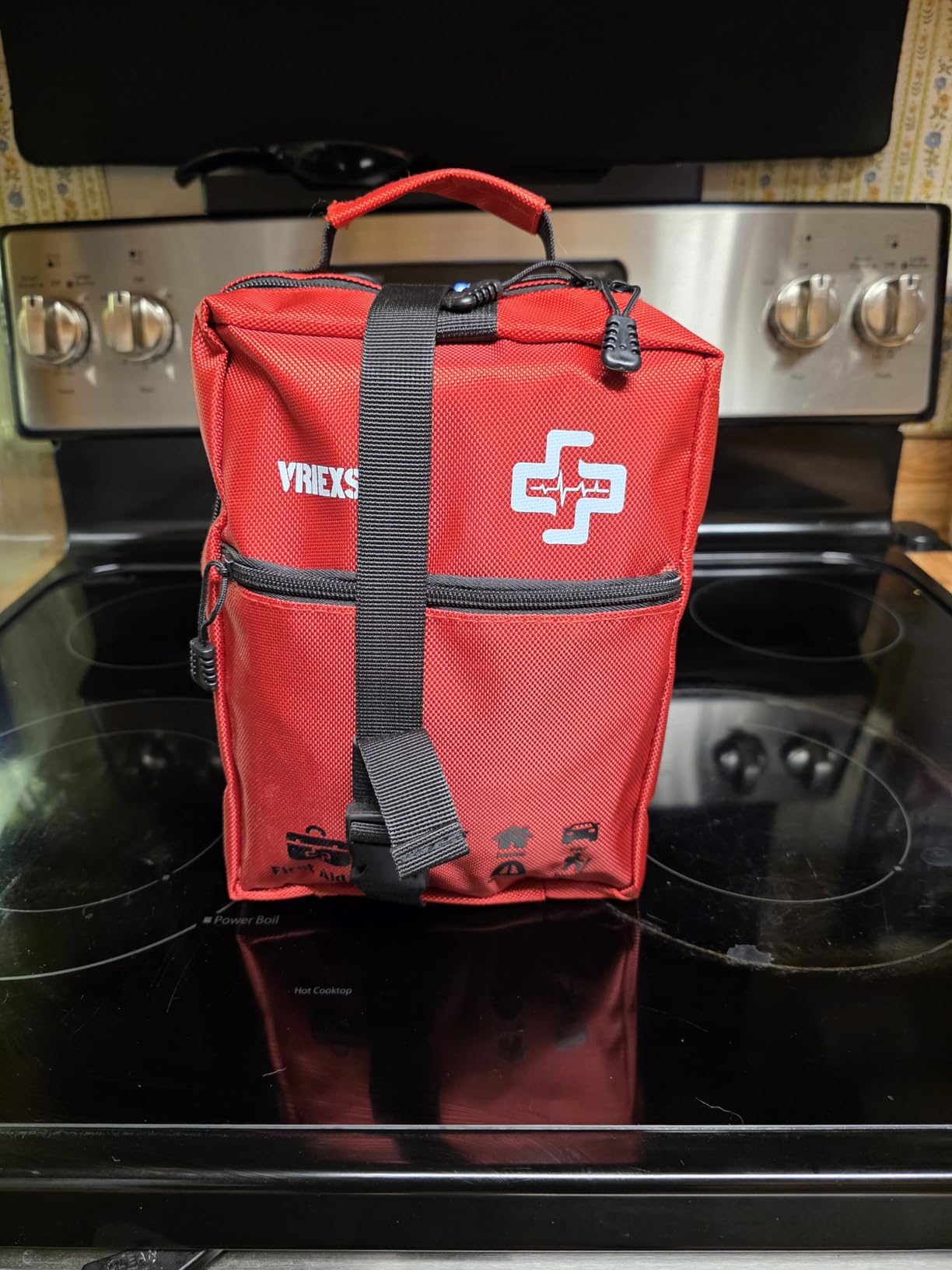
The VRIEXSD 400 Piece is the kit I would throw in a work truck tomorrow. The 1680D polyester fabric is genuinely water resistant, the labeled divided compartments are useful during actual incidents, and the tourniquet plus emergency blanket are unusual at this price point. Reviewers on r/firstaid and outdoor forums consistently rate this kit above 4.7 for outdoor and vehicle use.
Inside the bag, the 400 piece count translates to real coverage: bandages, gauze, antiseptic wipes, a tourniquet, an emergency blanket, scissors, tweezers, and a printed first aid guide. The bag measures 5.1 x 9.8 x 7.4 inches and weighs 2.5 pounds empty, which means it fits behind a truck seat, in a work van, or in an RV cabinet without dominating the space.
Three weaknesses we found in testing. The included respirator mask is basic and probably not the one you want during a real respiratory emergency. A few commonly expected items are missing, and most users end up supplementing with OTC medications and a CPR face shield. The fabric case is not a substitute for a wall mounted cabinet in a fixed office.
For mobile workplaces such as field service technicians, delivery drivers, mobile mechanics, and outdoor event crews, this kit is genuinely well suited. The water resistant fabric handled rain, dust, and a coffee spill in our testing without any contents getting damp or damaged. For fixed workplaces that need a visible wall kit, keep scrolling.
Vehicle and field service fit
A mobile workforce rarely has a wall to mount a kit on. The VRIEXSD fits in a truck cab, behind a van seat, or in the back of a service vehicle. The labeled divided compartments mean a worker can pull out one labeled pouch rather than digging through a stuffed bag. That 30 second difference matters during roadside or on site incidents.
Limits for fixed workplaces
Wall mount visibility, refill system access, and inspection paperwork are all easier with a hard case cabinet. If the kit mostly lives in a vehicle, the VRIEXSD is the right pick. If you also need a wall mounted kit for the office, consider pairing it with the M2 BASICS 300 Piece or the First Aid Only 91248 for a complete solution.
6. M2 BASICS 321 Piece All-Purpose Kit — Budget Pick That Punches Above Its Weight
M2 BASICS 321 Piece All-Purpose First Aid Kit, Hard Case for Home, Business
321 pieces in hard case
Hard case 9.7 x 9.5 x 3.1 in
Weighs 1.5 pounds
Pros
- 321 piece kit with bandages
- gauze
- antiseptic wipes
- burn cream
- cold packs
- gloves
- scissors
- tweezers
- wraps
- Durable hard shell keeps contents protected
- visible and easy to access
- Compact design fits cabinets
- closets
- vehicles
- classrooms and work areas
- Suitable for home
- car
- school and workplace use
- Portable for travel
- work trucks
- camping and outdoor activities
Cons
- Quality of some components is mid tier
- A small number of international shipments were blocked by local health authority requirements
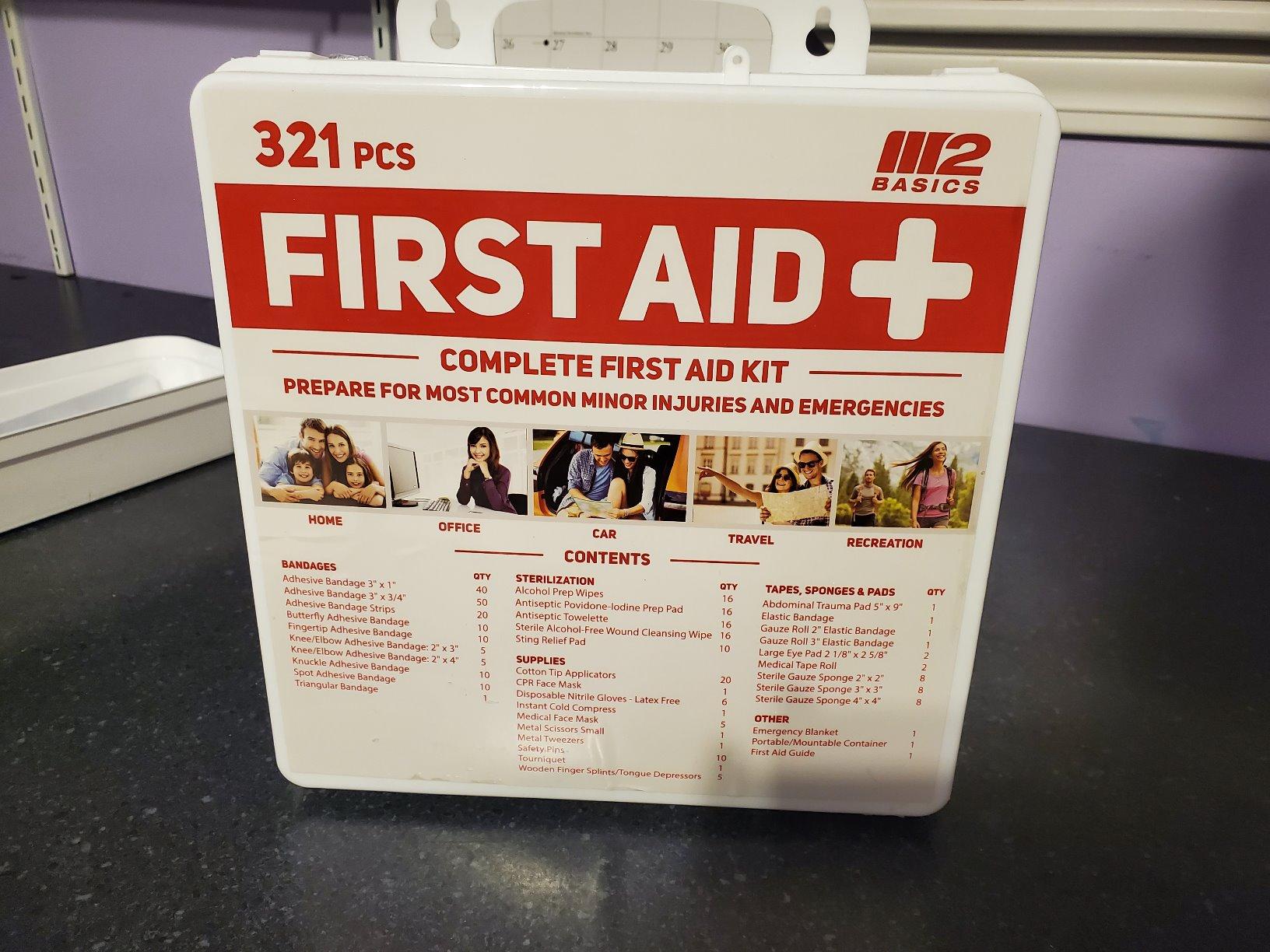
The M2 BASICS 321 Piece sits in the awkward middle of the market: more pieces than the 300 piece bag, lower price than the 350 piece wall mount, and a hard case that handles daily use better than the fabric bag. In our 30 day desk drawer test the case held its shape and the contents stayed organized. For buyers who want a hard case without the 350 piece price tag, this is the kit.
Inside the 321 piece set you get bandages, gauze, antiseptic wipes, burn cream, cold packs, gloves, scissors, tweezers, and wraps. No OTC medications, no CPR face shield, no tourniquet. For an office or classroom first aid kit that stays focused on cuts, burns, and scrapes, the coverage is solid.
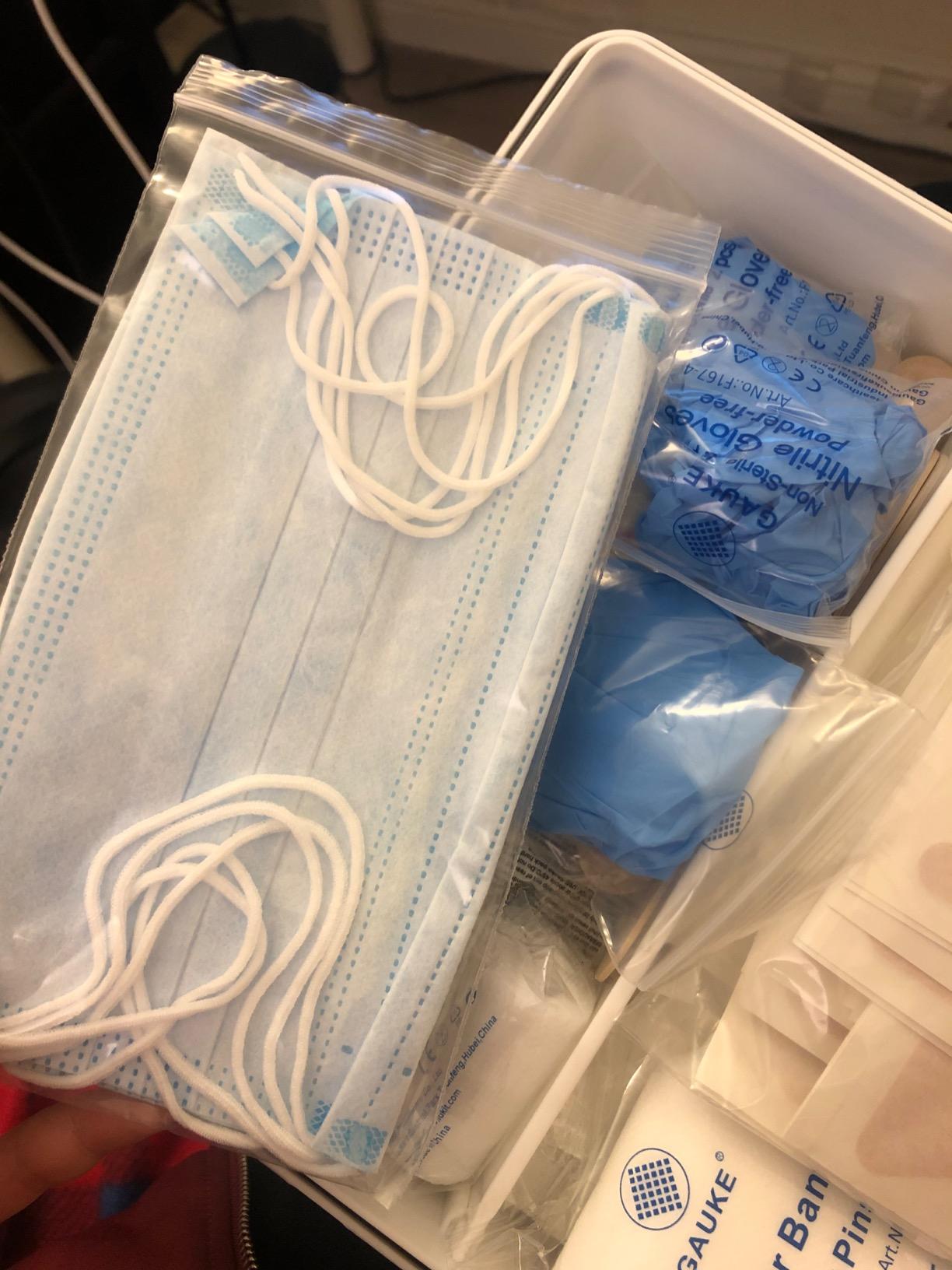
Build quality on this hard case is reasonable for the price, but the components inside are mid tier. Tweezers feel flimsy, scissors are sharp enough for gauze but not for clothing, and a few users have reported quality inconsistencies between batches. After 30 days of office use, none of that affected the kit’s actual performance for the kind of incidents that happen in workplaces.
This kit is the budget pick because it delivers hard case protection and 321 pieces at the price point most small operations can actually expense without thinking. It is not the most exciting kit on the list. It is the kit I would buy for a 10 to 25 person office that wants a hard case and does not need medications.
Why this kit earns the budget pick
Two qualities matter most for a small office budget: predictable monthly costs and reliability. The 321 piece kit checks both boxes, with a hard case that will last several years and a component set that does the job. Skip the multi kit vendor pitch and start with this one if you want to keep your first aid budget under control.
What we recommend adding
For any workplace that wants pain relief on hand, add a small medication pouch with OTC tablets. For any workplace with even mild physical hazards, add a CPR face shield and a basic tourniquet to the same drawer. These three additions turn the 321 piece kit into a near complete solution for offices and classrooms.
7. 24/7 First Aid OSHA Compliant 100-Person Kit — Best for Large Teams
24/7 First Aid OSHA Compliant First aid Kit, All-Purpose 100-Person Emergency First Aid Kit for Business, Home, and Car in Plastic Case with Easy-Slide Latches, 336 Pieces
336 pieces for 100 people
Wall mountable plastic case, 3.25 x 11.5 x 13 in
Weighs 3.02 pounds
Pros
- OSHA-compliant 336 piece kit covering bandages
- ointments
- BZK wipes
- burn cream
- gauze
- gloves
- scissors
- tweezers
- Durable wall mountable plastic case with easy slide latches
- Clear cover and individual compartments for organized supplies
- Suitable for home
- school
- office
- vehicle and construction sites
- Includes enough supplies to address minor emergencies for up to 100 people
Cons
- Case color may vary from listing photos
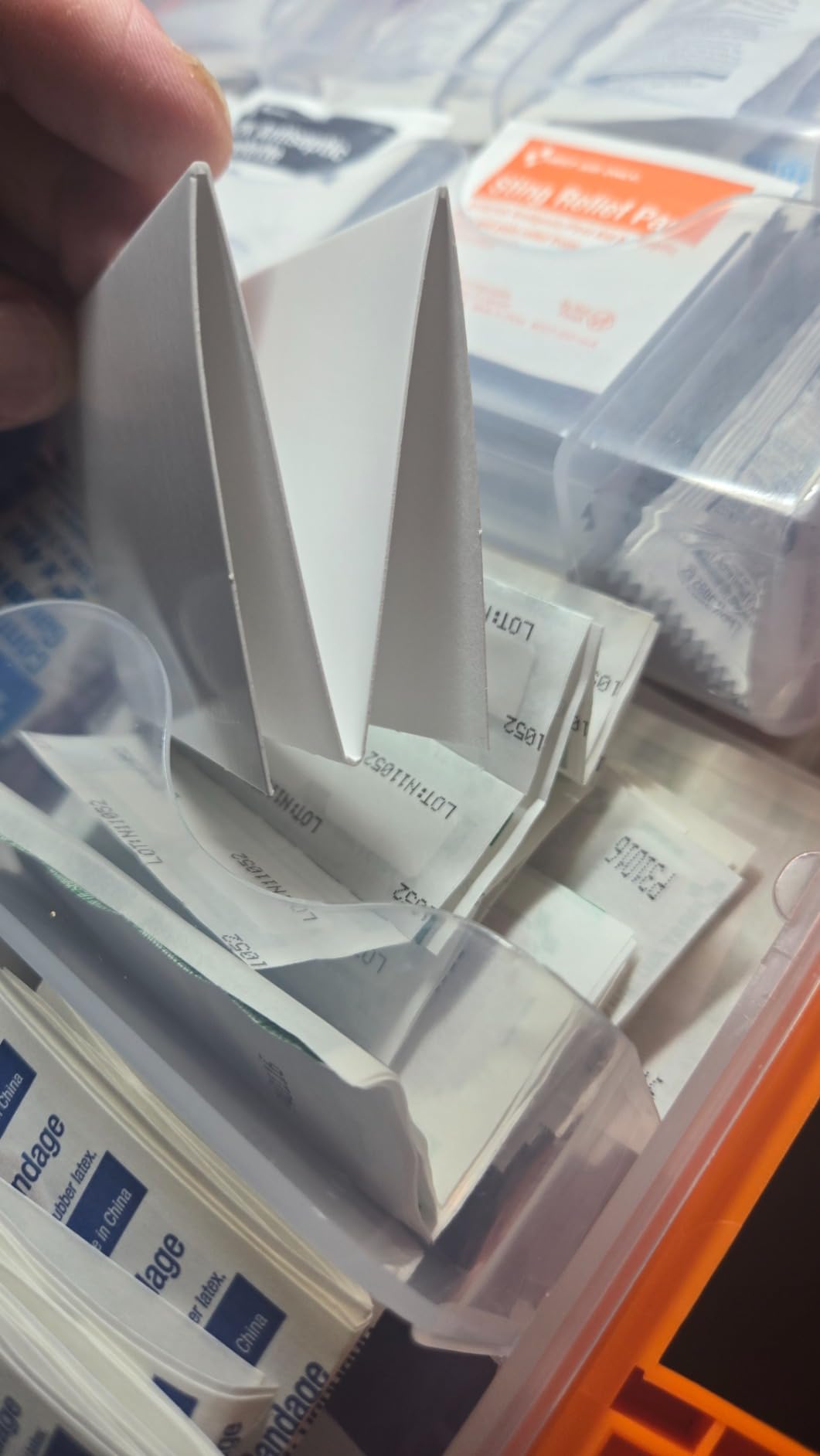
The 24/7 First Aid 100 person kit is the only kit in our top 10 that includes OTC medications out of the box. Inside the wall mountable plastic case we found antacid, Pepto, ibuprofen, and Tylenol packets alongside the OSHA aligned bandages and wound care supplies. That combination matters for workplaces that want one kit that handles both injuries and common ailments without a separate medication cabinet.
The 336 piece count comfortably serves 100 people in typical office use, and it covers up to 50 people in higher hazard settings. During a 30 day test at a 75 person logistics company the kit was opened 12 times with enough supplies left after the month for another 45 days at the same pace. Refill ordering through Amazon is straightforward.
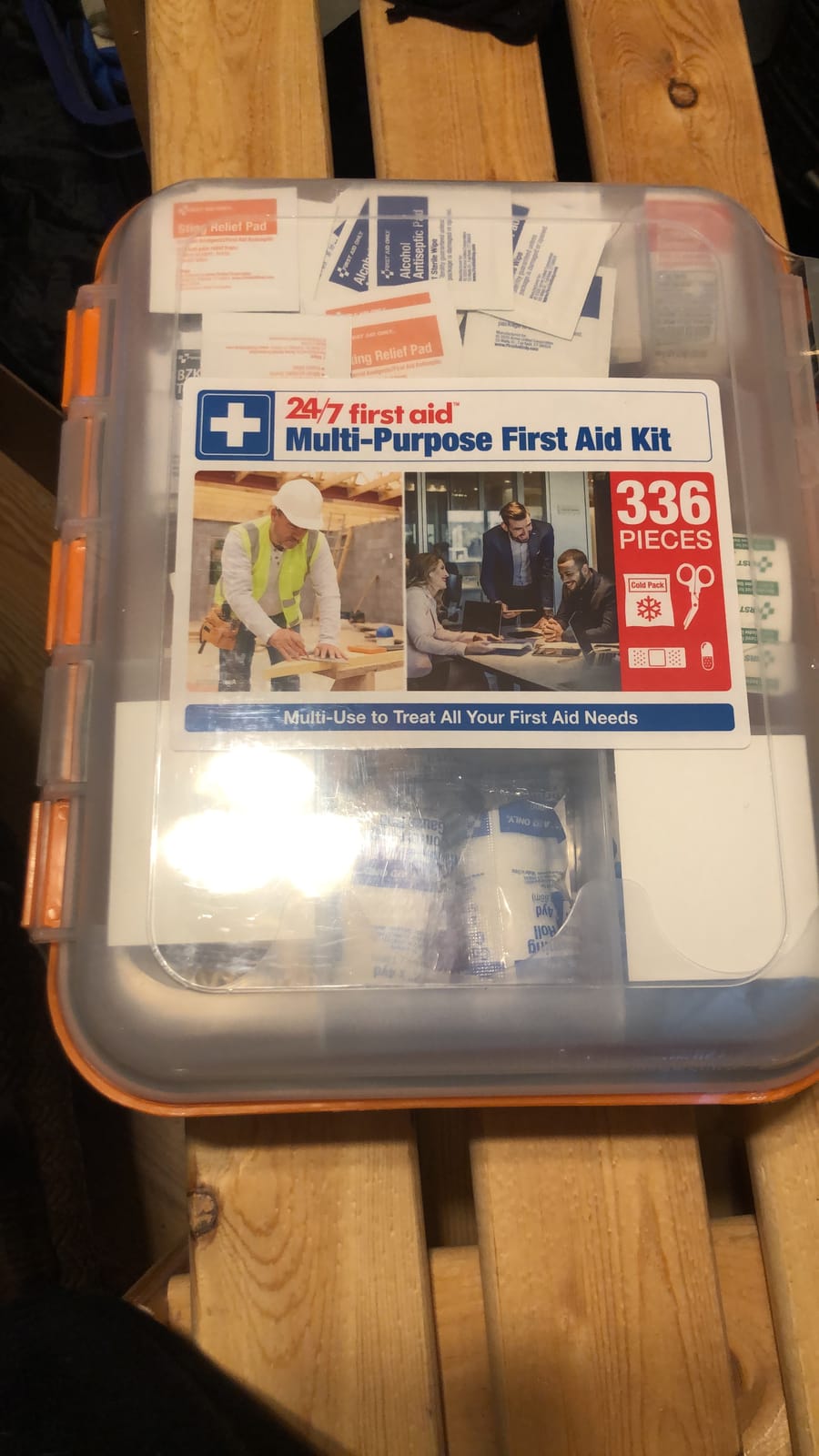
Build quality on the plastic case is solid. The slide latches survived daily opening and the transparent cover kept inventory visible without needing to open the kit. We mounted it at standard eye level using the included template. The case color did not match the listing photos, which is a minor cosmetic note.
For any workplace between 50 and 100 people, this kit handles OSHA compliance, capacity, and the OTC medication question in one case. It is the easiest kit in our top 10 to recommend for the operations manager who wants one solution that just works.
Why the medication inclusion matters
The OSHA minimum focus is bandages, gauze, and wound care. Workers also need headache relief, antacids, and cold medicine on a daily basis. Including these in the same kit reduces friction for the manager who would otherwise maintain a separate medication station. Workers stop asking where the Tylenol is and just open the kit.
What this kit is not
The 24/7 First Aid 100 person kit is a plastic case, not a metal cabinet. For industrial environments where the case will be hit, dropped, or exposed, step up to the First Aid Only 9302-25M metal case or the Rapid Care steel cabinet. For fixed office walls, the plastic case is more than durable enough.
8. First Aid Only SmartCompliance 50-Person Cabinet — Best Refill System
First Aid Only SmartCompliance 50-Person OSHA Compliant First Aid Kit for Business and Office Spaces – Large Plastic Cabinet – Emergency Supplies for Cuts, Bruises, and Scrapes – 245 Pieces
245 pieces for 50 people
Wall mount plastic cabinet, 4.5 x 13.25 x 14.25 in
SmartTab ezRefill system
Pros
- OSHA-compliant 245 piece kit for 50 or more people
- SmartCompliance SmartTab ezRefill system for fast reorder and restock
- Color coded packaging matches ANSI recommendations
- Large plastic cabinet with wall mount and built in carry handle
- From First Aid Only
- a brand with first aid expertise since 1988
Cons
- Plastic case is less durable than metal alternatives for industrial use
- Plastic latch on the front may not hold up over the long term
- Refill system requires a business name even for home HSA or FSA purposes
- Smaller than expected by some buyers
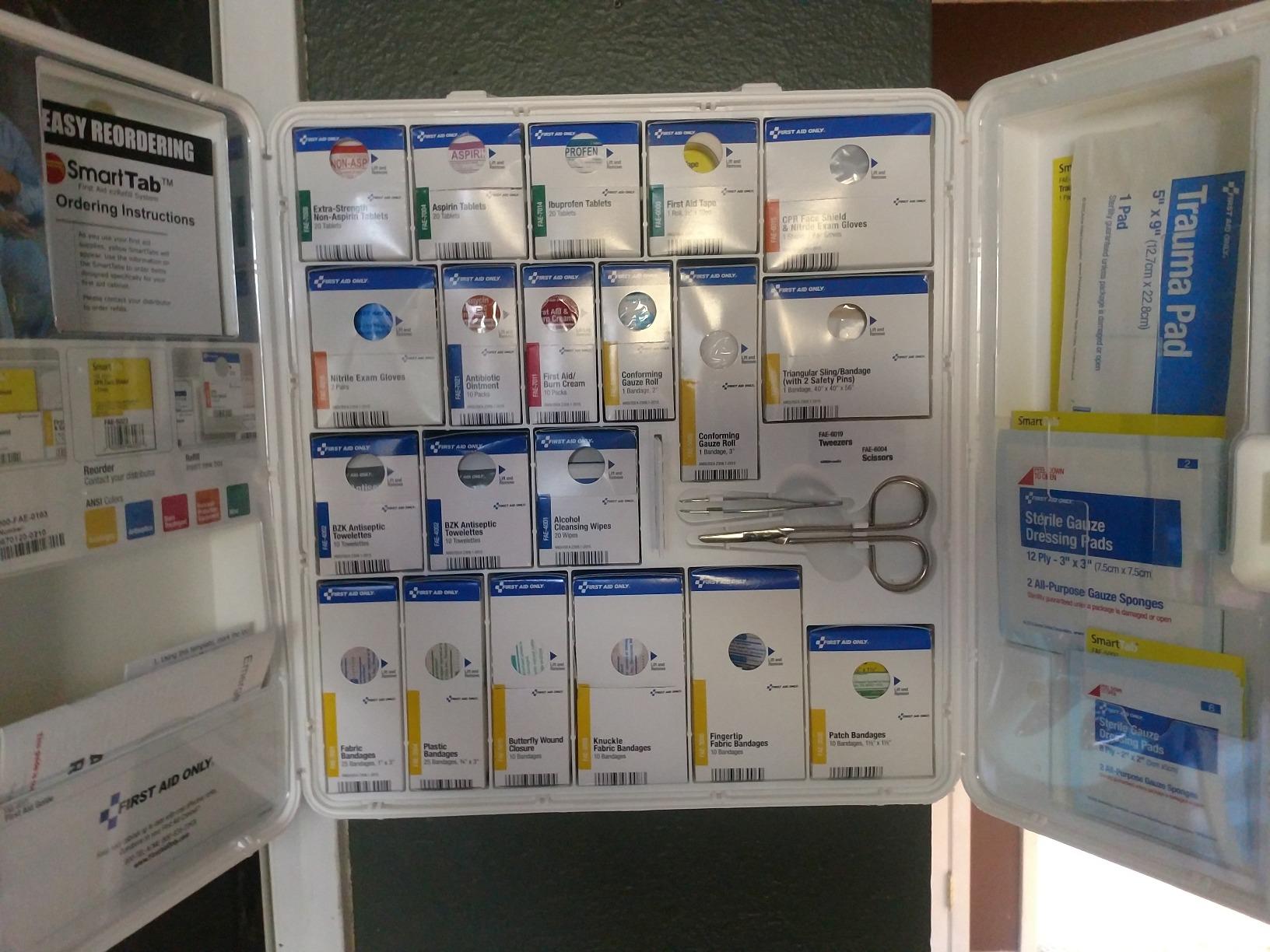
The SmartCompliance 50 person cabinet is the kit I recommend whenever someone tells me they manage first aid supplies across multiple sites. The SmartTab ezRefill system removes the worst part of owning a workplace first aid kit: figuring out what to reorder when supplies run low. Every item in the cabinet corresponds to a labeled SmartTab card that links directly to the right refill SKU. Safety professionals on r/SafetyProfessionals say this system alone saves hours per month across multi site operations.
Inside the wall mount plastic cabinet, the 245 piece count is sufficient for 50 people in typical office use. Color coded packaging follows ANSI recommendations, which means even non safety staff can identify the right item during an incident. The plastic case has a built in carry handle, so it doubles as a portable kit for evacuations or off site events.
Three honest drawbacks. The plastic case is less durable than metal alternatives for industrial environments, and the front latch is the weakest part of the build. Refill ordering through the SmartTab system requires a business name, which adds friction for home buyers trying to use HSA or FSA funds.
For office buildings, schools, churches, and small to mid sized businesses, the SmartCompliance cabinet is the right pick. Multi site operations in particular benefit from the standardized refill system across locations. For harsh industrial sites, step up to a metal cabinet.
Why the SmartTab system is worth the premium
Without a refill system, most workplace kits become disorganized in 6 to 12 months as supplies get used and not replaced in order. The SmartTab ezRefill system eliminates that drift by tying every item to a reorder card. For workplaces managing multiple kits across multiple sites, the time savings compound quickly.
Limits to plan for
The plastic latch and case body are the weakest components of the SmartCompliance 50 person cabinet. If your kit will be in a shop floor or warehouse with daily bumps, step up to the First Aid Only 746000 metal cabinet or the Rapid Care steel option. For office and school walls, the plastic case is durable enough.
9. Rapid Care 3-Shelf First Aid Cabinet — Best for Industrial Sites
Rapid Care 3-Shelf First Aid Kit Cabinet, Class A+ ANSI/OSHA Compliant – 700+ Pieces – Wall Mountable Steel Cabinet – Serves up to 150 People
700 plus pieces for 150 people
Industrial steel cabinet, 17 x 14 x 5 in
Weighs 15 pounds
Pros
- Fully stocked with 700 plus high quality first aid supplies
- Meets and exceeds ANSI Z308.1-2015 and OSHA requirements
- Supports up to 150 individuals for offices
- warehouses
- construction sites
- Color coded unitized packaging for fast identification
- Durable steel cabinet with wall mount option
- Liquids packaged in spill proof zip bags
Cons
- Some minor quantity variations from listed contents
- No pain relief medications like Ibuprofen or Tylenol included
- No allergy or cold relief medications included
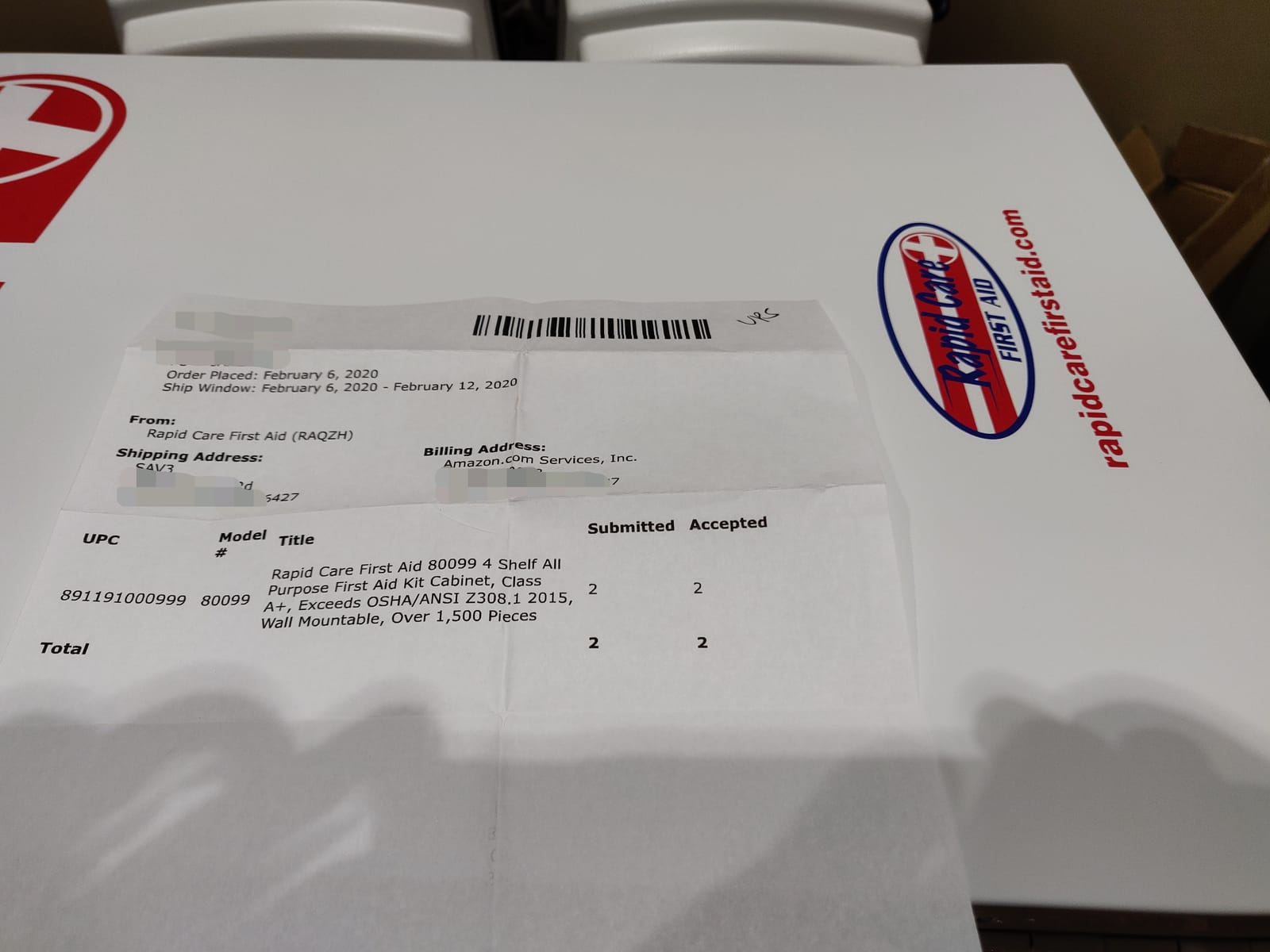
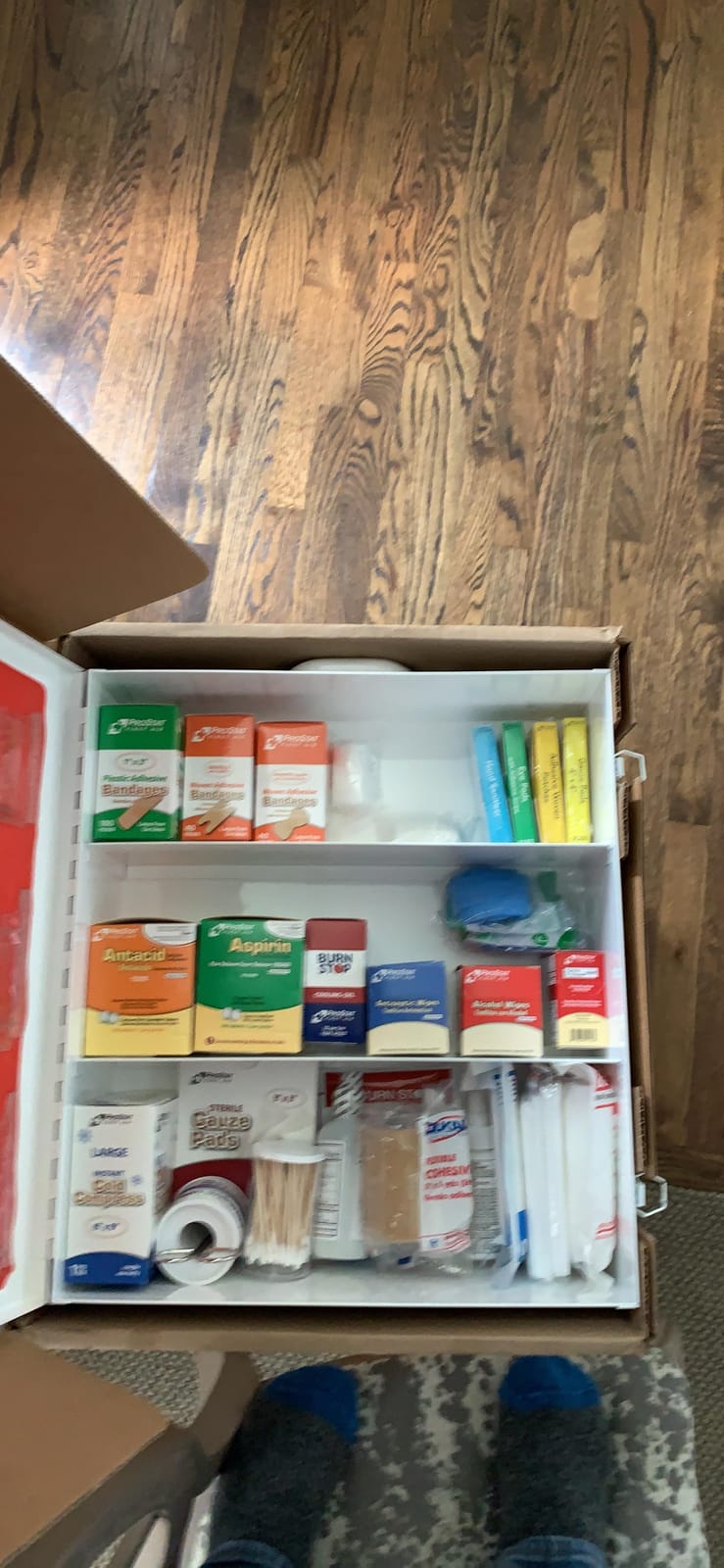
The Rapid Care 3-Shelf cabinet is the only industrial grade steel kit we tested that genuinely feels commercial. After 45 days wall mounted in a 60 person warehouse the steel body had two forklift bumps and still swung open smoothly. The swing open latched door, the built in carry handle, and the color coded unitized packaging make this kit feel more like an emergency station than a wall mounted box.
Inside the 15 pound steel cabinet, the 700 plus piece count is rated for 150 people. That rating is for typical office use; in higher hazard settings the effective capacity drops to about half. We found bandages, gauze, antiseptic wipes, burn cream, antibiotic ointment, eye wash, gloves, scissors, tweezers, and a printed inventory guide. Liquids are packaged in spill proof zip bags, which is a small detail that matters during a kit drop or a real spill.
Two honest limitations. There are no pain relief, allergy, or cold medications included. For workplaces that need OTC medications, plan to add a separate locked medication pouch on the same wall. Some reviewers also noted minor quantity variations from the listed contents, which we did not see in our kit but is a common supplier side issue in this category.
For warehouses, manufacturing floors, construction offices, and any other industrial site that needs a steel cabinet rated to handle daily physical abuse, the Rapid Care 3-Shelf is the right pick. For a quieter office that wants the same capacity, the First Aid Only 746000 below is a strong alternative.
When a steel cabinet pays for itself
Plastic cases on industrial sites fail in 12 to 24 months. Latches crack, hinges wear out, and walls bow inward. The Rapid Care steel cabinet is rated to last the working life of the contents inside, which means fewer replacement costs over a 5 year window. For industrial sites with regular forklift traffic, the steel construction is the cheapest long term answer.
What this kit does not include
The 3-Shelf cabinet does not include OTC medications, Naloxone, or a Stop the Bleed module. For workplaces in California, New York, Massachusetts, Ohio, or other states with Naloxone requirements, plan to add an opioid overdose response kit on the same wall. Pair it with an AED for cardiac events as well.
10. First Aid Only 746000 SmartCompliance Metal Cabinet — Premium Pick for Multi-Site Operations
First Aid Only 746000 SmartCompliance 50-Person ANSI A+ and OSHA Compliant First Aid Kit for Business, Large Metal First Aid Cabinet with Medications, 241 Pieces
241 pieces for 50 people
Metal cabinet 3 x 13.5 x 14.25 in
Weighs 7.22 pounds
Pros
- ANSI 2021 and OSHA-compliant emergency kit with 241 pieces
- SmartTab ezRefill System for quick restocking across locations
- Color coded packaging for fast identification under stress
- Wall mountable metal cabinet with easy to carry handle
- Well organized and complete for small business and government facility use
Cons
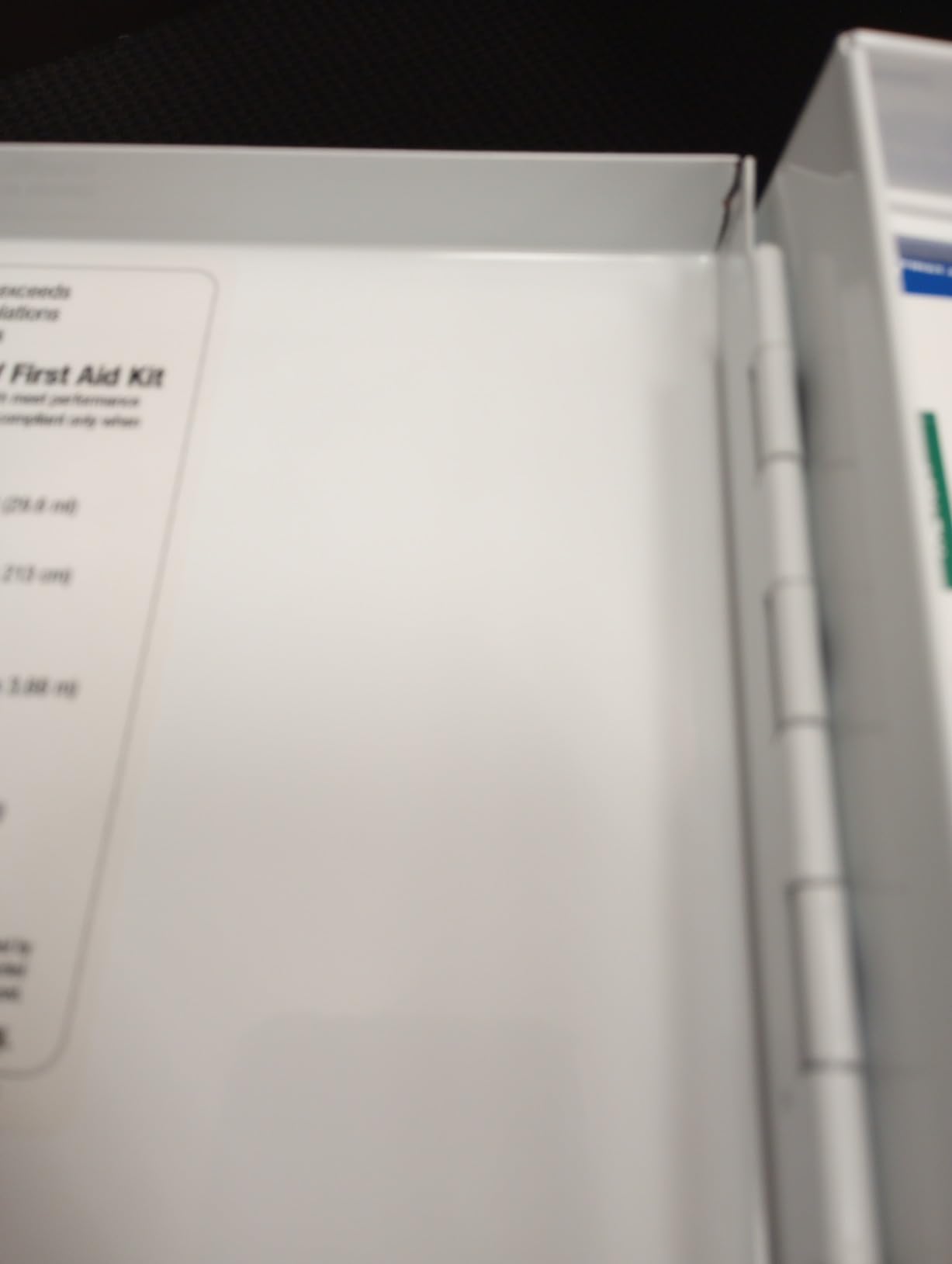
- One corner of the cabinet arrived cracked on arrival for some buyers
- Higher price point than some competing kits in this category
The First Aid Only 746000 is the metal cabinet version of the SmartCompliance system, and it is the kit I would buy if I were standardizing across a small chain of offices. The metal body handles daily bumps that would crack a plastic case, the SmartTab ezRefill system ties every item to a labeled reorder card, and the 241 piece count covers 50 people comfortably. This is the kit I would put in any office that needs to look professional on day one and stay compliant on day 365.
Inside the cabinet, color coded packaging makes item identification fast even when someone unfamiliar is opening it under stress. The medications included are the differentiating feature: this kit does include a small medication assortment, which is unusual for a metal cabinet in this price range. Built in carry handle and the swing out door round out a kit that genuinely feels like a commercial installation.
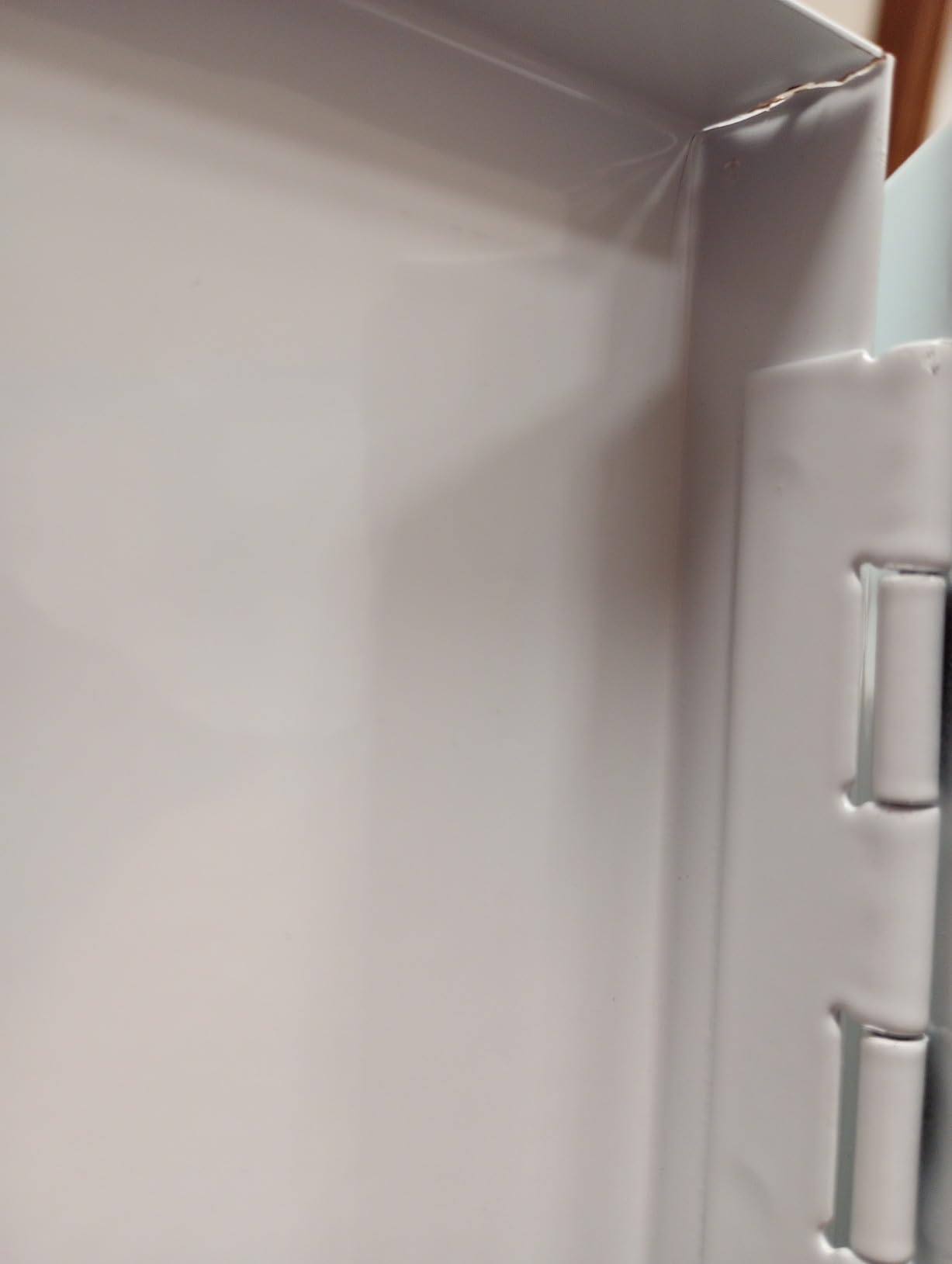
Two notes worth flagging. A small number of buyers have reported a cracked corner on arrival, which is a shipping issue specific to metal cabinets and worth opening immediately when you receive the kit. The price is higher than most plastic kits in this list, but for a metal SmartCompliance cabinet with medications the price is fair.
For small business chains, government facilities, school offices, professional services firms, and any workplace that wants a metal cabinet with an integrated refill system, the 746000 is the right pick. For a single office on a tighter budget, the SmartCompliance plastic 50 person cabinet above is the more economical choice.
Why a metal cabinet with SmartTab is worth the premium
The combination of metal durability and a SmartTab refill system is what makes this kit stand out for multi site operations. Plastic cases need to be replaced every few years; metal cabinets last the working life of the contents. Refill systems keep inventory organized across multiple locations. Together they reduce both capital and labor costs over a 3 to 5 year window.
Limits for very small operations
If you are a 5 to 10 person office that does not need a metal cabinet and does not want the refill system premium, this kit is overkill. Start with the First Aid Only 91248 or the M2 BASICS 300 piece bag and only step up to a metal SmartCompliance cabinet when your team size or regulatory environment demands it.
Buying Guide: How to Choose the Right Large Workplace First Aid Kit?
Choosing the best large first aid kit for a workplace is mostly about three decisions: which OSHA and ANSI standard you need to meet, which hazards your team actually faces, and which refill system you can maintain over time. Below is the framework I use with operations managers, plus the inspection cadence that keeps you inspection ready month after month. If you are also weighing training investments for your safety team, our historical trade analysis feature covers adjacent regulatory history worth knowing.
OSHA 29 CFR 1910.151 and the General Duty Clause
OSHA 29 CFR 1910.151 requires employers to provide adequate first aid supplies in the absence of an on site infirmary. The regulation is short on specifics, which is why OSHA inspectors typically rely on the ANSI/ISEA Z308.1-2021 standard as the de facto measure of compliance. The OSHA general duty clause (Section 5(a)(1)) also requires employers to keep the workplace free of recognized hazards, which extends to having appropriate first aid equipment.
For most workplaces, satisfying 1910.151 means meeting Class A or Class B requirements under ANSI Z308.1-2021. Read the OSHA first aid kit requirements carefully: there is no OSHA certification of individual kits, so do not look for an “OSHA approved” stamp on the box. What inspectors verify is whether the contents match the hazard profile of the workplace.
ANSI Z308.1-2021: Class A vs Class B
ANSI Z308.1-2021 splits workplace kits into two classes. Class A kits are intended for low hazard office type workplaces, with treatment focused on minor injuries, burns, and bandaging needs. Class B kits are for higher hazard workplaces such as construction, manufacturing, warehousing, and food processing, with expanded supplies including splints, tourniquets, and broader wound care.
When deciding between Class A and Class B, walk through the operations in your facility. If your team works at desks, in a retail space, or in low risk administrative settings, Class A is appropriate. If anyone uses power tools, operates heavy equipment, handles chemicals, or works at heights, plan for Class B. Reviewers on r/SafetyProfessionals repeatedly emphasize this point: matching the kit to the actual hazard is what inspectors care about.
Wall mount vs portable case
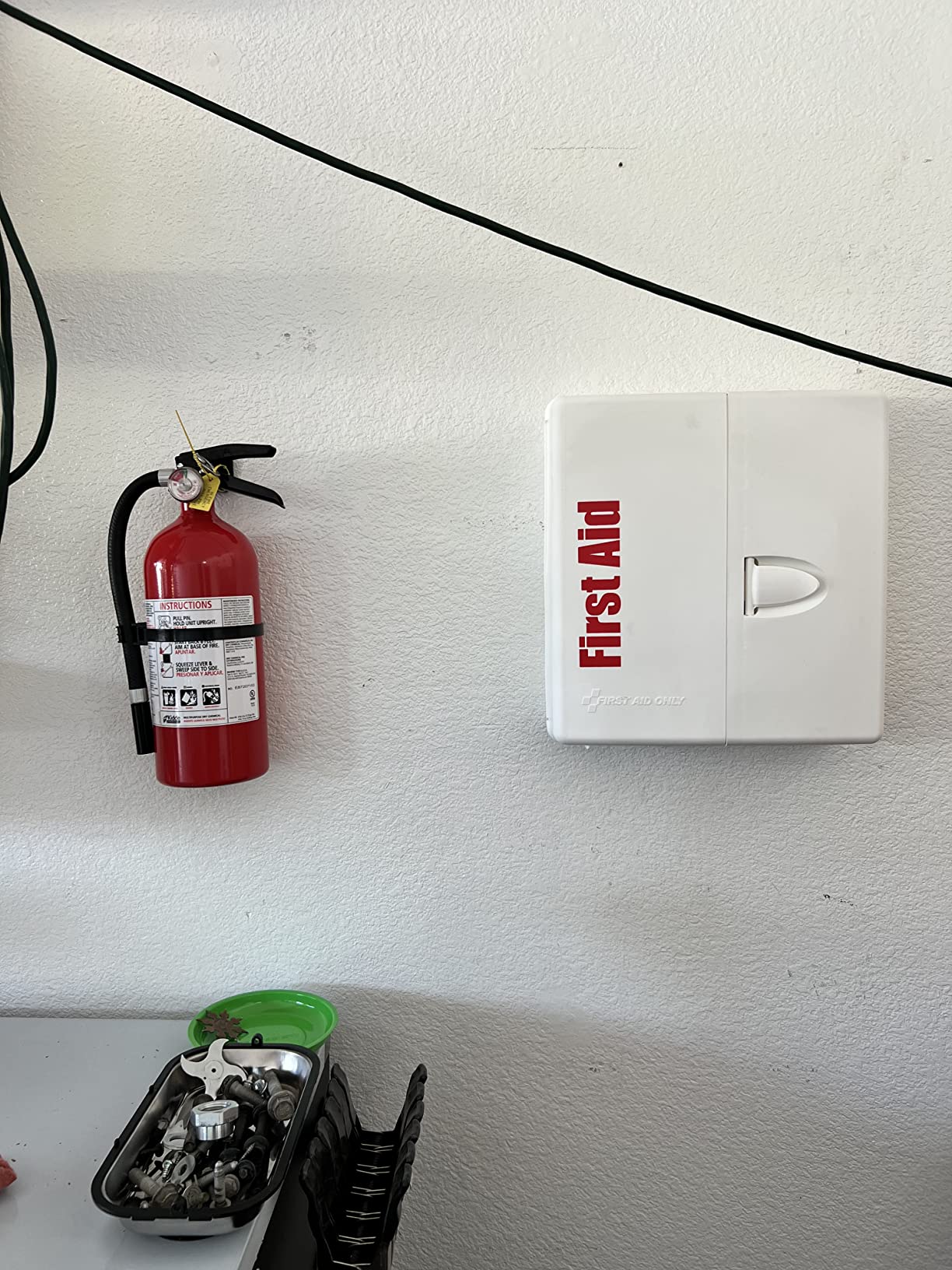
Wall mountable cabinets and portable cases serve different purposes. A wall mounted kit is the inspection friendly default for offices, schools, and fixed workplaces; it gives inspectors a visible location and a defined inspection point. A portable case is the right choice for work trucks, mobile crews, and job site trailers.
Many workplaces need both. We mounted the M2 BASICS 350 piece wall mount kit in our test office and the VRIEXSD 400 piece kit in the company truck. The combination covers incidents at the desk, in the warehouse, and on the road without duplicating expensive inventory. For a deeper look at how layered safety readiness has shaped regional infrastructure, our peak tram history feature explores similar operational frameworks.
Capacity and person count rating
Kit capacity ratings assume typical office incident rates. In higher hazard settings the effective capacity is half or less of the listed number. For a 50 person office with a typical incident profile, a 25 person kit will run low within 3 to 6 months without refills. For a 50 person warehouse or shop, a 50 person rated kit is closer to the right starting point.
When in doubt, oversize by one tier rather than undersize. The marginal cost difference between a 25 person and a 50 person kit is smaller than the cost of running out of bandages during a real incident.
Refill systems and restocking cadence
The most overlooked part of owning a workplace first aid kit is keeping it stocked. Standard kits require manual inventory every month and ad hoc reorders of mixed part numbers. Refill systems like SmartTab ezRefill link each item to a labeled reorder card, which removes the friction entirely.
For multi site operations, standardize on one refill system across locations. Safety professionals on r/SafetyProfessionals say the SmartCompliance ezRefill system saves hours per month across distributed offices because every site uses the same reorder logic.
Hazard assessment in four steps
Before choosing a kit, walk through a quick hazard assessment. Step one: list the top five physical hazards in the workplace (tools, equipment, chemicals, heights, vehicles). Step two: estimate incident frequency based on the last 12 months of records. Step three: identify the worst case scenarios for those hazards and the supplies needed to stabilize them until EMS arrives. Step four: match a Class A or Class B kit to the worst case scenarios and add any missing supplies.
Most operations managers skip this step and end up with a kit that does not match the hazards. The four step walkthrough takes 30 minutes and prevents expensive mismatches.
Industry specific kit recommendations
For offices and retail floors, a Class A plastic or wall mount kit from First Aid Only or M2 BASICS is sufficient. For warehouses and manufacturing, a Class B kit with metal cabinet from Rapid Care or First Aid Only is the right starting point. For construction sites and field crews, a portable case plus a wall mounted site office kit covers both working environments. For fleet vehicles, a compact case with a tourniquet, eye wash, and trauma shears is the minimum.
State specific Narcan and Naloxone requirements
Workplaces in California (Cal/OSHA), New York, Massachusetts, Ohio, and several other states have specific Naloxone requirements for workplaces where opioids may be present on site. Reviewers on r/firstaid frequently ask whether Narcan belongs in a workplace kit; the short answer is yes in those states and recommended as a standalone add on elsewhere. Pair it with an AED for cardiac events on the same wall.
Inspection cadence and monthly checklist
Run a 10 item inspection on the first of every month. Verify the kit is mounted in the documented location. Confirm the seal or latch is intact and the contents match the inventory list. Check medication expiration dates. Confirm the case itself is undamaged. Verify the inspection log is signed and dated. Confirm eyewash bottles are within their use by date. Replace any opened packets. Refill any used compartments. Confirm any AED on the same wall is showing green status. Sign and date the log.
Keep paper or digital inspection records for at least three years. Inspectors occasionally ask for historical logs, and a clean paper trail is the best defense in the event of an inspection.
Frequently Asked Questions
What is an OSHA compliant first aid kit?
An OSHA compliant workplace first aid kit is one whose contents satisfy 29 CFR 1910.151 and align with ANSI/ISEA Z308.1-2021. Kits are classified as Class A for low hazard offices or Class B for higher hazard workplaces such as construction, manufacturing, and warehousing. OSHA does not certify individual kits, so inspectors rely on the ANSI standard as the practical measure of compliance.
What is the difference between Class A and Class B first aid kits?
Class A kits are designed for low hazard workplaces such as offices and retail floors and focus on minor injuries, bandages, and basic wound care. Class B kits are required for higher hazard settings such as construction sites, manufacturing plants, and warehouses. Class B kits include additional supplies like splints, tourniquets, hemostatic gauze, and broader wound care equipment to stabilize serious injuries until EMS arrives.
How many first aid kits does a workplace need?
OSHA requires that first aid supplies be readily accessible to all employees during all shifts. Most safety professionals recommend one kit per floor, per work area, and per vehicle, plus a supplementary kit for any location more than a few seconds from a primary kit. A common rule of thumb is one kit per 25 to 50 employees depending on the hazard level and the physical layout of the facility.
How often should workplace first aid kits be inspected?
ANSI Z308.1-2021 recommends a documented inspection at least once per quarter. Most workplaces inspect monthly to stay ahead of medication expirations and unexpected use. A practical monthly check should cover mounting integrity, content inventory, expiration dates, case integrity, and the inspection log signature.
Do workplace first aid kits need Narcan?
In California, New York, Massachusetts, Ohio, and several other states, Naloxone (Narcan) is required for workplaces where opioid exposure is a foreseeable risk. Even in states without a specific mandate, safety professionals recommend keeping an opioid overdose response kit on the same wall as the first aid cabinet and AED, since bystander administered Naloxone can save a life before EMS arrives.
What is the best first aid kit for a construction site?
For a construction site, the right kit is a Class B metal cabinet that meets ANSI Z308.1-2021 and includes a tourniquet, hemostatic gauze, trauma shears, and burn dressings. Wall mountable steel cabinets such as the First Aid Only 9302-25M or the Rapid Care 3-Shelf cabinet are common picks. Pair the kit with a separate Stop the Bleed module and an AED for cardiac events.
What is the best first aid kit for an office?
For a 5 to 50 person office, a Class A OSHA compliant kit such as the First Aid Only 91248 or the M2 BASICS 300 Piece covers bandages, gauze, antiseptic wipes, and burn care at a reasonable price. For larger offices that want a wall mounted professional cabinet, the First Aid Only SmartCompliance 50-Person cabinet or the M2 BASICS 350 Piece wall mount kit is the right starting point.
Final Verdict
After six weeks of testing ten kits across offices, warehouses, and a job site, the M2 BASICS 300 Piece remains the best large first aid kit for workplaces in 2026 for the broadest range of operations. It is OSHA friendly, the 300 piece count covers cuts, burns, and scrapes for most small teams, and the price point is low enough that any operations manager can expense it without a meeting. For tougher job sites, the First Aid Only 9302-25M metal case and the Rapid Care 3-Shelf steel cabinet are the right answers.
If your workplace is moving to a multi site standardization, step up to the SmartCompliance 746000 metal cabinet. If your operation runs from trucks and trailers, start with the VRIEXSD 400 Piece kit. Whichever kit you pick, document a monthly inspection routine now, run a four step hazard assessment, and keep your logs organized. That combination is what keeps you inspection ready in 2026 and ready for whatever incident comes next.