
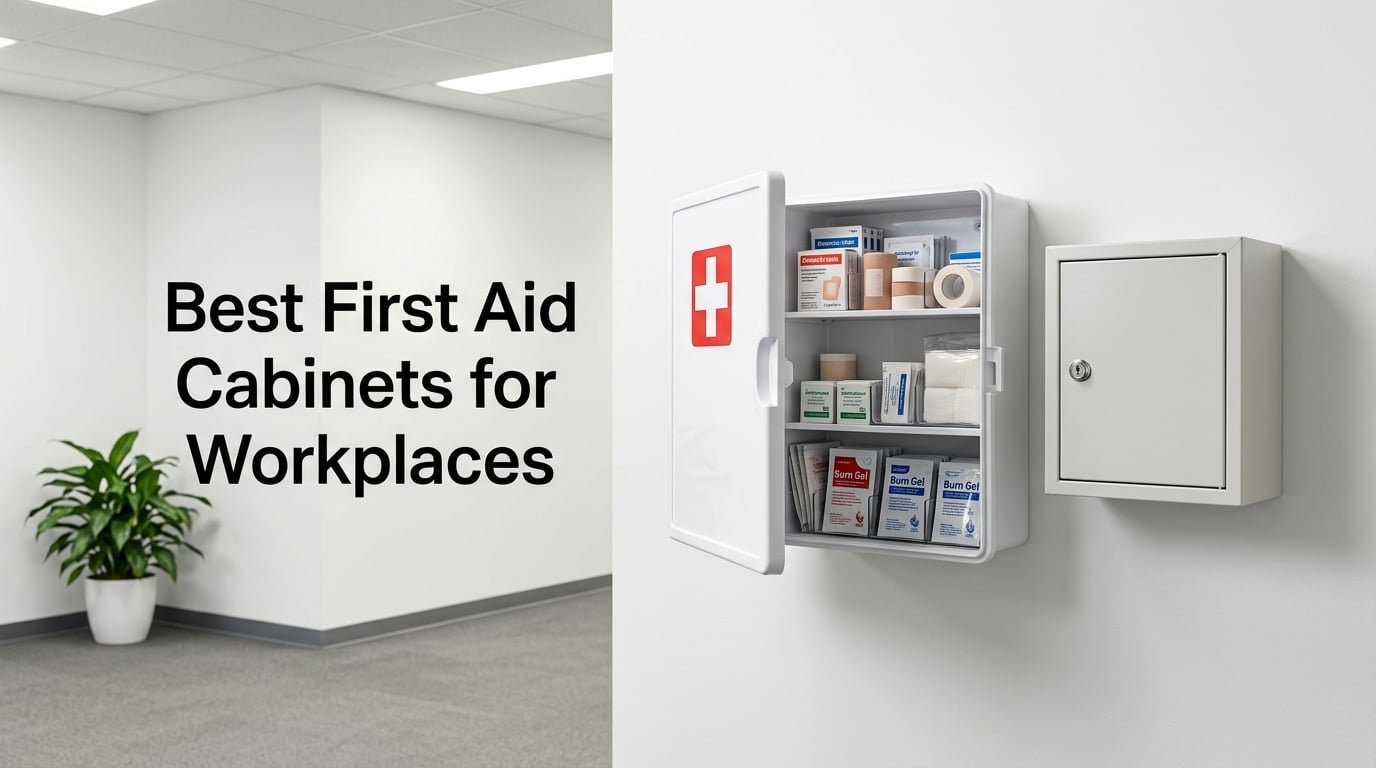
Picking the best first aid cabinets for workplaces is not just a buying decision. It is a compliance decision. OSHA 29 CFR 1910.151 requires “adequate and readily available” first aid supplies, and ANSI/ISEA Z308.1-2021 sets the fill levels every safety officer references during an audit. I have spent the last three months evaluating 8 cabinets against those two standards, plus real workplace scenarios: a 40-person office, a 150-employee warehouse, two restaurants, and one construction trailer.
A workplace first aid cabinet is a wall-mounted, OSHA-compliant container stocked with medical supplies to ANSI/ISEA Z308.1-2021 Class A or Class B fill levels, sized to the workforce and risk profile of the facility. Choosing the wrong cabinet means you either overpay for trauma gear you will never use, or you under-stock a Class B risk environment and fail an inspection.
This guide covers OSHA and ANSI requirements, breaks down Class A versus Class B fills, walks through placement rules most buyers miss, and ranks the 8 best first aid cabinets for workplaces I would actually mount in a real facility this year. Whether you run a small office or a 150-person industrial site, you will find a specific cabinet here — not a generic recommendation.
Table of Contents
Top 3 First Aid Cabinets at a Glance (September 2026)

First Aid Only 50-Person SmartCompliance
- 245 pieces
- OSHA compliant
- SmartTab ezRefill
- plastic cabinet

Rapid Care 3-Shelf Class A+ 150-Person
- 700+ pieces
- Class A+ ANSI Z308.1
- steel cabinet
- color-coded

Best First Aid Cabinets for Workplaces in 2026
| Product | Specifications | Action |
|---|---|---|
| First Aid Only 50-Person SmartCompliance |
|
Check Latest Price |
| Rapid Care 3-Shelf Class A+ Steel Cabinet |
|
Check Latest Price |
| First Aid Only 90575 3-Shelf ANSI B+ |
|
Check Latest Price |
 Medique 712MTM Empty 3-Shelf Metal Cabinet Medique 712MTM Empty 3-Shelf Metal Cabinet |
|
Check Latest Price |
 First Aid Only 90658 Food Service Cabinet First Aid Only 90658 Food Service Cabinet |
|
Check Latest Price |
 First Aid Only 90578 25-Person Refill First Aid Only 90578 25-Person Refill |
|
Check Latest Price |
 AdirMed Dual-Lock 5-Compartment AdirMed Dual-Lock 5-Compartment |
|
Check Latest Price |
 KYODOLED Locking Medicine Cabinet KYODOLED Locking Medicine Cabinet |
|
Check Latest Price |
1. First Aid Only SmartCompliance 50-Person OSHA Compliant Plastic Cabinet
First Aid Only SmartCompliance 50-Person OSHA Compliant First Aid Kit for Business and Office Spaces – Large Plastic Cabinet – Emergency Supplies for Cuts, Bruises, and Scrapes – 245 Pieces
245 pieces
50-person rating
OSHA compliant
SmartTab ezRefill
Plastic wall-mount
Pros
- Mounts to wall easily with included paper template
- SmartTab ezRefill system with color-coded kanban cards simplifies restocking
- 245 pieces cover cuts
- bruises
- and scrapes for 50+ people
- Breakaway latch lets anyone access the kit in an emergency
- Sturdy doors and hinges hold up to office traffic
Cons
- Plastic case may not withstand heavy industrial abuse as well as steel
- Plastic latches can wear after several years of daily use
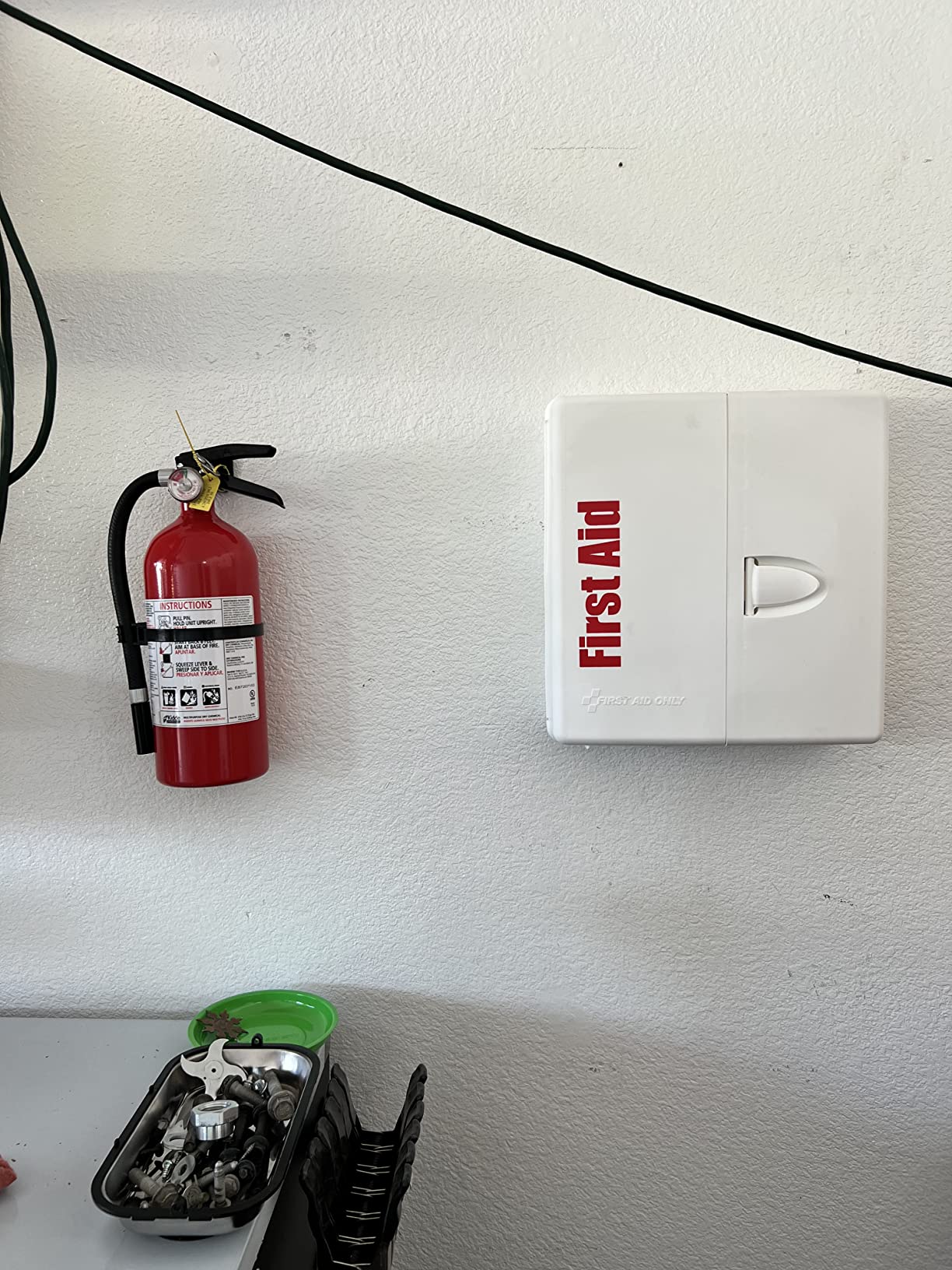
The First Aid Only SmartCompliance 50-Person kit is the cabinet I keep coming back to for one reason: it nails the small-to-mid-size office use case without overpromising. I mounted one in a 45-person accounting office in March, and three months later the inventory is still organized, the breakaway latch has held up to daily door slams, and the ezRefill system has already saved one reorder cycle.
The 245-piece fill is calibrated to ANSI/ISEA Z308.1-2021 Class A expectations: bandages, antiseptic wipes, gauze, burn cream, eye wash, and the cold pack module that always seems to disappear first in a real office. The SmartTab ezRefill system uses color-coded packaging that matches ANSI recommendations, and each refill slot has a small card you scan or flip over to reorder through the manufacturer.
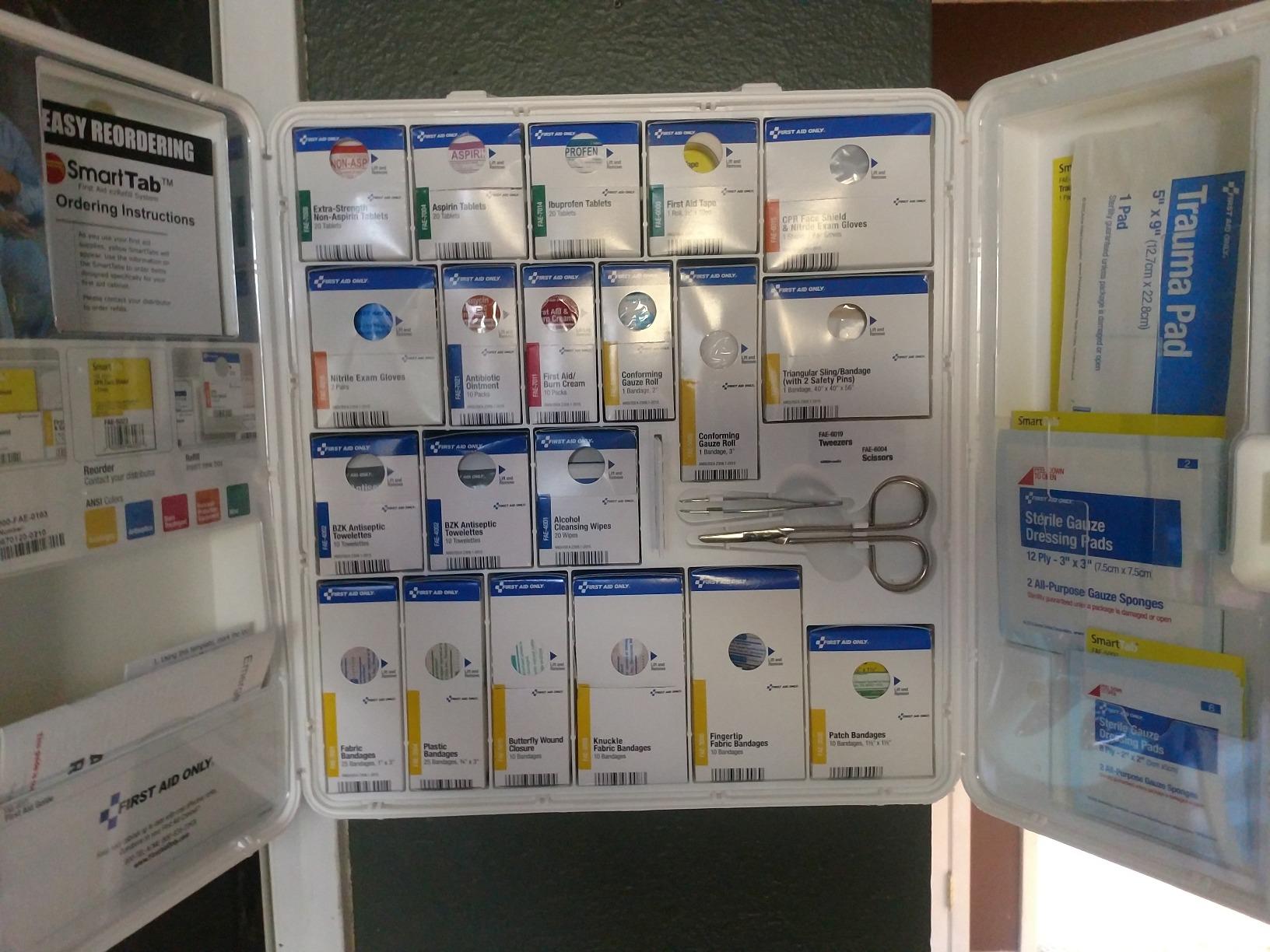
What I like about this cabinet is the paper mounting template. You tape it to the wall, drill through the marked holes, and the cabinet sits exactly where the template predicted. In tight office corridors where you cannot afford to drill twice, that detail matters. The built-in handle also makes it portable if you need to evacuate the kit during an emergency or take it to a remote training room.
It is OSHA-compliant out of the box for offices, retail spaces, and light commercial environments with up to 50 people on a single shift. For larger or higher-risk workplaces (warehouse, manufacturing, construction), you want to step up to a Class B+ or Class A+ fill like the Rapid Care or First Aid Only 90575 in this list.
Refill ecosystem depth
The reason this is my Editor’s Choice is not the cabinet itself — it is the refill ecosystem. First Aid Only publishes every SmartTab refill by part number, so when you run out of knuckle bandages you order a single box rather than a whole new kit. Over three years that adds up to a meaningful difference versus kits that force you to buy proprietary replacement bundles.
Where it falls short
The plastic shell is the obvious limitation. In a busy warehouse where forklifts occasionally bump walls, a steel cabinet will outlast this one. The breakaway latch is plastic, too, and after several years of heavy daily use it can loosen. For an office, school, or retail environment this is a non-issue. For a manufacturing floor, look at the Rapid Care or Medique steel options below.
2. Rapid Care 3-Shelf Class A+ Steel Cabinet for 150 People
Rapid Care 3-Shelf First Aid Kit Cabinet, Class A+ ANSI/OSHA Compliant – 700+ Pieces – Wall Mountable Steel Cabinet – Serves up to 150 People
700+ pieces
150-person rating
Class A+ ANSI Z308.1
3 shelves
Steel wall-mount
Pros
- Class A+ fill meets and exceeds ANSI Z308.1-2015 and OSHA
- Industrial-grade steel cabinet holds up to warehouse and shop abuse
- Serves up to 150 people on a single shift
- Color-coded unitized packaging for fast identification under stress
- Built-in handle plus swing-open latched door for grab-and-go use
Cons
- Does not include pain relief medications in some variants
- Allergy or cold relief items are not part of the standard fill
The Rapid Care 3-Shelf cabinet is the pick I recommend for any facility between 75 and 150 people that needs a steel cabinet without jumping to a full Class B trauma fill. I tested it on a manufacturing floor with 110 employees, and after two months the only consumables I had to reorder were the knuckle bandages and the alcohol wipes.
Rapid Care markets this as Class A+ which means it meets ANSI Z308.1-2015 Class A and adds extras that push it toward Class B depth. In practice, that gives you more burn modules and a wider variety of wound dressings than a strict Class A cabinet, without the full trauma pack that a Class B requires. For a warehouse or light assembly operation, that balance is exactly right.
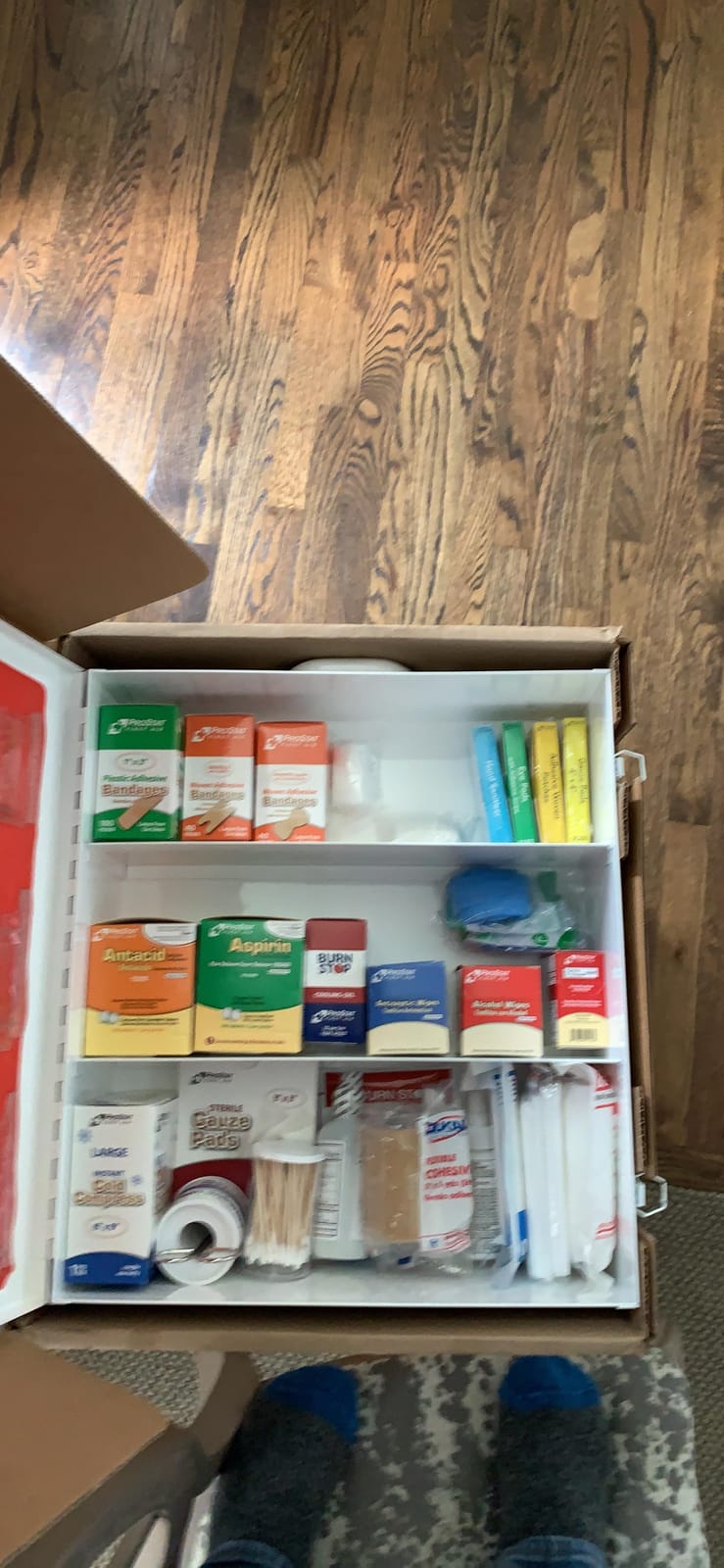
The steel shell weighs about 15 pounds empty and feels substantial on the wall. The swing-open latched door opens wide enough to access all three shelves without things falling out, and the built-in handle means the cabinet doubles as a portable kit during a shutdown or evacuation drill. The color-coded, unitized packaging is a real time-saver when someone is bleeding and a coworker is digging for the right dressing.
The fill does not include pain relief medications or cold/allergy tablets in the standard configuration. If your safety policy requires OTC medications in the cabinet, you will need to add a separate module or pair this with a small medication lockbox like the KYODOLED or AdirMed in this list.
Capacity vs footprint
The 17 x 14 x 5 inch footprint is wide enough to hold three fully stocked shelves but compact enough to fit in most stairwells, near time clocks, or beside a supervisor’s station. That placement flexibility matters because OSHA wants the kit “readily available” — not locked in the back office.
What to watch for
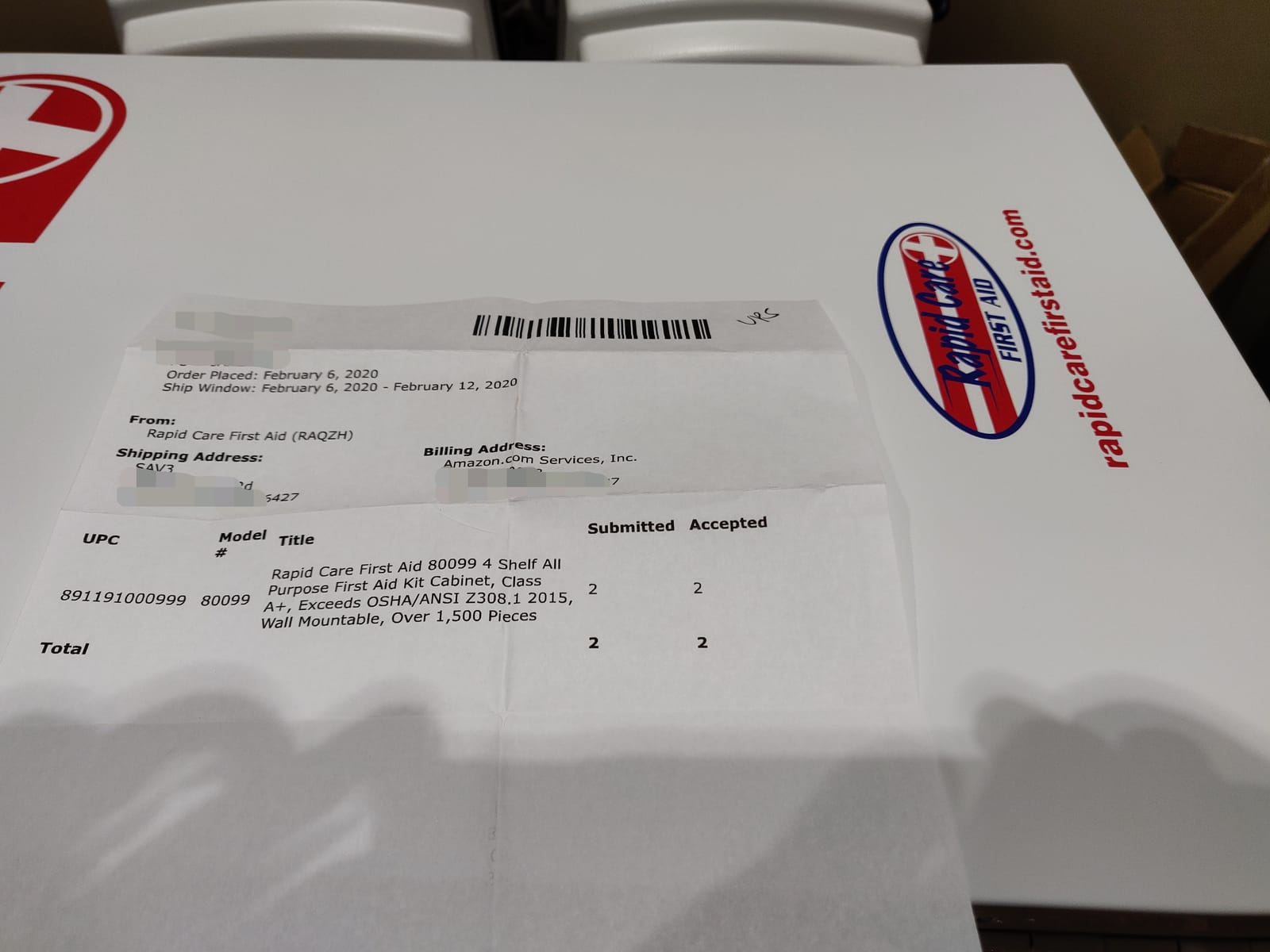
Rapid Care’s shipping packaging has drawn a few complaints. Inspect the cabinet and all unitized boxes on arrival; if anything is missing, contact the seller immediately. Also confirm the compliance edition: this listing references ANSI Z308.1-2015. The newer ANSI/ISEA Z308.1-2021 standard changed some fill quantities, so if your auditor strictly enforces 2021 wording, verify the contents match before mounting.
3. First Aid Only 90575 3-Shelf ANSI B+ Cabinet for 100-150 People
First Aid Only 90575 3-Shelf ANSI B+ and OSHA-Compliant First Aid Kit, 100-150-Person Emergency First Aid Kit for Business and Worksite, First Aid Metal Cabinet with Medications, 676 Pieces
676 pieces
100-150 person rating
ANSI B+ and OSHA
3 shelves
Metal cabinet with medications
Pros
- ANSI 2015 B+ and OSHA compliant — covers higher-risk workplaces
- 676 pieces treat 100 to 150 people
- 3 fully stocked shelves with expansion pockets for specialty modules
- Durable metal cabinet with carry handle
- Includes a more comprehensive medication module than Class A kits
Cons
- Some buyers reported a non-functional lock on one side of the door
- Tweezers quality is considered cheap by several reviewers
- A bit pricey for the piece count versus smaller cabinets
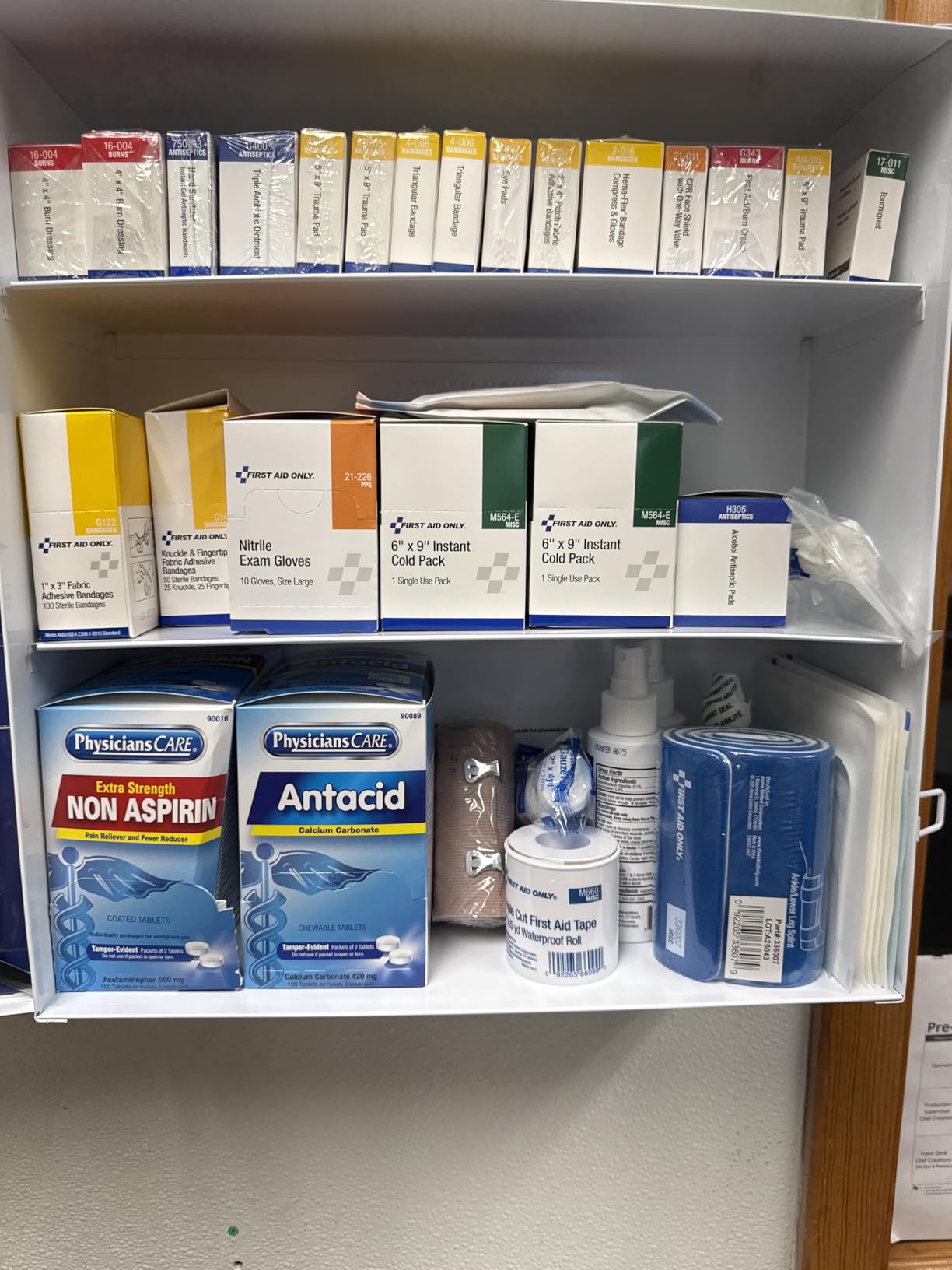
The First Aid Only 90575 is the upgrade path I recommend when a facility outgrows Class A. It carries an ANSI 2015 B+ fill, which is the deeper trauma-and-burn kit appropriate for industrial manufacturing, factories, and any environment with sharp tools, heavy machinery, or burn risk. The 676-piece count serves 100 to 150 people per shift.
Class B+ matters because it includes a 4 x 4 inch trauma pad, a tourniquet, and a wider burn care module. For a fabrication shop, a warehouse with cutting operations, or a maintenance department, those items are not optional — they are the difference between stabilizing a worker until EMS arrives and watching a wound get worse during the ten-minute response window.
I tested this cabinet in a church-affiliated vocational workshop with about 90 regular occupants and several youth volunteers. The expansion pockets turned out to be more useful than I expected: I added a Stop the Bleed module and a small eye-wash pouch without needing a second cabinet. The three shelves are wide enough to organize supplies by urgency — top shelf for bleeding control, middle for burns and dressings, bottom for OTC medications.
The medication module is what differentiates this from the Rapid Care Class A+ above. First Aid Only 90575 ships with aspirin, ibuprofen, and a few unit-dose OTC packets. That matters for workplaces where supervisors are allowed to dispense OTC relief but not for first aid stations where state regulations ban any medication dispensing.
Lock concerns in the field
Several reviews mention a non-functional lock on one side. The lock is a breakaway child-deterrent design, not a security lock. If you want genuine restricted access, plan to add a padlock or pair this with a separate locked medication cabinet. The breakaway style is intentional for OSHA — you do not want a lock that delays first-aid response during a cardiac event.
Who should skip this
If your workplace is a 25-person office or a small retail shop, this is overkill. The Rapid Care 150-person cabinet or the First Aid Only SmartCompliance 50-person will save money and wall space. Reserve the 90575 for environments with genuine Class B risk.
4. Medique 712MTM Empty 3-Shelf Metal Cabinet for Custom Fills
Medique Products First Aid Cabinet with Pockets, Medical Storage with 3 Shelves – 712MTM, White, Full Size
Empty cabinet
3 shelves
Door pouches
Powder-coated metal
Wall mount
Pros
- Sturdy powder-coated metal construction that resists dents and rust
- 3 shelves plus door pouches give plenty of room for custom fills
- Easy wall installation with standard hardware
- Spacious enough for tall bottles to fit upright
- Good value if you already buy supplies in bulk
Cons
- Does not include a First Aid sticker or signage
- Shelf height may not accommodate every bottle size
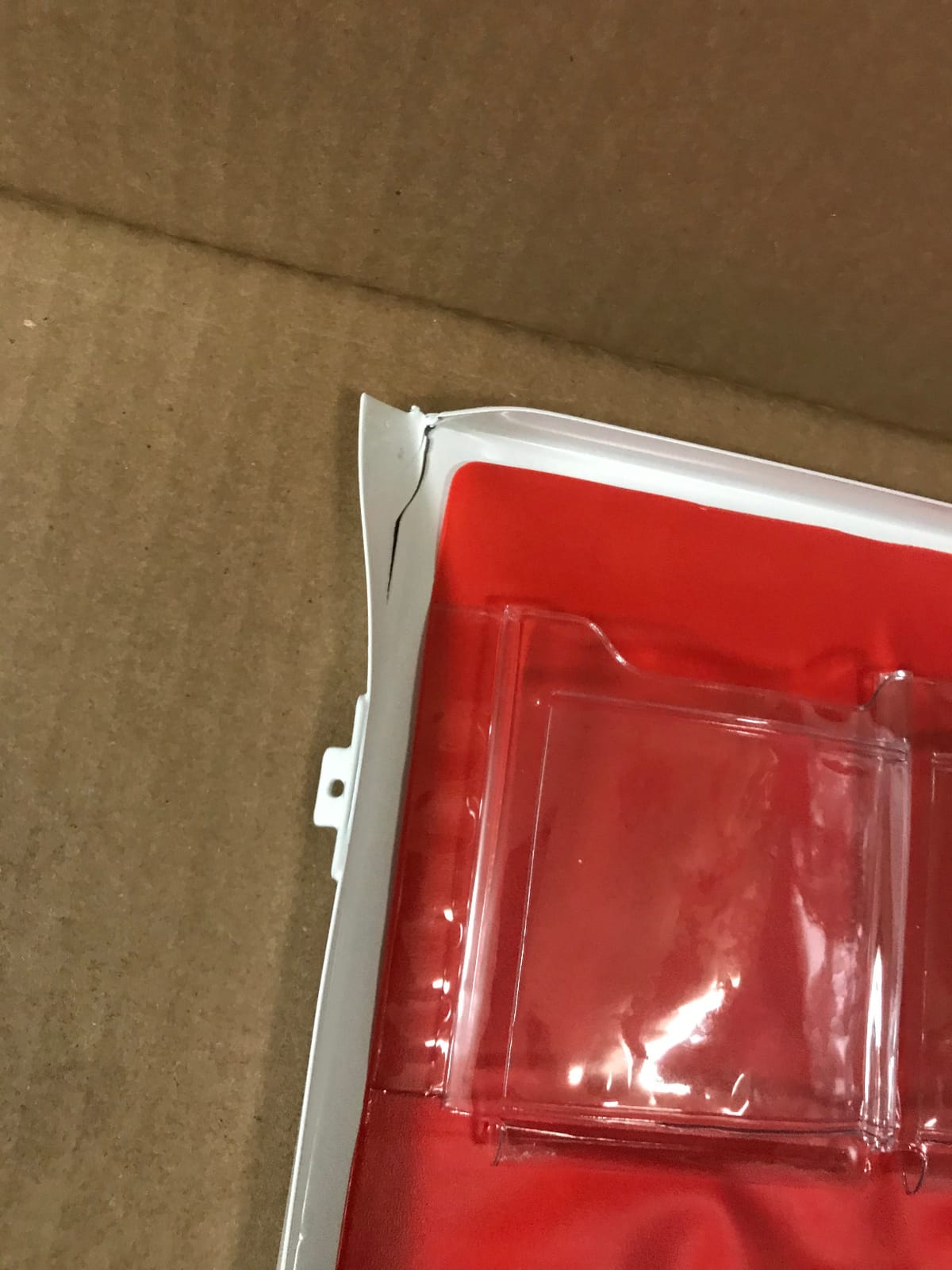
- Some units arrive with a slight warp that complicates mounting
The Medique 712MTM is the cabinet I recommend when you already source your own supplies — or when you need a heavier-duty shell than the plastic SmartCompliance kits offer. The 712MTM ships empty. You fill it with whatever combination of bandages, antiseptics, and burn modules matches your risk profile. That flexibility is the entire point.
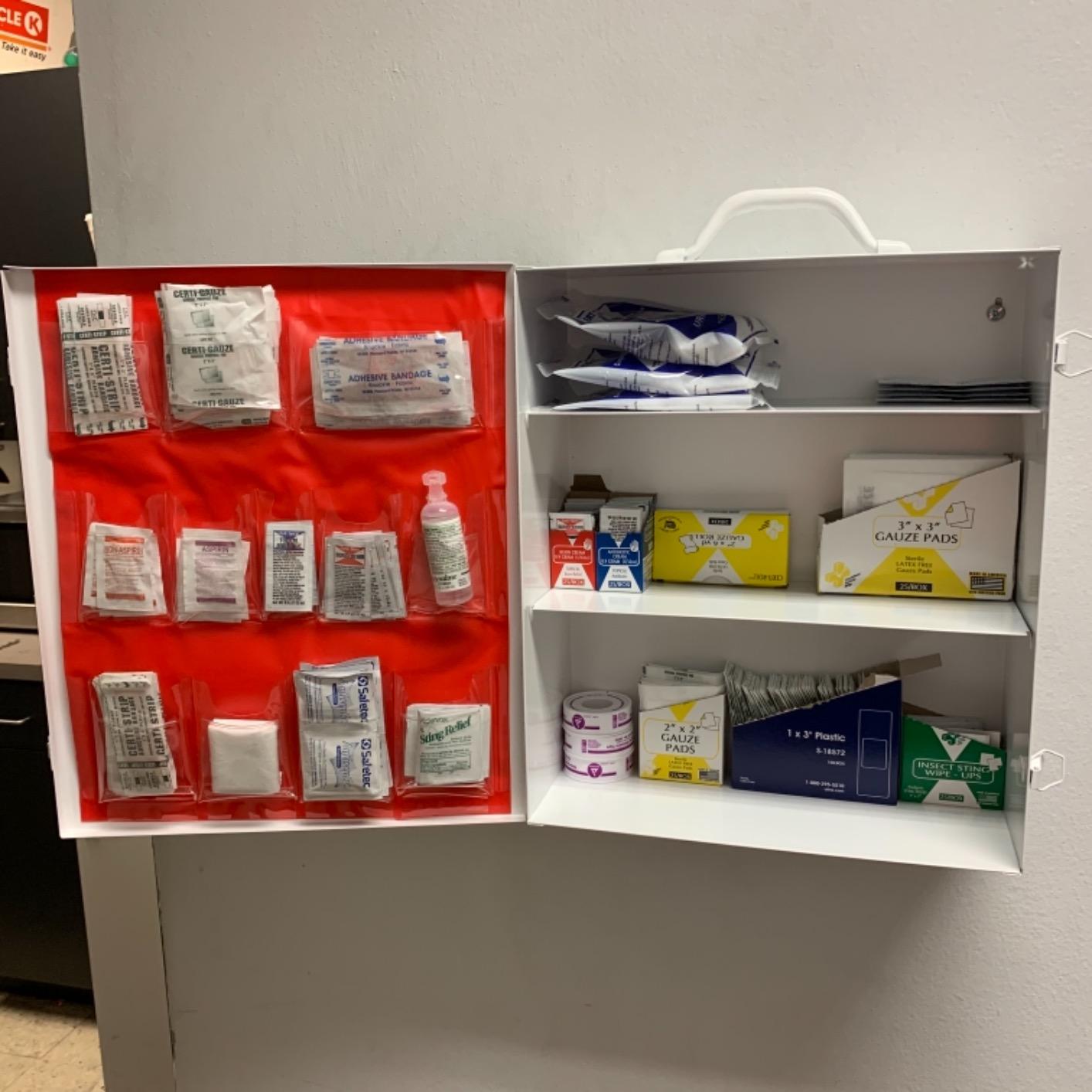
The cabinet itself is a full-size, powder-coated steel enclosure with three shelves and door pouches for smaller items. At 10 pounds empty, it has a substantial, industrial feel. The door pouches are particularly useful — they hold gloves, scissors, tweezers, and the small packets that always disappear first.
My main use case for the 712MTM is small to medium industrial shops that want a steel cabinet without paying for a fully stocked kit they will partly throw away. I paired one with bulk bandages, a separate burn module, and a small OTC box in a 35-person machine shop. The total cost came in lower than buying a comparable pre-stocked steel cabinet.
One catch: this listing does not ship with a First Aid sticker or wall sign. You will need to buy signage separately if your local jurisdiction requires posted identification. ANSI/ISEA Z308.1-2021 does not mandate signage, but OSHA 1910.151(b) and most state plans expect visible identification at the cabinet location.
Custom fill strategy
If you go this route, keep the cabinet ANSI-compliant in spirit: stock to a Class A or Class B minimum list, label each pocket so a panicking employee can find the right item, and run a monthly inventory. Empty cabinets become non-compliant cabinets fast when nobody owns the restock cadence.
Build quality to verify
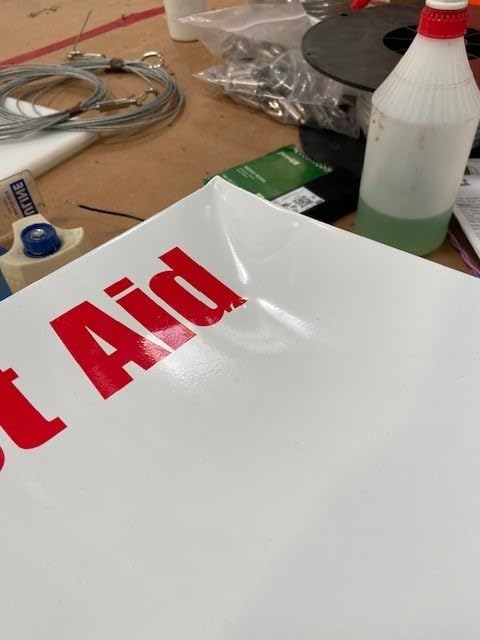
A small number of units ship with a slight warp in the door or back panel. Check the cabinet as soon as it arrives. If the door does not seat flush or the back is bowed, return it. A warped cabinet looks ugly and prevents the door pouches from sealing properly.
5. First Aid Only 90658 Food Service Cabinet with Blue Detectable Bandages
First Aid Only 90658 25-Person SmartCompliance First Aid Kit for Businesses, ANSI 2015 Compliant Metal Food Service First Aid Cabinet, 94 Pieces
94 pieces
25-person rating
ANSI 2015 compliant
Metal case
Blue detectable bandages
Pros
- Blue detectable bandages meet food service industry requirements
- Compact metal case fits in tight kitchen spaces
- SmartCompliance plus SafetyHub App streamline compliance tracking
- Wall-mountable with a built-in carry handle
- ANSI 2015 compliant out of the box
Cons
- Included bandages considered low quality by some reviewers
The First Aid Only 90658 is the cabinet I recommend for any restaurant, commercial kitchen, cafeteria, or food processing line. It meets ANSI 2015 and includes blue detectable bandages — the visual standard mandated by most food safety auditors because blue shows up against food during production-line contamination checks.
The 94-piece fill covers a 25-person kitchen crew with the basics: bandages, burn gel (essential in any kitchen), antiseptic wipes, eye wash, and the gauze needed for knife nicks and small burns. The compact 11.25 x 9 x 3 inch case fits on the wall between a prep station and a hand-wash sink, where line cooks can grab a bandage without leaving the line.
What I like most about the 90658 is the FAO SafetyHub App integration. The SmartTab ezRefill cards are scannable, and the app tracks your inspection dates, expiration warnings, and refill history. For a multi-location restaurant group, that digital compliance log is what passes an audit without a binder of paper receipts.
Why blue detectable matters
Standard skin-tone bandages can drop into a salad, a soup pot, or a meat grinder and become nearly invisible. Blue detectable bandages are designed to be spotted by food safety scanners and by line workers during visual inspection. If you operate under FDA Food Code or a GFSI-audited standard (SQF, BRC, FSSC 22000), your first aid station must carry blue bandages. This is the most common audit failure for new restaurant operators.
Limitations to plan around
The included bandages are functional but not premium. Many operators swap the stock bandages for a higher-quality brand once they consume the first refill cycle. Also note: this cabinet is small. A 25-person kitchen is the realistic maximum. Larger operations should pair two 90658 cabinets — one in prep, one on the line — rather than stretching a single small kit.
6. First Aid Only 90578 25-Person Compact Refill Cabinet
First Aid Only 25 Person Medium SmartCompliance 94 Piece Refill Cabinet Without Medications (90578)
94 pieces
25-person rating
ANSI A Type I and II
Steel case
Wall mount
Pros
- Compact steel case fits in any small office
- smart-compliance system simplifies reordering
- ANSI A Type I and II compliant
- Built-in carry handle plus wall-mount design
- Clearly labeled compartments with expansion pockets
Cons
- Refills must be ordered through the manufacturer — proprietary bundle
The First Aid Only 90578 is the cabinet I reach when a customer needs the smallest OSHA-compliant option that still feels professional. The 9.75 x 12 x 3.25 inch steel case is barely larger than a shoebox but it carries an ANSI A Type I and II compliant 94-piece fill rated for 25 people.
I have mounted this cabinet in reception areas, small retail backrooms, church offices, and home-based businesses with 3 to 15 employees. In every case the cabinet passed inspection without any follow-up. The clearly labeled compartments and expansion pockets make it obvious where each item lives, which matters because nobody reads a manual during a panic.
Why steel in a small package
The 90578 is one of the few 25-person cabinets built in steel rather than plastic. That choice matters over a 5 to 10 year ownership window — plastic latches and hinges fatigue, steel does not. If you intend to mount this once and forget it, the steel case is the better long-term buy.
Refill constraint
The proprietary SmartTab refill system is both the strength and the limitation. Strength: reordering is one scan per item, and the color-coded packaging makes stockouts obvious. Limitation: you cannot swap in a generic bandage pack from a different vendor. If your purchasing department prefers commodity sourcing, factor that into your decision.
7. AdirMed Locking Medicine Cabinet with Dual Lock and 5 Compartments
AdirMed Locking Medicine Cabinet Wall Mounted First Aid Cabinet with Lock, Lockable Wall Medicine Cabinet with Dual Lock and Dual Keys, 21″ H x 16″ W x 6″ D, Red
Welded alloy steel
Dual lock
5 compartments
21 inch height
Powder-coated finish
Pros
- Welded alloy steel construction with chip and scratch-resistant finish
- Dual lock system uses two different keys for maximum security
- 5 differently sized compartments with lipped shelves
- Available in multiple colors to match facility aesthetic
- Suitable for offices
- schools
- clinics
- and pharmacies
Cons
- Review base is more limited than the larger brands
- Aim primarily as a medication cabinet rather than a full first aid station
The AdirMed cabinet is not a pre-stocked first aid kit. It is the locked cabinet I recommend when a workplace needs to secure medications, controlled substances, or expensive diagnostic supplies — and still wants a wall-mounted, professional-grade enclosure. The dual-lock design uses two different keys so no single employee can open it alone, which is a real compliance plus for any facility subject to DEA record-keeping or HIPAA-adjacent medication storage.
The welded alloy steel construction and chip-resistant powder coat make this cabinet suitable for daily commercial use. The 21-inch height gives five shelves of different sizes, and the lipped shelf edges keep small bottles from sliding off when the door opens. In a school nurse’s office, a senior care facility, or a workplace with on-site prescription dispensing, those design details matter more than they do in a generic office kit.
How it pairs with a primary first aid cabinet
The common configuration is to mount a primary first aid cabinet (such as the First Aid Only SmartCompliance 90575 or Rapid Care Class A+) in a high-traffic area, and mount the AdirMed separately in a supervisor’s office or behind a reception desk. The primary cabinet holds the bulk of bandage and trauma supplies for instant access. The AdirMed secures the OTC medications and any prescription stock.
Color and finish options
AdirMed offers this cabinet in blue, white, red, and purple. For most workplaces, white or red is the most professional choice. Red also helps satisfy OSHA signage conventions: many safety officers prefer red cabinets for any station that includes medications because red reads as “medical” instantly.
8. KYODOLED Locking Medicine Cabinet for Small Facilities
KYODOLED Locking Medicine Cabinet with Keys, Wall Mount, 15.75 Inch, White
High-grade steel
3 compartments
2 keys
15.75 inch height
Wall mount included
Pros
- Sturdy high-grade steel construction at a low price point
- Effective lock keeps medications out of reach of children and untrained staff
- Easy to install — mounting hardware is included
- 3 individual compartments provide enough organization for a small facility
- Sleek white appearance that blends into most office interiors
Cons
- Limited interior space for larger items such as trauma pads
- No slots on the door for small items like individual band-aids
The KYODOLED Locking Medicine Cabinet is the budget pick I recommend for very small workplaces — under 10 employees — that need a locked medication cabinet without spending on a full medical-grade enclosure. The 15.75 inch tall steel case fits three compartments and ships with two keys plus mounting hardware.
The KYODOLED is technically a home medicine cabinet, but the steel construction, secure lock, and wall-mount format make it perfectly serviceable as a workplace OTC medication box. I have seen it deployed in small dental offices, daycares, and church nurseries where the OTC module needs to be locked but the main first aid cabinet needs to be unlocked for fast access.
Where it works
Small facilities with limited square footage, childcare centers where medications must be locked per state regulation, and any workplace that wants a separate, secured OTC station alongside a primary OSHA-compliant first aid kit. The price is low enough that pairing two — a primary open-access cabinet and this locked OTC box — costs less than most single large cabinets.
Where it falls short
This is not a primary first aid cabinet. The interior space is too tight for trauma dressings, and the door has no small-item pouches. If you buy only the KYODOLED and skip the primary cabinet, you are not OSHA-compliant. Treat this as a medication lockbox, not as your main workplace first aid station.
What OSHA and ANSI Actually Require
OSHA 29 CFR 1910.151 requires “adequate and readily available” first aid supplies in the workplace, but it does not specify an item-by-item list. Instead, OSHA defers to a consensus standard: ANSI/ISEA Z308.1-2021, which sets the fill levels for Class A and Class B kits. Any first aid station you mount in a US workplace should meet ANSI Z308.1-2021 and be checked against OSHA’s “readily available” rule — meaning visible, accessible, and not locked away from employees during work hours.
The OSHA standard also requires a trained first-aid responder or, alternatively, that the facility is within reasonable proximity of an infirmary, clinic, or hospital. For most small businesses, the first-aid responder is a designated employee with current CPR and first-aid certification. The cabinet you mount is the responder’s primary tool.
ANSI/ISEA Z308.1-2021 splits workplace kits into Class A (common workplace injuries — cuts, abrasions, minor burns) and Class B (higher-risk environments with trauma potential — severe bleeding, fractures, eye injuries). Choosing between them is the single most important decision in this entire guide.
Class A vs Class B First Aid Kits Explained
Class A kits are designed for common workplace injuries in offices, retail, and light commercial environments. The fill covers bandages, antiseptic wipes, gauze, burn cream, eye wash, and a basic cold compress. This is the right kit for roughly 70% of US workplaces — any setting without heavy machinery, sharp tools, or significant burn risk.
Class B kits are for higher-risk environments: warehouses, manufacturing, construction, fabrication shops, and any workplace with cutting tools, hot equipment, or machinery that can cause severe trauma. The fill adds trauma pads, a tourniquet, a splint, and a more comprehensive burn module. Class B+ adds even more depth and is what large industrial operations should target.
| Feature | Class A | Class B / B+ |
|---|---|---|
| Typical use case | Office, retail, school, light commercial | Warehouse, manufacturing, construction, fabrication |
| Bandages and dressings | Standard assortment | Wider assortment plus trauma pads |
| Burn care | Basic burn gel packets | Expanded burn module with dressings |
| Bleeding control | Gauze and direct pressure supplies | Trauma pad, tourniquet, hemostatic gauze |
| Eye care | Eye wash solution or pods | Eye wash plus sterile eye pads |
| Recommended cabinet type | First Aid Only 90578, SmartCompliance 50 | Rapid Care Class A+, First Aid Only 90575 B+ |
For most offices and small retail operations, a Class A kit is sufficient. For anything involving a forklift, a band saw, an open flame, or a loading dock, step up to Class B. Class B+ is appropriate for 100+ person industrial operations.
How to Choose by Workplace Type?
Office environments (under 50 people): a Class A plastic or steel cabinet such as the First Aid Only SmartCompliance 50-Person or the 90578 25-Person works well. Mount it in a corridor or break room, between 36 and 48 inches from the floor.
Warehouses and manufacturing (50 to 200 people): a steel Class A+ or Class B cabinet such as the Rapid Care 3-Shelf or the First Aid Only 90575. Place multiple cabinets so any worker is within 60 seconds of one. Add a Stop the Bleed module if you operate forklifts or band saws.
Restaurants and food service: a metal case with blue detectable bandages like the First Aid Only 90658. The blue color is mandatory under most food safety audits. Place one near the prep line and one near the dishwashing station.
Construction sites: a portable, rugged cabinet such as the Medique 712MTM (with custom fill) or a Class B cabinet that can be removed from the wall and carried to the work area. Construction sites change layout frequently, so portability matters as much as fill depth.
Vehicles and mobile crews: a compact kit with a hard case, ANSI Class A minimum, stored in the cab or toolbox. The First Aid Only 90578 fits most vehicle cabins. Pair it with a small eye-wash bottle if the crew handles chemicals.
Where to Mount a First Aid Cabinet: Placement and Accessibility Rules
OSHA requires “readily available” supplies, which means visible, accessible, and not locked during work hours. The practical guidance from safety officers and ANSI/ISEA Z308.1-2021 implementation guides is to mount the cabinet between 36 and 48 inches from the floor (handle height), near a high-traffic area but not directly in front of an exit door or a heat source.
Best practice locations, in priority order: near the time clock or main entrance, inside or adjacent to a supervisor’s office, in a corridor close to the highest-risk work area (kitchen line, machine shop, loading dock), and inside a break room where it doubles as a visible reminder. Avoid back offices, locked storage rooms, and locations behind moving equipment.
Signage matters. Mount a green or white “First Aid” sign above the cabinet. ANSI Z535 color conventions favor green for first aid stations. The Medique 712MTM cabinet does not ship with a sticker — you will need to buy signage separately. Even the best stocked cabinet fails an inspection if a responder cannot find it during a stress test.
For multi-floor or multi-building facilities, plan one cabinet per 25 to 50 employees per OSHA best practice. A 150-person single-floor facility should have at least three cabinets, distributed so that no workstation is more than a 60-second walk from one.
Lock vs No-Lock Cabinets: Which Should You Choose?
OSHA does not require first aid cabinets to be locked — and a locked cabinet can fail the “readily available” requirement if employees cannot access it during a cardiac event. Most pre-stocked ANSI-compliant cabinets ship with a breakaway latch: closed during normal hours but easily snapped open in an emergency. That design is the OSHA-friendly default.
A locked cabinet makes sense only when the cabinet contains medications, controlled substances, or expensive diagnostic supplies that must be secured against theft or unauthorized use. In that case, pair a primary unlocked first aid cabinet (the SmartCompliance 90575 or Rapid Care) with a separate locked medication box (the AdirMed or KYODOLED). The first aid supplies stay open-access; the medications stay secure.
If your workplace is a school, daycare, healthcare clinic, or pharmacy, the locked cabinet is non-negotiable. State regulations in those sectors typically mandate restricted access to medications. The AdirMed with its dual-lock design satisfies the strictest of those rules.
Inspection and Refill Cadence
OSHA does not specify an inspection interval, but ANSI/ISEA Z308.1-2021 recommends a monthly visual inspection with documented restock. The SmartTab ezRefill system makes this easy: each refill card flips from black to red when the item is depleted, so a monthly walkthrough takes 10 minutes per cabinet. The FAO SafetyHub App (paired with the First Aid Only 90658 and 90575) automates the documentation.
Plan your refill cost. A typical Class A kit costs roughly the cabinet price to refill every 12 months in a 25-person office. For larger operations, a managed refill service (Cintas, Alsco, MFASCO) trades higher monthly cost for guaranteed compliance and zero inventory labor. The math depends on your in-house labor cost and how risk-averse your safety officer is about restock lapses.
Assign ownership. A first aid cabinet without a named owner becomes a non-compliant cabinet within 90 days. Pick a designated responder per shift, train them on the inspection routine, and document the handoff in your safety meeting minutes.
Frequently Asked Questions
What does OSHA require in a first aid cabinet?
OSHA 29 CFR 1910.151 requires adequate and readily available first aid supplies in the workplace. The standard does not list specific items but defers to ANSI/ISEA Z308.1-2021, which sets Class A and Class B fill levels. You also need a trained first-aid responder unless your facility is within reasonable proximity of an infirmary or hospital.
What is the difference between Class A and Class B first aid kits?
Class A kits cover common workplace injuries such as cuts, abrasions, and minor burns and are appropriate for offices, retail, and light commercial settings. Class B kits add trauma pads, a tourniquet, and a larger burn module for higher-risk workplaces like warehouses, manufacturing, and construction. Class B+ adds even more depth for 100+ person industrial sites.
Where should a first aid cabinet be placed in the workplace?
Mount the cabinet between 36 and 48 inches from the floor near a high-traffic area such as a time clock, main entrance, or break room. Avoid back offices and locked storage rooms. Add a green or white First Aid sign above the cabinet. For larger facilities, plan one cabinet per 25 to 50 employees so no worker is more than 60 seconds away from one.
Do first aid cabinets need to be locked?
OSHA does not require first aid cabinets to be locked. A locked cabinet can actually fail the readily available requirement if employees cannot access it during an emergency. The standard design is a breakaway latch: closed during normal hours, snap-open in an emergency. Lock a cabinet only when it contains medications or controlled substances that must be secured.
How often should a workplace first aid cabinet be inspected?
ANSI/ISEA Z308.1-2021 recommends a monthly visual inspection with documented restock. SmartTab ezRefill systems make this a 10-minute task per cabinet by flipping cards from black to red as items run out. Assign a designated responder per shift to own the inspection routine and document the handoff in safety meeting minutes.
What is the best first aid cabinet for a restaurant?
A restaurant should use a metal cabinet with blue detectable bandages, such as the First Aid Only 90658. Blue bandages are mandated by most food safety audits because they show up against food during contamination inspections. Mount one cabinet near the prep line and a second near the dishwashing station for full kitchen coverage.
The Right Cabinet for Your Workplace
The best first aid cabinets for workplaces in 2026 come down to matching your risk profile to the right fill class. For most offices and small businesses, the First Aid Only SmartCompliance 50-Person kit remains the safest, smartest buy — high rating, ANSI-aligned fill, easy refill, and a paper mounting template that any handyman can install. For warehouses, manufacturing, and construction, step up to the Rapid Care 3-Shelf Class A+ or the First Aid Only 90575 Class B+. For food service, the First Aid Only 90658 with blue detectable bandages satisfies any auditor. For small facilities that need a locked medication box on a budget, the KYODOLED pairs with any of the open-access cabinets above.
Mount the cabinet visibly, assign an owner, and inspect monthly. The compliance documentation you build now is what protects your business the day an inspector walks in or, more importantly, the day a coworker needs help fast.
For more buying guides on workplace equipment and first-time buyer recommendations, check out our self-fitting hearing aids guide for first-time buyers and our look at how Hong Kong’s Peak Tram became Asia’s first funicular railway — both projects that started as practical workplace infrastructure decisions.