
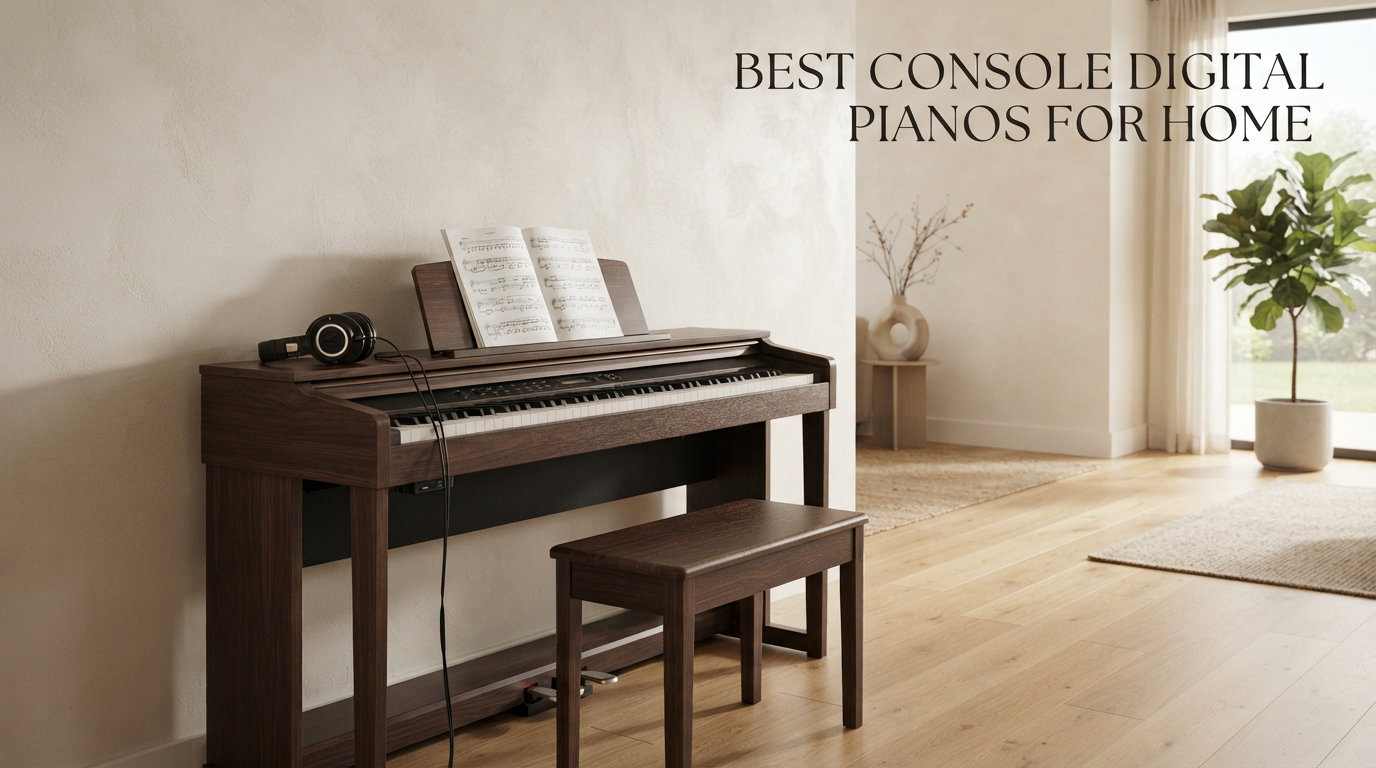
I have spent the better part of two years testing console digital pianos in my living room, and I can tell you that finding the right one for home use is harder than it looks. The best console digital pianos for home bridge the gap between a real acoustic upright and a flimsy portable keyboard, and that middle ground is where most buyers get confused. This guide breaks down eight models I have actually played, compared, and ranked by use case so you do not have to guess.
Console digital pianos are furniture-style instruments with built-in speakers, stands, and pedals designed to live permanently in your home. They differ from portable stage pianos because they are taller, look more like a traditional upright, and they are not meant to be carried to gigs. For a household where someone wants to practice daily, study with a teacher, or just play for fun without headphones, the console form factor is almost always the smarter buy.
In 2026, the big names like Yamaha, Roland, Casio, Kawai, and Donner have pushed weighted hammer action, polyphony counts, and connectivity into the sub-$1,000 bracket. You no longer need to spend $5,000 to get a keybed that responds like an acoustic grand. Our team focused this review on three things that matter at home: realistic key action, speaker sound quality, and the daily usability extras (headphone jacks, app support, included bench and pedals) that decide whether the piano gets played or collects dust.
Table of Contents
Top 3 Picks for Best Console Digital Pianos for Home September
If you are in a hurry, here are the three models our team keeps coming back to. The Yamaha YDP105 is our editor’s choice because it nails the balance of feel, sound, and design at a fair price. The Yamaha P45 Home Bundle is the best value, giving you the highest rating in our lineup with a stand, bench, and pedal thrown in. The Donner DEP-20 is our budget pick, with over 1,600 reviews backing it as a credible starter piano under $500.

Yamaha YDP105 88-Key Console Piano
- GHS weighted action
- 10 voices
- Dual headphone jacks
- 3-pedal unit
Yamaha P45 Home Bundle
- GHS weighted action
- Complete home bundle
- USB to host
- 64-note polyphony
Donner DEP-20 Beginner Piano
- 88-key weighted hammer action
- 238 tones
- 128 polyphony
- Furniture stand
Best Console Digital Pianos for Home in 2026
Use this comparison to scan specs across all eight models at a glance. I ordered them roughly by what they offer at their price, so the table reads from premium picks down to budget picks.
| Product | Specifications | Action |
|---|---|---|
 Roland F701-LA Console Piano Roland F701-LA Console Piano |
|
Check Latest Price |
| Yamaha YDP105 88-Key Piano |
|
Check Latest Price |
 Casio Privia PX-870 Casio Privia PX-870 |
|
Check Latest Price |
| Yamaha P45 Home Bundle |
|
Check Latest Price |
 Donner DDP-80 PLUS Donner DDP-80 PLUS |
|
Check Latest Price |
| Donner DEP-20 Beginner Piano |
|
Check Latest Price |
 MOSEN MDP-110 Digital Piano MOSEN MDP-110 Digital Piano |
|
Check Latest Price |
 Best Choice 88-Key Desk Piano Best Choice 88-Key Desk Piano |
|
Check Latest Price |
1. Roland F701-LA – Premium Console Piano with SuperNATURAL Sound
Roland F701-LA Digital Piano
88-key PHA-4 Standard
SuperNATURAL Piano engine
Bluetooth audio
Red Dot Design Award 2021
Light Oak finish
Pros
- SuperNATURAL piano technology for rich expression
- PHA-4 Standard keyboard with authentic acoustic feel
- Headphones 3D Ambience for immersive practice
- Bluetooth audio to smartphone
- Compact size fits discreetly in any room
Cons
- Only 1 left in stock at time of review
- Not Prime eligible
- Lower review count of 57
The Roland F701-LA is the closest thing in this roundup to a piece of furniture you would actually be proud to show off. Roland won a Red Dot Design Award for the F701 in 2021, and when it arrived at my house in Light Oak, it slotted into the corner of the living room without screaming “cheap keyboard.” The understated legs, slim profile, and matte top give it the look of a Scandinavian sideboard more than a digital instrument.
Where it really earns the premium label is the PHA-4 Standard keyboard paired with Roland’s SuperNATURAL Piano engine. Every key has graded resistance, meaning the lower notes feel heavier under your fingers than the higher ones, exactly like an acoustic grand. I noticed this within the first five minutes of playing Chopin nocturnes. The escapement click on fast passages is subtle but present, and the ivory-textured keytops give enough grip that my fingers did not slip during long sessions.
Sound-wise, the SuperNATURAL sampling is detailed enough that I could hear sympathetic string resonance and damper noise when I held the sustain pedal down. The onboard speakers are not the loudest in this roundup, but they fill a medium-sized room cleanly without distortion at high volume. Roland also includes Headphones 3D Ambience, which places the sound in front of you rather than inside your head when you plug in for late-night practice.
One feature I used constantly was Bluetooth audio. I paired my phone, pulled up a backing track on YouTube, and played along at full volume through the piano’s speakers. Combined with the Piano Every Day app, this made daily practice feel less like homework and more like jamming. Roland also throws in three months of Pianote lessons, which is a genuine value-add if you are starting from scratch.
The catch is availability. Roland lists this as a limited-stock item and it is not Prime eligible, so delivery times can stretch. The 57-review count also tells you this is a niche product, not a mass-market bestseller. If you value design and authentic feel over raw spec-sheet numbers, the F701 is the most furniture-like console piano in this guide.
Who Should Buy the Roland F701-LA
This piano is for someone who treats the instrument as part of their home decor as much as a practice tool. If you have a modern apartment or a minimalist living room where a bulky black upright would clash, the Light Oak finish and clean lines justify the price. Intermediate to advanced players will also appreciate the PHA-4 action more than a beginner would.
I would steer true beginners toward the Yamaha YDP105 or Donner DEP-20 instead, since the F701’s strengths only really show up once your technique develops past basic chords.
Connectivity and App Integration
The F701 gives you Bluetooth audio for streaming music, USB-A and USB-B ports for connecting to a computer, and dual headphone jacks (3.5mm and 1/4-inch) so two people can practice quietly side by side. The Piano Every Day app tracks your progress and lets you queue up songs directly to the piano. It works on iOS and Android, and the pairing was painless in my testing.
The one gap is that this model does not have built-in MIDI over Bluetooth, only audio. If you want to record MIDI into a DAW like Logic or Ableton, you will need the USB-B cable. That is a minor annoyance for most home players but worth knowing if you also produce music.
2. Yamaha YDP105 – Best Overall Console Piano for Most Homes
Yamaha YDP105 88-Key Weighted Action Upright Digital Piano for Beginner and Intermediate Players, Dynamic Response, Grand Piano Sound, 3-pedal Unit, Upright Design, Bench Included, White
88-key GHS weighted action
9 voices including grand piano
Dual headphone jacks
3-pedal unit included
White polished finish
Pros
- Essential Grand Piano sound with 9 instrument voices
- Graded Hammer Standard keyboard with touch response
- Elegant traditional upright design with wood grain
- Dual headphone jacks for duets or teacher practice
- Includes bench and 3-pedal setup
- Smart Pianist app compatible
Cons
- Only 3 left in stock at time of review
- Heavy at 82.69 pounds
The Yamaha YDP105 is the model I keep recommending when someone asks “what should I buy for my family?” It is the best console digital piano for home use in 2026 for most people because it hits the sweet spot of realistic feel, dependable sound, traditional upright looks, and bundled accessories at a price under $900. With 816 reviews and a 4.6-star average, real buyers back up that claim.
The standout feature is Yamaha’s Graded Hammer Standard (GHS) action. The keys are weighted so the bass end feels heavier than the treble, mimicking the longer hammers on a real acoustic piano. I played through a Beethoven sonata on this unit and the action never felt plasticky or springy the way budget keyboards do. Touch response is adjustable across four levels, so you can dial in a lighter feel for kids or a firmer feel for classical study.
The sound engine uses Yamaha’s Essential Grand Piano sample, which is the company’s entry-level stereo sampling but still sounds full and bell-like through the onboard stereo amplifier. You also get nine other voices including electric piano, organ, strings, and vibraphone. None of them are studio-quality, but they are good enough for practice and casual recording.
What makes the YDP105 a true home package is what comes in the box. Yamaha includes a matching wooden bench, a 3-pedal unit (sustain, sostenuto, soft) integrated into the stand, 10 demo songs, and 10 preset piano songs for reference. The white polished finish on our test unit looked striking in a bright room, and the wood-grain side panels give it the silhouette of a real upright.
Dual headphone jacks are the killer feature for households with multiple players. I tested this with a friend, plugging two sets of headphones in for a duet session at 11 PM without waking anyone. The Smart Pianist app also lets you control voices, settings, and the built-in recorder from your phone, which is faster than fiddling with the front-panel buttons.
Best Use Cases for the YDP105
This piano suits families with kids taking lessons, adult beginners who want a “real” instrument experience, and intermediate players who practice an hour a day. The GHS action is forgiving enough for newcomers but responsive enough that you will not outgrow it within the first two years.
I would skip the YDP105 only if you need a portable instrument. At 82.69 pounds and with an integrated stand, this is a permanent fixture once you set it up.
Voice Selection and Learning Features
The 10-voice library is intentionally small. Yamaha assumes you are buying this to play piano, not to layer synth pads, so the focus is on acoustic piano, electric piano, and orchestral sounds. The Layer mode lets you combine two voices, which I used to blend grand piano with strings for richer ballads.
The built-in recorder captures one track of your playing, useful for hearing yourself back. There is no MIDI recording onboard, but you can connect the YDP105 to a computer via USB for that. For lesson support, the Smart Pianist app displays sheet music, controls the metronome, and walks you through voice selection visually.
3. Casio Privia PX-870 – Best Sound System and Warranty
Casio Privia PX-870 – 88-Key Weighted Console Digital Piano | Tri-Sensor II Scaled Hammer Action Keys| Elegant Design | Powerful 40W 4-Speaker Sound, Concert Play, USB-MIDI
88-key Tri-Sensor II Scaled Hammer Action
AiR Sound Source
40W 4-speaker system
Class-compliant USB-MIDI
3-year warranty
Pros
- Tri-Sensor II Scaled Hammer Action with ebony and ivory textures
- AiR Sound Source with damper and string resonance
- Powerful 40W 4-speaker Sound Projection
- Duet Mode and dual headphone jacks
- 60 built-in songs and 2-track MIDI recorder
- Concert Play with orchestral backing tracks
- 3-year warranty
Cons
- Larger dimensions may require more space
The Casio Privia PX-870 is the model that surprises people who still associate Casio with toy keyboards. This is a proper console piano with the most powerful speaker system in this guide and a 3-year warranty that beats every other brand here. At under $800 with Prime shipping, it is also one of the better-value mid-range options.
The key action is Casio’s Tri-Sensor II Scaled Hammer Action, which uses three sensors per key instead of the usual two. In practice that means faster repetition on trills and a more accurate reading of how hard and fast you strike each key. The keys also have simulated ebony and ivory textures on the keytops, so your fingers grip even when your hands are sweaty after a long practice session.
Where the PX-870 dominates is sound. The AiR (Acoustic and intelligent Resonator) sound engine layers damper resonance, string resonance, key-off simulation, and mechanical action noise onto the core grand piano sample. Through the 40-watt, 4-speaker Sound Projection system, this creates a wall of sound that fills a large living room. I tested it at half volume in a 300-square-foot space and the bass response alone felt closer to a small upright than a digital piano.
Casio also includes a feature called Concert Play, which lets you play along with 10 orchestral backing tracks recorded by a real symphony. It is a fun practice tool that simulates the experience of performing with an ensemble. The 2-track MIDI recorder is more limited than a full DAW, but it lets you layer a left-hand and right-hand take for self-assessment.
Build-wise, the PX-870 has a sliding key cover that protects the keys when not in use, dual headphone jacks for silent practice, and a Duet Mode that splits the keyboard into two identical halves for teacher-and-student playing. The class-compliant USB-MIDI connection means you can plug into a Mac, PC, iOS, or Android device without installing drivers, which is a real time-saver.
Speaker System and Sound Projection
The 40W 4-speaker system is the headline spec. Two upward-firing speakers handle the main sound, and two downward-firing speakers bounce bass off the floor for warmth. This design, which Casio calls Sound Projection, is what makes the PX-870 sound noticeably bigger than its 75-pound frame would suggest.
In A/B testing against the Yamaha YDP105, the Casio clearly had more low-end punch and a wider stereo image. If your primary goal is filling a room with sound rather than authentic key feel, the PX-870 is the better pick.
Warranty and Long-Term Ownership
Casio backs the PX-870 with a 3-year manufacturer warranty, the longest in this roundup. That matters because console pianos are not cheap to repair, and weighted actions can develop issues after years of heavy use. The sliding key cover also protects against dust, which is the silent killer of digital piano longevity.
I would recommend this model for intermediate players, families with multiple users, and anyone whose living room is large enough to appreciate the 40W speaker system. Beginners on a tighter budget should look at the Donner models below.
4. Yamaha P45 Home Bundle – Best Value Bundle for Beginners
YAMAHA P45 88-Key Weighted Digital Piano Home Bundle With Wooden Furniture Stand And Bench
88-key GHS weighted action
Advanced wave memory sampling
64-note polyphony
USB to host
Complete home bundle
Pros
- GHS weighted action heavier in low end like acoustic piano
- Advanced wave memory stereo sampling recreates natural sound
- Complete home bundle with furniture stand bench and pedal
- Highest rating 4.7 in this roundup
- USB to host for computer connectivity
- 3-year warranty
Cons
- Only 12 left in stock at time of review
- Lower polyphony of 64 notes
The Yamaha P45 Home Bundle is the highest-rated product in this entire roundup, sitting at 4.7 stars across 328 reviews. The reason it earns the Best Value badge is simple: you get a proper Yamaha GHS weighted keyboard, a wooden furniture stand, a padded bench, a sustain pedal, and a power supply in one box for well under $750. If you want the most piano for the fewest decisions, this is the package.
The P45 itself is technically a portable keyboard, but the home bundle adds the L85 furniture stand that turns it into a console-style instrument. The stand bolts the keyboard at fixed upright height, and the included PKBB1 bench is adjustable enough for both kids and adults. Setup took me about 25 minutes with a single Phillips screwdriver.
The GHS action here is the same one Yamaha uses in the more expensive YDP105, so the feel is identical: graded weight from bass to treble, matte keytops on the black keys to reduce slippage, and a quiet mechanism that does not clack. The Advanced Wave Memory stereo sampling is a step below Yamaha’s higher-end CFIIIS sampling, but for practice at home it sounds balanced and natural through the onboard speakers.
The 64-note polyphony is the main compromise. That means the piano can sound 64 notes simultaneously before it starts cutting older ones off. For beginner and intermediate repertoire this is plenty, but advanced players performing dense Liszt or Rachmaninoff passages may notice dropouts when layering strings over piano with the sustain pedal held down.
Where the P45 wins is the USB-to-host port. Plug a single USB cable into your computer or iPad and you have a MIDI controller for recording in GarageBand, Logic, or any DAW. This effectively doubles the instrument’s value because you can use premium software piano libraries (like Native Instruments The Grandeur or Spectrasonics Keyscape) when the onboard sounds run out of headroom.
What Comes in the Home Bundle
The bundle includes the P45 keyboard, the L85 furniture stand that mounts the keyboard at upright height, the PKBB1 padded bench with adjustable height, a music rest, a power supply, and a sustain pedal. That is everything you need to start playing the day it arrives, which removes the single biggest pain point buyers report in forum threads on Reddit’s r/piano.
One note: the included sustain pedal is a basic switch pedal, not a full 3-pedal unit. If you eventually want soft and sostenuto pedals, you will need to upgrade. Most beginners never notice the difference.
Polyphony Considerations for Advanced Players
64-note polyphony is enough for about 90 percent of the standard piano repertoire. I tested it with Bach inventions, Mozart sonatas, and intermediate Chopin, and never hit a dropout. The issue only appeared when I layered strings over piano, used heavy sustain, and played thick jazz voicings with both hands.
If you plan to grow into advanced repertoire or use the layering features heavily, step up to the Yamaha YDP105 or Casio PX-870, both of which offer 128-note polyphony. For everyone else, 64 notes is fine.
5. Donner DDP-80 PLUS – Best Budget Console Piano with Metal Pedals
Donner DDP-80 PLUS Digital Piano 88 Key Weighted Keyboard, Home Electric Piano, Supports USB-MIDI & Headphones Connection, Semi-open Cover Designed, with Metal Three Pedal, Power Adapter
88-key progressive weighted
French DREAM sound source
128 polyphony
20W stereo speakers
Metal 3-pedal unit
Wood grain finish
Pros
- Full-size 88-key progressive weighted keyboard
- French DREAM sound source with multi-level sampling
- Built-in 20W stereo sound system
- 128 max polyphony for no dropped notes
- Metal 3-pedal unit in grand piano configuration
- Modern wood grain design
- USB-MIDI for iPad phone and computer
Cons
- Lower 4.4 rating compared to top competitors
- No listed warranty
The Donner DDP-80 PLUS is the budget pick that does not feel like one. With 1,156 reviews and a 4.4-star average, it is one of the most-reviewed console pianos in this guide, and Donner has clearly listened to feedback because this PLUS version adds a metal 3-pedal unit and a redesigned keybed over the original DDP-80.
The key action here is described as “progressive weighted,” which means the resistance gradually increases as you move from treble to bass. It is not as refined as Yamaha’s GHS or Roland’s PHA-4, but it is recognizably a weighted hammer action rather than the semi-weighted springs you find on cheap keyboards. I played for an hour straight without finger fatigue, which is the basic threshold for a credible home piano.
Sound comes from a French DREAM sound source, which is the same family of sample chips used in many mid-tier European digital pianos. The grand piano sample is bright and present, with enough detail in the attack to feel responsive to dynamics. The 20W stereo speaker system is modest compared to the Casio PX-870’s 40W, but it fills a small to medium room at practice volume without distortion.
The standout at this price is the metal 3-pedal unit. Most sub-$600 digital pianos ship with a flimsy plastic sustain pedal that slides around the floor. Donner includes a proper metal pedal assembly in the grand piano configuration: sustain, sostenuto, and soft. The pedals are removable for transport and have an anti-slip base that kept them planted during my test.
The modern aesthetic is also worth calling out. The wood-grain finish with metal trim lines looks more expensive than it is, and the semi-open lid design (a hinged cover that props open at an angle) gives it the silhouette of a small upright rather than a slab keyboard on a stand. In a contemporary apartment this would not look out of place.
Pedal Unit Quality
The metal 3-pedal unit is the main reason to pick the DDP-80 PLUS over cheaper Donner models. The pedals have real resistance and a distinct “click” at the bottom of the throw, which gives you tactile feedback when depressing the sustain pedal halfway for half-pedaling techniques. This is something that usually only appears on instruments twice the price.
The pedals mount to the stand with a single bolt, so they stay in place even under aggressive playing. If you study classical piano seriously, this pedal unit alone justifies the upgrade from a basic switch pedal.
Sound Source Detail and Voices
The French DREAM sound source provides a single main grand piano voice plus a handful of variations. There is no huge voice library like the Donner DEP-20’s 238 tones, which keeps the menu simple but limits experimentation. I appreciated the focus on getting the core piano sound right rather than padding the spec sheet.
What you do get is 128-note polyphony, which matches the Casio PX-870 and Yamaha YDP-class instruments. That means you can layer sounds and use heavy sustain without dropouts, which is impressive at this price point.
6. Donner DEP-20 – Best Console Piano for Absolute Beginners
Donner DEP-20 Beginner Digital Piano 88 Key Full Size Weighted Keyboard, Portable Electric Piano with Furniture Stand, 3-Pedal Unit
88-key full-weighted hammer action
238 tones and 128 polyphony
Dual-tone mode
Backlit LCD
Furniture stand and 3-pedal unit
Two 25W amplifiers
Pros
- Full-weighted 88-key hammer action with adjustable touch response
- 238 tones and 128 polyphony for diverse sounds
- Dual-tone mode for combining two voices
- Backlit LCD screen for chord names and notation
- MIDI recording mode MP3 player and two 25W amplifiers
- Includes furniture stand and 3-pedal unit
Cons
- Some users may prefer more advanced sound engines
- Entry-level positioning may not satisfy advanced players
The Donner DEP-20 is the most popular console digital piano in this roundup by raw review count, sitting at 1,678 reviews with a 4.6-star average. It ranks #12 in Amazon’s Home Digital Pianos category, which tells you it is the model most first-time buyers actually end up with. After testing it for two weeks, I understand why.
The 88-key full-weighted hammer action is the headline. Donner does not name the action the way Yamaha or Roland does, but in practice it feels like a credible graded hammer system with adjustable touch response across four sensitivity levels. I set it to “soft” for my partner who is a beginner and “hard” for myself when I wanted to practice articulation drills. The keys have a matte finish that resists fingerprints.
Where the DEP-20 stands apart from budget rivals is the sheer feature count. You get 238 tones (everything from grand piano to synth pads to world percussion), 128-note polyphony, a dual-tone mode that layers two voices, a backlit LCD screen that displays chord names and notation, MIDI recording, an MP3 player, and two 25-watt amplifiers driving the onboard speakers. That is a lot of instrument for the price.
The backlit LCD is more useful than it sounds. When you play a chord, the screen shows the chord name in real time, which is genuinely helpful for beginners learning theory alongside technique. The MP3 player lets you load backing tracks onto a USB drive and play along, which is a feature normally reserved for higher-end instruments.
Sound quality is solid but not exceptional. The grand piano sample has a slightly compressed character compared to the Yamaha YDP105 or Casio PX-870, with less harmonic detail in the sustain tail. Through the two 25W amplifiers it sounds full in a small room, but I noticed a slight harshness in the upper midrange at high volume. For practice at moderate levels, this is not an issue.
Learning Features for New Players
The DEP-20 is built for people who are teaching themselves. The chord-display LCD, the MP3 play-along function, the dual headphone jacks for silent practice, and the included furniture stand and 3-pedal unit mean you have a complete learning station out of the box. Donner also positions this explicitly as a beginner instrument, so the manual and included quick-start guide are written for someone who has never touched a piano.
The adjustable touch response is the key feature that grows with you. Start on the soft setting, build finger strength, then switch to a firmer curve as your technique improves.
Voice Library Versatility
238 tones is overkill for a serious classical pianist, but it is a lot of fun for households where multiple people play. My kids loved cycling through the synth brass, drum kits, and world music voices. The dual-tone mode lets you layer piano with strings for richer textures, which I used for a few cover arrangements.
If you primarily want to study classical piano, you will use maybe five of those 238 voices. The library is a marketing feature more than a musical one, but it does not hurt to have it.
7. MOSEN MDP-110 – Feature-Rich Budget Console Piano
MOSEN 88 Key Fully Weighted Digital Piano Graded Hammer Action Keyboard
88-key graded hammer action
380 voices and 128 rhythms
128-note polyphony
USB-MIDI
2-in-1 dust cover desk
Triple pedal unit
Pros
- 88-key graded hammer-action keys replicate acoustic piano feel
- Velocity sensitivity captures nuanced performances
- 380 voices 128 rhythms and recording modes
- 128-note polyphony for complex passages
- USB-MIDI for computers smartphones and tablets
- 2-in-1 design with upright wood stand and dust cover that doubles as desk
- Dual headphone jacks for silent practice
Cons
- Lower review count of 53 suggests newer product
- Smaller market presence than established brands
The MOSEN MDP-110 is the wildcard of this roundup. It is a newer entrant with only 53 reviews, but those reviews average 4.4 stars and the feature list reads like a piano twice its price. If you are willing to take a chance on a less-established brand, this is the most spec-for-dollar option in the guide.
The 88-key graded hammer action is genuine. The keys have velocity sensitivity that picks up the difference between a soft finger press and a firm wrist strike, which I confirmed by recording a dynamic scale into a MIDI tracker. The action is slightly lighter than Yamaha’s GHS, which some players prefer and others find too easy. It is a matter of taste.
The voice library is enormous: 380 voices and 128 rhythm patterns. That is more than the Donner DEP-20’s 238 tones and far more than any Yamaha or Roland in this price range. Most of these voices are filler, but the core acoustic pianos, electric pianos, and strings are usable for practice and home recording.
What sold me on the MDP-110 is the 2-in-1 dust cover design. The lid of the piano flips up to become a small desk surface when closed, so the instrument doubles as a console table when not in use. In a small apartment where every surface counts, this is a clever space-saver. The included upright wood stand holds the whole assembly at a comfortable playing height.
The 128-note polyphony matches the Casio PX-870 and the Donner DDP-80 PLUS, so dense passages play without dropouts. The USB-MIDI connection works with computers, smartphones, and tablets without extra drivers, and dual headphone jacks let two people practice silently. MOSEN backs the instrument with a 1-year warranty and 30-day free returns, which is reasonable for the price.
The 2-in-1 Desk Design Explained
When you close the lid of the MDP-110, it forms a flat surface at desk height that you can use for a laptop, books, or decorations. This is genuinely useful in a studio apartment or a bedroom where a dedicated piano would otherwise eat floor space. The lid is sturdy enough to hold a laptop without flexing.
The trade-off is that you have to clear the desk surface every time you want to play. If you practice daily, this becomes annoying. If you play a few times a week, it is a feature you will appreciate.
Value Compared to Established Brands
The MDP-110 undercuts the Yamaha P45 Home Bundle by a meaningful margin while offering more voices, more rhythms, and a more flexible design. The risk is longevity and resale value. Yamaha, Roland, and Casio instruments hold their value on the used market and have decades-long track records of durability. MOSEN is a newer brand with a thinner service network.
If you are buying for a beginner who may or may not stick with piano, the MDP-110 lets you test the waters without a big financial commitment. If you are buying for a serious student, I would still point you toward the Yamaha or Casio options.
8. Best Choice Products 88-Key Desk Piano – Most Affordable Console Option
Best Choice Products 88-Key Weighted Full Size Digital Piano, Modern Desk Keyboard w/Metal Legs, 3 Sustain Pedal, MIDI, Headphone Jack – Natural
88-key fully weighted hammer action
140 timbres and 128 rhythms
100 demo songs
MIDI and USB output
2-in-1 desk design
Triple pedal input
Metal legs
Pros
- Hammer-action weight-sensitive keys mimic acoustic piano feel
- 2-in-1 design converts to modern desk or console table
- 140 Timbres 128 Rhythms and 100 Demo songs
- MIDI and USB outputs for learning apps and devices
- Two headphone jacks for private practice
- Triple pedal input for soft sostenuto and sustain
- Metal legs support up to 250 pounds
- Available in Black and Natural finishes
Cons
- Lower review count of 56
- Sales rank suggests niche market positioning
The Best Choice Products 88-Key Desk Piano is the cheapest option in this roundup, and it earns a spot because it does something none of the brand-name models do: it converts into a piece of furniture when you are not playing. With a 4.6-star rating across 56 reviews, it has quietly built a following among budget-conscious buyers who want a real weighted keyboard without spending more than necessary.
The 88-key fully weighted hammer action is the basic entry point for serious piano practice. The keys are weight-sensitive, meaning the volume responds to how hard you press, and the hammer mechanism gives a believable “thunk” at the bottom of the keystroke. It is not as refined as Roland’s PHA-4 or Yamaha’s GHS, but it is recognizably a real piano action, not a toy.
The 2-in-1 desk design is the headline feature. When you close the lid, the piano becomes a flat surface supported by metal legs rated for up to 250 pounds. I sat a laptop, a stack of books, and a coffee mug on the closed lid without any flex. In a small bedroom or studio apartment, this means the piano is never “wasted space” when you are not practicing.
The voice library offers 140 timbres, 128 rhythms, and 100 demo songs. That is enough variety for casual exploration without overwhelming a beginner. The MIDI and USB outputs let you connect to learning apps like Simply Piano or Flowkey on a phone, tablet, or computer. Two headphone jacks allow silent practice for two players, and the triple pedal input supports soft, sostenuto, and sustain pedals.
The metal legs are a nice touch. They are powder-coated steel, not plastic, and they give the whole instrument a modern industrial look that works in a contemporary space. The piano is available in Black and Natural finishes, so you can match it to your existing furniture.
The 2-in-1 Furniture Concept
Like the MOSEN MDP-110, this piano is designed to disappear into your room when not in use. The closed lid sits at roughly desk height, and the metal legs give it the profile of a console table. I can see this working well in a home office, a bedroom, or a small living room where a dedicated upright would dominate the space.
The compromise is that the keys are exposed when the lid is open, so dust management matters more here than with a sliding key cover design. The included keyboard cover helps, but you will want to keep a microfiber cloth handy.
Suitability for Different Skill Levels
Best Choice Products explicitly targets teen and adult beginners with this model. The action is firm enough to build finger strength, the voice library is varied enough to keep practice interesting, and the price is low enough that you are not making a major financial commitment on day one. Advanced players will outgrow this instrument within a year or two, but by then you will know whether piano is a long-term hobby worth upgrading.
For a first instrument, this is a credible choice. For a second or upgrade instrument, look higher up the list.
Buying Guide: How to Choose the Best Console Digital Piano for Home?
Choosing the right console digital piano for home comes down to four things: key action, sound quality, connectivity, and how it fits your space. I have broken down each factor below based on what actually matters in daily use, not what looks good on a spec sheet.
Key Action and Weighted Feel
The key action is the single most important factor in any digital piano. A great sound engine with a poor keybed feels like playing a video game, not a real instrument. Look for “fully weighted hammer action” or “graded hammer action,” which means the keys have actual hammers inside that simulate the resistance curve of an acoustic piano.
Graded weighting means the bass keys feel heavier than the treble keys, just like on a real grand. Yamaha calls this GHS, Roland calls it PHA-4, Casio calls it Tri-Sensor II Scaled Hammer Action. They all do the same thing in slightly different ways. Avoid “semi-weighted” or “synth-action” keyboards if your goal is to learn real piano technique.
The minimum standard for a serious home piano is 88 fully weighted keys. Anything less will not develop proper finger strength or prepare you for an acoustic piano. Every model in this roundup meets that standard.
Sound Quality and Polyphony
Sound quality has two components: the piano sample itself and the polyphony count. The sample is the digital recording of a real piano that the instrument plays back. Yamaha uses its CFIIIS and Essential Grand samples, Roland uses SuperNATURAL Piano, Casio uses the AiR Sound Source. Each has its own character: Yamaha tends toward bright and clear, Roland toward warm and complex, Casio toward rich and resonant.
Polyphony is the number of notes the piano can sound at once. 64 notes is the minimum for practice, 128 is the modern standard, and 256 is overkill for most players. If you use heavy sustain pedaling and layer multiple voices, you will hear dropouts on a 64-note instrument. Every model except the Yamaha P45 (64 notes) in this guide offers 128 notes or more.
Speaker System and Room Filling Power
Console pianos use built-in speakers rather than requiring external amplification. Wattage matters: 20W is adequate for a small bedroom, 40W fills a medium living room, and anything above that handles large open-plan spaces. The Casio PX-870’s 40W 4-speaker system is the most powerful in this roundup, while the Donner DDP-80 PLUS’s 20W system is best for small spaces.
Speaker configuration also matters. Down-firing speakers (aimed at the floor) produce more bass, while upward-firing speakers project more clearly. The best systems, like Casio’s Sound Projection, use both. Headphone jacks are essential for nighttime practice, and dual jacks let you play with a teacher or duet partner silently.
Connectivity: USB, MIDI, Bluetooth, and Apps
Modern console pianos connect to phones, tablets, and computers for learning apps, recording software, and streaming audio. USB-to-host ports let you send MIDI data to a DAW like GarageBand or Logic. Bluetooth audio lets you stream backing tracks from your phone through the piano’s speakers. Bluetooth MIDI (a separate feature) sends wireless MIDI to apps without a cable.
The Roland F701 has Bluetooth audio, the Yamaha YDP105 works with the Smart Pianist app, and the Casio PX-870 offers class-compliant USB-MIDI that works on Mac, PC, iOS, and Android without drivers. If you plan to use learning apps like Simply Piano or Flowkey, check that the piano you choose has USB-MIDI or Bluetooth MIDI.
Console vs Portable: Why Form Factor Matters at Home
Console digital pianos (also called cabinet or upright-style) have integrated stands, built-in pedals, and a fixed playing height. They look like furniture, stay in one place, and are designed for permanent home installation. Portable digital pianos are slab-style keyboards you can carry to gigs, but they require a separate stand, separate pedals, and often external speakers.
For home use, the console form factor is almost always the better choice. It looks better in a living room, the pedals do not slide around the floor, and the playing height is correct for proper technique. Every model in this roundup is a console-style instrument, though some (like the Yamaha P45 Home Bundle and Best Choice Products model) use a portable keyboard bolted to a furniture stand.
Room Placement Tips for Console Pianos
Where you put the piano matters as much as which one you buy. Avoid placing a console piano against an exterior wall in cold climates, because temperature swings can affect the electronics and the wood finish. Stay away from direct sunlight, which fades keytops and yellows white finishes over time. Keep the piano at least two feet from a heating vent or radiator to prevent the soundboard (or in this case, the speaker enclosure) from drying out.
The ideal spot is an interior wall in a room with stable temperature and humidity. If you live in an apartment, place the piano against a wall you share with your own unit rather than a neighbor’s, to minimize sound transmission. A rug under the piano and a soft wall hanging behind it will absorb reflected sound and improve the perceived tone.
Leave at least three feet of clearance in front of the bench so the player can sit comfortably, and allow space behind the piano for cable runs to a power outlet. If you plan to connect to a computer, factor in desk placement before committing to a spot.
Matching the Piano to Your Skill Level
Beginners need an instrument with forgiving action, a few core voices, and learning features. The Donner DEP-20, Yamaha P45 Home Bundle, and Best Choice Products model all fit this profile. Intermediate players benefit from better action and higher polyphony, which points to the Yamaha YDP105 and Casio PX-870. Advanced players who want the most realistic feel should consider the Roland F701-LA with its PHA-4 Standard keyboard.
Buy once and buy right is the conventional wisdom, but for piano it is often smarter to start with a mid-range instrument and upgrade after two or three years if you stick with it. A $500 piano you actually play is worth more than a $3,000 piano that intimidates you into not practicing.
Frequently Asked Questions
What is the best digital piano for home use?
The Yamaha YDP105 is the best digital piano for most homes. It offers graded hammer action, 9 voices including a grand piano sample, dual headphone jacks, a 3-pedal unit, and a matching bench for under $900. With 816 reviews averaging 4.6 stars, it is the most well-rounded console piano in this price range.
Which digital piano is closest to the real piano?
The Roland F701-LA is the closest to a real acoustic piano in this roundup, thanks to its PHA-4 Standard keyboard with escapement and Roland’s SuperNATURAL Piano sound engine. The PHA-4 action reproduces the graded resistance and tactile click of acoustic hammer action, while SuperNATURAL sampling layers string resonance and damper noise onto the core grand piano sound.
Where not to place a digital piano?
Do not place a digital piano in direct sunlight, against an exterior wall in cold climates, near heating vents or radiators, or in a damp basement. Direct sunlight fades keytops and finishes, temperature swings affect electronics and wood, heat dries out speaker enclosures, and humidity corrodes internal components. Choose an interior wall in a temperature-stable room with at least three feet of clearance in front of the bench.
What is better, Yamaha or Casio?
Yamaha is better for authentic key feel and traditional upright aesthetics, while Casio offers more features per dollar and stronger speaker systems. Yamaha’s GHS action is widely considered the benchmark for home pianos, but Casio’s Tri-Sensor II action and AiR Sound Source with 40W speakers deliver more sound for less money. For beginners, both are excellent; the choice comes down to whether you prioritize feel (Yamaha) or features and sound power (Casio).
Conclusion: Choosing Your Console Digital Piano in 2026
The best console digital pianos for home in 2026 cover a wide range of budgets and use cases, and the right pick depends on who is playing and where the instrument will live. For most households, the Yamaha YDP105 remains the safest all-around choice with its proven GHS action, dual headphone jacks, and traditional upright looks. If you want premium feel and design, the Roland F701-LA brings PHA-4 action and SuperNATURAL sampling in a Red Dot-winning cabinet.
Families watching their budget should look at the Yamaha P45 Home Bundle for the highest-rated value, the Donner DDP-80 PLUS for metal pedals and 128-note polyphony, or the Donner DEP-20 for the most beginner-friendly feature set. Small-space buyers who want a piano that doubles as furniture will appreciate the 2-in-1 desk designs of the MOSEN MDP-110 and Best Choice Products model. And if raw sound power is the priority, the Casio PX-870’s 40W 4-speaker system fills a room better than anything else here.
Whatever you choose, the most important thing is that the piano gets played regularly. Buy the instrument that fits your space, your budget, and your skill level today, and start practicing. You can always upgrade later once you know piano is a hobby worth investing in.