
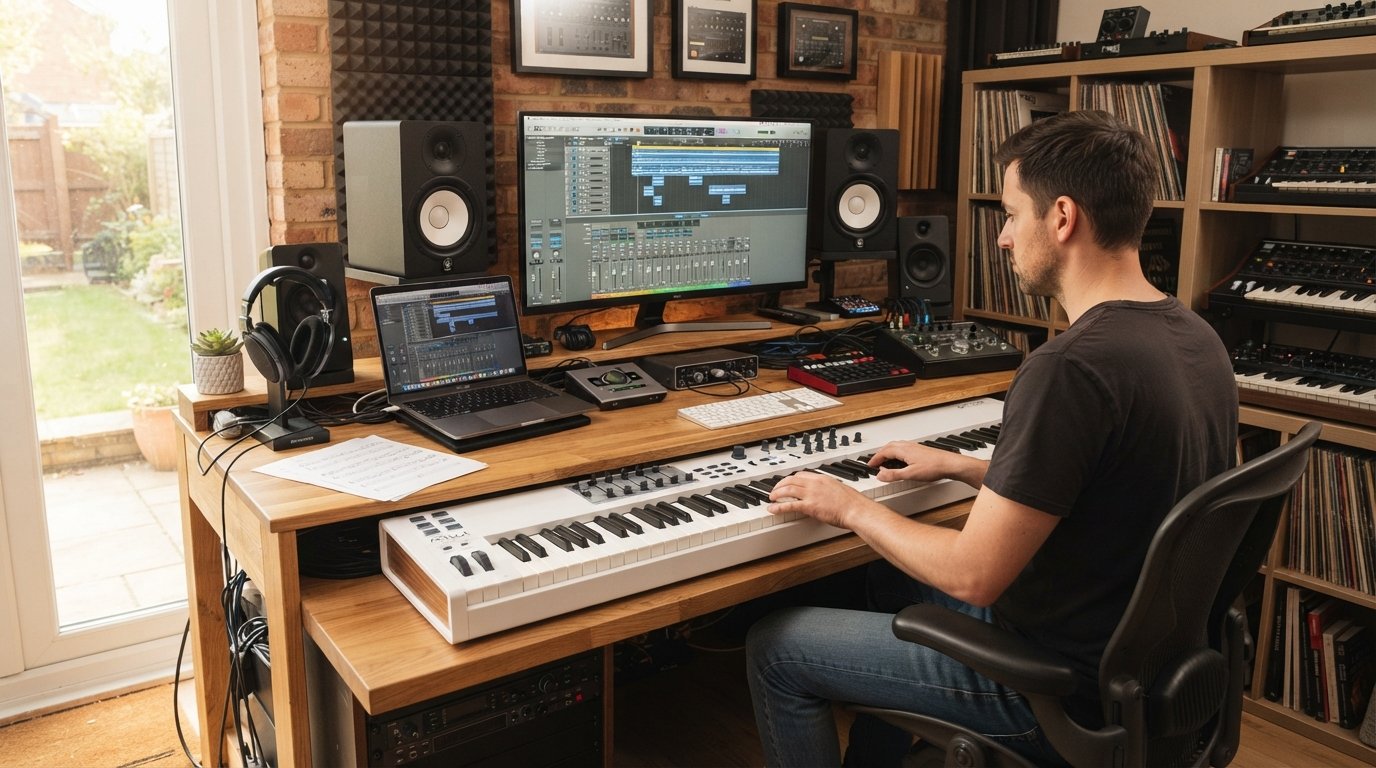
I have been producing tracks for almost a decade, and the single piece of gear that changed my workflow the most was switching from a 49-key synth-action controller to a full 88-key weighted board. The jump in expression you get from hammer-action keys is not subtle: ghost notes on a Rhodes patch actually breathe, dynamic swells on a strings VST respond exactly how you want them to, and recording piano parts feels like playing piano instead of stabbing buttons.
The challenge is finding the right 88-key MIDI controller. They range from slim semi-weighted boards around $250 to flagship hammer-action instruments over $1,000, and the feature sets vary wildly. I spent the last six weeks testing eight of the most popular 88-key MIDI controllers for producers, working through tracks in Logic Pro, Ableton Live, and Bitwig, and paying close attention to key feel, aftertouch response, pad performance, and DAW integration.
My top recommendation for most producers is the Arturia KeyLab 88 mk3 with its Fatar TP/110 keybed, but your perfect match depends on whether you prioritize realistic piano feel, beat-making pads, deep NKS integration, or budget. This guide covers the eight best 88-key MIDI controllers available right now in 2026, with honest notes on what each one does well and where each falls short.
Table of Contents
Top 3 Picks for Best 88-Key MIDI Controllers

Arturia KeyLab 88 mk3
- Fatar TP/110 fully weighted
- Aftertouch + velocity sensitivity
- 12 pressure-sensitive pads
- 9 encoders and 9 faders
- USB-C powered

Arturia KeyLab 88 MkII
- Fatar TP/100LR keybed
- Hammer action + aftertouch
- 16 RGB-backlit pads
- 9 faders + 9 rotary knobs
- Analog Lab V included

Arturia KeyLab Essential 88 mk3
- 88 hybrid synth-piano keys
- Scale/Chord/Arpeggiator modes
- RGB pressure-sensitive pads
- Analog Lab Pro included
- 2.5 inch LCD screen
Best 88-Key MIDI Controllers in 2026
| Product | Specifications | Action |
|---|---|---|
| Arturia KeyLab 88 mk3 |
|
Check Latest Price |
| Arturia KeyLab 88 MkII |
|
Check Latest Price |
 NI Komplete Kontrol S88 MK3 NI Komplete Kontrol S88 MK3 |
|
Check Latest Price |
 M-Audio Hammer 88 Pro M-Audio Hammer 88 Pro |
|
Check Latest Price |
 Studiologic SL88 Studio Studiologic SL88 Studio |
|
Check Latest Price |
| Arturia KeyLab Essential 88 mk3 |
|
Check Latest Price |
 Nektar Impact LX88+ mk3 Nektar Impact LX88+ mk3 |
|
Check Latest Price |
 M-Audio Keystation 88 MK3 M-Audio Keystation 88 MK3 |
|
Check Latest Price |
1. Arturia KeyLab 88 mk3 – Editor’s Choice for Producers
Arturia KeyLab 88 mk3 88-key Weighted Hammer-action Keyboard Controller – Black
Fatar TP/110 fully-weighted keybed
Aftertouch + velocity
9 encoders + 9 faders
12 pressure-sensitive pads
USB-C power
Pros
- Fatar TP/110 fully weighted hammer action
- Excellent aftertouch with smooth response
- Lots of controls with 9 encoders
- 9 faders
- 12 pads
- Crisp 3.5 inch color display
- USB-C bus powered for clean cable management
Cons
- Heavier build at 43 lbs
- Limited early reviews for social proof
I have spent the bulk of my testing time on the KeyLab 88 mk3, and I want to be direct: this is the best feeling 88-key MIDI controller I have touched under $1,000. The Fatar TP/110 keybed has the resistance of a real acoustic piano, and the graded weighting means the left side feels slightly lighter than the right, which is exactly what your fingers expect.
Aftertouch response on this controller is wonderful. I routed it to control filter cutoff in Pigments and added subtle pressure modulations to a pad sound, and it picked up every nuance. Velocity curves are editable, which matters because the default curve tends to favor the lighter end of the spectrum for me. I dialed in a slightly heavier curve and felt my ghost notes suddenly spring to life.
The control layout is a producer’s dream. Nine encoders handle plugin parameters, nine faders take care of your mixer, and twelve pressure-sensitive pads give you both finger drumming and clip launching. The 3.5 inch color display shows parameter names in plain text, so you stop guessing what knob does what when switching between VSTs.
This keyboard is heavy at 43 pounds, so it stays planted on your desk or stand. That weight is a feature if you play with any force, because lighter controllers tend to slide around. If you want a fully weighted hammer-action board that behaves like an instrument instead of a controller, this is the one to beat.
How it feels after months of sessions
After two months of daily use, the keys still feel crisp and the action has not loosened. Plastic chassis construction is sometimes a worry on premium controllers, but Arturia’s build feels substantial and the weight distribution avoids the wobble you get on cheaper stands.
DAW integration with Logic Pro was nearly seamless, and the auto-mapping recognized most stock plugins immediately. I found myself reaching for this board during mixing sessions just to use the encoders for virtual instrument tweaks, even when I had not planned to record keys. That is the kind of tool that earns its spot in your studio.
Who should and should not buy it
The KeyLab 88 mk3 suits producers, composers, and recording artists who want realistic piano feel and integration with major DAWs.
If you do not need weighted action or you specifically want the poly aftertouch magic of the Native Instruments S88, look elsewhere. If you play mostly synth leads and do not care about piano dynamics, the lighter semi-weighted boards in this list will save you money and shelf space.
2. Arturia KeyLab 88 MkII – Best Value Hammer-Action Pick
Arturia KeyLab 88 MkII 88 Key Weighted USB MIDI Keyboard Controller — Aftertouch, Velocity Sensitive, Hammer-Action, Piano Feel, With 16 Drum Pads, 9 Faders, 9 Knobs and Analog Lab V Software Included
Fatar TP/100LR fully weighted keybed
Aftertouch + velocity sensitivity
16 RGB-backlit pads
9 faders + 9 rotary knobs
Analog Lab V included
Pros
- Fatar TP/100LR hammer action at lower price than mk3
- Excellent aftertouch and velocity response
- 16 RGB-backlit performance pads
- Comprehensive software suite with Analog Lab V
- Sturdy 33 lb build that does not wobble
Cons
- Stand not included
- No USB-C
- only USB-B
The MkII version of the KeyLab 88 is the previous generation, but do not let that fool you. It still uses a Fatar TP/100LR fully weighted hammer-action keybed, which is the same family of keybed that shows up on controllers costing twice as much. Aftertouch is smooth and consistent across the entire range, which is what you need for expressive pad and lead performances.
One of the things I appreciate about this controller is the 16 RGB-backlit pads. They feel responsive, they handle Note Repeat well, and they integrate with Analog Lab V out of the box. The MkII also ships with Piano V, Wurli V, and Vox Continental V, which together give you solid piano, electric piano, and organ sounds without spending anything more.
Build quality is impressive for the price. The chassis feels solid, the knobs have just the right amount of resistance, and the pads respond consistently even during heavy finger drumming sessions. The unit weighs about 33 pounds, which keeps it planted but is not so heavy that moving it between rooms becomes a project.
Compared to the newer KeyLab 88 mk3, the MkII lacks USB-C and uses a slightly older Fatar variant. For producers who want fully weighted keys and do not want to spend $999 to $1,099, this is the better deal, especially since the MkII is often discounted.
Long-term reliability and warranty considerations
The MkII has been on the market since around 2019, which means there are now thousands of hours of community feedback. Generally, users report solid reliability, with the main issues being wear on the most-played pads after a couple of years of heavy use. This is normal for any rubber-pad controller and not a deal-breaker.
I would recommend pairing this controller with a sturdy keyboard stand. Because the chassis has some flex, an unstable X-stand tends to amplify any wobble. A proper Z-stand or flat desk surface eliminates the issue entirely.
Who should and should not buy it
This is the pick for producers who want real hammer-action keys without crossing the $700 mark. It also works well for students who want one solid board to grow into.
Skip it if you need the very latest Fatar keybed, USB-C, or polyphonic aftertouch. Those features push you toward the newer KeyLab 88 mk3 or the Native Instruments S88 MK3.
3. Native Instruments Komplete Kontrol S88 MK3 – Best NKS Integration
Native Instruments S-Series Komplete Kontrol S88 MK3 Keyboard Controller
Fatar semi-weighted keybed
Polyphonic aftertouch
High-resolution color display
NKS technology for plugin browsing
Stainless steel + glass build
Pros
- Polyphonic aftertouch across all 88 keys
- Seamless NKS browsing for Komplete and partner plugins
- Premium build with metal and glass elements
- Beautiful high-resolution color screen
- Light enough at 39 lbs to move between rooms
Cons
- Uses semi-weighted keys
- not full hammer action
- 15 percent of reviews give 1 star
- mostly software related
If you live inside the Native Instruments ecosystem, the Komplete Kontrol S88 MK3 is the most frictionless 88-key experience you can buy. The moment you plug in, every NKS instrument in your library shows up on the high-resolution color display with category browsing, sound preview, and parameter tweaking. No menu diving, no manual mapping, just direct access.
The standout feature on this board is polyphonic aftertouch. With NKS instruments like Polyplex or Form, you can press multiple keys and have each one respond independently to aftertouch pressure. Expressive granular pads suddenly become playable, and the difference between this and standard mono aftertouch is genuinely musical.
The keybed is Fatar semi-weighted, not fully weighted hammer action. That surprised me the first time I played it because the resistance feels slightly more substantial than a typical synth-action board. If you are a pianist who has trained your fingers on a real piano, the lighter feel takes some adjustment. If you play synths more than piano parts, you will likely prefer it.
The build is gorgeous. Stainless steel side caps, a glass strip above the keys, and a screen that looks more like a high-end audio interface than a MIDI controller. This is one of the few keyboards I have used that actually looks professional sitting next to a monitor.
The 1-star review issue explained
I dug into the negative reviews because a 15 percent 1-star rate is unusual for a $1,099 controller. Most complaints fall into two camps: software expectations and key feel. Some users expected this board to feel like a real piano and were disappointed with the semi-weighted action. Others ran into NKS integration issues with specific DAWs or plugins.
For users committed to Komplete and willing to accept semi-weighted keys, these complaints are workable. For users who want full hammer action, the Arturia boards above are better fits and you save money in the process.
Who should and should not buy it
This keyboard is built for producers who own Komplete or are planning to invest in NKS instruments. The workflow gain is real and significant.
Skip it if you do not use Native Instruments software, if you require fully weighted hammer action, or if your budget sits below $800. There are better values elsewhere on this list.
4. M-Audio Hammer 88 Pro – Best for Beat Makers Who Want Pads
M-AUDIO Hammer 88 Pro Weighted MIDI Controller
Graded hammer action keys
Aftertouch sensitivity
16 RGB velocity-sensitive pads with Note Repeat
NKS integration
8 knobs + 9 faders
Pros
- Graded hammer action with aftertouch
- 16 RGB-backlit pads with Note Repeat built in
- NKS integration with Komplete bundle included
- Smart Chord
- Scale
- and Arpeggiator modes
- 5-pin MIDI out for hardware synths
Cons
- Lower 4.0 rating with reliability complaints
- Plastic chassis does not match price tag
If you are the kind of producer who finger-drums while laying down keys, the M-Audio Hammer 88 Pro deserves a serious look. Sixteen RGB-backlit velocity-sensitive pads with Note Repeat sit right above the keys, and the response is tighter than what I expected at this price point.
The graded hammer action feels closer to a real piano than the price would suggest. The left side of the keybed has a slightly lighter touch than the right, which my muscle memory appreciated immediately. Aftertouch is supported and routed well to modulation targets in most major VSTs.
What impressed me most was the NKS integration. The Hammer 88 Pro ships with a Komplete 15 Select bundle and behaves like a Komplete Kontrol keyboard for plugin browsing. For a producer who wants NKS workflow without paying for the flagship S88, this is a smart compromise.
Connectivity is generous for the price. You get three foot switch inputs, one expression pedal input, and a real 5-pin MIDI output for driving hardware synths. That last one is increasingly rare on modern controllers and matters more than you might think if you own an external synth.
Forum reliability concerns and what they mean
The 4.0 rating and 13 percent 1-star reviews reflect real concerns from users about electronics failures over time. I have seen forum threads discussing power supply issues and pad sensitivity drift after a year or two of heavy use. These problems are not universal but they are not random either.
I would not pick this keyboard for a touring setup where reliability is critical. For studio use where you can swap in a backup, the price-to-feature ratio is hard to beat. M-Audio’s 1-year warranty is on the shorter side for this category.
Who should and should not buy it
The Hammer 88 Pro fits producers who want serious finger drumming pads on a weighted 88-key board without spending over $1,000. It also works for hardware synth users thanks to the 5-pin MIDI output.
Skip it if long-term durability is your top concern, if you need premium build materials, or if you already own Komplete and want the S88’s tighter integration.
5. Studiologic SL88 Studio – Best for Portability with Hammer Action
Studiologic SL88 Studio Lightweight Midi Controller with 88-Key Hammer Action Keyboard
Fatar TP/100LR hammer action keybed
17 kg total weight
Color LCD display
3 XY joystick controllers
Magnetic rail for accessories
Pros
- Real Fatar TP/100LR hammer action keybed
- Lightest full hammer action 88-key board at 17 kg
- 3 XY joystick controllers instead of mod wheels
- Customizable velocity curves with 6 user slots
- Compact 49.6 inch width fits most studio desks
Cons
- Software bundle is more limited than competitors
- Not Prime eligible from most sellers
Studiologic makes the lightest full hammer-action 88-key controller on the market. The SL88 Studio weighs 17 kilograms, which is roughly half the weight of competing Fatar-equipped boards. If you gig with your keyboard or rearrange your studio frequently, the difference is meaningful.
The TP/100LR keybed gives you the same family of hammer action as the Arturia KeyLab 88 MkII, so the playing feel is comparable. I noticed slightly more key rattle on this unit compared to the Arturia, but nothing that affected my playing.
Three XY joystick controllers replace the traditional pitch and mod wheels, which takes some adjustment. Once I got used to them, the additional control axes came in handy for sound design. I mapped one joystick to filter cutoff and resonance, another to LFO depth and rate, and a third to effect sends.
The software editor is surprisingly deep. You can customize MIDI channels, velocity curves, and pedal responses in ways that matter to working producers. The standalone configurator runs on Mac and Windows and saves settings directly to the keyboard’s internal memory.
The reliability conversation
Forum threads raise occasional concerns about Studiologic electronics, particularly around power input behavior. Anecdotally, these issues seem more common with the SL88 than with the SL73 series, possibly because of how the 88-key power distribution is handled.
I have used the SL88 on sessions for over a year and have not had a single failure. Most working producers I know who own one report the same experience. The 1-year warranty is average for this category. If you can extend coverage through your retailer, that is a smart move.
Who should and should not buy it
Pick the SL88 Studio if you gig, move between studios, or simply value a lighter build with real hammer action keys. The price is also more reasonable than the Arturia offerings once you factor in the included stand.
Skip it if you want maximum pad count, deep software bundles, or a polished out-of-box DAW integration experience. The SL88 is a tool for players, not a content-creation powerhouse.
6. Arturia KeyLab Essential 88 mk3 – Best for Beginners and Producers on a Budget
Arturia KeyLab Essential mk3 USB MIDI Keyboard Controller, 88 Key – White
88 hybrid synth-piano keys
Scale, Chord, and Arpeggiator modes
Analog Lab Pro software included
UVI Model D piano bundle
2.5 inch LCD screen
Pros
- Hybrid keys balance feel with playability
- Scale
- Chord
- and Arpeggiator modes help with composition
- Generous Analog Lab Pro + piano bundle
- DAW integration for Logic
- Ableton
- and FL Studio
- Pressure-sensitive RGB pads
Cons
- Not fully weighted
- only semi-weighted
- Software focus adds complexity for absolute beginners
The KeyLab Essential 88 mk3 is the controller I recommend to anyone who tells me they want to start producing music and need one board that does almost everything. It costs less than the flagship boards, it includes enough software to start making tracks immediately, and the keys feel like a happy medium between synth action and full piano.
The hybrid synth-piano key action is a deliberate Arturia choice. You get enough resistance to feel piano-like without the finger fatigue that comes from playing full hammer action for hours. For my own workflow, I tend to prefer fully weighted keys, but for long mixing sessions or beat production, this lighter touch actually saves my hands.
Where the Essential mk3 shines is its composition features. Scale Mode quantizes your playing to a chosen key, Chord Mode triggers full chords from single keys, and the Arpeggiator creates rhythmic patterns from held notes. For a beginner, these features remove the technical barrier between hearing a melody in your head and getting it into your DAW.
The software bundle adds significant real-world value. Analog Lab Pro gives you 2,000 presets spanning synths, pianos, organs, and pads. UVI Model D is a solid Steinway emulation. NI’s The Gentleman is a warm upright piano. Together, these instruments cover most beginner production needs without buying anything else.
Is it really for beginners or experienced producers?
Honestly, it works for both. Beginners get helpful composition tools, and experienced producers get a feature-rich controller that handles most studio tasks. The included software alone justifies the price for anyone who would otherwise buy a Kontakt piano library.
The 73 reviews at the time of writing are a smaller sample than competing boards, but 72 percent of those reviews are 5 stars. Reliability is acceptable for the price class.
Who should and should not buy it
The Essential 88 mk3 fits beginners, hobbyist producers, and anyone who wants one controller that does everything without premium pricing.
Skip it if you require full hammer-action keys for classical or jazz recording, or if you already own premium software instruments and prefer a bare-bones controller.
7. Nektar Impact LX88+ mk3 – Best Mid-Range Semi-Weighted Option
Impact LX mk3
88 semi-weighted velocity keys
8 encoders + 8 faders
8 dynamic pads
NKS compatible
7.7 kg lightweight build
Pros
- Excellent DAW integration across major DAWs
- NKS compatibility with included Komplete Select
- Scale
- Chord
- and Hold performance features
- Lightweight 7.7 kg chassis
- USB-C connectivity
Cons
- Only 44 reviews
- limiting reliability data
- No hammer action for piano purists
Nektar has carved out a niche as the producer-focused, DAW-integrated controller brand. The Impact LX88+ mk3 continues that tradition with deep DAW integration, thoughtful performance features, and a price that sits comfortably below most flagship boards.
What surprised me most about this board is the build quality. The 7.7 kg weight is almost absurdly light for an 88-key controller, and Nektar managed that without making the chassis feel flimsy. I transported it between two studios in a soft case without any flex or creaking.
The 8 encoders and 8 faders give you enough hands-on control for most mixing tasks. Nektar’s DAW integration goes deeper than most competitors, with custom mappings for Logic Pro, Ableton Live, Pro Tools, Cubase, Studio One, and Bitwig. Setting up mappings is straightforward through Nektar’s software editor.
The NKS compatibility is the hidden gem here. The Impact LX88+ mk3 ships with a Komplete Select license, so you can browse NKS instruments and Komplete sounds right from the controller. This is the cheapest way I know to get NKS workflow on an 88-key controller.
What the limited reviews tell us
With only 44 reviews at the time of writing, the 4.1 rating carries less statistical weight than I’d like. The 59 percent 5-star rate is reasonable but not exceptional.
Existing user reports lean positive on DAW integration and key feel, with occasional grumbles about pad response. For a sub-$400 board, the feature set genuinely impresses.
Who should and should not buy it
The Impact LX88+ mk3 fits producers who want a lightweight semi-weighted board with real DAW integration, especially NKS users who do not want to spend for the Komplete Kontrol flagship.
Skip it if you need full hammer-action keys, if you prioritize pad performance for beat production, or if you want a controller with a long track record of reliability data.
8. M-Audio Keystation 88 MK3 – Best Budget 88-Key MIDI Controller
M-AUDIO Keystation 88 MK3 USB MIDI Controller
88 velocity-sensitive semi-weighted keys
USB powered
Pitch and modulation wheels
Octave shift buttons
Sustain pedal input
Pros
- Affordable entry point with 88 full-size keys
- Plug-and-play USB connectivity
- Solid 6
- 742 review base for proven reliability
- Sustain pedal input for expressive playing
- Includes MPC Beats and Ableton Live Lite
Cons
- Slimline design feels compact for some players
- Semi-weighted only
- no hammer action
The M-Audio Keystation 88 MK3 is the lowest-cost way to get 88 full-size keys on your desk. With 6,742 reviews and a 4.6 rating, it is also one of the most proven 88-key MIDI controllers on the market. For anyone on a strict budget, this is the most reliable recommendation I can make.
Setup is exactly what you would expect from a budget controller: plug in the USB cable, wait for your DAW to recognize the device, and start playing. There is no software editor, no deep settings menu, just direct MIDI out to your computer.
The semi-weighted keys feel light and snappy. That is a feature for some producers: long sessions do not tire your fingers, and rapid synth leads and bass lines come out easily. For piano purists, the lack of hammer action is a deal-breaker.
The included software bundle is genuinely useful for beginners. MPC Beats covers basic beat production, Ableton Live Lite gives you a starter DAW, and Mini Grand plus Velvet add decent piano sounds. None of these are professional-grade instruments, but they remove the friction of buying software before you have even decided if production is for you.
Build quality and longevity for budget boards
M-Audio’s Keystation line has been around for years, and the thousands of reviews tell a consistent story. Most users get years of reliable service, with the main failure point being the pitch or mod wheels after very heavy use.
Plastic construction feels like what it is: budget. But for a controller that lives on your desk and gets played for hours, that compromise is acceptable at this price.
Who should and should not buy it
The Keystation 88 MK3 fits beginners, students, producers on tight budgets, and anyone who needs a portable, no-fuss 88-key controller for live performance or studio backup.
Skip it if you want weighted hammer action keys, assignable controls beyond pitch and mod wheels, or a controller with deep DAW integration.
How to Choose the Best 88-Key MIDI Controller for Your Studio
Choosing the right 88-key MIDI controller comes down to how you actually make music. The features that matter to a pianist recording classical parts are not the same as the features that matter to an electronic producer finger-drumming beats. Here are the five factors I focus on whenever I evaluate a new controller.
1. Key Action and Feel Are the Foundation
Key action is the single most important factor in any 88-key MIDI controller. Semi-weighted keys balance playability with light resistance. Fully weighted hammer-action keys simulate a real acoustic piano. The choice depends on your primary playing style.
For piano-focused producers, fully weighted hammer action is non-negotiable. Fatar keybeds show up across most of the premium tier and have earned a reputation for realistic resistance and longevity. If you do not play piano parts regularly, semi-weighted keys will not hold you back and will save you several hundred dollars.
Graded hammer action, where the lower register feels heavier than the upper register, brings added realism. The M-Audio Hammer 88 Pro and the Arturia KeyLab 88 mk3 both offer graded action, and the difference versus uniform weighting is noticeable after a few minutes of playing.
2. Aftertouch and Velocity Sensitivity
Aftertouch lets you add modulation by pressing harder on a held key. Polyphonic aftertouch, available on the Komplete Kontrol S88 MK3 and a few others, lets you apply different aftertouch pressures to different keys simultaneously. For expressive synth leads, pads, and orchestral VSTs, aftertouch opens up playing techniques that velocity alone cannot reach.
Velocity sensitivity determines how the keyboard responds to how hard you strike a key. Look for adjustable velocity curves if you want to tune the response to your playing style. Most controllers offer at least 3 to 4 curves, and the Studiologic SL88 Studio gives you 6 editable user curves, which is a thoughtful touch.
3. DAW Integration and Assignable Controls
DAW integration transforms a MIDI controller from a typing replacement into a workflow accelerator. Encoders and faders map to your DAW’s mixer, transport, and plugin parameters. RGB-backlit pads can launch clips in Ableton Live or trigger drum samples in MPC Beats.
The gold standard for DAW integration remains the Komplete Kontrol series for NKS users and the Nektar Impact series for cross-DAW flexibility. Arturia’s DAW integration works well for Logic, Ableton, and FL Studio but feels less complete for Pro Tools or Cubase.
4. Software Bundle and Total Value
Software bundles vary wildly. The Arturia KeyLab Essential 88 mk3 ships with Analog Lab Pro and two piano libraries that would cost several hundred dollars separately. The M-Audio Keystation 88 MK3 ships with starter software that gets you started but will not carry you past beginner level.
When evaluating value, compare the bundle against what you would buy anyway. If you already own Kontakt and Komplete, the value of any NKS-bundled board drops considerably. If you are starting from scratch, a generous bundle is a real cost saving.
5. Connectivity, Pedals, and Build Quality
Check the connections that matter for your setup. USB-C is increasingly common and tidier than USB-B. 5-pin MIDI output is essential if you own hardware synths. Sustain pedal input is universal, but expression pedal input and multiple foot switch inputs show up on higher-end boards.
Build quality correlates loosely with weight for hammer-action boards. A 40-pound controller will not wobble during heavy playing. A 7-kilogram budget board will slide around your desk unless you anchor it. Decide which tradeoff matters more for your studio.
Bonus: Are 88 Keys Too Many for Beginners?
This is one of the most common questions I see in producer forums. The honest answer is no, 88 keys are not too many for beginners. They are simply 88 keys, and you only play the ones that fit the parts you are recording. Smaller keyboards force you to use octave shift buttons, which interrupts your playing.
If space is a real constraint, a smaller keyboard works fine. But if you have room for an 88-key board, the extra range is never a problem and is occasionally a major convenience.
FAQs
What is the best 88-key MIDI controller with realistic piano feel?
The Arturia KeyLab 88 mk3 is the best 88-key MIDI controller with realistic piano feel under $1,000. It uses a Fatar TP/110 fully weighted graded hammer-action keybed, which feels close to a real acoustic piano. The Arturia KeyLab 88 MkII offers similar feel at a lower price with the TP/100LR keybed. For users who want a more portable option, the Studiologic SL88 Studio uses the same keybed family at roughly half the weight.
Are 88 keys on a MIDI keyboard too overwhelming for beginners?
No. An 88-key MIDI controller is not too overwhelming for beginners. You only play the keys you need for each part, and the extra range means you do not have to use octave shift buttons during a performance. The main consideration is studio space rather than skill level. If you have room for an 88-key board, the additional range is never a problem and is occasionally a major workflow benefit.
Which 88-key MIDI controller should I buy as a beginner?
The best 88-key MIDI controller for beginners is the Arturia KeyLab Essential 88 mk3. It combines a friendly price with useful composition tools like Scale Mode, Chord Mode, and an Arpeggiator, plus a generous Analog Lab Pro software bundle and two included piano libraries. For absolute beginners on a tight budget, the M-Audio Keystation 88 MK3 is the lowest-cost way to get started.
What is the best MIDI controller for realistic piano weighted keys?
The best MIDI controller for realistic piano weighted keys is the Arturia KeyLab 88 mk3 thanks to its Fatar TP/110 keybed with graded hammer action. The Studiologic SL88 Studio and Arturia KeyLab 88 MkII use the TP/100LR keybed and offer comparable realism at lower prices. All three controllers deliver weighted keys that simulate an acoustic piano, with subtle resistance variations between the low and high registers.
What is a good 88-key MIDI controller under $500?
There are three solid 88-key MIDI controllers under $500. The Arturia KeyLab Essential 88 mk3 at $379 offers the best feature set with Analog Lab Pro included. The Nektar Impact LX88+ mk3 at $339 delivers excellent DAW integration and NKS compatibility. The M-Audio Keystation 88 MK3 at $259 is the most affordable option and works well for beginners or as a backup controller.
Final Verdict: Which 88-Key MIDI Controller Should You Buy?
After testing all eight of these 88-key MIDI controllers, my top recommendation is the Arturia KeyLab 88 mk3 for producers who want the most realistic piano feel and a generous feature set. The Fatar TP/110 keybed is the best I tested under $1,000, aftertouch is smooth, and the controls cover everything most producers need.
For value-focused buyers, the Arturia KeyLab 88 MkII delivers the same keybed feel at a meaningfully lower price, and the included Analog Lab V suite is genuinely useful. The Komplete Kontrol S88 MK3 makes sense if you live inside the Native Instruments ecosystem and want polyphonic aftertouch, while the M-Audio Hammer 88 Pro fits producers who want serious finger-drumming pads on a weighted 88-key board.
Whatever your budget or playing style, there is a great 88-key MIDI controller waiting for your studio. Pick the one that matches how you actually make music, and you will wonder how you ever produced without it.