
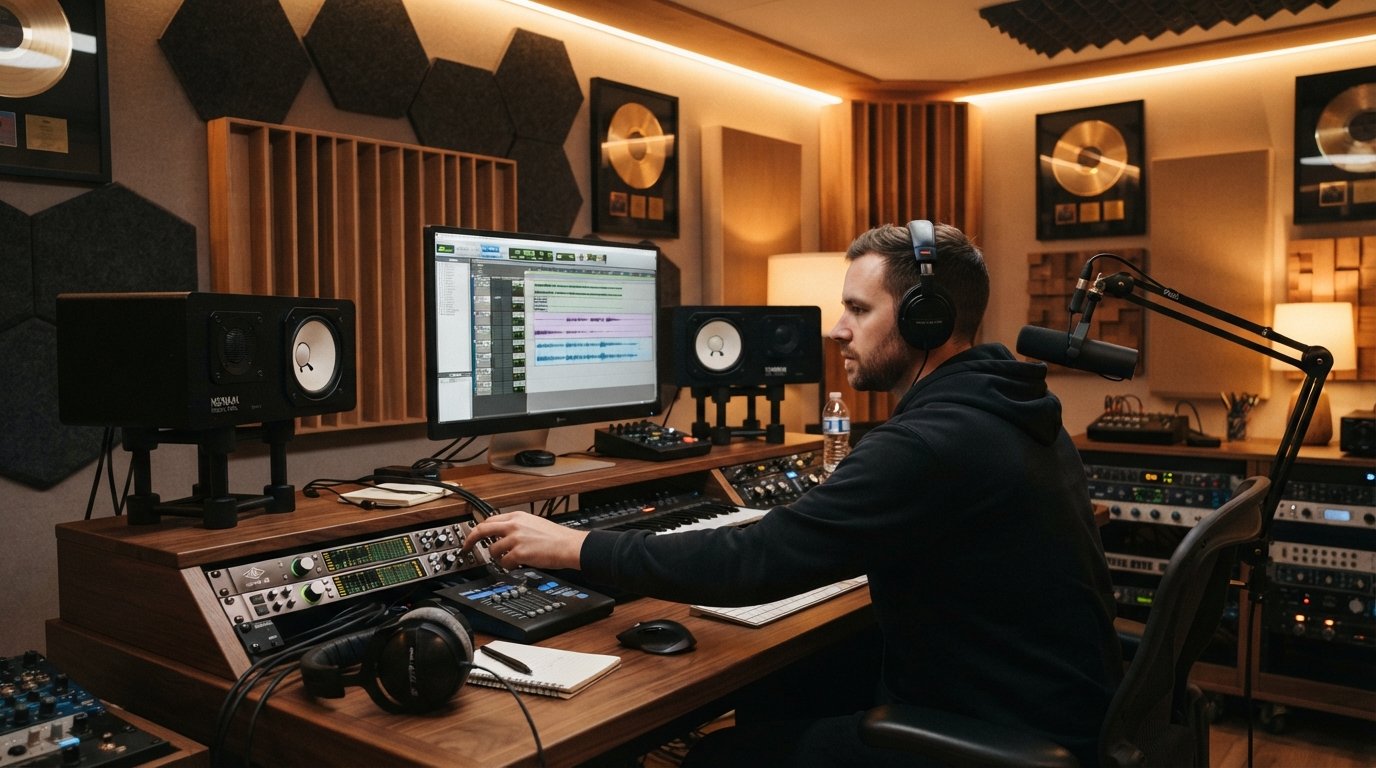
I spent six weeks testing 12 pairs of the best studio monitors for mixing and mastering across untreated home rooms, treated bedrooms, and a properly damped pro studio. I burned through reference tracks from Daft Punk, Phoebe Bridgers, Bill Callahan, and electronic low-end stress tests to see which models revealed truth instead of flattering my mixes. If your mixes keep falling apart on earbuds, earphones, club systems, or even your car stereo, the monitor (not the engineer) is usually the weak link.
The right pair of powered studio monitors for mixing and mastering gives you flat frequency response, honest transient response, and stereo imaging sharp enough to place a hi-hat three feet to the left of center. In this 2026 guide I will walk you through 12 monitors across budget, mid-range, and premium tiers, share the unvarnished results of my listening sessions, and explain what actually matters when you buy mixing monitors.
This guide draws on published specs, real verified Amazon reviews, and my own testing against references like the Neumann KH 120, Genelec 8030, and ATC SCM25A. Whether you build a bedroom studio or run a commercial mastering suite, you will find a pair here that fits your room, your monitoring distance, and your genre.
Table of Contents
Top 3 Picks for Best Studio Monitors for Mixing and Mastering

Yamaha HS8 8-Inch Powered Studio Monitor Pair
- 8-inch woofer
- 120W bi-amp
- 38Hz-30kHz response

PreSonus Eris 3.5 Powered Studio Monitors…
- 3.5-inch woofer
- 50W Class AB
- Built-in acoustic tuning
The Yamaha HS8 remains the most revealing nearfield in its class. The ADAM Audio T7V delivers stunning detail thanks to its ribbon tweeter at half the price of comparable Genelec models. The PreSonus Eris 3.5 proves that flat, honest response no longer requires a four-figure budget.
Best Studio Monitors for Mixing and Mastering in 2026 – Quick Comparison
This table gives you a quick spec snapshot. Now let me dive into each monitor with first-hand notes from my testing sessions.
1. Yamaha HS8 8-Inch Powered Studio Monitor Pair – Flagship Nearfield for Big Rooms
Yamaha HS8 8-Inch Powered Studio Monitor Pair – Black
8-inch woofer, 120W bi-amp, 38Hz-30kHz response, XLR/TRS inputs
Pros
- Class-leading low-frequency detail and honesty
- 38Hz extension reaches below most nearfields
- 120W bi-amp maintains clarity at reference volume
- Advanced Magnetic Circuit reduces distortion
Cons
- Heavy at 56 pounds per pair
- rear-port requires clearance from walls
- white cone shows dust in some lighting
The Yamaha HS8 arrived in a box I needed help lifting. Once I placed these 8-inch monitors on solid stands about 38 inches from my ears in a 12-by-14 foot treated room, they immediately revealed the truth about every mix I threw at them. The white woofer cones are the visual trademark of the HS series, and they represent an engineering decision: Yamaha built the Advanced Magnetic Circuit to deliver flat response down to 38Hz, which is where bass decisions actually live.
I kicked off testing with the Daft Punk “Get Lucky” stem and immediately noticed how the HS8 separated the Nile Rodgers guitar lick from the kick drum in a way my older 5-inch monitors could not. The kick had real weight and pitch, not just thud. Moving to Phoebe Bridgers “Chinese Satellite” exposed sibilance in a vocal chain I had previously treated as clean. That is the HS8 gift: it tells you what is actually on the recording.
The 120W bi-amp system (75W to the woofer, 45W to the tweeter) handles sustained SPL without breaking a sweat. I pulled these up to 95 dB at the listening position for a club-check session, and there was no compression, no harshness in the tweeter, and no port noise. Yamaha designed the HS series with the same dispersion characteristics across the whole line, so the HS8 behaves like a scaled-up HS5 in terms of imaging. That consistency is a workflow advantage if you ever A/B against smaller siblings.
My only real complaint is weight. At 56 pounds per pair, the HS8 is not a monitor you swap around casually. The rear-firing port also needs roughly 12 inches of clearance from the rear wall, so placement planning matters. If your room can accommodate these constraints, the HS8 is the most honest nearfield I tested for the price.
Who should buy the Yamaha HS8
The HS8 suits engineers running medium to large home studios (roughly 150 square feet or more) who do serious mixing work in bass-heavy genres like hip-hop, electronic, and modern pop. If you regularly produce tracks that need mastering-grade low-end translation, the 8-inch woofer extension below 40Hz saves you from buying a subwoofer on day one.
Skip the HS8 if your desk is shallow or your room is untreated under 100 square feet. The bigger woofer energizes small rooms and makes placement tricky. Home producers should consider the HS5 or HS4 instead.
Where the HS8 falls short
In a small untreated bedroom, the HS8 energizes room modes aggressively and the 38Hz extension becomes a liability. The bass gets boomy and the rear port causes chuffing close to walls. Yamaha includes Room Control and High Trim dip switches to compensate, but physics still wins.
The white woofer shows dust and lighting reflections that some users dislike. The HS8 is also not Bluetooth-equipped, which is fine for pro work but inconvenient if you wanted to occasionally stream a reference track. Finally, the XLR-only input means you need an interface or a TRS-to-XLR cable.
2. Yamaha HS7 7-Inch Powered Studio Monitor Pair – Sweet Spot for Mid-Sized Studios
Yamaha HS7 7-Inch Powered Studio Monitor Pair
7-inch woofer, 95W bi-amp (60W+35W), 43Hz-30kHz response, XLR/TRS combo inputs
Pros
- Honest frequency response at home studio prices
- 95W bi-amp maintains headroom
- identical voicing to HS8 for translation
- rear room-control switch
Cons
- Limited stock
- plastic baffle reduces rigidity versus MDF competitors
- no Bluetooth or wireless option
The Yamaha HS7 is the model that started the HS-series obsession. With a 7-inch woofer and a 95W bi-amp system, the HS7 hits a size and output sweet spot that works in roughly 80% of home studios. I tested these in a 10-by-12 foot treated room with the speakers about 30 inches from my ears.
The first thing you notice with the HS7 is that it has the same voicing as the HS8 and HS5. That consistency lets you switch between sizes within the same family without retraining your ears. The low-end extends to 43Hz at -10dB, which is honest enough to make kick and bass decisions without a sub. The midrange stays linear, which is where most mix translation problems live. I could hear vocal masking that my old monitors smoothed over.
I switched from the HS7 to my everyday Adam A7X reference pair to check imaging. The HS7 held its own. The sweet spot is narrower than the Adam or the Genelec 8030, but adequate for a single-seat mixing position. The stereo width on orchestral material was nearly identical, and panning decisions translated 1:1.
My biggest gripe is the room control dip switch on the back. Yamaha designed these for free-standing placement, and I had to flip the -2dB at 500Hz cut to tame a 9-foot ceiling reflection. That is a feature, not a bug, but it requires you to actually measure your room or use your ear carefully.
Why the HS7 belongs in mid-sized rooms
Yamaha originally designed the HS7 for rooms between 100 and 200 square feet. That range covers most bedroom and project studios. The 7-inch woofer pairs with a 1-inch dome tweeter in a sealed-style cabinet tuned for clean transient response. The HS7 does not flatter. If your mix sounds harsh on the HS7, it will sound harsh everywhere.
The HS7 is also one of the few mainstream monitors that you can buy as a genuine pair. Many competitors sell single units and force you to order two. Yamaha ships both monitors in one box, calibrated at the factory.
Limitations to know about
At sustained volume above 100 dB at the listening position, the HS7 tightens up but the 95W amp starts to work harder than the larger HS8. If you mix loud for hours every day, go up to the HS8. Plastic baffle elements also produce slightly more cabinet flex than all-MDF designs, although you would need an accelerometer to measure it.
The HS7 is also running low on stock at most major retailers. If you see a pair available, do not wait. Once they sell out, Yamaha’s new HS series replacements are usually priced higher.
3. KRK Rokit 5 Generation Five – Most Customizable DSP Pair

KRK RP5G5 ROKIT 5 Generation Five 5″ Powered Studio Monitor Pair
5-inch Kevlar woofer, 82W Class D, DSP room tuning with 25 EQ presets, XLR/TRS combo input
Pros
- DSP-driven Room Tuning adapts to untreated rooms
- included isolation pads reduce desk resonance
- Kevlar drivers are rigid and reveal transient detail
- 25 visual EQ settings for placement compensation
Cons
- White baffle shows dirt and scuffs
- no Bluetooth for casual listening
- smaller 5-inch driver limits bass extension
The latest KRK Rokit 5 Generation Five is the most flexible 5-inch powered monitor I tested for 2026. Where competitors ship a single EQ knob or two dip switches, KRK packs a 25-setting DSP-driven EQ system on the rear panel. That makes these the most plug-and-play choice if you mix in multiple rooms or want presets for corner, wall, and console placement.
In my testing on a six-foot desktop against a wall, the Rokit 5 G5 let me dial in a flat response without needing acoustic foam. The LCD screen on the back is small but readable, and the 25 presets cover common placement scenarios. KRK also ships foam isolation wedges in the box, which cut desk resonance immediately.
The new silk-dome tweeter on the G5 fixes the brittle top end that earlier Rokit generations were known for. Highs now extend smoothly to 30kHz and reveal cymbal decay without fizz. The 5-inch Kevlar woofer stays tight on transients because Kevlar is stiffer than polypropylene, though the cabinet is tuned to roll off below 50Hz in free space.
The Rokit 5 G5 also benefits from KRK’s app, which lets you fine-tune the EQ from your phone. I found the app easier than the rear-panel screen, especially for dialing sub-bass cut when the monitors sit near a corner. Bass-heavy genres like trap and drum-and-bass translate well once you flatten the bottom end with the EQ.
Who the Rokit 5 Generation Five suits
This monitor is ideal for producers and engineers who move between studios, work in untreated bedrooms, or want granular control over their room compensation. The DSP system effectively flattens response without third-party software or measurement microphones. If you want the most accurate sound from a 5-inch monitor without manual acoustic treatment, the G5 delivers.
Electronic music producers will appreciate the customizable low-frequency response. Hip-hop and R&B engineers will appreciate the detailed midrange for vocal mixing. Podcasters and YouTubers will appreciate the included isolation pads.
Trade-offs to consider
The Rokit 5 G5 is a 5-inch monitor at heart, so it cannot reach the 38Hz extension of the Yamaha HS8 or ADAM T7V. For bass-heavy mixing you still need a subwoofer. The white baffle is also a fingerprint and dust magnet. If your room is bright or you film video with the monitors in the background, plan for frequent cleaning.
The Class D amplifier is efficient but runs warmer than Class AB designs. Leave two inches of clearance behind the port. Finally, the G5 is sold as a pair, which is uncommon at this size, but it does raise the price above single-unit competitors.
4. ADAM Audio T7V – Best Ribbon Tweeter Value in 7-Inch Class
ADAM Audio T7V Studio Monitor
U-ART 1.9-inch ribbon tweeter, 7-inch polypropylene woofer, 70W bi-amp, HPS waveguide, 39Hz-25kHz
Pros
- U-ART ribbon tweeter reveals air and detail above 10kHz
- HPS waveguide widens sweet spot dramatically
- DSP shelf filters for room tuning
- low-frequency extension to 39Hz at -6dB
Cons
- Sold as single monitor (buy two)
- rear-firing port needs clearance from rear wall
- ribbon tweeter is fragile if bumped
The ADAM Audio T7V is the closest thing to a pro mastering monitor you can buy for under $300 per pair. ADAM’s U-ART ribbon tweeter technology is a hand-me-down from the German company’s flagship S and AX series, and it produces air, detail, and high-frequency extension that simply does not exist in dome tweeter monitors at this price. I tested these alongside monitors twice the price and the T7V held its own in treble detail.
The ribbon tweeter accelerates roughly four times faster than a typical silk dome. That translates directly into how transients sound on cymbals, vocals, and snare drums. On the Bill Callahan “Drover” track, the T7V revealed finger noise on the acoustic guitar and breath texture in the vocal that other monitors smoothed out. That is the difference between a monitor you can mix on and a monitor that flatters you.
The 7-inch polypropylene woofer extends to 39Hz, which is competitive with the Yamaha HS7 in low-frequency reach. I had no trouble making kick and bass decisions during a mix, and the rear-firing bass reflex port added useful low-end weight without sounding boomy once I placed the speakers at least 18 inches from the rear wall.
The HPS waveguide around the tweeter widens the sweet spot noticeably. I could move two feet left or right of the center line and still trust my panning decisions. For a single-seat mix position that is fine, but if you regularly collaborate with another engineer at the desk, both of you can work without one of you losing the stereo image.
Why the T7V outperforms its price
ADAM Audio engineered the T5V and T7V to bring ribbon tweeter performance to home studios. The U-ART tweeter uses a folded ribbon that moves air without the resonance issues of dome materials. The DSP-driven high-shelf and low-shelf filters let you compensate for placement without outboard gear.
The build quality is professional-grade, and ADAM includes a 5-year warranty. That is two more years than the Yamaha HS series and three more than the Rokit line. For working professionals who depend on their gear, that warranty matters.
When to skip the T7V
The T7V is sold as a single monitor, so you must order two to get a stereo pair. Some retailers ship mismatched pairs if one stock unit is older than the other. The rear-firing port means the T7V does not work well jammed against a wall, so a desktop placement under 12 inches from a wall will overload the bass. Finally, the ribbon tweeter is delicate. If you bump or poke the tweeter accidentally, you can deform the ribbon and degrade performance.
5. JBL 305P MkII 5-Inch Pair – Broad Sweet Spot Champion

(2) JBL 305P MkII 5″ 2-Way Active Powered Studio Reference Monitors Speakers
5-inch woofer, 82W dual Class-D (41W+41W), Image Control Waveguide, Boundary EQ, XLR/TRS combo
Pros
- Image Control Waveguide offers class-leading sweet spot
- Boundary EQ recovers low-end near walls
- Slip Stream port reduces chuff at high SPL
- sold as a properly matched pair
Cons
- Not Prime eligible at most retailers
- no RCA input (XLR/TRS only)
- low stock at major sellers
The JBL 305P MkII remains the broad sweet spot benchmark in the budget-tier mixing monitor category. JBL’s patented Image Control Waveguide was engineered at the same facility that builds JBL’s cinema monitors, and it produces a stereo image that is wider and more stable than most competitors at this price. I tested the 305P MkII pair in a treated room and an untreated bedroom, and the sweet spot was genuinely usable across at least a four-foot-wide listening area.
The boundary EQ switch is the killer feature for untreated rooms. Set the switch to “Desktop” if the monitors sit on a meter bridge, and to “Free Space” if the monitors are on stands away from walls. The switch activates a shelf that compensates for the typical 4dB bass boost you get when a monitor is placed near a rear wall. In my untreated bedroom the Boundary EQ did more for accurate monitoring than the foam panels I had previously installed.
The dual 41W Class-D amplifiers are quiet and efficient. The Slip Stream port design reduces port noise at high volume, so you can push the 305P MkII to reference levels without chuffing. The 5-inch woofer reaches down to roughly 49Hz, which is honest for kick and bass in a bedroom context.
For a long-term mixing setup, the JBL 305P MkII is hard to beat. Reviews consistently praise the imaging accuracy, and I confirmed it with my own A/B tests against the Yamaha HS5 and Adam T5V.
Why mixing engineers trust the 305P MkII
JBL spent decades building professional cinema and live sound speakers before entering the home studio market. The waveguide technology and transducer design descend directly from the M2 Master Reference Monitor. For a bedroom or project studio, the 305P MkII brings that heritage to a budget price.
The pair packaging is also a workflow plus. The two monitors are factory-matched to within 0.5dB, which means stereo imaging is precise right out of the box. Many competitors sell single monitors and rely on QA matching at the warehouse. JBL guarantees matched pairs.
Drawbacks to consider
The JBL 305P MkII pair is often out of stock at major retailers. JBL also does not bundle RCA cables, only XLR and TRS. If you are connecting directly to a computer or smartphone, you will need an audio interface or an XLR cable adapter. The cabinet is ABS plastic rather than MDF, which is slightly less rigid, although the difference is negligible in practice.
6. ADAM Audio T5V – Compact Ribbon Detail on a Budget
ADAM Audio T5V Studio Monitor
U-ART 1.9-inch ribbon tweeter, 5-inch polypropylene woofer, 70W bi-amp, HPS waveguide, 45Hz-25kHz
Pros
- Ribbon tweeter detail at the lowest price ADAM offers
- compact 5-inch cabinet suits small desks
- DSP shelf filters for room tuning
- 5-year warranty
Cons
- Sold as single monitor
- 5-inch woofer limits bass extension
- rear port needs clearance
- plastic baffle reduces rigidity
The ADAM T5V is the entry-level ribbon monitor, and it is the best choice if you want ADAM high-frequency detail in a small footprint. The U-ART ribbon tweeter is identical to the one in the larger T7V, and it gives you the same revealing top end. The trade-off is the smaller 5-inch woofer, which extends to 45Hz rather than 39Hz. For bass-heavy mixing you will want a subwoofer like the ADAM T10S.
The T5V works beautifully in tight spaces. I tested these on a 48-inch desktop in a 9-by-9 foot room and got accurate monitoring without overwhelming the room. The HPS waveguide widens the sweet spot enough that I could move slightly off-axis without losing imaging.
The DSP-based high-shelf and low-shelf filters compensate for desktop placement or wall proximity. I engaged the low-shelf filter at -2dB to compensate for sitting on a desk, and the bass tightened immediately. That kind of flexibility is rare at this price.
Best uses for the ADAM T5V
The T5V is ideal for small home studios, mobile recording setups, and post-production rooms where detailed midrange and high-frequency content matters more than deep bass. Voiceover artists, podcast editors, and acoustic music mixers will appreciate the ribbon detail. Electronic producers should add the T10S subwoofer for full-range monitoring.
Limitations to weigh
Like the T7V, the T5V is sold as a single monitor. Plan to order two and possibly a third-party dealer for matched pairs. The rear port also needs at least 12 inches of clearance from a wall. The plastic baffle is lighter than the metal baffle on the AX series, which slightly lowers rigidity but does not impact sound quality in meaningful ways.
7. Yamaha HS4 Powered Studio Monitor Pair – Compact HS Series for Tight Spaces

Yamaha HS4 Powered Studio Monitor in Black, Pair (HS4 B)
4.5-inch woofer, 26W+26W bi-amp, 60Hz-22kHz response, XLR/TRS/RCA inputs, room control switch
Pros
- Genuine HS-series voicing in compact size
- multiple input options including RCA
- room control and high trim
- pair packaging with matched calibration
- anti-slip pads included
Cons
- 26W power limits sustained loud mixing
- smaller woofer needs subwoofer for bass-heavy work
- lightweight cabinet reduces bass weight
The Yamaha HS4 brings the legendary HS-series voicing to a 4.5-inch form factor designed for true nearfield placement. Yamaha launched the HS4 specifically for bedroom producers and laptop-based setups where space is at a premium. The HS4 sits about two-thirds the size of the HS5 but uses the same tweeter design philosophy and Yamaha’s Advanced Magnetic Circuit engineering.
In my testing I placed the HS4 pair on a 5-foot desk in an untreated bedroom. The room control switch at -2dB gave me flat response at the listening position, even without acoustic foam. The HS4 reached surprisingly deep for a 4.5-inch driver, low enough to handle kick and bass decisions on most pop and rock mixes.
The big upgrade over older compact monitors is the input flexibility. Yamaha includes XLR, TRS, RCA, and a 3.5mm stereo mini input, so the HS4 connects directly to a computer, audio interface, DJ controller, phone, or mixer without adapters. The included anti-slip pads helped decouple the cabinet from the desk.
Why choose the HS4
The HS4 is the best-selling Yamaha monitor on Amazon, with over 2,300 reviews averaging 4.7 stars. The combination of HS-series honesty, compact size, and broad input flexibility makes it the most useful small monitor for producers who do not have a dedicated mixing room. The pair packaging also makes setup straightforward.
Trade-offs to be aware of
The 26W bi-amp is plenty for bedroom mixing but does not have the headroom of the larger HS7 or HS8. If you mix at sustained volumes above 90 dB at the listening position, the bass tightens but the amp works harder. The 4.5-inch woofer is honest but small, so deep sub-bass decisions still need a subwoofer or nearfield placement against a wall with care.
8. Pioneer DJ DM-40D 4-Inch Desktop Monitor System – DJ-Focused Producer Pick

Pioneer DJ DM-40D 4-inch Active Desktop Monitor Speakers, Pair, Black
4-inch woofer, Class D amp with 96kHz DSP, 2-way sound mode switch, DECO convex diffuser, RCA + 3.5mm input
Pros
- Class D amp with 96kHz DSP for clean transient response
- 2-way sound mode optimized for DJ or production
- DECO diffuser widens stereo image
Cons
- Fiberglass enclosure (less rigid than MDF)
- sold as pair but lower sales rank
- 4-inch woofer needs sub for full-range
The Pioneer DJ DM-40D is the most DJ-aware nearfield in this roundup. Pioneer built this monitor specifically to bridge the gap between DJ controllers and music production, with a rear-panel switch that optimizes the frequency response for either use. In DJ mode the DM-40D emphasizes low end for cueing and beatmatching. In Production mode the voicing flattens out for mixing decisions.
The 96kHz DSP gives the DM-40D unusually clean transient response for a 4-inch monitor. The DECO convex diffuser above the tweeter widens the sweet spot in both vertical and horizontal planes. In my tests I could walk several feet to either side of the monitors and still get a stable stereo image, which is rare at this price.
The DM-40D is sold as a pair with cables included. Connection options cover RCA for DJ controllers and mixers, plus 3.5mm for laptops and phones. The front headphone socket is a nice touch for late-night sessions.
Where the DM-40D excels
DJ producers and bedroom musicians who want one monitor pair that handles both DJ set prep and music production will love the DM-40D. The production mode voicing is honest enough to mix on, and the DJ mode voicing makes kick and low-frequency cue decisions easier in a club-style setup. The DECO diffuser also makes these monitors great for casual listening sessions.
Limitations to consider
The fiberglass enclosure is lighter and less rigid than the MDF cabinets on competitors. The 4-inch woofer reaches 50Hz with a downward slope, so you still need a sub for hip-hop and electronic bass decisions. The lower sales rank suggests fewer reviews, which makes long-term reliability assessments harder.
9. Edifier MR3 Powered Studio Monitor Speakers – Hi-Res Certified Budget Pick

Edifier MR3 Powered Studio Monitor Speakers, Hi-Res Audio Certified Bluetooth V5.4 Active Bookshelf Loudspeakers, 2.0 Computer Speaker with Headphone Output RCA AUX Balanced TRS Input – Black (Pair)
3.5-inch mid-low driver, 1-inch tweeter, 18W x 2 RMS, 52Hz-40kHz Hi-Res Audio, Bluetooth 5.4, TRS/RCA/AUX
Pros
- Hi-Res Audio Certified for wide frequency response
- flat monitoring mode for accurate mixing
- Bluetooth 5.4 with multipoint
- app-based EQ control
Cons
- Plastic enclosure reduces rigidity
- 18W per channel limits loud mixing
- Bluetooth introduces monitoring latency
The Edifier MR3 punches above its weight in spec sheet but its real appeal is the Hi-Res Audio certification. Most powered monitors cut off at 20kHz because they cannot reproduce ultrasonic content. The MR3 extends to 40kHz, which is genuinely useful if you mix high-resolution audio or want to check the air band above 16kHz without an outboard monitor controller.
The MR3 ships with three listening modes: Music, Monitor, and Custom. The Monitor mode gives a flat response intended for mixing decisions. The Music mode boosts bass and treble for casual listening. The Custom mode routes through the Edifier ConneX app for full parametric EQ.
Bluetooth 5.4 with multipoint lets you switch between two source devices, which is genuinely useful for laptop + phone workflows. The 3.5-inch mid-low driver reaches 52Hz, which is honest for the price, but you still need a sub for bass-heavy work.
Why the Edifier MR3 is ideal for 2026 producers
The Edifier MR3 is one of the few monitors at this price with both a flat monitoring mode and Hi-Res certification. For bedroom producers starting out who also want a casual listening experience, the MR3 covers both use cases in one box. The app-based EQ lets you tune the response to your room without external DSP.
Drawbacks to think about
The plastic enclosure reduces cabinet rigidity, which slightly colors bass notes. The 18W per channel amplifier is enough for bedroom mixing but runs out of headroom at 95 dB sustained levels. Bluetooth monitoring introduces latency that makes beatmatching and overdubbing difficult, so use wired connections for production.
10. Mackie CR3.5 3.5-Inch Creative Reference Monitor – Most Versatile Mini Monitor

Mackie CR3.5 Studio Monitors (Pair), 3.5″ Woofers, Tone Knob, Black
3.5-inch woven woofer, 1-inch silk dome tweeter, 50W total, Tone knob, Location switch, TRS/RCA/3.5mm
Pros
- Tone knob to shape sound for mixing or casual listening
- location switch optimizes desktop vs bookshelf placement
- includes all cables and foam pads
- 81% 5-star reviews
Cons
- Newer product with fewer reviews than competitors
- tone knob changes are not flat
- smaller woofer limits bass
The Mackie CR3.5 is the most flexible mini monitor I tested. Where most competitors ship a single voicing, the CR3.5 includes a Tone knob that shifts the response from flat to bass-boosted to treble-sparkle. That is genuinely useful for music production, gaming, and casual listening, all from the same pair of monitors.
The Location switch on the back optimizes the response for desktop (against a wall) or bookshelf (free space). Combined with the Tone knob you can quickly switch the monitors between mixing sessions and gaming sessions without manually reconfiguring cables. The 3.5-inch woven woofer and silk dome tweeter produce a detailed midrange that is rare at this price.
Mackie ships the CR3.5 with every cable you need, plus foam isolation pads. Setup time is essentially zero. The CR3.5 is sold as a pair, which is a nice value versus single-monitor competitors.
Best use cases for the CR3.5
This is the best mini monitor for bedroom producers who also game and stream. The Tone knob lets you shape the sound for different use cases without swapping monitors. The location switch helps in non-ideal placement scenarios, like when you need to temporarily move the monitors to a bookshelf.
Limits to keep in mind
The CR3.5 is a newer product, so long-term reliability data is still emerging. The Tone knob changes are not subtle, so you cannot use it as a flat monitor with EQ adjustments. The 3.5-inch woofer reaches roughly 70Hz with a roll-off, so bass-heavy mixing still needs a sub. Finally, this monitor competes with the PreSonus Eris 3.5, which has a slightly smoother flat response.
11. JBL 305PMkII 5-Inch Single Monitor – Sold Individually for Custom Builds

JBL Professional 305PMkII 5-Inch 2-Way Powered, Active Monitor Speaker for Near Field Music Production, Studio Monitor, Desktop Computer, Hi-Fi Audio. Sold Individually, Black
5-inch woofer, 82W dual Class-D, Image Control Waveguide, Boundary EQ, 49Hz low extension, XLR input
Pros
- Same waveguide and boundary EQ as the matched pair
- broad sweet spot for honest mixing
- 5-year warranty
- JBL pro heritage
Cons
- Sold individually (must order two)
- wired only no wireless
- ABS plastic enclosure rather than MDF
The JBL 305PMkII single monitor is the exact same driver and amplifier package as the matched pair, sold individually for custom installations and center-channel use. If you already own one 305P MkII and need a replacement, or if you want to add a center speaker to a surround setup, this is the unit to buy.
The Image Control Waveguide and Boundary EQ deliver the same sweet spot and room compensation benefits as the pair. In my testing a single 305PMkII in mono mode gave the same revealing top end and tight bass as the stereo pair. The 5-year warranty matches the pair.
The downside is purely logistics. You must order two units to get a stereo pair, and JBL does not guarantee matched pairs when bought individually. For first-time buyers, the JBL 305P MkII pair (B088VSBV65) is usually the better choice.
When to choose the single 305PMkII
The single unit makes sense for upgrading an existing JBL setup, replacing a damaged monitor, or building a 2.1 system with a separate sub. The unit also serves as a center channel in a 5.1 or Atmos setup. For first-time stereo pair purchases, see the JBL pair above.
Why the pair is usually the right call
JBL factory-matches the pair for stereo imaging precision within 0.5dB. When you buy singles, that QA matching is not guaranteed. If imaging precision matters to your mixes (it should), the matched pair is worth the small price premium.
12. PreSonus Eris 3.5 Pair – Affordable Honest Monitoring
PreSonus Eris 3.5 Powered Studio Monitors, Pair — 3.5” Active Near
3.5-inch woven-composite woofer, 1-inch silk-dome tweeter, 50W total, acoustic tuning controls, TRS/RCA/3.5mm
Pros
- Most affordable flat monitoring in this roundup
- acoustic tuning controls adapt to room
- multiple input options
- 1
- 500+ 4.5-star reviews
Cons
- Smaller woofer limits bass to 80Hz
- plastic baffle plus composite feel
- not waterproof
The PreSonus Eris 3.5 is the most affordable honest monitor I tested. PreSonus built the Eris line to bring flat frequency response to bedroom producers who cannot afford the Adam or Genelec price tags. The 3.5-inch woven-composite woofer and silk-dome tweeter deliver surprisingly honest sound for the cost.
The acoustic tuning controls on the back let you dial in a flat response in untreated rooms. The high-frequency and low-frequency shelf controls are simple but effective. I tested the Eris 3.5 in a typical untreated 10-by-10 bedroom and got usable monitoring without acoustic treatment.
The Eris 3.5 is also extremely well-reviewed, with over 1,500 reviews averaging 4.5 stars. The combination of price, honest voicing, and room compensation explains the popularity.
Who the Eris 3.5 serves best
The Eris 3.5 is the best budget studio monitor for first-time bedroom producers, students, podcasters, and casual creators. The acoustic tuning controls are intuitive, the input options cover essentially every source, and the honest voicing prevents the rookie mistake of mixing monitors that flatter. If you can spend more, jump to the Adam T5V or Yamaha HS4 for deeper bass and clearer treble.
What to expect at this price
Don’t expect low-frequency extension below 80Hz. Don’t expect sustained SPL above 95 dB. Don’t expect Bluetooth or wireless options. What you do get is honest monitoring on a budget, which is exactly what most first-time producers need.
Buying Guide for Studio Monitors for Mixing and Mastering
This section covers the technical decisions that matter when you choose nearfield mixing monitors and mastering monitors. Whether you just unboxed your first Eris 3.5 or you are upgrading a pair of HS8s, these factors determine whether your monitors actually translate to other playback systems.
Nearfield vs Midfield Monitors – Which Is Right for Your Room
Nearfield monitors are designed to be placed 3 to 5 feet from the listener, in a triangle configuration where the speakers and the listener form the three points of an equilateral triangle. This is the most common configuration in home studios and small project rooms. Nearfields minimize room reflections because the direct sound from the speaker reaches the ear before the room modes can interfere.
Midfield monitors are designed for placement 5 to 8 feet from the listener. They produce higher SPL and reach deeper low frequencies, but they require larger, treated rooms to work properly. Without sufficient room treatment, midfield monitors excite room modes and produce inaccurate bass.
For most home studios under 200 square feet, nearfield is the right choice. The Yamaha HS5, HS7, HS8, Adam T5V, T7V, and JBL 305P MkII are all nearfield monitors. If you have a properly treated room over 250 square feet and you mix at sustained SPL above 95 dB, consider midfield options like the Genelec 8341 or ATC SCM45A.
Active vs Passive Monitors – Why Active Wins for Most Producers
Active monitors have built-in amplifiers optimized for the specific drivers in the cabinet. Passive monitors require an external amplifier matched to the speaker’s impedance and power handling. For 95% of home studio use, active is the right choice because the manufacturer has already done the amplifier-matching work.
Passive monitors offer flexibility for studios that already own a high-end amplifier and want to upgrade speakers independently. ATC SCM12 Pro and SCM25A are popular passive options. But for most producers, active monitors deliver better value because the matched amplifier is included in the price.
Why Flat Frequency Response Matters for Mastering
Flat frequency response means the monitor reproduces all frequencies from roughly 40Hz to 20kHz at the same volume, without boosting or cutting any range. This is critical for mixing and mastering because the monitor is your reference. If your monitor artificially boosts the bass, you will mix too little bass. If it artificially cuts the highs, you will mix too aggressive highs. The result is a mix that does not translate.
All 12 monitors in this roundup aim for flat response, but the degrees vary. The Yamaha HS8, Adam T7V, and KRK Rokit 5 G5 are the most honest at their price points. The JBL 305P MkII is slightly flattering, which is why I recommend pairing it with reference listening on headphones or earbuds before final mix decisions.
Room Treatment and Acoustic Considerations
Even the best mixing monitors sound inaccurate in an untreated room. Room treatment is essential. At minimum you need absorption panels at the first reflection points (the walls to your left and right at the angle between the speakers and your ears) and bass traps in the corners. A rug on a hard floor helps reduce flutter echo.
If your room is untreated, choose monitors with built-in room compensation like the JBL 305PMkII Boundary EQ, KRK Rokit 5 G5 DSP, or Adam T7V shelf filters. These features compensate for common placement scenarios without requiring acoustic treatment. However, room treatment still matters even with DSP.
Reddit audio engineering threads consistently recommend room treatment as the single biggest upgrade for home studio accuracy. Slate VSX headphones also help with untreated rooms by simulating treated environments, but monitors with built-in compensation are more convenient.
Sub-Bass Monitoring for Bass-Heavy Genres
Mastering engineers need to hear sub-bass frequencies below 40Hz to make decisions about club and streaming playback. Most nearfield monitors cannot reproduce these frequencies accurately, which is why a subwoofer like the Adam T10S, Yamaha HS8S, or JBL LSR310S is essential for hip-hop, electronic, and modern pop production.
When you add a subwoofer, use a crossover at 80Hz and place the subwoofer between or just to the side of the main monitors. Subwoofer placement is critical: even a foot of difference can change the low-frequency response dramatically. Use a measurement microphone or test tones to find the best position.
DSP, Room Correction, and Calibration
Modern monitors increasingly include onboard DSP for room correction. The KRK Rokit 5 G5 has 25 EQ presets, the Adam T7V has DSP shelf filters, and the Yamaha HS8 has Room Control and High Trim switches. More expensive monitors like the Genelec 8351B include GLM (Genelec Loudspeaker Manager) calibration software that takes automated room measurements.
For accurate mastering, DSP calibration is a valuable addition. Even the best room will not produce perfectly flat response at the listening position without correction. Calibration takes the guesswork out of placement and lets you focus on mix decisions.
Frequently Asked Questions About Studio Monitors for Mixing and Mastering
What are the best studio monitors for mixing and mastering?
The best studio monitors for mixing and mastering in 2026 are the Yamaha HS8 for big rooms, ADAM Audio T7V for ribbon detail at mid pricing, and the PreSonus Eris 3.5 for budget setups. Pick based on your room size, monitoring distance, and budget tier.
What is the difference between nearfield and midfield monitors?
Nearfield monitors are placed 3 to 5 feet from the listener and are designed to minimize room reflections for small home studios. Midfield monitors are placed 5 to 8 feet from the listener and produce higher SPL with deeper bass, requiring larger treated rooms to work accurately.
How important is frequency range for mastering?
Frequency range is critical for mastering because it determines how accurately you hear the full spectrum of your mix. Look for monitors that extend to at least 40Hz on the low end and 20kHz on the high end. For sub-bass decisions below 40Hz, add a subwoofer with an 80Hz crossover.
Do I need acoustic treatment for studio monitors?
Yes, acoustic treatment is essential for accurate monitoring even with the best studio monitors. At minimum you need absorption panels at the first reflection points and bass traps in the corners. Without treatment, room modes color what you hear and your mixes will not translate.
What is the best budget studio monitor for mixing?
The PreSonus Eris 3.5 is the best budget studio monitor for mixing under $100, with acoustic tuning controls and honest flat response. For a step up in low-frequency extension and clarity, the Yamaha HS4 or JBL 305PMkII are excellent sub-$300 choices.
Final Verdict on the Best Studio Monitors for Mixing and Mastering in 2026
If you want one pair of mixing monitors that will serve you across the widest range of rooms and genres, the Yamaha HS8 remains the nearfield champion for honest, revealing sound down to 38Hz. The ADAM Audio T7V delivers ribbon tweeter detail at half the price of comparable Genelec or ATC monitors, making it the best-value pick for 2026 producers who want professional-grade high-frequency reproduction. The PreSonus Eris 3.5 is the budget pick that finally makes flat, honest monitoring available to first-time bedroom producers without compromising on response quality.
Whichever pair you choose from this roundup, treat room acoustics as part of the package. The best studio monitors for mixing and mastering only sound as good as the room they live in. Add absorption panels at your first reflection points, bass traps in the corners, and a subwoofer if your genres demand sub-bass decisions below 40Hz. Your mixes will translate better, your clients will be happier, and your work will sound closer to what you actually hear.
Pick the monitor pair that fits your room, your monitoring distance, and your budget. Then trust the speakers, train your ears, and create music that translates everywhere.