
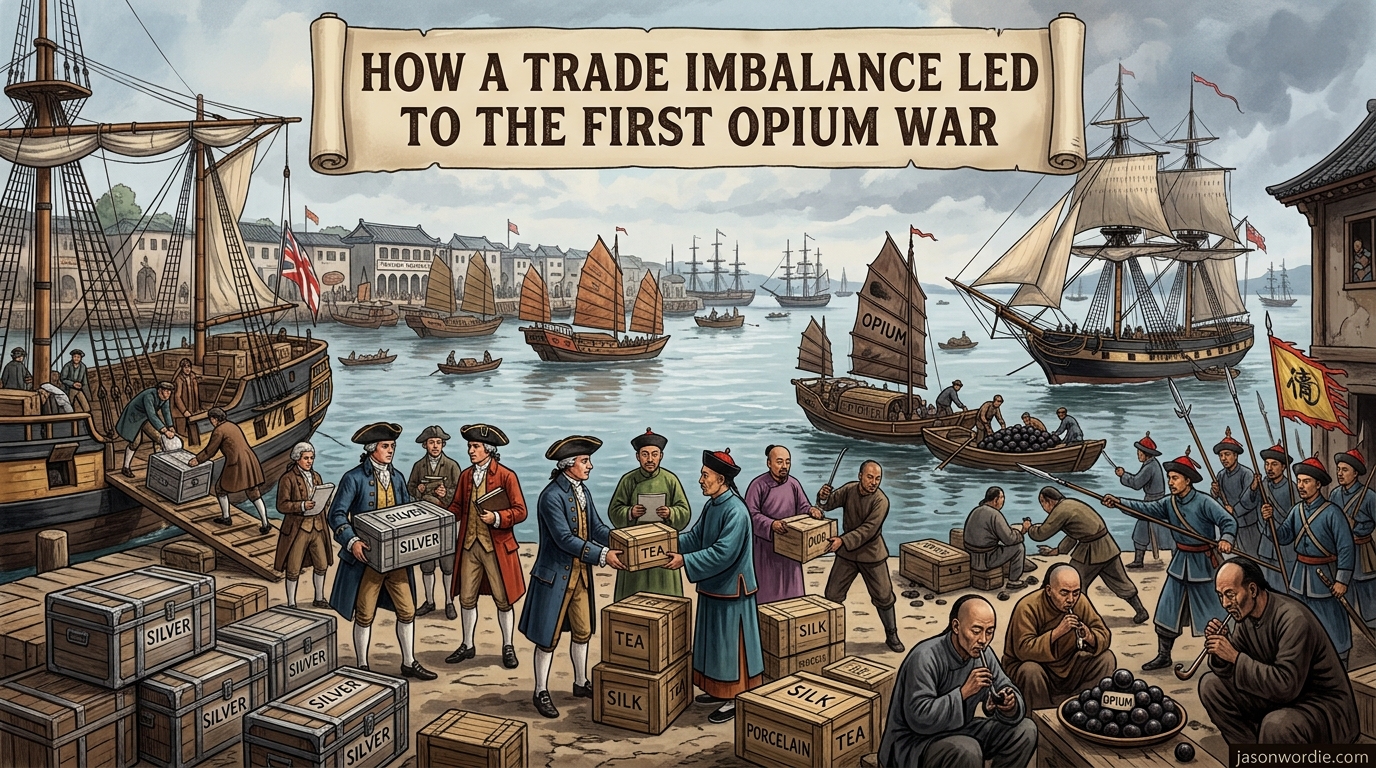
In the late 1700s, Britain could not stop drinking Chinese tea, but China had zero interest in buying anything Britain produced. This lopsided relationship forced Britain to pay for every shipment of tea, silk, and porcelain with silver bullion, draining its reserves year after year. When the British East India Company solved that problem by smuggling Indian opium into China, the resulting addiction epidemic, silver crisis, and diplomatic breakdown ignited the First Opium War (1839 to 1842).
Understanding how a trade imbalance with China led to the First Opium War means tracing a causal chain that stretches from a teacup in London to a naval bombardment in Guangzhou. Each link in that chain, from the Canton System’s trade restrictions to Lin Zexu’s destruction of 20,000 chests of opium, followed a grim economic logic. In this article, I walk through every stage of that chain, pulling in the numbers, the key figures, and the competing historical perspectives that shaped one of the most consequential conflicts of the 19th century.
Table of Contents
The Short Answer: How a Trade Imbalance Led to the First Opium War
The trade imbalance between Britain and China worked like a one-way valve. Silver flowed into China and never came back. Here is the causal chain in five steps:
- China’s trade restrictions: The Qing dynasty’s Canton System (established 1757) confined all foreign trade to a single port and demanded payment in silver only.
- British demand for Chinese goods: Britain imported massive quantities of tea, silk, and porcelain, but Chinese consumers refused to buy British manufactured goods in return.
- The silver drain: Britain lost between 2 million and 9 million ounces of silver per year paying for Chinese imports, threatening its monetary system.
- The opium reversal: The British East India Company began growing opium in India and smuggling it into China, demanding silver payment, which reversed the flow of bullion.
- War: When China cracked down on the opium trade to stop the addiction epidemic and silver outflow, Britain sent a naval fleet to force the trade back open.
That is the essence of it. Now let us look at how each of those stages actually unfolded.
The Canton System: China’s Closed-Door Trade Policy (1757 to 1842)
The Canton System was the framework of trade restrictions that China’s Qing dynasty imposed on all Western merchants starting in 1757. Emperor Qianlong decreed that foreigners could trade only at a single port, Canton (modern-day Guangzhou), and only through a guild of licensed Chinese merchants called the Cohong. No foreigner was allowed to learn Chinese, bring their families, or stay in Canton outside the designated trading season. Western ships arrived, unloaded, loaded up on tea and silk, and left.
This system reflected China’s self-sufficiency. The Qing empire produced everything it needed internally, from food to textiles to manufactured goods. Western merchants brought woolens, clocks, and other manufactured products to Canton, and Chinese buyers largely ignored them. There was simply no market for British goods in a society that had functioned for centuries without them.
China also insisted on being paid in silver. The Qing economy ran on silver for large transactions and copper cash for everyday commerce. Foreign traders had to bring silver specie, mostly Spanish dollars, to purchase any Chinese goods. This requirement would prove devastating for Britain in the decades that followed, because it meant every single pound of tea leaving Canton took silver out of British reserves permanently.
The Canton System also created friction through its cultural requirements. Foreign merchants chafed under rules they saw as humiliating, including restrictions on movement and the requirement to deal only through Cohong intermediaries who set prices. Britain attempted to negotiate more open trade terms through the Macartney Embassy of 1793, sending Lord George Macartney to the Qing court with gifts and requests for expanded trading rights. Emperor Qianlong dismissed the mission entirely, reportedly telling King George III that China had no need for British goods. That rejection convinced many British merchants that diplomatic reform was impossible and that only commercial pressure, or force, could change the system.
Britain’s Insatiable Demand for Chinese Goods
The engine of the trade imbalance was British consumption of Chinese tea. By the late 1700s, tea had become a daily necessity for nearly every social class in Britain. The British East India Company imported roughly 15,000 tons of tea per year by the early 1800s, and that figure kept climbing. Tea was not a luxury item anymore. It was a staple, and virtually all of it came from China.
Beyond tea, British consumers craved Chinese silk for clothing and porcelain for dining. Chinese porcelain was lighter, more durable, and more beautifully crafted than anything European kilns could produce at the time. Silk from China dominated the European textile market for garments and upholstery. Together, tea, silk, and porcelain made China the single most important trading partner for British merchants in Asia.
The problem was structural: China did not need anything from Britain. British woolens were too heavy for southern China’s climate. British clocks and mechanical devices held some novelty appeal but no mass market. Indian cotton textiles had some demand in China, but not enough to offset the enormous value of tea exports. The result was a trade relationship where Britain imported far more than it exported, and the difference had to be made up in silver.
Reddit users on r/AskHistorians frequently ask why China did not simply buy British goods to balance the trade. The answer is that the Qing economy was genuinely self-sufficient. China had a population of roughly 400 million people with mature domestic industries producing food, textiles, metalwork, and ceramics. British manufactured goods offered nothing the Chinese market could not already supply domestically at competitive prices. This fundamental economic mismatch, a surplus-producing Britain desperate for Chinese goods and a self-sufficient China uninterested in British products, created the deficit that would define the relationship.
Forum discussions also highlight the irony that history classes often skip this economic dimension. Students learn that Britain fought a war over opium, but the deeper story is about tea. Without the British public’s addiction to Chinese tea, there would have been no silver drain, no opium smuggling, and no war.
The Silver Drain: How Britain Bled Bullion
The silver drain was the steady outflow of silver bullion from Britain to China to pay for imported goods. At its peak in the early 1830s, Britain was sending between 2 million and 9 million ounces of silver per year to Canton. That silver left the British economy and entered Chinese reserves, where it stayed. Unlike a balanced trade relationship where currency circulates back through exports, this was a net transfer of wealth from one nation to another.
The economic consequences were serious. Silver was the backbone of Britain’s monetary system, backing the currency and facilitating international trade. When silver reserves shrank, credit tightened and the cost of goods rose. The East India Company, which held a legal monopoly on British trade with China until 1834, watched its silver position deteriorate year after year with no diplomatic solution in sight.
The Macartney Embassy of 1793 had been Britain’s best attempt at a peaceful fix. King George III sent Lord Macartney to Beijing with a list of requests: more ports open to trade, a permanent British embassy in the capital, and permission for British merchants to trade freely throughout China. Emperor Qianlong refused every request and sent a letter to King George stating that China possessed all things in abundance and had no need for the manufactures of barbarian nations. That dismissal ended any realistic hope of reforming the Canton System through diplomacy.
By the 1820s, British merchants and government officials were growing desperate. The silver drain was not a temporary fluctuation. It was a structural feature of the Sino-British trade relationship, and it was getting worse every year as British tea consumption continued to rise. Something had to change. Either Britain had to find a product the Chinese would actually buy, or it had to accept a permanent and growing drain on its silver reserves. The solution they found would prove catastrophic for China.
Britain’s Opium Solution: Reversing the Flow of Silver
The British East India Company found its answer in opium. The company controlled vast territories in Bengal, India, where it oversaw opium poppy cultivation on an industrial scale. The drug was processed into balls called chests, each weighing roughly 140 pounds, and shipped to the Chinese coast. British merchants demanded silver for the opium, and Chinese buyers paid it. For the first time in the history of Sino-British trade, silver was flowing back toward Britain.
This three-country trade operation worked in a triangle. British ships carried manufactured goods to India. In India, they loaded opium grown under East India Company supervision. They sailed the opium to the Chinese coast, sold it for silver, and used that silver to purchase tea, silk, and porcelain at Canton. The tea went back to Britain for sale. Every leg of the triangle was profitable, and the silver that had been draining into China for decades began flowing back out.
The numbers tell the story. Opium imports to China stood at roughly 4,500 chests per year in 1810. By 1820, that figure had risen to about 5,000. By 1830, it had surged past 18,000 chests. And by 1838, on the eve of the Chinese crackdown, opium imports reached an astonishing 40,000 chests per year. That is nearly a tenfold increase in under three decades. The trade was worth millions of silver ounces annually, and it had completely reversed the trade balance that had defined the Sino-British relationship.
Private British trading firms played a central role in this expansion. The most famous was Jardine Matheson, founded in 1832 by William Jardine and James Matheson. These private firms bought opium from the East India Company at auction in Calcutta, shipped it to receiving ships anchored off the Chinese coast, and distributed it through a network of Chinese smugglers. When the East India Company’s monopoly on China trade ended in 1834, private firms flooded into the market and opium volumes exploded.
American merchants were also involved, though on a smaller scale. Firms based in Salem and Boston, including the Perkins family business, shipped Turkish opium to China as early as the 1810s. The American share of the trade never matched British volumes, but it was significant enough that the United States negotiated its own unequal treaty, the Treaty of Wangxia, in 1844.
It is worth noting that this trade was illegal under Chinese law. The Qing dynasty had banned opium smoking in 1729 and banned opium imports entirely in 1800. Every chest sold by British merchants was smuggled past Chinese customs officials. By 1830, an estimated 100-plus Chinese smuggling boats operated along the coast, facilitated by corrupt officials who looked the other way for a cut of the profits.
The Opium Crisis: Addiction and Social Devastation in China
By the mid-1830s, China faced a full-scale addiction crisis. Estimates of the number of opium users vary widely, but historians generally agree that several million Chinese people were addicted, with some figures ranging as high as 12 million. Opium dens operated in every major city. Soldiers, government officials, students, and laborers all fell into dependency. The drug destroyed lives, families, and productivity on a scale that the Qing government could no longer ignore.
The economic impact was just as devastating as the social one. Before the opium trade, silver had flowed into China. Now it was flowing out. Chinese consumers used silver to buy opium from foreign merchants, and that silver left the Chinese economy for good. The silver outflow caused inflation in copper-based everyday transactions, because the declining supply of silver drove up the silver-to-copper exchange rate. Ordinary Chinese citizens who earned wages in copper found that their money bought less and less. The economic pain was not theoretical. It was felt in every market stall in the empire.
Within the Qing court, a fierce debate erupted between two factions. The legalization faction argued that opium could not be stopped and that the government should legalize it, tax it, and retain the silver domestically rather than letting it flow to foreign merchants. The suppression faction argued that legalization would doom millions more to addiction and that the only solution was to cut off the supply at its source by cracking down on foreign traders. This users versus pushers debate, as some historians have called it, raged through the 1830s with increasing urgency.
The suppression faction ultimately won the argument. The human cost of addiction was simply too high to accept, and the silver drain was threatening the fiscal stability of the Qing state itself. Emperor Daoguang decided that the opium trade had to be destroyed, whatever the consequences. He would soon choose the man to carry out that decision.
Lin Zexu and the 1839 Crackdown
In 1838, Emperor Daoguang appointed Lin Zexu as Imperial Commissioner with extraordinary powers to eliminate the opium trade in Canton. Lin was a distinguished scholar-official with a reputation for personal integrity and administrative competence. He arrived in Canton in March 1839 and moved quickly, ordering the arrest of known opium dealers and demanding that foreign merchants surrender every chest of opium in their possession.
Lin also wrote a remarkable open letter to Queen Victoria, asking how Britain could justify selling a poison to China that it itself had banned. He pointed out the hypocrisy of a nation that outlawed opium consumption at home while profiting from its sale abroad. The letter was never delivered to Victoria in any official capacity, but it articulated the moral case against the opium trade with clarity and force. Lin asked the British to reflect on whether they would want the same drug pushed on their own people.
When foreign merchants refused to surrender their opium voluntarily, Lin blockaded the foreign factories in Canton, cutting off food supplies and confining the merchants to their quarters. After weeks of standoff, the British Superintendent of Trade, Charles Elliott, ordered the merchants to hand over their opium, promising that the British government would compensate them. Over 20,000 chests of opium were surrendered, and Lin Zexu had them publicly destroyed at Humen (also called the Bocca Tigris) over a period of three weeks in June 1839. The opium was mixed with lime and salt water in large trenches and flushed into the sea.
This was the trigger. The destruction of British property worth millions of pounds outraged merchants in Canton and their political allies in London. William Jardine traveled to Britain and lobbied the Foreign Secretary, Lord Palmerston, for military action. The question now moved from a trade dispute to a question of war.
Lin Zexu himself is a complex historical figure. In Chinese historiography, he is celebrated as a national hero who stood up to foreign aggression and fought to protect his people from a devastating drug epidemic. In British accounts of the period, he was often portrayed as an inflexible official who provoked a conflict he could not win. Modern historians increasingly see him as a principled administrator who was handed an impossible task: stopping a trade backed by the most powerful navy in the world.
From Trade Dispute to War: The Military Conflict
The British government debated whether to go to war. The issue was deeply controversial. Many members of Parliament argued that fighting a war to protect an illegal drug trade was morally indefensible. A young William Gladstone, then a Conservative MP, gave a passionate speech against the war in 1840, declaring that a war fought for opium would brand Britain with everlasting shame. The motion to wage war passed by a narrow margin of 271 to 262 votes in the House of Commons.
Lord Palmerston, the Foreign Secretary, framed the conflict not as a defense of the opium trade but as a defense of British rights, British property, and British national honor. He argued that China had illegally confiscated British merchandise and illegally imprisoned British merchants. The opium question was secondary to the principle that no foreign government could seize British property with impunity. This framing allowed the war to proceed despite its moral complications.
The First Opium War lasted from 1839 to 1842, and it was never a close contest. Britain sent a modern fleet of warships armed with heavy guns, including the newly developed steamship Nemesis, which could navigate shallow rivers where Chinese war junks could not operate. The technological gap between the two sides was enormous. Chinese forces fought with cannons and firearms that had changed little in centuries, and their wooden war junks were no match for iron-hulled British vessels.
The British captured Chusan (Zhoushan) in 1840, bombarded and took Amoy (Xiamen) in 1841, seized Shanghai in 1842, and threatened to advance on Nanjing itself. Chinese forces fought bravely in several engagements but could not overcome the disparity in military technology. British casualties were remarkably light, with fewer than 70 killed in action across the entire war. Chinese casualties, military and civilian, were far higher, numbering in the thousands.
By August 1842, with British warships anchored on the Yangtze River and the Grand Canal, the vital artery for grain shipments to Beijing, the Qing government had no choice but to negotiate. The resulting agreement would reshape China’s relationship with the Western world for the next century.
The Treaty of Nanjing: Terms and Consequences
The Treaty of Nanjing, signed on August 29, 1842, was the first of what Chinese historians call the unequal treaties. It was forced on China from a position of military weakness, and its terms reflected British demands entirely. The five key provisions were:
- Cession of Hong Kong: China ceded Hong Kong Island to Britain in perpetuity, giving the British Empire a strategic foothold on the Chinese coast that would remain under British control until 1997.
- Opening of treaty ports: Five Chinese ports, Canton, Amoy, Foochow, Ningbo, and Shanghai, were opened to foreign trade and residence. Foreign merchants could operate freely in these ports without Cohong intermediaries.
- War indemnity: China was required to pay Britain 21 million silver dollars as compensation for the war costs, the destroyed opium, and debts owed to British merchants.
- Abolition of the Cohong system: The licensed merchant guild that had controlled foreign trade at Canton was dissolved, and British merchants could trade directly with any Chinese merchant willing to do business with them.
- Equal diplomatic status: Britain and China would conduct correspondence on a basis of equality, ending the tribute system framework that had previously governed China’s relations with foreign powers.
A supplementary treaty in 1843 added the most-favored-nation clause, which guaranteed that any privilege China granted to another nation would automatically extend to Britain. This meant that any future concessions extracted by France, the United States, or Russia would benefit Britain as well, creating a cascading system of foreign privileges that steadily eroded Chinese sovereignty.
Another critical addition was extraterritoriality. Under this legal principle, British citizens in China were subject to British law, not Chinese law. If a British merchant committed a crime in a Chinese treaty port, they would be tried in a British consular court under British legal standards. This meant that foreign nationals in China effectively lived outside the jurisdiction of the Chinese state, a provision that deeply humiliated the Qing government and fueled lasting resentment.
The Treaty of Wangxia, signed between China and the United States in 1844, replicated most of these terms and added extraterritoriality rights for American citizens. Caleb Cushing, the American negotiator, secured these concessions without firing a single shot, simply by pointing to the British precedent. The unequal treaty system was now expanding beyond Britain.
Long-Term Impact: The Century of Humiliation
The First Opium War did not settle anything. It opened a wound. The Treaty of Nanjing did not legalize opium, which meant the trade continued illegally and in even greater volumes. It did not satisfy British merchants who wanted unlimited access to the entire Chinese market, not just five ports. And it inflicted a deep national trauma on China that would shape its politics for generations.
The Second Opium War (1856 to 1860) followed the same pattern. Britain and France deployed joint military forces to demand further concessions, including the legalization of the opium trade, the opening of more treaty ports, and the right of foreign diplomats to reside in Beijing. British and French forces looted and destroyed the Old Summer Palace in Beijing in 1860, an act of cultural destruction that remains a powerful symbol of national humiliation in China to this day.
The broader consequence was what Chinese historians call the Century of Humiliation, roughly spanning from the First Opium War in 1839 to the establishment of the People’s Republic in 1949. During this century, China was forced to sign dozens of unequal treaties with multiple foreign powers, lost territory to imperial expansion, suffered through the devastating Taiping Rebellion (which killed an estimated 20 to 30 million people), and saw its sovereignty steadily eroded by foreign concessions, spheres of influence, and extraterritorial legal privileges.
The memory of this period remains politically potent in modern China. The opium trade and the wars it triggered are taught in Chinese schools as foundational lessons about national weakness and the consequences of falling behind technologically. The phrase “never forget national humiliation” is a recurring theme in Chinese political discourse, and the Opium Wars are its origin point.
Forum discussions on Reddit frequently highlight how differently this history is taught in Western and Chinese schools. Western narratives often frame the Opium War as a conflict about free trade and diplomatic equality, downplaying the drug trade at its center. Chinese narratives emphasize the aggression, the drug pushing, and the humiliation. Both perspectives contain elements of truth, and understanding the Opium War requires holding both framings simultaneously.
British public opinion on the war was more divided than is often remembered. While the government and merchant class pushed for military action, significant opposition existed within Britain itself. William Gladstone’s speech condemning the war was widely reported, and religious and humanitarian groups organized petitions against the opium trade. The controversy was real, even if it ultimately failed to prevent the conflict.
Key Timeline: From Canton System to Treaty of Nanjing
Here is a chronological reference of the key dates that trace the path from trade imbalance to war:
- 1757: Emperor Qianlong establishes the Canton System, restricting all foreign trade to Canton.
- 1793: Lord Macartney’s diplomatic mission to Beijing fails. Emperor Qianlong dismisses British trade requests.
- 1800: China bans all opium imports. The trade continues illegally.
- 1810: Approximately 4,500 chests of opium smuggled into China annually.
- 1813: China outlaws opium smoking. Enforcement remains weak.
- 1830: Over 18,000 chests of opium smuggled into China annually, with 100-plus Chinese smuggling boats operating.
- 1834: The East India Company’s monopoly on China trade ends. Private firms like Jardine Matheson expand operations dramatically.
- 1838: Opium imports reach 40,000 chests. Emperor Daoguang appoints Lin Zexu as Imperial Commissioner.
- March 1839: Lin Zexu arrives in Canton and demands foreign merchants surrender their opium.
- June 1839: Over 20,000 chests of opium destroyed at Humen.
- 1839: British Parliament narrowly votes for war (271 to 262).
- 1840: British fleet arrives and captures Chusan.
- 1841: British forces take Amoy and other ports.
- 1842: Shanghai captured. British warships threaten Nanjing.
- August 29, 1842: Treaty of Nanjing signed.
- 1843: Supplementary treaty adds most-favored-nation clause and extraterritoriality.
- 1844: Treaty of Wangxia extends similar terms to the United States.
Multiple Perspectives: Free Trade or Imperialism?
How you interpret the First Opium War depends heavily on whose perspective you adopt. British historians of the 19th and early 20th centuries often framed it as a conflict over free trade and diplomatic recognition. From this view, China’s Canton System was an unreasonable restriction on commerce, and Britain was merely demanding the right to trade freely and communicate with the Chinese government as an equal. The opium question, in this telling, was incidental to the larger issue of opening a closed society.
Chinese historians have traditionally viewed the war as an act of imperialist aggression driven by the drug trade. From this perspective, Britain was a powerful nation that deliberately addicted millions of Chinese people to a dangerous drug to solve its own economic problems, then used military force to protect that criminal enterprise when China tried to defend itself. The opium trade was not incidental. It was the core issue.
Modern Western historians have increasingly moved toward the Chinese interpretation on the central question. The fact that Britain was fighting to protect an illegal drug trade, one that it itself had banned domestically, is difficult to reconcile with the free trade framing. The narrow parliamentary vote and the significant domestic opposition within Britain itself suggest that even contemporaries recognized the moral problems with the war.
A more nuanced reading acknowledges that both dynamics were at work. Britain genuinely wanted to break open the Canton System for commercial and diplomatic reasons. But the specific mechanism it chose, opium smuggling, and the specific trigger for war, Lin Zexu’s destruction of British-owned opium, meant that the conflict was inextricably tied to the drug trade. The free trade argument was both sincerely held and strategically convenient. It provided moral cover for a war fought largely to protect a lucrative criminal enterprise.
What was the trade imbalance in the Opium Wars?
The trade imbalance was Britain importing far more from China (tea, silk, porcelain) than it exported in return. China demanded silver for its goods and refused to buy British products, causing a massive silver drain of 2 million to 9 million ounces per year. Britain reversed this deficit by smuggling opium into China, which caused silver to flow back toward Britain.
How was China affected by the Opium Wars?
China suffered widespread opium addiction affecting millions of people, a silver drain that caused economic instability and inflation, military defeat by British naval forces, and the forced Treaty of Nanjing which ceded Hong Kong, opened treaty ports to foreign trade, imposed a large indemnity, and established extraterritoriality for foreign nationals. These consequences began what Chinese historians call the Century of Humiliation.
Why did China want to stop the opium trade in 1840?
China wanted to stop the opium trade because it had caused a devastating addiction epidemic affecting millions of citizens, including soldiers and government officials, and because the silver flowing out of China to pay for opium was causing severe economic disruption including inflation in everyday copper-based transactions.
Who led China in the First Opium War?
Emperor Daoguang led China as the Qing dynasty ruler, and he appointed Lin Zexu as Imperial Commissioner to carry out the opium suppression campaign in Canton. Lin Zexu was the key figure who confiscated and destroyed over 20,000 chests of British opium in 1839, directly triggering the British military response.
Could China have won the First Opium War?
China had almost no chance of winning given the enormous military technology gap. British forces had iron-hulled steamships and modern artillery, while Chinese forces relied on wooden war junks and centuries-old firearms. However, historians note that faster military modernization, earlier diplomatic engagement with Western powers, or a stronger central military response could have improved China’s position.
Was the Opium War really just about free trade?
No. While Britain framed the war as a fight for free trade and diplomatic equality, the conflict was fundamentally triggered by the destruction of British opium and fought to protect the illegal opium trade that was reversing Britain’s silver drain. The free trade argument provided moral justification, but the specific cause and trigger of the war was opium.
Conclusion
The story of how a trade imbalance with China led to the First Opium War is a case study in how economic pressures can drive nations toward catastrophic decisions. Britain needed tea. China would only accept silver. The resulting drain of bullion pushed British merchants to find a product the Chinese would buy, and they found opium. When China moved to stop the resulting addiction epidemic and silver outflow, Britain sent its navy. Each step followed a logical, if morally bankrupt, progression from the last.
The war reshaped the world. It gave Britain Hong Kong, opened China to foreign trade on coercive terms, and initiated a century of foreign domination that continues to shape Chinese national identity and foreign policy today. The lessons of the First Opium War, about the dangers of trade imbalances, the uses and abuses of military power, and the human cost of economic expediency, remain relevant in any era where commerce and geopolitics collide.