
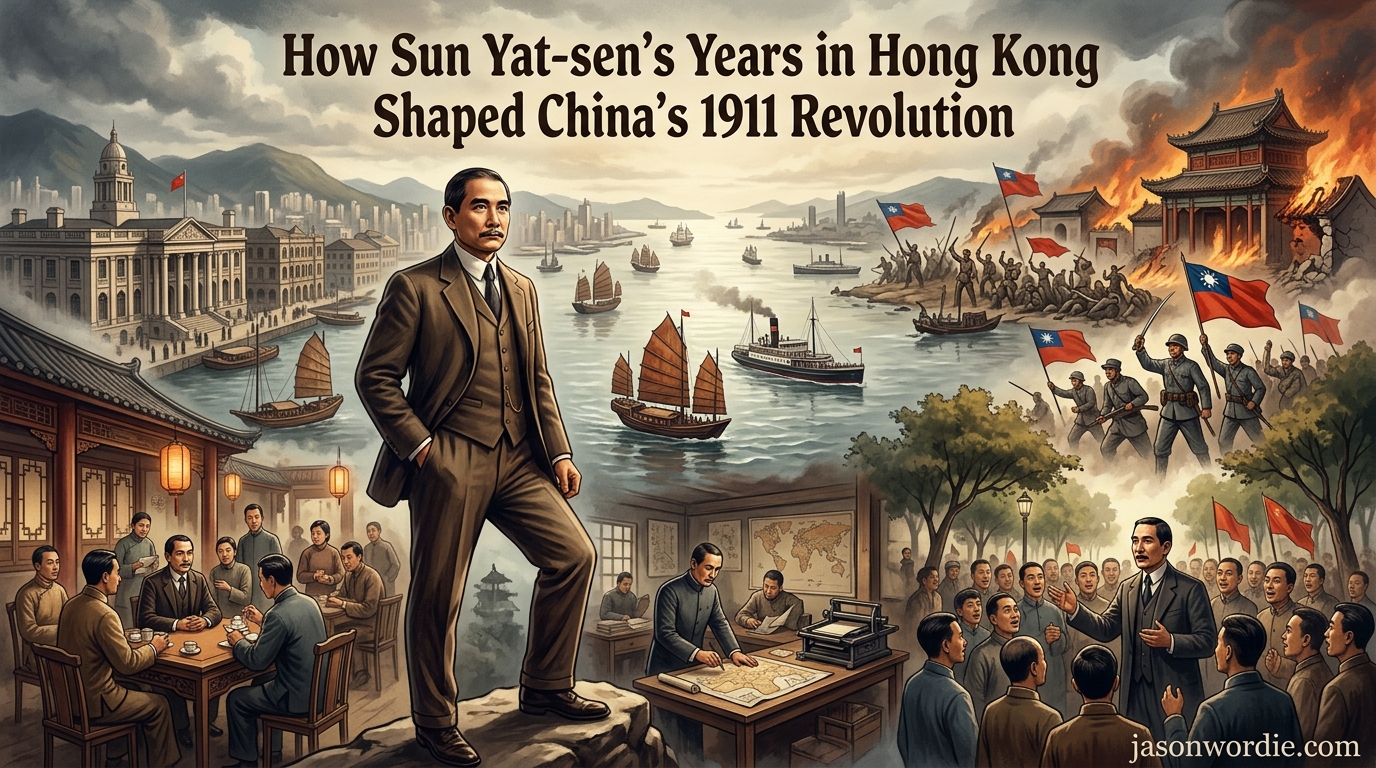
Sun Yat-sen is widely remembered as the Father of Modern China, the man who led the revolution that ended more than two thousand years of imperial rule. But the story of how he became a revolutionary is inseparable from one place in particular: Hong Kong. Understanding how Sun Yat-sen’s years in Hong Kong shaped China’s 1911 Revolution means looking beyond the familiar narrative of uprisings and political manifestos to the city where his ideas were actually forged.
Born in a small village in Guangdong province, Sun could easily have remained an obscure rural doctor. Instead, his education in Western institutions, first in Hawaii and then in British-ruled Hong Kong, exposed him to political systems, legal structures, and intellectual currents that simply did not exist inside Qing China. Hong Kong was not just where Sun studied medicine. It was the laboratory where he developed the ideology that would eventually bring down an empire.
In this article, I trace Sun’s journey from his village origins through his formative Hong Kong years, the founding of his revolutionary societies, the string of failed uprisings that preceded 1911, and the Xinhai Revolution itself. The focus throughout is on a question that most accounts gloss over: what exactly did Hong Kong give Sun Yat-sen that nowhere else could?
Table of Contents
Sun Yat-sen’s Early Life in Guangdong
Sun Yat-sen was born on November 12, 1866, in the village of Cuiheng in Xiangshan County, Guangdong province, just a short distance from the Portuguese colony of Macau and not far from British Hong Kong. This geography mattered enormously. Guangdong had been China’s most outward-facing province for centuries, the point of first contact for foreign traders, missionaries, and the Opium Wars that had humiliated the Qing Dynasty in the 1840s and 1850s.
His family were poor farmers. His father had little land and the household struggled financially, like many peasant families in southern China during the late Qing period. Corruption, heavy taxation, and natural disasters made rural life precarious. These conditions, the grinding poverty and the obvious incapacity of the imperial government to protect its own people, left a deep impression on Sun from an early age.
At thirteen, Sun left for Hawaii to join his elder brother Sun Mei, who had emigrated earlier and become a successful merchant and rancher on Maui. This departure was the first decisive turning point. A boy from an impoverished Guangdong village was about to receive an education that would have been unthinkable had he remained in Qing China.
The Importance of Guangdong’s Proximity to Colonial Enclaves
Guangdong’s location next to Hong Kong and Macau meant that local people had more contact with foreigners and foreign ideas than almost anyone else in China. Villagers could see the contrast between the modernizing colonial ports and the stagnation of Qing administration. That visible contrast, between what a functioning modern system looked like and what imperial decay produced, became central to Sun’s entire political worldview.
It is no coincidence that nearly all the major revolutionary figures of the late Qing period came from southern China. Liang Qichao, Kang Youwei, and Sun himself all hailed from Guangdong. The province’s exposure to Western political thought, Christianity, and commercial capitalism created the conditions for revolutionary thinking to take root.
Education in Hawaii: The First Taste of the West
Sun arrived in Honolulu in 1879 and enrolled at Iolani College, an Anglican school run by British missionaries. He later attended Oahu College, the institution now known as Punahou School, the same school that would later educate Barack Obama. This was Sun’s first sustained immersion in a Western educational environment.
At Iolani, Sun learned English, studied mathematics and science, and was exposed to Christian teachings. He excelled academically, winning second prize in an English grammar competition among a student body of mostly foreign-born pupils. The experience gave him something that almost no one in mainland China possessed at the time: fluency in Western ideas, comfort with Western institutional structures, and a personal network that crossed cultural boundaries.
His brother, alarmed by Sun’s growing interest in Christianity, sent him back to China in 1883. But the damage, from a traditional Qing perspective, was already done. Sun had seen a society governed by law, religious tolerance, and representative institutions. When he returned to Cuiheng and encountered the corruption and brutality of local Qing officials, the contrast was unbearable.
From Hawaii to Hong Kong: The Logical Next Step
Back in Guangdong, Sun quickly clashed with local authorities over what he saw as superstitious and oppressive practices. Realizing that his future lay outside the traditional Chinese system, he made the decision that would define his life: he went to Hong Kong in 1883 to continue his education under British colonial rule. This move placed him in the one Chinese city where Western political and legal systems operated in full.
How Sun Yat-sen’s Years in Hong Kong Shaped China’s 1911 Revolution
This is the heart of the story. Sun Yat-sen lived in Hong Kong from 1883 to 1892, and returned repeatedly throughout the 1890s and 1900s. These were the years when a village doctor became a revolutionary strategist. The question of how Sun Yat-sen’s years in Hong Kong shaped China’s 1911 Revolution can be answered by looking at three specific dimensions: his formal education, the colonial environment itself, and the network of contacts he built there.
The Hong Kong College of Medicine for Chinese
In 1887, Sun enrolled at the Hong Kong College of Medicine for Chinese, an institution founded by the London Missionary Society and modeled on British medical training. He studied anatomy, surgery, chemistry, and clinical medicine under Western-trained professors. He graduated in 1892, becoming one of the first Chinese doctors trained in Western medicine in Hong Kong.
The medical training itself was less important than what it represented. The college operated under a Western model of inquiry: evidence-based, experimental, skeptical of unexamined authority. This method of thinking, the willingness to question received wisdom and test ideas against observed reality, became the intellectual foundation of Sun’s entire approach to politics. If traditional Chinese medicine could be questioned and replaced with something more effective, why not traditional Chinese governance?
Sun himself later drew this exact parallel. In his own writings, he argued that just as a doctor diagnoses and treats a diseased body, a revolutionary must diagnose and treat a diseased political system. The medical metaphor recurs throughout his political thought and it originated directly from his Hong Kong education.
Government Central School and Broader Education
Before medical school, Sun attended the Government Central School (later renamed Queen’s College), one of Hong Kong’s premier government schools. There he received a thorough grounding in English, history, and the humanities alongside a curriculum that included study of British political institutions, the Enlightenment, and constitutional government.
This was an education that simply did not exist anywhere in Qing China. The imperial examination system, which still dominated Chinese education, focused on memorizing Confucian classics and composing stylized essays. It produced scholars trained for bureaucratic service, not citizens trained to think critically about political structures. Sun received the opposite: an education designed to produce informed participants in a modern civic order.
The Contrast Between British Hong Kong and Qing China
Perhaps the most powerful influence on Sun was not any single institution but the daily, lived contrast between Hong Kong and the China he had grown up in. Hong Kong in the 1880s and 1890s was by no means a democracy. It was a crown colony governed by British officials with minimal Chinese representation. But it had something Qing China did not: the rule of law.
Under British colonial rule, Hong Kong had an independent judiciary, a functioning police force that was, while imperfect, far less corrupt than Qing magistrate systems, property rights that were generally enforced, freedom of the press that allowed newspapers to criticize government policy, and freedom of association that allowed political groups to organize. Sun could see these things operating around him every day.
He said as much himself. In a famous 1923 speech at the University of Hong Kong, Sun reflected on his years in the city and stated plainly that his revolutionary ideas came from Hong Kong. He observed that he had seen good government, orderly administration, and a society where ordinary people could live relatively free from the arbitrary exactions of corrupt officials. He then compared this to the conditions in mainland China under Qing rule and concluded that China needed a complete political transformation.
This is the answer to the central question of this article. Hong Kong did not just give Sun an education or a base of operations. It gave him a working model of modern governance that he could hold up against the failing Qing system. The contrast was not abstract or theoretical. He had lived under both systems and the comparison was devastating.
Key Hong Kong Locations in Sun’s Revolutionary Formation
Several specific locations in Hong Kong played important roles in Sun’s development. The Hong Kong College of Medicine for Chinese was located on Hollywood Road in the Mid-Levels district. The Government Central School stood on Gough Street in Central. Sun lived in various addresses in the Sai Ying Pun and Sheung Wan neighborhoods, areas with dense Chinese populations where he could mix freely with merchants, laborers, and other students.
Beyond the schools, Sun frequented the Hong Kong headquarters of various Christian missions and the meeting halls of Chinese merchant associations. The Daarship Society meeting place and the sites where the Furen Literary Society convened were all within walking distance in Central Hong Kong. Today, the Sun Yat-sen Historical Trail in the Central and Western District commemorates these locations, allowing visitors to trace the physical geography of revolutionary formation.
The Birth of Revolutionary Ideology in Hong Kong
It was during his Hong Kong years that Sun began meeting regularly with like-minded young men to discuss the future of China. The most famous of these gatherings involved Sun and three close friends, Yau Lit, Chan Siu-bak, and Yeung Hok-ling, who called themselves the Si Da Kou, the Four Bandits, a self-mocking name for a group of young men who dared to dream of overthrowing an empire.
These were not idle discussions. The Four Bandits met regularly in Hong Kong during the late 1880s and early 1890s, debating political philosophy, studying Western revolutionary movements, and gradually arriving at the conclusion that reform of the Qing Dynasty was impossible. The system was too corrupt, too resistant to change, and too structurally incapable of modernization. Only revolution, the complete overthrow of the imperial system and its replacement with a republic, could save China.
Genesis of the Three Principles of the People
Sun’s political philosophy, later codified as the Three Principles of the People, began taking shape during these Hong Kong discussions. The Three Principles are Mínzú (Nationalism), Mínquán (Democracy or People’s Power), and Mínshēng (People’s Livelihood). Each was directly informed by what Sun had absorbed from his Western education.
Nationalism reflected his conviction that China needed to free itself from both Manchu Qing rule and foreign imperialist domination. Democracy came straight from his study of Western political theory, the American and French revolutions, British constitutionalism, and Enlightenment philosophy. People’s Livelihood, sometimes translated as socialism, reflected his awareness of the economic inequality he had witnessed in both rural Guangdong and the rapidly industrializing colonial cities.
Revolutionaries Versus Reformists
Sun’s path was not the only one available to politically engaged Chinese intellectuals of his generation. The reformist movement, led by Kang Youwei and Liang Qichao, argued that China could modernize through gradual reform of the imperial system rather than its complete overthrow. The reformists wanted a constitutional monarchy along British or Japanese lines, with the Qing emperor retained as a figurehead.
The Hundred Days’ Reform of 1898, a brief attempt by Kang and his allies to implement top-down reforms under the Guangxu Emperor, ended in failure when Empress Dowager Cixi launched a coup and imprisoned the emperor. This failure vindicated Sun’s argument that the Qing system could not be reformed from within. It also sent Kang and Liang into exile, where they continued to compete with Sun for influence among overseas Chinese communities.
The rivalry between revolutionaries and reformists would persist until 1911, but the failure of the Hundred Days’ Reform steadily shifted opinion toward Sun’s position. If the Qing court would not even tolerate modest reform, what remained except revolution?
Formation of the Revive China Society and the Tongmenghui
Sun’s revolutionary organizing began in earnest in 1894 when he founded the Revive China Society, also known as the Xingzhonghui, in Honolulu, Hawaii. The society’s stated goal was explicit: to overthrow the Qing Dynasty and establish a republican government in China. This was the first organized revolutionary society Sun created, and it would be the template for everything that followed.
A branch of the Revive China Society was established in Hong Kong in early 1895, with its headquarters in the Sai Ying Pun district. This Hong Kong branch became the operational nerve center for the society’s first major action, the First Guangzhou Uprising of 1895. The choice of Hong Kong as a base was deliberate. From Hong Kong, revolutionaries could plan operations, smuggle weapons, and raise funds with a degree of freedom that was impossible inside Qing territory.
The Tongmenghui: A United Revolutionary Front
In 1905, Sun achieved a major breakthrough by merging several revolutionary groups into a single organization: the Tongmenghui, or Chinese Revolutionary Alliance. The merger took place in Tokyo, where Sun had built strong connections among Chinese students studying in Japan. But Hong Kong remained a critical node in the Tongmenghui’s network.
The Tongmenghui adopted Sun’s Three Principles of the People as its official platform and its members swore an oath to “expel the Tatar barbarians, revive China, establish a republic, and equalize land rights.” The phrase “expel the Tatar barbarians” referred specifically to the Manchu Qing rulers, reflecting the ethnic dimension of the revolutionary movement: Han Chinese revolutionaries seeking to end Manchu domination.
The Tongmenghui was far more organized and broadly based than the earlier Revive China Society. It had branches across Southeast Asia, Europe, and the Americas, all funded primarily by overseas Chinese communities. And Hong Kong remained the logistical hub through which funds, weapons, people, and information flowed between the Chinese diaspora and revolutionary cells inside China.
The Role of Overseas Chinese Funding
One of the most underappreciated aspects of Sun’s revolutionary movement is its financial backbone. The revolts, the publications, the arms shipments, and the salaries of full-time organizers all required money, and that money came overwhelmingly from overseas Chinese communities. Sun spent years on fundraising tours through Southeast Asia, North America, and Europe, appealing to Chinese immigrants who wanted to see their homeland freed from imperial rule.
These overseas communities, many of whom had left China to escape exactly the conditions of poverty and official corruption that Sun decried, were remarkably generous. They donated millions of dollars to the revolutionary cause over the years, often at considerable personal sacrifice. Hong Kong served as the financial clearinghouse for much of this money, with funds from diaspora communities flowing through Hong Kong-based merchants and banks before reaching revolutionary operatives on the mainland.
Hong Kong as a Revolutionary Safe Haven
Beyond its role as Sun’s intellectual birthplace, Hong Kong served a critical practical function throughout the revolutionary period: it was a safe haven. When uprisings failed and Qing authorities launched manhunts for revolutionary leaders, Hong Kong provided legal protection that Qing agents could not penetrate. This aspect of how Sun Yat-sen’s years in Hong Kong shaped China’s 1911 Revolution is often overlooked but was absolutely essential to the revolution’s survival.
Under British colonial law, the Qing government could not simply arrest someone in Hong Kong and drag them across the border. Extradition required legal proceedings, and political offenses were often exempt. As long as revolutionaries did not commit crimes under Hong Kong law, they could plan, organize, publish, and fundraise from British territory with relative impunity.
British Tolerance of Revolutionary Activity
The British were not motivated by sympathy for Sun’s cause. They were motivated by self-interest. British policy in Hong Kong rested on maintaining the colony as a stable, prosperous trading port, and that stability depended on the rule of law. If the colonial government started handing political dissidents over to Qing executioners on demand, it would undermine the legal framework that made Hong Kong attractive to merchants and investors.
There was also a geopolitical calculation. Britain had fought two Opium Wars to secure its position in China and had no particular loyalty to the Qing Dynasty. If the Qing were eventually overthrown, Britain wanted to be on good terms with whatever replaced them. Allowing revolutionaries to operate from Hong Kong was a way of hedging bets.
That said, British tolerance had limits. After particularly provocative actions, the colonial government occasionally banned Sun from Hong Kong territory. In 1896, following the failed Guangzhou Uprising, Sun was barred from Hong Kong for five years under a ban that remained formally in place until 1911. Even so, Hong Kong’s legal system and geographic proximity meant that revolutionary networks continued to operate in and through the colony even when Sun himself could not be physically present.
Why the Safe Haven Mattered
Without Hong Kong, the revolutionary movement would almost certainly have been crushed. Inside Qing territory, revolutionary organizations faced infiltration, arrest, torture, and execution. The Qing secret police were effective and ruthless. But across the border in Hong Kong, revolutionaries could regroup, reassess, recruit new members, and plan their next moves. Every failed uprising was followed by a retreat to Hong Kong, where the survivors could rebuild.
This cycle of failure, retreat, and renewal was the pattern of Sun’s revolutionary career from 1895 until 1911. Hong Kong was the place the movement returned to after each defeat. It was the anchor that kept the revolutionary enterprise alive through its darkest periods.
Failed Urisings: The Road to 1911
The 1911 Revolution did not come out of nowhere. It was the culmination of more than fifteen years of failed attempts, each of which taught Sun and his allies hard lessons about organization, timing, and popular mobilization. The series of failures is sometimes treated as a mere prelude, but understanding the pattern of failure is essential to understanding why 1911 succeeded.
The First Guangzhou Uprising (1895)
The first organized revolutionary action was the Guangzhou Uprising of October 1895, planned from the Revive China Society’s Hong Kong headquarters. The plan was to seize the provincial capital of Guangdong and use it as a base for a broader revolt. The uprising was betrayed to Qing authorities before it could be properly launched. Several conspirators were arrested and executed, including Sun’s close friend Lu Haodong, who became one of the revolution’s first martyrs.
Sun himself narrowly escaped, fleeing to Hong Kong and then onward to Japan, beginning his long years of exile. The failure was devastating but also instructive. The movement had been penetrated by informants, security was lax, and the conspiracy was too dependent on a small number of individuals. These were lessons Sun would carry forward.
The Huizhou Uprising (1900)
During the Boxer Rebellion of 1900, Sun saw an opportunity to launch an uprising in southern China while the Qing was distracted by the foreign intervention in the north. The Huizhou Uprising, launched from a base near Hong Kong, involved several hundred revolutionaries who fought Qing forces for over two weeks. It was ultimately suppressed, but it demonstrated that revolutionary forces could mount sustained military resistance.
A Decade of Smaller Actions
Between 1900 and 1911, Sun and his allies organized or inspired at least nine additional uprisings, including the Huanghuagang Uprising of April 1911 in Guangzhou, in which many young revolutionary martyrs died. Each failure cost lives, funds, and morale. But each also built the organizational experience, the network of committed fighters, and the growing public sympathy that would eventually make 1911 possible.
The lesson of these failures was that a successful revolution would not come from a single dramatic blow launched by a small group of conspirators. It would come from a broader political process in which accumulating public discontent with Qing incompetence, corruption, and foreign humiliation reached a tipping point at which even a relatively small spark could trigger a cascade.
The Xinhai Revolution of 1911
The revolution that finally succeeded was not the one Sun planned. The Wuchang Uprising of October 10, 1911, began accidentally, when a bomb exploded prematurely in the Russian concession in Hankou, revealing a revolutionary cell to Qing authorities. Revolutionary soldiers, facing imminent arrest, seized the initiative and launched an armed revolt in the city of Wuchang.
What happened next was what made this uprising different from all the previous failures. Province after province declared independence from the Qing government. Within six weeks of the Wuchang Uprising, fifteen of China’s eighteen provinces had broken away from imperial authority. The speed of the collapse stunned everyone, including Sun himself.
Sun Yat-sen’s Return
When the Wuchang Uprising occurred, Sun was in the United States, on yet another fundraising tour. He learned of the revolution from a newspaper report while in Denver, Colorado. Rather than rushing back to China immediately, Sun traveled first to London and then to Paris, conducting diplomatic negotiations to seek international recognition and to prevent foreign powers from intervening to support the Qing.
This diplomatic work reflected lessons Sun had learned from his years of exile and his deep understanding of international politics, an understanding rooted in the Western education he had received in Hong Kong and Hawaii. He knew that a revolution that provoked foreign intervention would fail. Securing international neutrality was as important as the military campaign on the ground.
Sun arrived back in China on December 25, 1911, and was elected Provisional President of the Republic of China on December 29 by delegates from the independent provinces. The Qing Dynasty had not yet formally fallen, but its end was imminent.
Establishment of the Republic of China
On January 1, 1912, Sun Yat-sen was inaugurated as the Provisional President of the Republic of China in Nanjing. The new republic was the first of its kind in Asia, and its founding marked the formal end of a dynastic system that had governed China for more than two millennia.
However, the new republic faced immediate and severe challenges. The Qing military, particularly the powerful Beiyang Army under General Yuan Shikai, remained a potent force. Yuan controlled the most effective military units in China and was negotiating with both the Qing court and the revolutionaries. Sun, recognizing that the new republic lacked the military power to defeat Yuan’s forces, agreed to step aside in favor of Yuan in exchange for Yuan’s support for the republic and the abdication of the Qing emperor.
On February 12, 1912, the six-year-old Emperor Puyi formally abdicated, ending the Qing Dynasty. Yuan Shikai then succeeded Sun as Provisional President. This arrangement, born of military necessity rather than political principle, would prove deeply problematic. Yuan would later attempt to declare himself emperor, and the republic Sun had founded would fragment into the warlord era of the 1910s and 1920s.
Sun’s decision to step aside remains controversial. Some historians argue it was a pragmatic recognition of military reality. Others see it as a fatal compromise that delivered the republic into the hands of a man who would destroy it. Either way, it reflects the gap between revolutionary ideals and political reality that would define China’s republican experiment.
Legacy: Hong Kong’s Enduring Imprint on Modern China
Sun Yat-sen is revered in both the People’s Republic of China and the Republic of China on Taiwan, a rare figure who bridges the political divide. In mainland China, he is honored as a pioneer of the revolution, the man who began the work that the Communist Party claims to have completed. In Taiwan, he is the founding father of the Republic that still exists there. Both sides claim his legacy because both sides need it.
The reason Sun is respected across this divide is that his revolution was genuinely national rather than partisan. He sought to end imperial rule and establish a modern republic. The Three Principles of the People, nationalism, democracy, and people’s livelihood, are broad enough to be claimed by almost any political movement that wants to wrap itself in legitimacy.
The Sun Yat-sen Historical Trail in Hong Kong
Today, Hong Kong preserves the physical memory of Sun’s formative years through the Sun Yat-sen Historical Trail, a walking route through the Central and Western Districts that connects the key locations where he studied, lived, and organized. Stops include the site of the old Government Central School, the Hong Kong College of Medicine for Chinese, the headquarters of the Furen Literary Society, and various meeting places where the revolution was planned.
The trail is a powerful reminder that revolution is not born from abstract theory alone. It emerges from specific places, specific institutions, and specific experiences. Sun’s revolution was shaped by Hong Kong in the most literal sense: it was conceived in Hong Kong classrooms, refined in Hong Kong meeting halls, funded through Hong Kong networks, and sheltered by Hong Kong’s legal system.
Why the Revolution’s Legacy Remains Debated
Among scholars and history enthusiasts, there is ongoing debate about the ultimate success of the Xinhai Revolution. On forum discussions and in academic literature, questions persist about whether Sun’s revolution achieved its goals or merely opened the door to decades of instability, warlordism, and civil war. Marie-Claire Bergere’s biography of Sun is widely cited as a nuanced scholarly assessment that neither deifies nor dismisses him.
The honest answer is that 1911 was both a triumph and an incomplete project. It ended the imperial system, which was an achievement of historic proportions. But it did not immediately deliver the stable, democratic, prosperous republic that Sun envisioned. That work would take another century and, in important respects, remains unfinished. Sun himself acknowledged this, stating shortly before his death in 1925 that “the revolution is not yet complete.”
Frequently Asked Questions
What was the role of Sun Yat-sen in the Revolution of 1911?
Sun Yat-sen was the principal organizer and ideological leader of the revolutionary movement that culminated in the 1911 Xinhai Revolution. He founded the Revive China Society in 1894 and the Tongmenghui in 1905, led years of fundraising and failed uprisings from abroad, and was elected Provisional President of the newly declared Republic of China in December 1911. Although he was not physically present when the Wuchang Uprising began, his decades of organizing made the revolution possible.
How did Sun Yat-sen influence China?
Sun Yat-sen influenced China by ending over 2,000 years of imperial rule and establishing the first republic in Asia. His Three Principles of the People, nationalism, democracy, and people’s livelihood, became the foundational political philosophy claimed by both the Kuomintang and the Communist Party. He is honored as the Father of Modern China in both mainland China and Taiwan.
What led to the Chinese Revolution of 1911?
The 1911 Revolution was caused by decades of Qing Dynasty decline, including military defeats in the Opium Wars, failed reform efforts like the Hundred Days Reform of 1898, corruption, economic hardship, and foreign humiliation. Revolutionary societies organized by Sun Yat-sen and others built pressure through repeated uprisings, and the accidental Wuchang Uprising of October 1911 triggered a cascade of provincial declarations of independence.
What role did Sun Yat-sen play in the formation of the Republic of China?
Sun Yat-sen was elected Provisional President of the Republic of China on December 29, 1911, and inaugurated on January 1, 1912, formally establishing the new republic. He stepped aside several months later in favor of Yuan Shikai to secure the Qing emperor’s abdication and avoid civil war, a decision that proved controversial but that Sun justified as a necessary political compromise.
What was Sun Yat-sen’s education like?
Sun Yat-sen received a Western education rather than a traditional Confucian one. He studied at Iolani College and Oahu College in Hawaii starting in 1879, then attended the Hong Kong College of Medicine for Chinese from 1887 to 1892, where he trained as a Western medical doctor. He also attended the Government Central School in Hong Kong. This education in British and American institutions exposed him to democracy, Christianity, and modern political thought.
Was Sun Yat-sen a US citizen?
Sun Yat-sen was not a US citizen by birth, having been born in Guangdong, China. He did obtain a certificate of Hawaiian birth in 1904, which some scholars debate the authenticity of, to facilitate his international travel and fundraising. He lived in the United States at various points but was fundamentally a Chinese revolutionary, not an American citizen in the conventional sense.
Why did Sun Yat-sen step down as president?
Sun Yat-sen stepped down as Provisional President in 1912 because the revolutionary government lacked the military strength to defeat the Beiyang Army under Yuan Shikai. By yielding the presidency to Yuan in exchange for Yuan’s support for the republic and the Qing emperor’s abdication, Sun hoped to achieve a peaceful transition and avoid a devastating civil war. The decision was pragmatic but ultimately disastrous, as Yuan later betrayed the republic.
Can Sun Yat-sen speak Cantonese?
Yes, Sun Yat-sen was a native Cantonese speaker. Born in Guangdong province, Cantonese was his mother tongue. He also learned English during his education in Hawaii and Hong Kong and could speak some Mandarin, though his Mandarin was reportedly heavily accented. His Cantonese background was an asset in Hong Kong and among overseas Chinese communities in Southeast Asia.
Conclusion: The Hong Kong Crucible
The story of how Sun Yat-sen’s years in Hong Kong shaped China’s 1911 Revolution is ultimately a story about the power of exposure to different systems of governance. Sun was not born a revolutionary. He became one through the daily experience of living in a society that functioned under the rule of law, where education was modern and evidence-based, where people could organize and speak relatively freely, and where corruption was not the defining feature of public life.
Hong Kong gave Sun three things that no other place could: a Western education that trained him to think critically about political structures, a working model of modern governance against which he could measure the failures of the Qing system, and a safe haven from which he could organize revolution when all else failed. Without any one of these three things, the Xinhai Revolution might never have happened, or might have happened very differently.
Sun’s revolution was incomplete, as he himself acknowledged. The republic he founded would face warlordism, foreign invasion, civil war, and eventual division between the People’s Republic and the Republic of China. But the fact that imperial rule ended, and that China entered the modern political world at all, owes more to those formative years in Hong Kong than to any single battlefield event of 1911.
For anyone seeking to understand modern China, the lesson is clear. Ideas matter. Institutions matter. And the places where people are exposed to different ways of thinking can change the course of history. Sun Yat-sen’s years in Hong Kong did exactly that.