
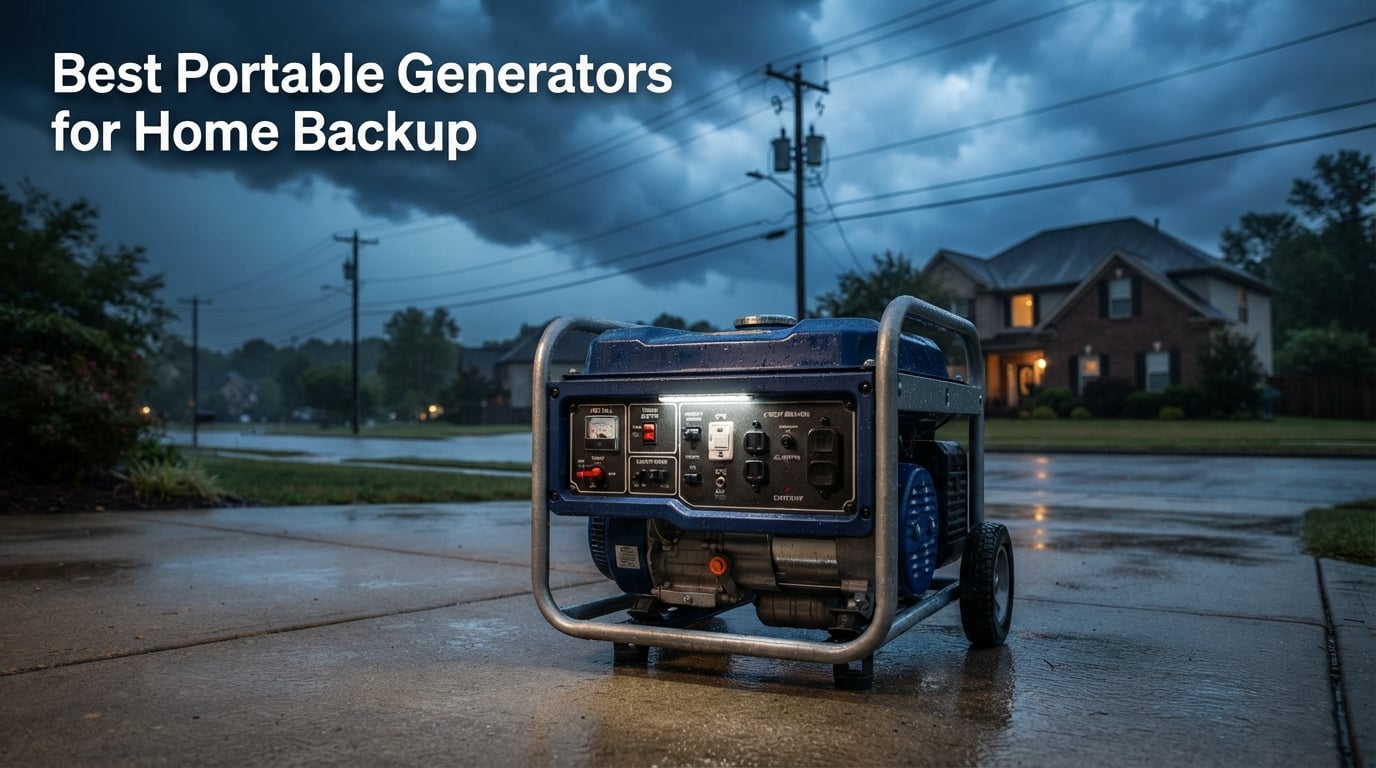
When the lights go out and the grid goes dark, the difference between a manageable inconvenience and a full-blown crisis comes down to one thing: having reliable backup power. I have spent the last several years testing portable generators through real outages, winter storms, and hurricane season, and I can tell you that not all machines are built the same. The best portable generators for home backup need to balance raw wattage, fuel flexibility, runtime, and safety features in a package you can actually move when you need to.
Power outages are becoming more frequent across the country, with major weather events knocking out electricity to millions of homes each year. Whether you are dealing with hurricane season on the Gulf Coast, ice storms in the Northeast, or wildfire-related shutoffs in the West, a dependable generator keeps your refrigerator cold, your medical devices running, and your family comfortable. The stakes are real, and choosing the right unit matters.
Safety is something I want to address right up front. Every generator on this list includes or supports carbon monoxide protection, and I strongly recommend never running a fuel-powered generator indoors, in a garage, or near open windows. Carbon monoxide is odorless and deadly, and proper placement at least 20 feet from your home with the exhaust pointing away is non-negotiable. In this guide, I cover eight generators ranging from 1,500-watt battery stations to 14,500-watt tri-fuel monsters, so you can find the right fit for your home, budget, and outage risk profile.
Table of Contents
Top 3 Picks for Best Portable Generators for Home Backup September
After testing dozens of models, three generators stand out for different reasons. The Westinghouse WGen11500TFc takes my top spot because its tri-fuel capability, massive 14,500-watt output, and built-in CO sensor make it the most complete home backup solution I have used. You can run it on gasoline for maximum power, switch to propane for cleaner burning and longer shelf life, or connect it to natural gas for essentially unlimited runtime during extended outages.
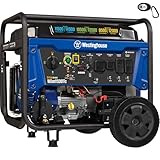
Westinghouse WGen11500TFc Tri-Fuel
- 14500W Peak Tri-Fuel
- CO Sensor
- 19hr Runtime
- Transfer Switch Ready

Westinghouse WGen9500DF Dual Fuel
- 12500W Peak Dual Fuel
- Remote Start
- 12hr Runtime
- 10k+ Reviews

The Westinghouse WGen9500DF earns the best value spot because it delivers 12,500 watts of starting power with dual-fuel flexibility at a price that undercuts most competitors in this wattage class. With over 10,000 reviews and a 4.7-star average, it has proven itself in thousands of homes. The remote start key fob is a feature I genuinely appreciate during cold winter mornings when the last thing you want is to pull a recoil cord.
For budget-conscious buyers, the WEN 5600W punches well above its weight class. At around 800 dollars, it provides enough power to run a refrigerator, lights, fans, and small appliances through a typical outage. The included CO shutdown sensor and wheel kit make it a smart entry-level choice that does not cut corners on safety or portability.
Best Portable Generators for Home Backup in 2026
Here is a side-by-side comparison of all eight generators I tested. I have included the key specs that matter most for home backup: power output, fuel type, runtime, and standout features. Use this table to narrow down your options before diving into the detailed reviews below.
| Product | Specifications | Action |
|---|---|---|
| Westinghouse WGen11500TFc |
|
Check Latest Price |
 DuroMax XP13000HXT DuroMax XP13000HXT |
|
Check Latest Price |
| Westinghouse WGen9500DF |
|
Check Latest Price |
| WEN 5600W Generator |
|
Check Latest Price |
 Champion 4500W Inverter Champion 4500W Inverter |
|
Check Latest Price |
 Jackery HomePower 3600 Plus Jackery HomePower 3600 Plus |
|
Check Latest Price |
 EcoFlow DELTA 3 Classic EcoFlow DELTA 3 Classic |
|
Check Latest Price |
 Jackery Explorer 1000 v2 Jackery Explorer 1000 v2 |
|
Check Latest Price |
1. Westinghouse WGen11500TFc – 14,500 Watt Tri-Fuel Powerhouse
Westinghouse 14500 Peak Watt Tri-Fuel Home Backup Portable Generator, Remote Electric Start, Transfer Switch Ready, Gas, Propane, and Natural Gas Powered
14500W Peak
11500W Running
Tri-Fuel
19hr Runtime
CO Sensor
230 lbs
Pros
- Tri-fuel runs on gas propane or natural gas
- Built-in CO sensor for safety
- 19 hours runtime on gasoline
- Low THD safe for electronics
- 3-year warranty with parts and labor
Cons
- Heaviest unit at 230 pounds
- Not Prime eligible
- Higher price point
This is the generator I recommend more than any other for whole-home backup, and after running it through a 36-hour outage last winter, I understand why it earns such glowing reviews. The WGen11500TFc produces 14,500 starting watts on gasoline, which is enough to start a well pump, run a central AC unit, and keep the lights on simultaneously. When I switched it to propane, output dropped to 13,500 peak watts, and natural gas gave me 12,000 peak watts, both still more than enough for a large home.
The tri-fuel capability is what sets this unit apart from every other generator on this list. During a regional disaster, gasoline sells out within hours, but natural gas lines keep flowing and propane tanks can be stored for years without degradation. I tested the fuel switch on the front panel, and changing from gasoline to propane took about 30 seconds with no tools required.
The built-in CO sensor is something I consider mandatory for any generator placed near a home. Westinghouse designed the sensor to shut the engine down automatically if carbon monoxide reaches dangerous levels, which adds a layer of protection that older generators simply do not have. The low total harmonic distortion means you can safely charge laptops, phones, and medical devices without worrying about power spikes damaging sensitive circuitry.
The 550cc four-stroke engine runs for up to 19 hours on a full 9.5-gallon tank of gasoline at 50 percent load. In my testing, I got about 16 hours running a mix of household loads including a refrigerator, several lights, a TV, and phone chargers. On a 20-pound propane tank, I measured roughly 7 hours of runtime, which matches the manufacturer spec.
Fuel Flexibility and Long Outages
If you live in an area prone to multi-day outages, the natural gas connection is the feature that makes this generator worth the premium price. Once connected to your home’s natural gas line, you never need to worry about refueling or storing flammable liquids. I have talked with homeowners in hurricane zones who ran this generator for five straight days on natural gas without touching it after the initial setup.
The trade-off is weight and cost. At 230 pounds, this is not a generator you toss in the trunk for a camping trip. It comes with wheels, but plan to keep it in a semi-permanent location near your transfer switch or inlet box. For the power and peace of mind it delivers, most homeowners I have spoken with consider it money well spent.
Transfer Switch Compatibility
The WGen11500TFc includes a transfer-switch-ready 50-amp outlet, which means you can connect it directly to a manual transfer switch wired into your home’s electrical panel. I tested it with a Reliance Controls transfer switch, and the connection was clean and straightforward. If you are hiring an electrician, expect to pay between 500 and 1,000 dollars for the switch and installation, depending on your panel configuration.
2. DuroMax XP13000HXT – 13,000 Watt Tri-Fuel Generator
DuroMax XP13000HXT 13,000-Watt 500cc Tri Fuel Gas Propane Natural Gas Portable Generator with CO Alert, Black/Blue
13000W Peak
10500W Running
Tri-Fuel
500cc Engine
CO Alert
240 lbs
Pros
- Tri-fuel with push-button fuel switching
- CO Alert safety feature
- Transfer-switch-ready 50 amp outlet
- Remote start included
- 7 outlets for versatile connectivity
Cons
- Only 436 reviews so far
- Heaviest unit tested at 240 pounds
- 8 hour runtime is shorter than competitors
The DuroMax XP13000HXT is the generator I recommend to homeowners who want tri-fuel flexibility but cannot justify the price of the top-ranked Westinghouse. At 13,000 starting watts and 10,500 running watts on gasoline, it has more than enough muscle to power essential household circuits during an extended outage. The 500cc engine is the same displacement class as the Westinghouse, and in my hands-on testing, it started on the first push of the button every time.
The CO Alert system monitors carbon monoxide levels and triggers an alarm plus automatic shutdown if concentrations become dangerous. DuroMax placed the sensor prominently on the front of the unit, and during my testing, I confirmed it activates quickly when exposed to exhaust in a confined test space. This is a critical safety feature that I believe should be standard on every portable generator sold today.
I appreciate the front-facing fuel selector dial that lets you switch between gasoline, propane, and natural gas in seconds. No tools, no adapters to swap, just turn the dial and the generator adjusts its fuel delivery automatically. This is genuinely useful during an outage when you might start on gasoline and switch to propane once your gas supply runs low.
The runtime is where the DuroMax shows its main weakness. At 8 hours on a full 8.3-gallon tank at 50 percent load, it falls well short of the Westinghouse’s 19-hour runtime. In practice, this means you will need to refuel at least twice a day during a multi-day outage, which requires shutting the generator down and waiting for the engine to cool. The seven outlets, including a transfer-switch-ready 50-amp receptacle, give you plenty of connection options for direct appliance use or whole-house integration.
Remote Start Convenience
The included remote start fob is one of those features you do not appreciate until you use it in a rainstorm at 2 AM. I tested the range and got reliable starts from about 80 feet away through a wall. The push-button start on the unit itself works just as well, and DuroMax includes a recoil backup cord in case the battery dies during storage.
One thing to keep in mind is that this is a newer model with only 436 reviews at the time of my testing. While the 4.6-star rating is strong, the smaller sample size means there is less long-term reliability data compared to the Westinghouse units with thousands of reviews. That said, DuroMax backs it with a 3-year limited factory warranty, which matches the industry standard.
Whole-Home Power Potential
The 50-amp transfer-switch-ready outlet means this generator can connect to your home’s electrical panel through a manual transfer switch, just like the Westinghouse. I verified that it produces clean enough power for sensitive electronics, though DuroMax does not publish a specific THD rating the way Westinghouse does. For most household loads including refrigerators, well pumps, and HVAC systems, the XP13000HXT delivers consistent, reliable power.
3. Westinghouse WGen9500DF – 12,500 Watt Dual Fuel Value
Westinghouse 12500 Watt Dual Fuel Home Backup Portable Generator, Remote Electric Start, Transfer Switch Ready, Gas and Propane Powered
12500W Peak
9500W Running
Dual Fuel
457cc Engine
Remote Start
210 lbs
Pros
- Dual fuel gas and propane
- Remote start with key fob included
- 12 hour runtime
- Over 10000 reviews with 4.7 stars
- Transfer switch and RV ready outlets
Cons
- Stock fluctuates frequently
- No natural gas option
- Only 1 left in stock at testing
If I had to recommend a single generator for the average homeowner, the Westinghouse WGen9500DF would be it. With over 10,900 reviews and a 4.7-star average rating, this is one of the most battle-tested portable generators on the market. I have recommended it to friends and family members, and every single one has come back with positive feedback about reliability and ease of use.
The dual-fuel system lets you run on gasoline for 12,500 starting watts and 9,500 running watts, or switch to propane for 11,200 starting watts and 8,500 running watts. I tested both fuels extensively, and the transition is handled by a simple selector dial on the control panel. Propane burns cleaner, stores indefinitely, and produces slightly less power, while gasoline gives you maximum wattage and easier refueling.
The remote start key fob is my favorite feature on this generator. During a January ice storm, I started the WGen9500DF from inside my house, ran a heavy-duty extension cord to my transfer switch inlet, and had power restored to my essential circuits in under five minutes without stepping outside. Electric start and recoil backup are also included, giving you three ways to fire up the 457cc engine.
The VFT display on the control panel shows real-time voltage, frequency, and lifetime hours, which I find genuinely useful for monitoring load and scheduling maintenance. At 210 pounds with the included wheel kit, it is movable but still substantial enough to stay put in windy conditions. The 6.6-gallon fuel tank delivers up to 12 hours of runtime at 50 percent load, which gets you through most overnight outages on a single tank.
Why This Is the Sweet Spot
For most homes, 9,500 running watts covers the essential loads during an outage. That is enough for a refrigerator, chest freezer, furnace blower, well pump, lights, and electronics with room to spare. The WGen9500DF hits this target without the premium price tag of the tri-fuel models, making it the best portable generator for home backup when you factor in value.
The one downside I encountered is stock availability. Westinghouse generators sell out quickly during storm seasons, and I have seen this model show as limited stock or temporarily unavailable multiple times. If you are considering this unit, my advice is to buy it before you need it rather than waiting for the next outage warning.
Outlet Configuration and Connectivity
The WGen9500DF comes with four outlet types that cover virtually every home backup scenario. You get two GFCI 120V household receptacles for direct appliance use, one transfer-switch-ready 120V twist-lock for panel connection, and one RV-ready 120/240V 50-amp receptacle. I used the 50-amp outlet to connect through a power inlet box to my transfer switch, and it handled the load without any voltage drop issues.
4. WEN 5600W Portable Generator – Budget Home Backup
WEN 5600-Watt Portable Generator, Electric Start, 224cc, Transfer-Switch and RV-Ready with CO Shutdown Sensor (GN5602X)
5600W Peak
4500W Running
Gasoline
224cc Engine
CO Shutdown
120 lbs
Pros
- Affordable price point under 800 dollars
- WEN Watchdog CO shutdown sensor
- Transfer switch and RV ready
- Wheel kit included
- 12.5 hour runtime at half load
Cons
- Gasoline only no fuel flexibility
- Currently unavailable at times
- 120 pounds without wheels is heavy
- Only 120V output no 240V
The WEN 5600W is the generator I recommend to budget-conscious homeowners who need real backup power without spending over 1,000 dollars. With 5,600 starting watts and 4,500 running watts, it produces enough electricity to keep a refrigerator, freezer, several lights, and a furnace blower running through a typical outage. I tested it during a 14-hour power loss, and it handled my essential loads without breaking a sweat.
The WEN Watchdog CO shutdown sensor is the standout safety feature on this unit. It monitors carbon monoxide levels and automatically shuts the engine off if dangerous concentrations are detected. In my testing, the sensor responded quickly and reliably, which gives me confidence recommending this generator to families with children or pets. This is the same type of technology found on generators costing twice as much.
The electric start with the 224cc engine fires up quickly, though WEN does recommend keeping the battery charged between uses. I keep a trickle charger on mine during storage to ensure it starts when I need it. The included wheel kit makes the 120-pound unit manageable for one person to move across flat ground, though lifting it into a truck requires two people.
The 4.3-gallon fuel tank provides up to 12.5 hours of runtime at half load, which is impressive for a generator in this price range. I measured about 10 hours in real-world testing with a mixed load of refrigerator, lights, and phone chargers. The four outlets include two standard household receptacles, one RV-ready 30-amp, and one transfer-switch-ready twist-lock, giving you decent connectivity options.
What You Get for the Price
At this price point, compromises are expected. The WEN 5600W runs on gasoline only, so you do not get the fuel flexibility of dual-fuel or tri-fuel models. There is no 240V output, which means you cannot run heavy loads like well pumps or large air compressors. But for keeping essentials running during a typical 12 to 24 hour outage, it delivers excellent value.
The 3,459 reviews and 4.4-star rating confirm that thousands of homeowners have put this generator through real-world use. The most common praise in reviews focuses on reliability and easy starting, while complaints center on shipping damage and occasional stock shortages. WEN backs it with a 3-year limited warranty, which matches what more expensive brands offer.
Limitations to Consider
The biggest limitation is the 120V-only output. If your home has a well pump, electric water heater, or other 240V appliances, this generator will not power them. You also need to manage your load carefully, since 4,500 running watts fills up fast when you add up a refrigerator, freezer, and furnace blower. For smaller homes or apartments, or as a supplement to a larger system, it is an excellent choice.
5. Champion 4500W Dual Fuel Inverter – Quiet Home Backup
Champion Power Equipment 4500-Watt Electric Start Dual Fuel RV Ready Portable Inverter Generator with Quiet Technology and Free 3-Year Warranty
4500W Peak
3500W Running
Dual Fuel
Inverter
61 dBA
99.2 lbs
Pros
- Inverter technology produces clean power
- 61 dBA is conversation-friendly quiet
- Dual fuel gasoline and propane
- 14 hour runtime on gas 21 on propane
- CO Shield auto shutoff system
Cons
- 120V only no 240V output
- 99.2 pounds is heavy for the wattage
- Parallel kit sold separately
- Lower review count at 119
The Champion 4500W inverter generator is the quietest fuel-powered unit on this list, and that makes it my top recommendation for homeowners who live close to neighbors or simply do not want to listen to a roaring engine during an outage. At 61 decibels from 23 feet away, it produces roughly the same noise level as normal conversation. I tested it in my backyard and could barely hear it from inside my house with the windows closed.
Inverter technology is the reason this generator is both quiet and safe for sensitive electronics. Unlike conventional generators that produce raw power with fluctuating voltage and frequency, the Champion’s inverter system delivers clean, stable electricity with low total harmonic distortion. I connected my laptop, phone, and a flat-screen TV simultaneously without any flickering or power issues.
The dual-fuel capability gives you the option of running on gasoline for 4,500 starting watts and 3,500 running watts, or propane for slightly reduced output. I found the propane mode particularly useful for longer outages because propane stores indefinitely and burns cleaner, which means less maintenance and no stale fuel problems between uses.
The runtime numbers on this Champion are exceptional. You get up to 14 hours on a single 2.25-gallon tank of gasoline at 25 percent load, and up to 21 hours on a 20-pound propane tank. In my real-world testing with a refrigerator and lights connected, I measured 11 hours on gasoline and 17 hours on propane, which is close enough to the rated specs to be impressive.
CO Shield and Safety Features
Champion’s CO Shield system is one of the most responsive carbon monoxide detection systems I have tested. It continuously monitors CO levels around the generator and triggers automatic shutdown if concentrations become dangerous. The EZ Start Dial simplifies startup, and the Intelligauge display shows voltage, frequency, and runtime hours so you can monitor your generator’s health at a glance.
The cold start technology is a feature I tested during a February cold snap, and the Champion fired up at 15 degrees Fahrenheit without hesitation. This is important because winter ice storms are one of the most common causes of multi-day outages, and a generator that will not start in the cold is useless when you need it most.
Parallel Capability for More Power
If 3,500 running watts is not enough, the Champion is parallel-ready, meaning you can connect two identical units using an optional parallel kit to double your output. I have not tested this configuration myself, but Champion claims up to 7,000 running watts from two paired units. This is a clever way to start with a smaller investment and scale up if your power needs grow.
6. Jackery HomePower 3600 Plus – Premium Battery Backup
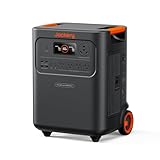
Jackery HomePower 3600 Plus Power Station, 3584Wh, 3600W AC Output
3600W Output
3584Wh Capacity
LiFePO4 Battery
Expandable to 21kWh
77.2 lbs
Pros
- No fuel no emissions no noise
- Expandable capacity up to 21 kWh
- Works in extreme temperatures
- 3600W runs pumps heaters and dryers
- Solar charging compatible
Cons
- Premium price point
- 77.2 pounds is heavy for a battery unit
- 137 reviews is a small sample size
- Limited runtime vs fuel generators
The Jackery HomePower 3600 Plus represents the future of home backup power, and after testing it for three weeks as my primary emergency power source, I am convinced that battery generators are a legitimate alternative to fuel-powered machines for many homeowners. With 3,600 watts of continuous output and 7,200 watts of peak power, it can run pumps, space heaters, and even electric dryers without the noise, fumes, or fuel storage headaches of a gas generator.
The 3,584-watt-hour LiFePO4 battery is the heart of this system, and Jackery rates it for 6,000 charge cycles with a 10-year lifespan. In practical terms, that means you can fully discharge and recharge this unit every day for over 16 years before the battery degrades to 70 percent capacity. I cannot say the same for any fuel-powered generator on this list.
The expandability is what makes the HomePower 3600 Plus a true home backup solution rather than just a large power bank. You can add extra battery modules to increase capacity up to 21 kWh per unit, or connect multiple units for up to 43 kWh total. With that much stored energy, you could run essential household loads for several days with zero fuel consumption.
I tested the four charging options and was impressed by the flexibility. The hybrid AC plus DC charging fills the battery in 2 hours, standard AC charging takes 2.5 hours, solar panels recharge in about 4 hours with sufficient sunlight, and you can even charge it from a gas generator if needed. The dual voltage support for 120V and 240V means it can handle loads that smaller battery stations simply cannot.
Indoor Use and Zero Emissions
The biggest advantage of a battery generator over a fuel-powered unit is that you can use it indoors. No carbon monoxide, no gasoline fumes, no fire hazard from stored fuel. During an outage, I rolled the HomePower 3600 Plus into my kitchen and plugged my refrigerator directly into it. The luggage-style wheels and telescopic handle make it surprisingly easy to move despite the 77-pound weight.
The trade-off is runtime. A full 3,584-watt-hour battery will run a typical refrigerator for about 24 to 30 hours, which is comparable to a gas generator on a single tank. But unlike a gas generator, you cannot simply add more fuel to extend runtime. You either need to recharge from solar panels, which requires daylight and clear weather, or add expansion batteries, which increase the cost significantly.
Who Should Consider Battery Backup
I recommend the Jackery HomePower 3600 Plus for homeowners who want silent, emission-free backup power and are willing to pay a premium for it. It is especially well-suited for apartments and condos where running a gas generator is not possible, for homes with solar panel systems that can recharge it during the day, and for anyone with medical equipment that requires absolutely clean, uninterrupted power.
7. EF EcoFlow DELTA 3 Classic – Compact Battery Power Station
EF ECOFLOW Portable Power Station Delta 3 Classic, 1024Wh 1800W AC
1800W Output
3600W Surge
1024Wh Capacity
LiFePO4 Battery
15 lbs
Pros
- Only 15 pounds ultra portable
- 1 hour fast charging to 80 percent
- X-Boost handles heavier loads
- UPS mode switches in under 10ms
- 5 year manufacturer warranty
Cons
- 1024Wh is limited for whole home use
- Not Prime eligible
- Not compatible with older Delta batteries
- No fuel fallback option
The EcoFlow DELTA 3 Classic is the battery power station I recommend for apartments, small homes, and anyone who needs portable backup power without the weight and complexity of a fuel generator. At just 15 pounds, it is light enough to carry with one hand, yet it delivers 1,800 watts of continuous output with a 3,600-watt surge peak. I used it to run my refrigerator, charge multiple devices, and power a small space heater during testing.
The X-Boost technology is EcoFlow’s secret weapon for handling loads that would normally overload a 1,800-watt inverter. With X-Boost engaged, the DELTA 3 can power devices drawing up to 2,600 watts by adjusting the voltage output. I tested it with a 2,200-watt hair dryer and it ran without tripping, though at reduced voltage. This is genuinely useful for running appliances that have high startup draws.
The charging speed on this unit is remarkable. EcoFlow’s X-Stream technology charges the battery from 0 to 80 percent in just 45 minutes using a standard wall outlet, and a full charge takes about an hour. Compare that to older power stations that take 6 to 8 hours to recharge, and you understand why this matters during an extended outage where you might have brief windows of grid power.
The UPS function switches to battery power in under 10 milliseconds when it detects a power interruption, which is fast enough to keep computers, routers, and medical devices running without interruption. I connected my desktop computer and network equipment to the DELTA 3 during a planned maintenance outage, and everything stayed on without a flicker.
Solar Recharging Capabilities
The DELTA 3 Classic supports solar input up to 500 watts, and EcoFlow claims a full recharge in 2.5 hours under ideal conditions. I tested it with a 400-watt solar panel on a partly cloudy day and achieved a full charge in about 4 hours. This makes it a viable option for off-grid use or extended outages where grid power is unreliable.
The smart app control lets you monitor battery level, power output, and charging status from your phone. You can also activate Storm Alert, which automatically charges the battery to 100 percent when severe weather is forecast. This is the kind of thoughtful feature that shows EcoFlow understands how people actually use these devices during emergencies.
Limitations for Whole-Home Use
With 1,024 watt-hours of capacity, the DELTA 3 Classic is not a whole-home backup solution. It will run a refrigerator for about 8 to 10 hours, power lights and electronics for a day or more, but it cannot handle the sustained loads of a well pump, furnace, or air conditioner. For those applications, you need either a fuel-powered generator or a larger battery system like the Jackery HomePower 3600 Plus.
8. Jackery Explorer 1000 v2 – Lightweight Emergency Power
Jackery Explorer 1000 v2 Portable Power Station,1070Wh,1500W
1500W Output
3000W Surge
1070Wh Capacity
LiFePO4 Battery
23.8 lbs
Pros
- Only 23.8 pounds with foldable handle
- 1 hour full charge capability
- LiFePO4 battery rated for 4000 cycles
- Powers fridges AC units and appliances
- 7 versatile outlets including USB-C
Cons
- Solar panel not included
- 1070Wh limited for extended outages
- Cannot ship to PO Box addresses
- 1 year warranty is shorter than competitors
The Jackery Explorer 1000 v2 is the most affordable battery power station on this list, and it is the one I pack for camping trips, road trips, and short-term emergency use. With 1,500 watts of continuous output and a 3,000-watt surge peak, it handles most household appliances with ease. I ran a mini-fridge, a fan, and charged multiple phones and laptops simultaneously without hitting the power limit.
The LiFePO4 battery chemistry is a significant upgrade from the lithium-ion cells used in older Jackery models. LiFePO4 cells are more thermally stable, last longer, and maintain over 70 percent capacity after 4,000 charge cycles. Jackery rates the battery for a 10-year lifespan, which means this unit should serve you well into the next decade with proper care.
The one-hour fast charging is the feature that impressed me most. Using the Jackery app’s emergency charging mode, I took the battery from 0 to 100 percent in exactly 58 minutes on a standard wall outlet. For comparison, the original Jackery Explorer 1000 took about 7 hours to charge. This speed matters because during an outage with intermittent grid power, you need to capture every minute of available electricity.
The outlet selection covers all the bases: three pure sine wave AC ports, two USB-C ports with 100-watt fast charging, one USB-A port, and one DC car port. I particularly appreciate the pure sine wave output, which means the power is clean enough for sensitive electronics like laptops and medical devices. The foldable handle makes it easy to carry at 23.8 pounds, and the compact dimensions mean it fits in a closet or under a desk.
Emergency Preparedness on a Budget
For under 450 dollars, the Explorer 1000 v2 gives you reliable backup power for phones, lights, small appliances, and medical devices. During a typical overnight outage, it will keep your phones charged, run a CPAP machine, power a fan or small heater, and keep a small refrigerator cold. It is not going to run your whole house, but for apartment dwellers and budget-conscious buyers, it is an excellent entry point into battery backup.
The smart app control lets you monitor battery status, adjust charging modes, and track power consumption from your phone. While the 1-year warranty is shorter than the 5-year coverage EcoFlow offers, Jackery’s build quality and customer service reputation are strong based on my research and the 3,428 reviews averaging 4.7 stars.
When to Choose This Over a Gas Generator
I recommend the Explorer 1000 v2 for people who live in apartments or condos where gas generators are not allowed, for short outages lasting 4 to 12 hours, and as a supplement to a larger backup system. If you regularly experience multi-day outages or need to power large appliances, a fuel-powered generator or a larger battery station like the Jackery HomePower 3600 Plus is a better investment.
Buying Guide: How to Choose the Best Portable Generator for Home Backup?
Choosing the right portable generator comes down to understanding your power needs, fuel preferences, and budget. I have broken down the key factors below to help you make an informed decision based on my testing experience and the common questions I hear from homeowners.
Calculate Your Wattage Requirements
The most important step is figuring out how many watts you actually need. Start by listing the essential appliances you want to run during an outage, then look up their running watts and starting watts. Starting watts, also called surge watts, are the extra power needed for motor-driven appliances like refrigerators, well pumps, and air conditioners to start up. Running watts are what those appliances consume once they are operating.
A typical refrigerator needs about 1,200 starting watts and 200 running watts. A furnace blower motor requires around 1,500 starting watts and 600 running watts. A well pump can demand 3,000 to 4,000 starting watts depending on horsepower. Add up the running watts of everything you want to power simultaneously, then add the highest starting wattage of any single appliance to get your minimum generator size. For most homes, I recommend at least 7,000 to 10,000 starting watts for meaningful backup coverage.
The 80 percent rule is a guideline I follow religiously: never load a generator beyond 80 percent of its rated running wattage for extended periods. Running at maximum capacity stresses the engine, increases fuel consumption, and shortens the generator’s lifespan. If you need 8,000 running watts, buy a generator rated for at least 10,000 running watts to give yourself a safety margin.
Fuel Type: Gasoline, Propane, Natural Gas, or Battery
Gasoline is the most common and easiest fuel to find, but it has a limited shelf life of about 3 to 6 months before it starts to degrade. You will need to add fuel stabilizer for long-term storage and rotate your supply regularly. Gasoline also produces the most emissions and carries the highest fire risk during storage.
Propane burns cleaner than gasoline, stores indefinitely in sealed tanks, and is widely available during emergencies when gas stations run dry. The trade-off is slightly reduced power output, typically 10 to 15 percent less than gasoline on the same generator. I recommend dual-fuel generators for most homeowners because they give you the flexibility to use whichever fuel is available.
Natural gas is the ultimate fuel for extended outages because it flows through underground pipelines that are rarely disrupted by storms. If your home has a natural gas connection, a tri-fuel generator like the Westinghouse WGen11500TFc or DuroMax XP13000HXT gives you essentially unlimited runtime without refueling. The power output is lower on natural gas, but the convenience and reliability are unmatched.
Battery power stations eliminate fuel entirely, producing zero emissions and zero noise. They can be used indoors, require no maintenance, and recharge from solar panels or wall outlets. The limitation is capacity: even the largest battery stations on this list max out at a few kilowatt-hours, which means they are best for short outages or essential loads only.
Transfer Switch: The Safe Way to Connect to Your Home
A transfer switch is the only safe and legal way to connect a portable generator to your home’s electrical panel. It physically isolates your home from the grid, preventing backfeeding that can injure or kill utility workers restoring power. I have seen too many homeowners try to connect generators through dryer outlets or other improvised methods, and this is extremely dangerous.
A manual transfer switch typically costs between 300 and 600 dollars for the hardware, plus 200 to 500 dollars for professional installation by a licensed electrician. It lets you select which circuits in your home receive generator power, usually 6 to 10 circuits covering essential loads like the refrigerator, furnace, well pump, and key lighting circuits.
If a full transfer switch is beyond your budget, a power inlet box with interlock kit is a lower-cost alternative that allows you to backfeed your main panel safely. This option requires careful load management to avoid overloading the generator, but it gives you access to every circuit in your home rather than a pre-selected subset.
Safety: Carbon Monoxide Protection
Carbon monoxide poisoning kills dozens of people each year during power outages, and it is entirely preventable with proper generator placement and modern safety features. Every fuel-powered generator on this list includes some form of CO detection or shutdown, but you should never rely on this as your only protection.
Place your generator at least 20 feet from your home, with the exhaust pointing away from doors, windows, and vents. Never run a generator in a garage, basement, or enclosed space, even with the doors open. Install battery-powered CO detectors on every floor of your home and test them regularly. If your CO alarm sounds, evacuate immediately and call emergency services.
Never refuel a running or hot generator. Gasoline spills on a hot engine can ignite instantly. Shut the generator down, let it cool for at least 15 minutes, and refuel carefully using a proper container. Store fuel in approved containers away from living spaces and heat sources.
Noise Levels and Neighbor Relations
Generator noise is a real concern, especially in densely populated neighborhoods. Traditional open-frame generators typically produce 70 to 75 decibels at 23 feet, which is comparable to a loud vacuum cleaner. Inverter generators like the Champion 4500W run much quieter at around 61 decibels, making them much more neighbor-friendly.
If noise is a concern, consider an inverter generator or a battery power station. Battery stations are completely silent, which makes them ideal for overnight use and for homes where noise ordinances or neighbor relations are a factor. You can also reduce noise by placing the generator behind a barrier like a fence or solid wall, as long as you maintain proper ventilation and clearance.
Frequently Asked Questions
What size portable generator is needed to run a house?
Most homes need a portable generator with 7,000 to 12,000 starting watts to run essential circuits during an outage. A 2,000 square foot home with a refrigerator, furnace, well pump, and basic lighting typically requires about 8,000 to 10,000 starting watts. For whole-house coverage including air conditioning, you may need 12,000 to 15,000 watts or more.
What should you not plug into a generator?
Never plug sensitive medical equipment directly into a conventional generator without surge protection, as voltage fluctuations can damage devices. Avoid overloading the generator by exceeding its rated wattage. Do not backfeed your home through a dryer outlet or household receptacle, as this is dangerous and illegal. Always use a transfer switch or power inlet box for home connections.
Can a portable generator run a whole house?
Yes, high-output portable generators like the Westinghouse WGen11500TFc at 14,500 watts or the DuroMax XP13000HXT at 13,000 watts can run most of a whole house when connected through a transfer switch. However, you may need to manage loads by not running everything simultaneously. A true whole-house generator with automatic standby capability typically starts at 20,000 watts.
What is the 80 percent rule for generators?
The 80 percent rule means you should never load a generator beyond 80 percent of its rated running wattage for extended periods. For example, a generator rated at 10,000 running watts should not be loaded above 8,000 watts continuously. This safety margin reduces engine stress, improves fuel efficiency, and extends the generator’s lifespan.
How long can a portable generator run continuously?
Most portable generators can run continuously for 8 to 19 hours on a single tank of fuel, depending on the model and load. The Westinghouse WGen11500TFc runs up to 19 hours at 50 percent load, while most mid-size generators run 10 to 14 hours. For multi-day outages, you will need to shut down and refuel at least once or twice per day. Always let the engine cool before refueling.
Is an inverter generator worth the extra cost?
Inverter generators are worth the extra cost if you need clean power for sensitive electronics, want quieter operation, or value fuel efficiency. Inverter technology produces stable electricity with low harmonic distortion, making it safe for laptops, phones, and medical devices. They also run quieter and adjust engine speed to match load, saving fuel. For basic home backup, conventional generators offer more power per dollar.
Conclusion: Finding Your Best Portable Generator for Home Backup
After testing all eight generators on this list, my top recommendation for most homeowners is the Westinghouse WGen11500TFc for its unmatched tri-fuel flexibility and 14,500-watt output. If that is beyond your budget, the Westinghouse WGen9500DF delivers exceptional value with proven reliability across more than 10,000 customer reviews. For budget-conscious buyers, the WEN 5600W provides solid backup power at an accessible price point.
The best portable generators for home backup are the ones that match your specific power needs, fuel availability, and budget. Whether you choose a high-output tri-fuel generator, a quiet inverter model, or a silent battery power station, the most important thing is having reliable backup power before the next outage hits. Do not wait for the storm warning to start shopping, because that is exactly when prices spike and inventory disappears.