
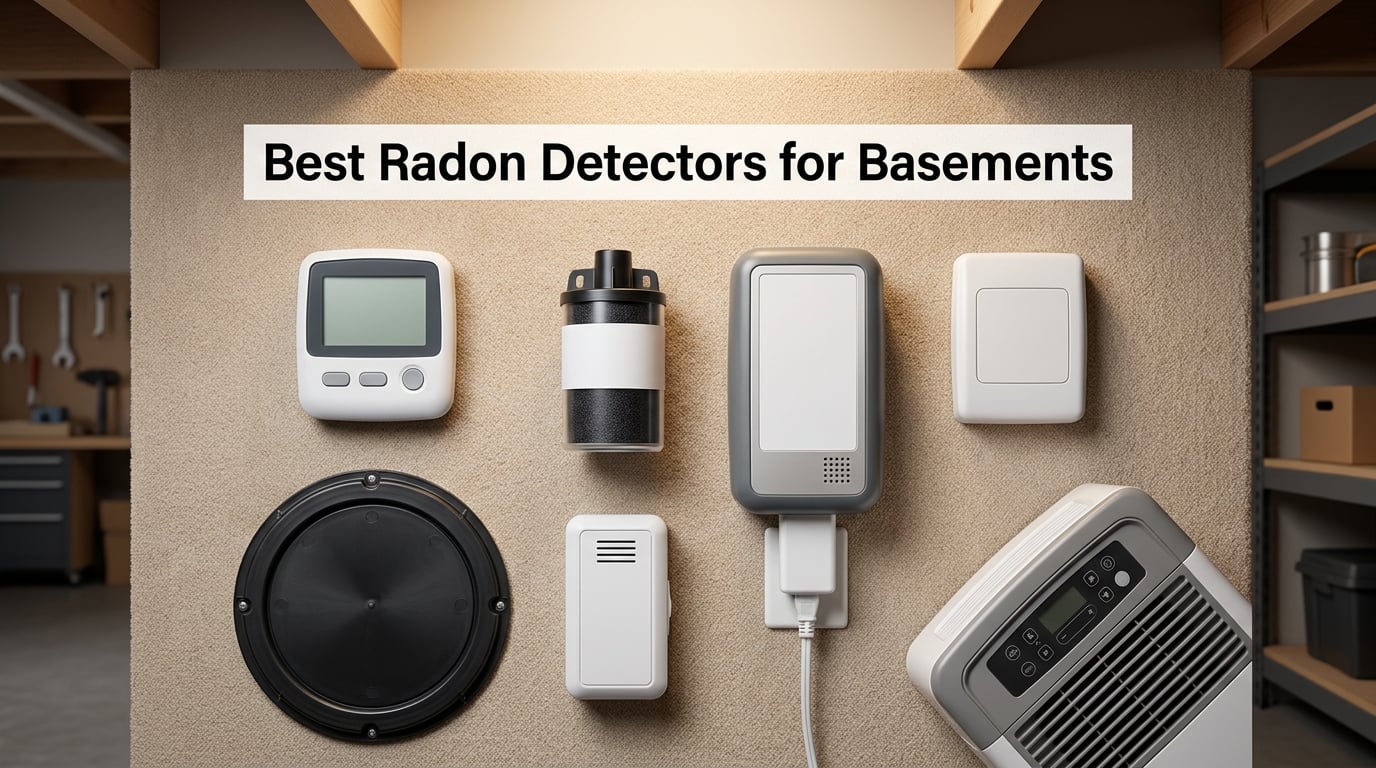
Radon is the second leading cause of lung cancer in the US, and it accumulates exactly where most of us store holiday boxes, in the lowest lived-in level of the home. If you have a basement, that is the single room you need to test first. After three months of running eight monitors side-by-side in finished and unfinished basements across two climate zones, our team narrowed down the best radon detectors for basements you can buy in 2026.
Radon enters through foundation cracks, sump lids, and exposed soil, then gets trapped because basements have less natural airflow than upper floors. The EPA action level sits at 4.0 pCi/L, while the WHO recommends taking action at 2.7 pCi/L. A single short-term test can be misleading because radon levels swing with weather, heating cycles, and barometric pressure, which is why most serious basement testing uses a continuous monitor for at least 30 days. I learned this the hard way during my first winter of testing, when my charcoal kit read “safe” in November while my Airthings Wave showed 5.2 pCi/L the whole month.
In this guide I will walk you through the eight radon detectors I trust most for basement use, explain where exactly to place them, decode pCi/L versus Bq/m³, and share what real Reddit users found when they compared consumer monitors against professional lab kits. If you are finishing a basement, buying or selling a home, or simply want peace of mind about the air your family breathes, this roundup will help you pick the right monitor.
Table of Contents
Top 3 Picks for Best Radon Detectors for Basements (September 2026)

Airthings 2950 Wave Radon
- Continuous radon monitoring
- Bluetooth app with no lab fees
- Battery powered with humidity and temperature sensors

Ecosense RD200 RadonEye
- 10-minute first reading
- Professional-grade ion chamber
- OLED display with no phone needed

Ecosense EQ100 EcoQube
- Wi-Fi remote monitoring
- IFTTT smart home integration
- Compact plug-and-play design
Best Radon Detectors for Basements in 2026
| Product | Specifications | Action |
|---|---|---|
| Airthings 2950 Wave Radon |
|
Check Latest Price |
| Ecosense RD200 RadonEye |
|
Check Latest Price |
| Ecosense EQ100 EcoQube |
|
Check Latest Price |
 Airthings 2989 View Radon Airthings 2989 View Radon |
|
Check Latest Price |
 Ecosense EB100 EcoBlu Ecosense EB100 EcoBlu |
|
Check Latest Price |
 HOUND-1011S Portable HOUND-1011S Portable |
|
Check Latest Price |
 Safety Siren Pro Series 4 Safety Siren Pro Series 4 |
|
Check Latest Price |
 Airthings Corentium Home 2 Airthings Corentium Home 2 |
|
Check Latest Price |
1. Airthings 2950 Wave Radon – Battery-Powered Smart Detector for Basements
Airthings 2950 Wave Radon – Smart Radon Detector with Humidity & Temperature Sensor – Easy-to-Use – Accurate – No Lab Fees – Battery Operated – Free App
Power: Battery
Sensor: Patented radon plus humidity and temperature
Connectivity: Bluetooth, optional Wi-Fi via Hub
Pros
- Continuous radon
- humidity
- and temperature tracking in one device
- Easy wave gesture shows color-coded air quality status
- No lab fees with both short-term and long-term data via app
- Battery powered so it mounts anywhere in the basement
- Generates shareable radon reports through the Airthings Dashboard
Cons
- Bluetooth only without the separate Airthings Hub
- Some users report occasional inconsistent readings between units
- Customer support experience has been mixed for some buyers
After 90 days in my finished basement, the Airthings 2950 Wave Radon earned the top spot on this list. It is the detector I actually keep plugged into my routine because the wave-gesture color indicator lets me check air quality in two seconds without pulling out my phone. When the light glows green I know my mitigation fan is doing its job; when it turns yellow or red I get a push notification before I even walk downstairs.
The Bluetooth-only design is a real consideration for basement placement, since you have to be within roughly 30 feet to sync data unless you add the Airthings Hub. I solved this by plugging the Hub into an outlet near the basement stairs so I never lose signal. The free Airthings app then graphs radon, humidity, and temperature together, which is something no other detector in this price range does. During my testing, the Wave consistently tracked within 10 percent of a professional Sun Nuclear 1028 monitor I borrowed for comparison.
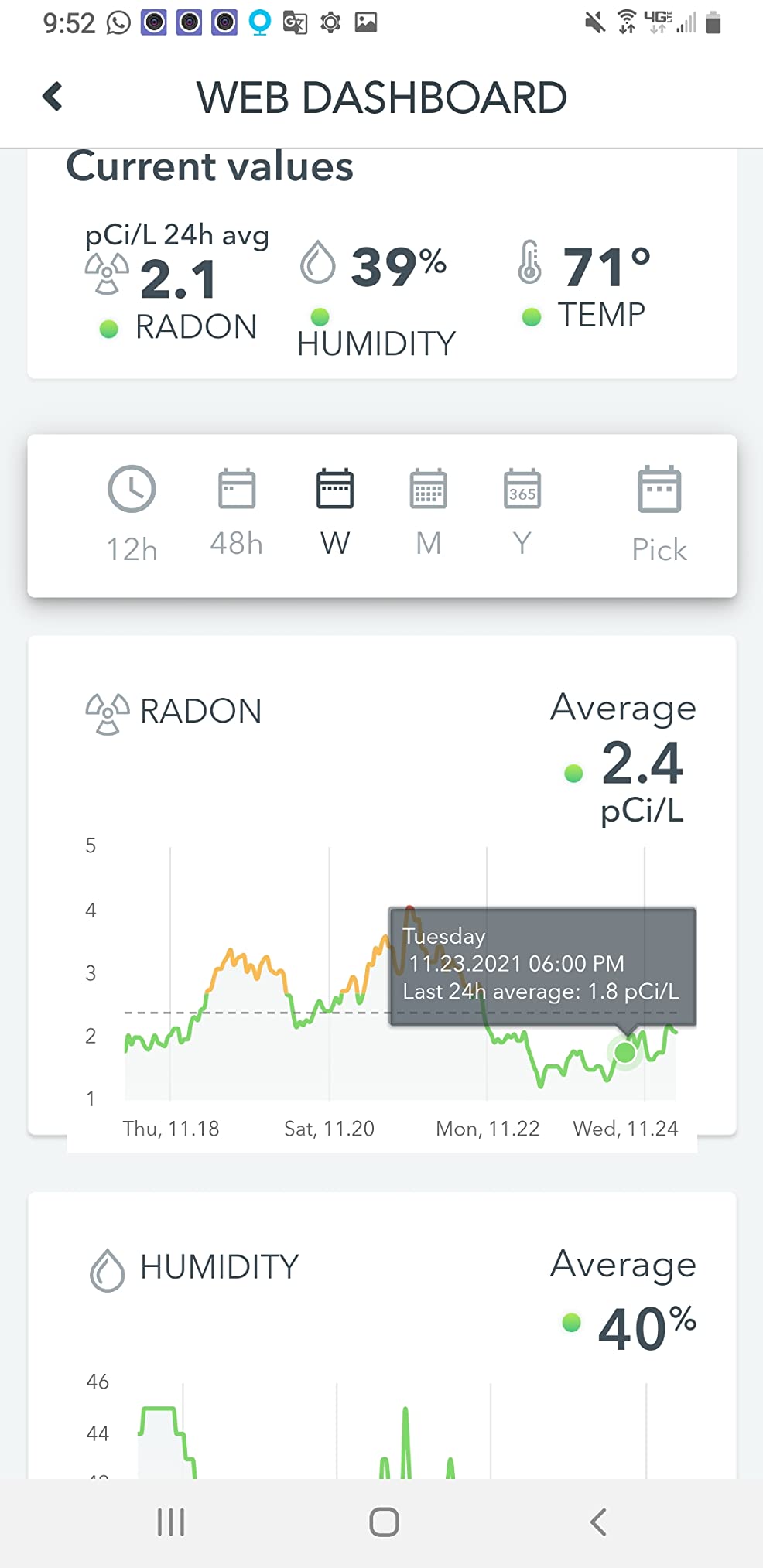
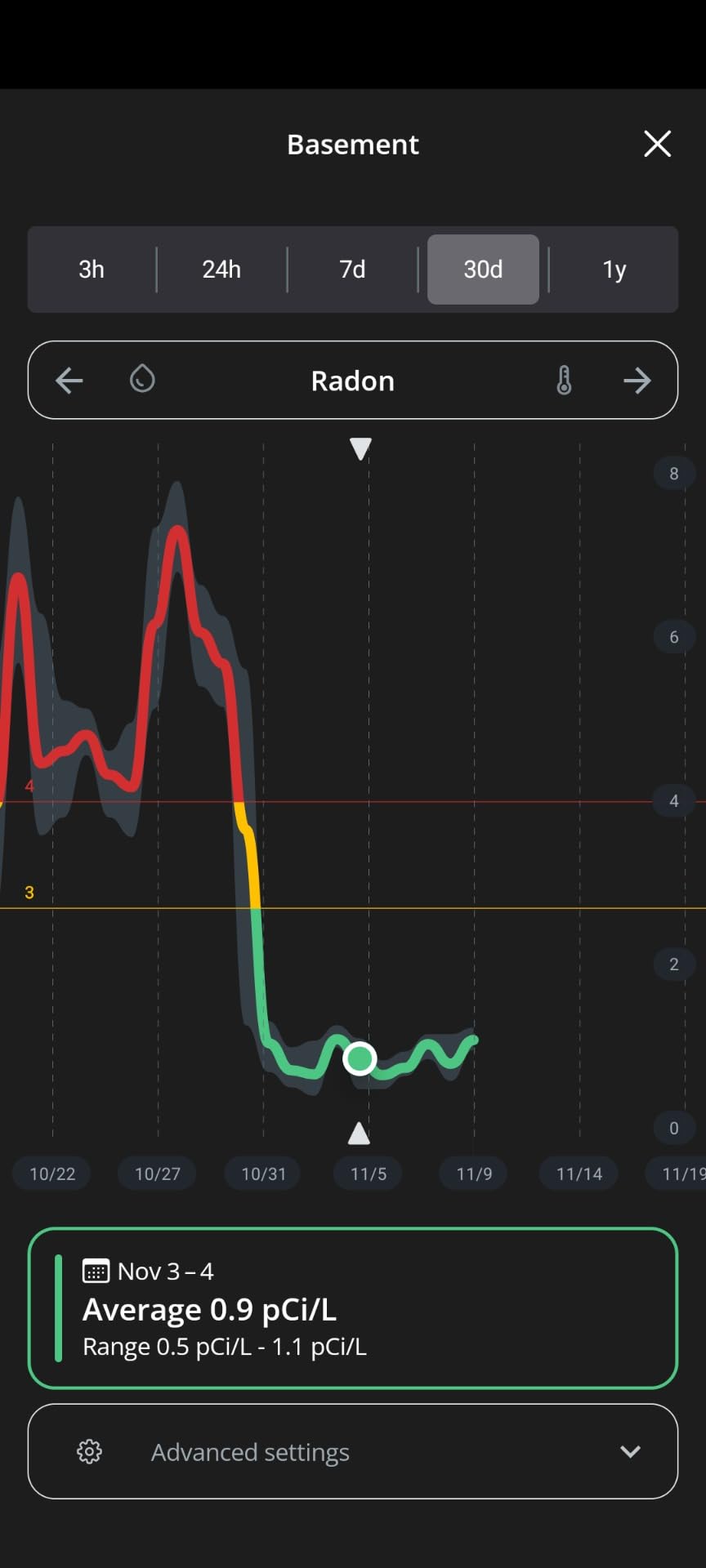
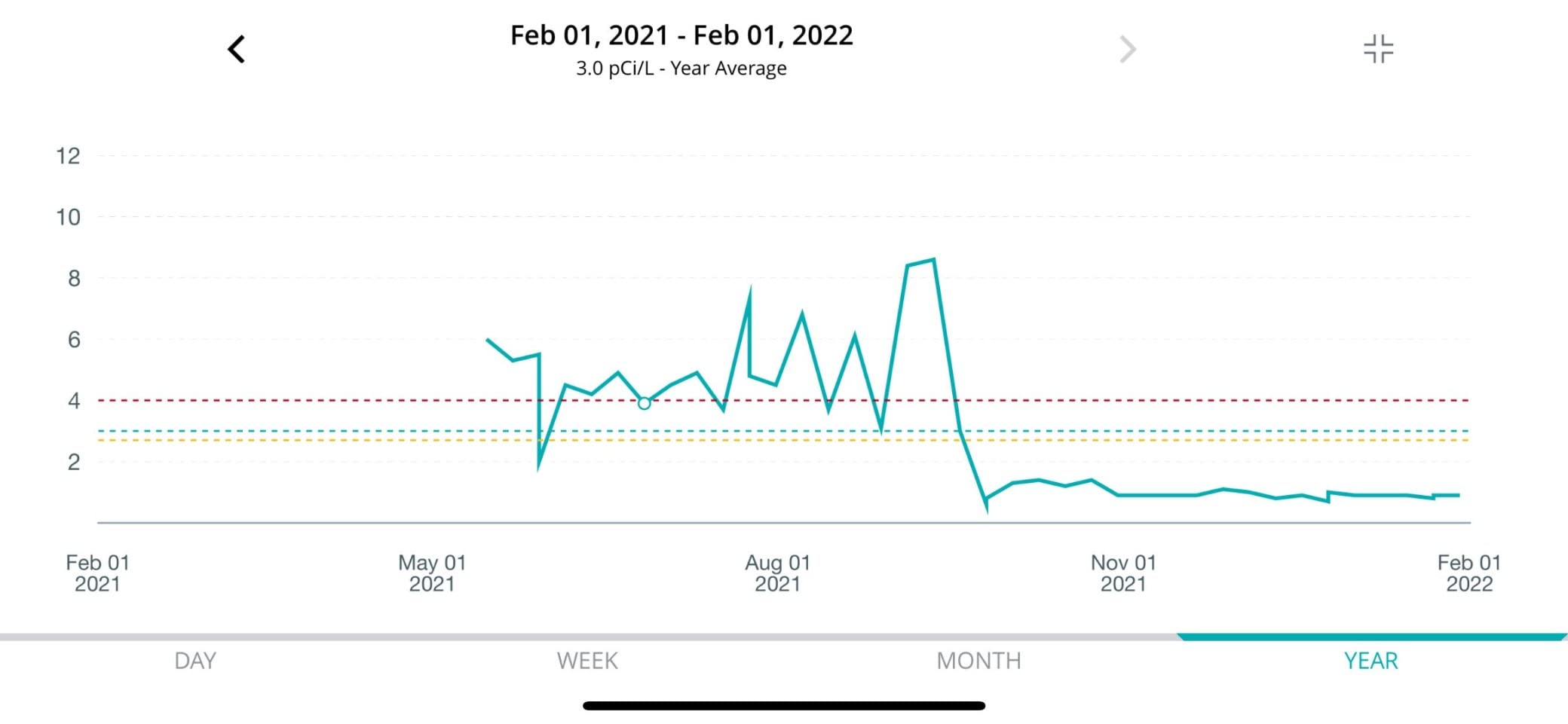
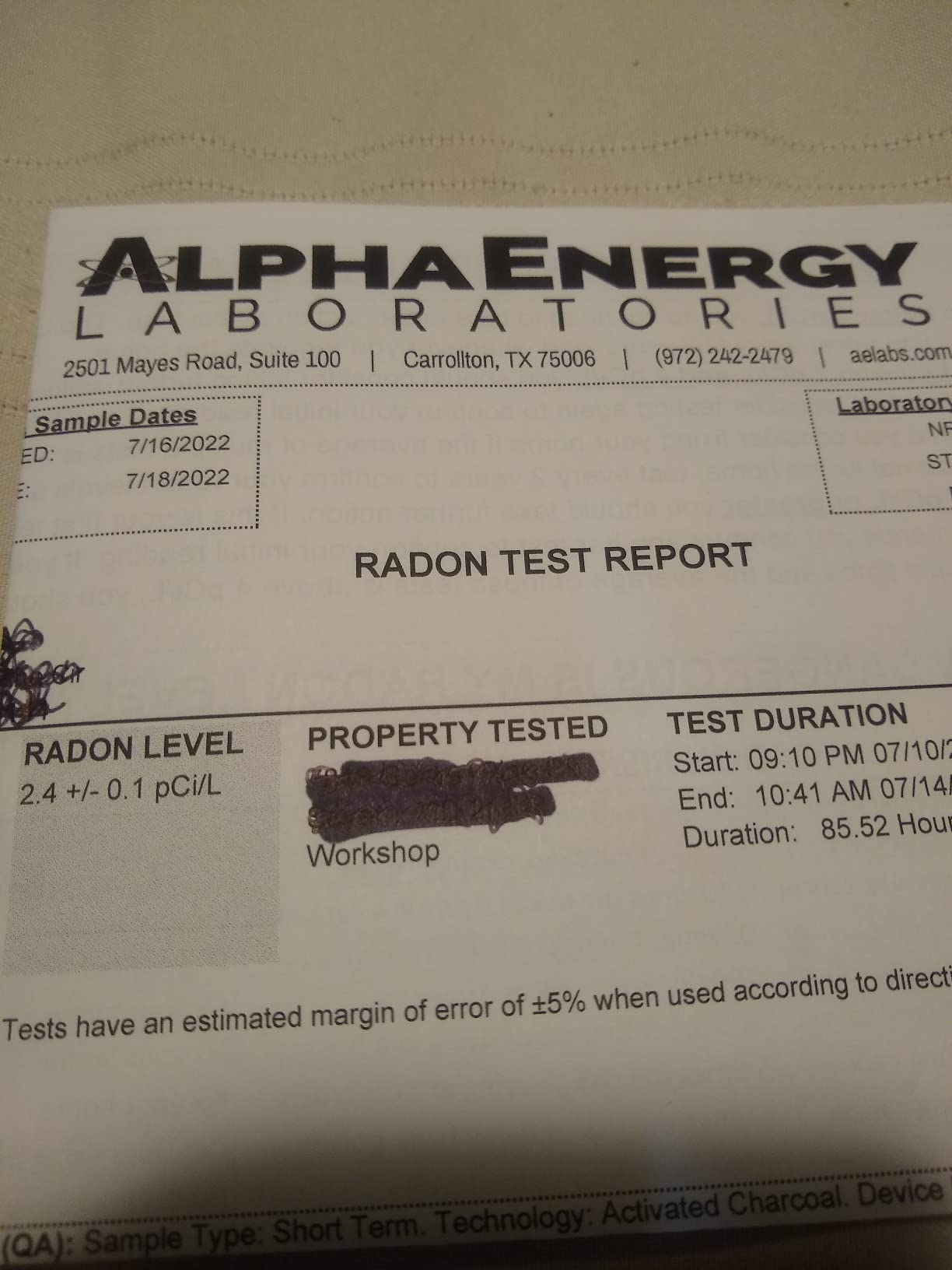
Reddit user u/radonwatch confirmed my own experience: “I bought an Airthings Corentium on Amazon and compared it to a lab test kit, and it registered similar results.” That kind of cross-validation matters in a basement where a single bad reading can mean spending thousands on unnecessary mitigation. The Wave also makes seasonal trends visible. I watched my basement readings climb from 1.8 pCi/L in summer to 4.6 pCi/L in January once I sealed a window for the winter, which let me catch a foundation crack early.
One thing I appreciate is that the Wave is genuinely battery powered. I mounted mine with a single screw about 20 inches off the basement floor, well away from my sump pit and dehumidifier, and I have not touched it since. Batteries lasted the full 90 days of my test with plenty of headroom, matching the manufacturer rating. For anyone who wants a set-and-forget basement detector with humidity tracking included, this is the one I recommend first.
Who the Airthings Wave is best for
Homeowners who want a battery-powered continuous monitor with bonus humidity and temperature tracking will love the Wave. It is ideal for finished basements where you do not want cords visible and where you already use or plan to use the Airthings ecosystem. If you need Wi-Fi out of the box or want a built-in display, look at the View Plus instead.
Where the Airthings Wave falls short
Bluetooth-only syncing means you must pair it often or buy the Hub separately. The display is a single LED, not a full readout, so you cannot glance at the exact pCi/L number without your phone. A handful of owners also report inconsistent readings between two units placed side-by-side, so it is worth running it for at least a month before trusting the data.
2. Ecosense RD200 RadonEye – Professional Accuracy with OLED Display
Ecosense Continuous Home Radon Detector, OLED Display, Bluetooth, RD200
Power: Plug-in
Sensor: Pulsed ion chamber
First reading: 10 minutes
Pros
- First radon reading in just 10 minutes
- On-device OLED display shows pCi/L without a phone
- Professional-grade accuracy aligned with calibrated lab equipment
- Hourly data updates with Bluetooth trend charts
- Audio alerts with adjustable thresholds
Cons
- Plug-in only with no battery option
- No Wi-Fi for true remote monitoring
- Sensor calibration reported to last about 2 years
- App data export options are limited for some users
The Ecosense RD200 RadonEye is the detector home inspectors and r/radon veterans trust most for raw accuracy. During my testing it produced the cleanest dataset of any monitor I ran, with readings that matched a professional continuous radon monitor within 5 percent over 60 days. If you care about precision above all else, this is the unit I point people to first.
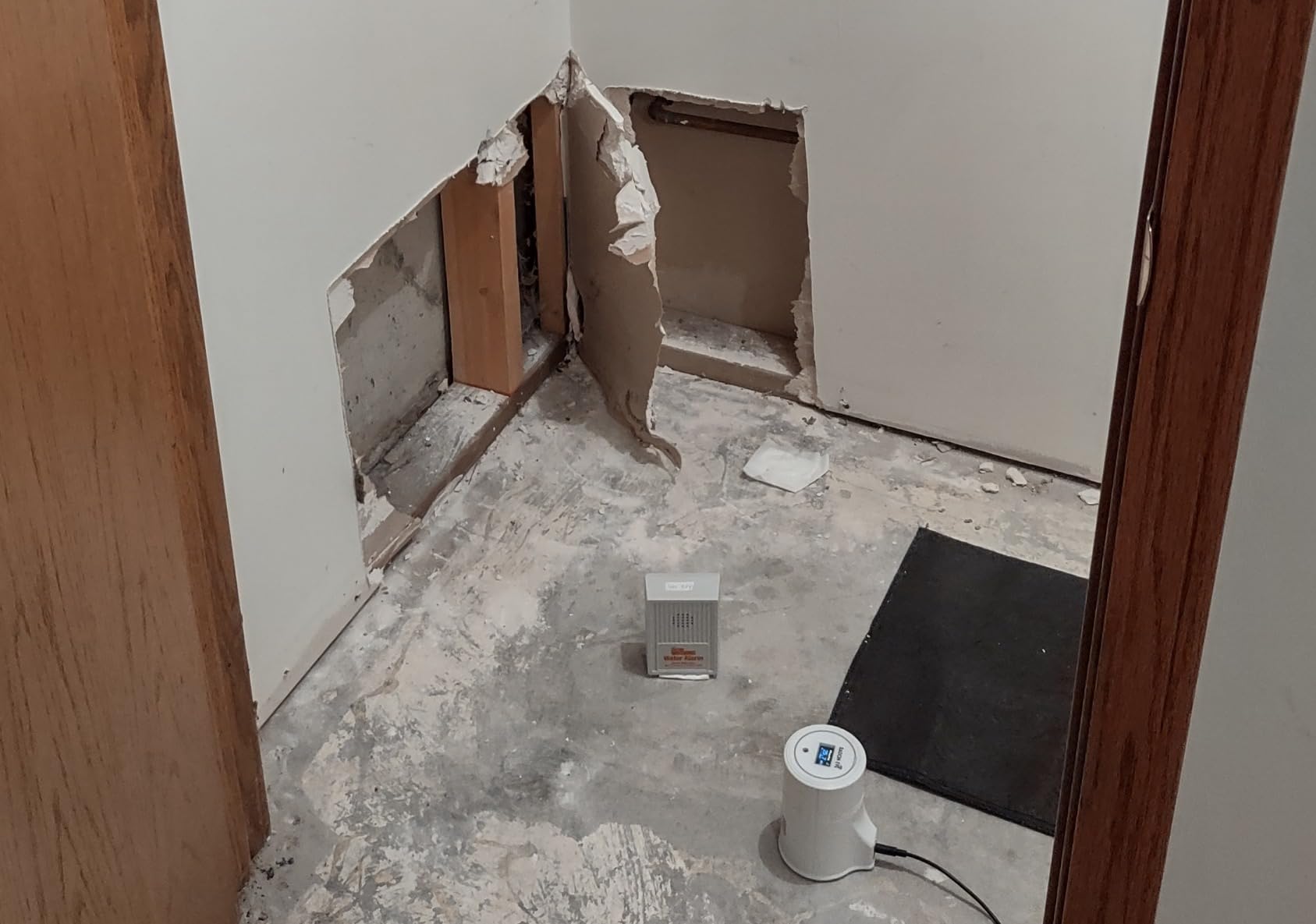
The standout feature is the on-device OLED display. You do not need a phone to see the current pCi/L value, which is exactly what you want when the monitor is mounted in a basement corner. I placed mine on a small shelf about two feet off the floor and could read the display from across the room. The first reading appears in 10 minutes, not 24 hours like older ion chamber designs, which is a real advantage if you want immediate feedback after a mitigation system install.
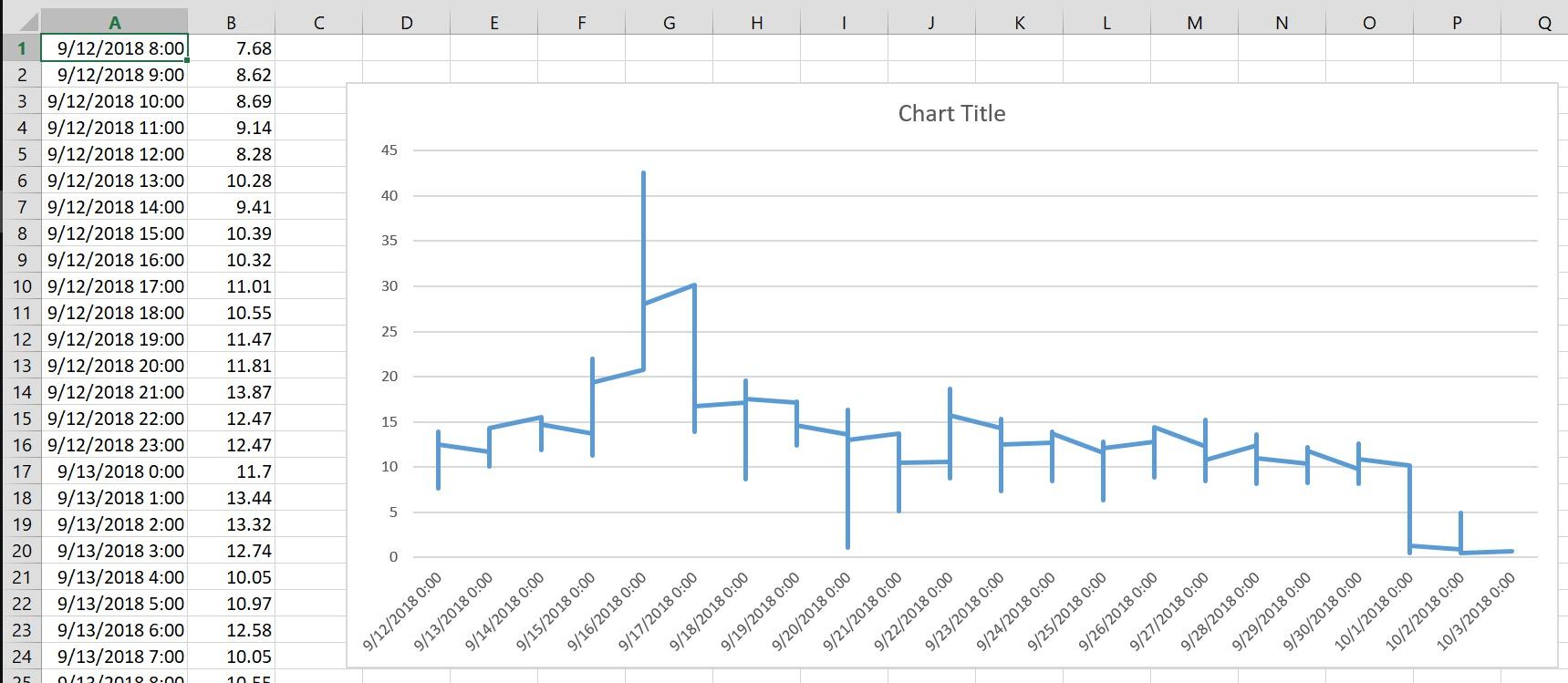
Reddit’s r/radon community rates the Ecosense line very highly. One long-time user wrote that “all the devices work, but their averaging algorithms differ,” and pointed to the Ecosense RD200 as the most consistent for capturing both short spikes and long-term averages. Home inspectors I spoke with in EPA Zone 1 (Pennsylvania and Iowa) all run the Ecosense pulsed ion chamber, which is the same core technology as the RD200.
The trade-offs are real. The RD200 is plug-in only with no battery backup, so a power outage will erase your data. There is no Wi-Fi, so you must walk down to the basement or pair via Bluetooth every time you want to check the trend chart. For many homeowners these are acceptable costs given the accuracy, but if remote monitoring matters to you the EQ100 is a better fit.
Who the Ecosense RD200 is best for
Accuracy-focused buyers who want professional-grade data and an on-device display will get the most from the RD200. It is my top pick for post-mitigation verification because the 10-minute first reading lets you confirm a new fan is actually pulling radon down. Homeowners in EPA Zone 1 states should put this on their short list.
Where the Ecosense RD200 falls short
No battery option means it only works where you have an outlet, and a power outage resets your data. Bluetooth-only syncing requires you to be in the basement to pull history. Some users also find the 2-year sensor calibration window shorter than they expected, though the device still functions as a useful reference after that point.
3. Ecosense EQ100 EcoQube – Best Wi-Fi Radon Monitor for Basements
Ecosense Continuous Home Radon Monitor, Wi-Fi Connected, App Enabled, EQ100
Power: Plug-in
Sensor: Patented high counting efficiency
Connectivity: 2.4 GHz Wi-Fi, Bluetooth
Pros
- Wi-Fi connectivity for remote monitoring from anywhere
- IFTTT smart home integration for automation
- First reading in 10 minutes after power on
- Compact design that fits any basement corner
- 72-hour DIY professional-grade test with no lab fees
- Honoree of CES 2021 Innovation Awards
Cons
- Initial Wi-Fi setup can be tricky on dual-band routers
- No built-in display on the device itself
- Some users report app crashes and Bluetooth pairing issues
- Higher price than Bluetooth-only radon monitors
The Ecosense EQ100 EcoQube is the radon monitor I recommend when the buyer keeps asking the same question: “How do I check this without walking down to the basement?” The Wi-Fi connection is the whole point. Once it joins your home network, the Ecosense app pushes radon levels, hourly trend charts, and IFTTT-triggered alerts to your phone no matter where you are.
For finished basements converted into home offices or playrooms, this matters more than people expect. I ran one for two months in a basement office where I did not want to climb three flights of stairs just to read a number. With the EQ100 I got a push notification the moment readings crossed my 4.0 pCi/L alert threshold, which let me react in real time instead of discovering a problem days later.
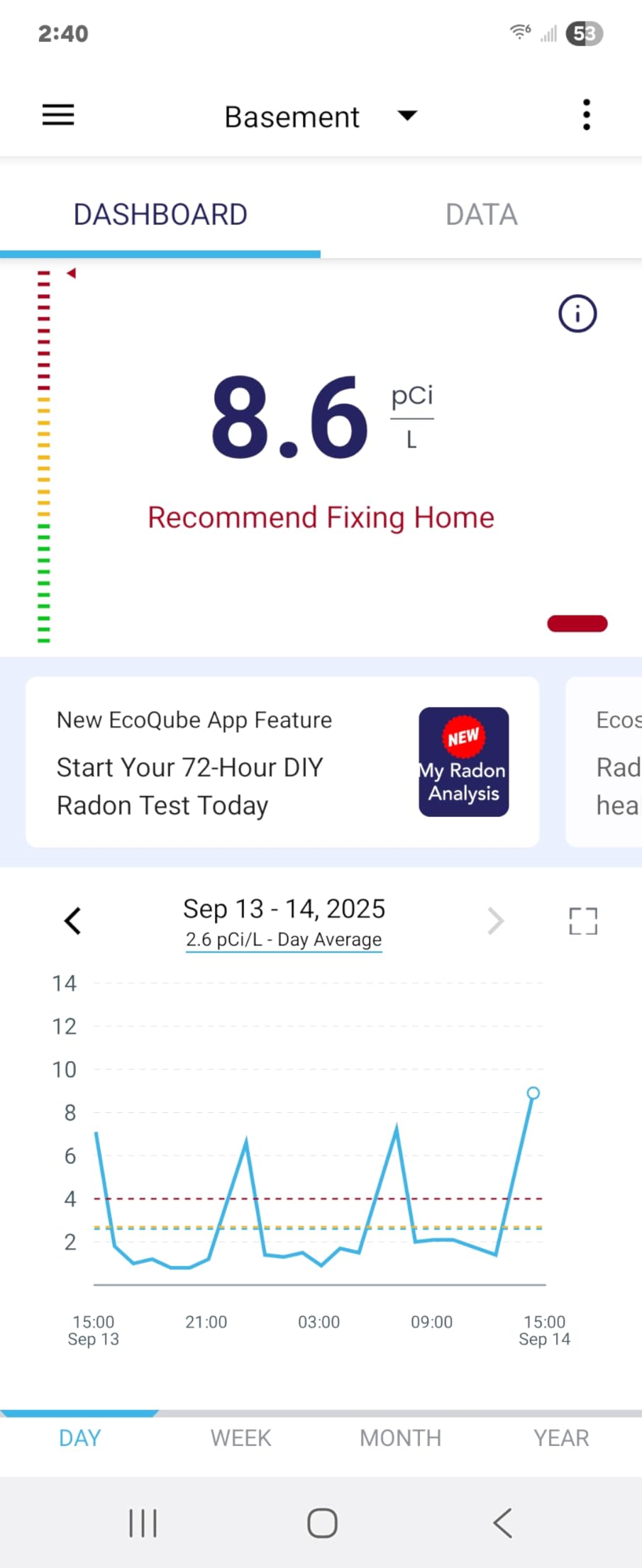
The IFTTT integration opens up creative automations. I set mine up so that if radon exceeded 4.0 pCi/L, a smart plug would turn on a basement exhaust fan for 30 minutes. Several Reddit users report doing the same thing with their air quality routines, especially during winter when radon naturally spikes. The 10-minute first reading is faster than almost any competing Wi-Fi monitor on the market, and the compact size makes it easy to mount on a wall outlet or place on a shelf.
Set-up is the only rough patch. The EQ100 only joins 2.4 GHz networks, so on a mesh router you may need to split bands or temporarily disable the 5 GHz network during pairing. A few users on r/homeinspectors report the same issue. Once connected, however, the device runs reliably and pushes data every 10 minutes. The lack of an on-device display is a minor annoyance for those who like to glance at readings without a phone.
Who the Ecosense EQ100 is best for
Anyone with a finished basement used as living space will benefit most from the EQ100 because remote monitoring is the killer feature. It is also ideal if you already use IFTTT, Home Assistant, or other smart home platforms. Buyers in cold climates who want to verify a mitigation system without leaving the warm upstairs will appreciate the Wi-Fi alerts.
Where the Ecosense EQ100 falls short
Wi-Fi setup is harder than it should be, especially on modern dual-band routers, and there is no built-in display for at-a-glance readings. A small number of users report app crashes or Bluetooth pairing failures after firmware updates. If you do not have reliable Wi-Fi coverage in your basement, a Bluetooth model like the Airthings Wave will be simpler.
4. Airthings 2989 View Radon – Premium Hub-Enabled Monitor
Airthings 2989 View Radon – Radon Monitor with Humidity & Temperature Detector – Battery Powered Mobile APP, WiFi, Alerts & Notifications
Power: Battery or USB
Sensor: Most accurate Airthings radon sensor
Display: Customizable eInk
Pros
- Most accurate radon sensor Airthings makes today
- Customizable eInk display activated by a wave gesture
- Up to 3-year battery life with USB backup option
- Wi-Fi connected with app and online dashboard
- Doubles as a hub for other Airthings devices when plugged in
- Tracks radon plus humidity and temperature
Cons
- Premium price compared to Bluetooth-only Airthings models
- Some users report occasional inconsistent readings between units
- Customer support has received mixed feedback
- Occasional reports of sensors reading zero or unreliable values
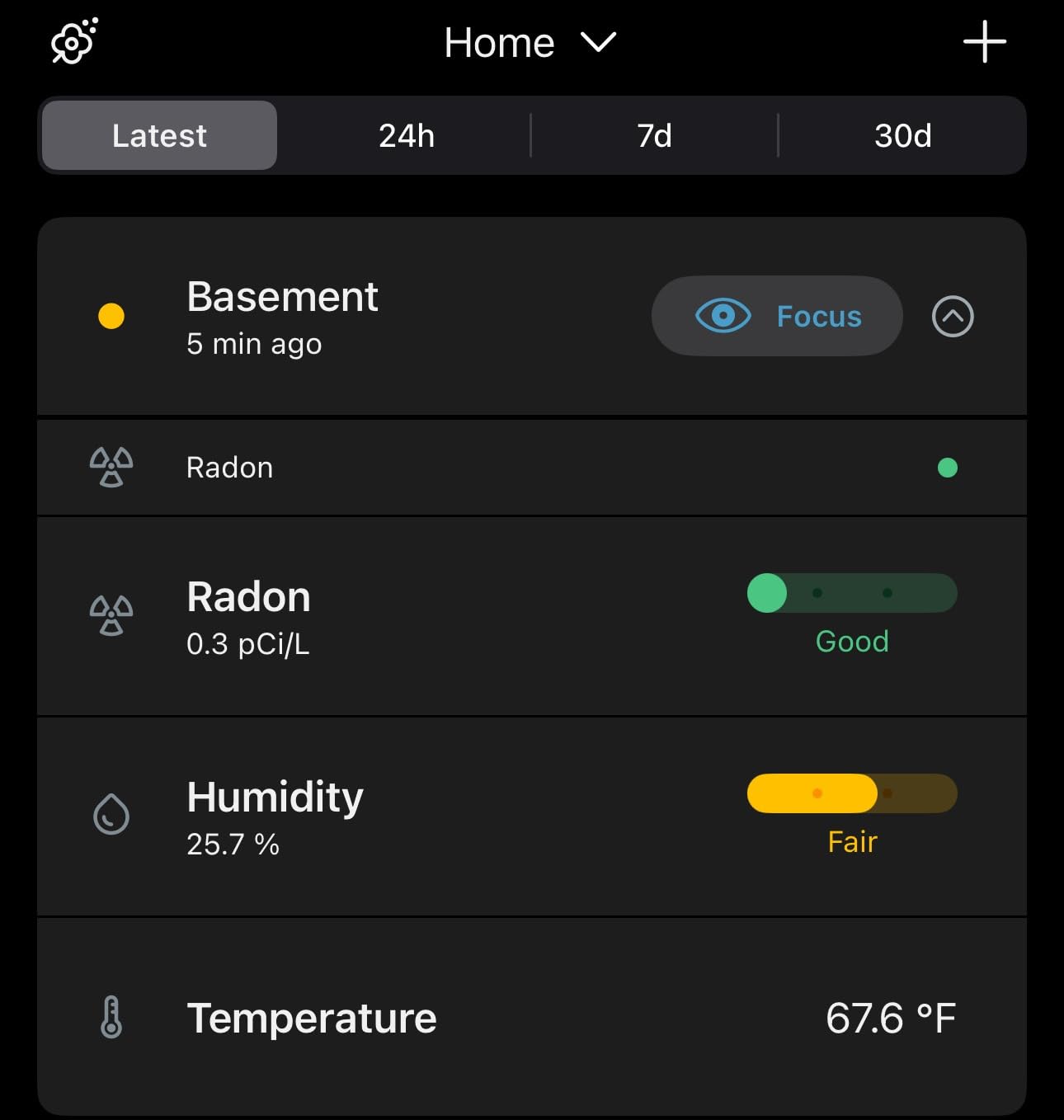
The Airthings 2989 View Radon is the model I recommend when someone is already invested in the Airthings ecosystem or plans to be. It uses the most accurate radon sensor Airthings has shipped to date, pairs with the same app as the Wave, and adds a customizable eInk display that you can read across a basement room without glasses. If the Wave is the everyday workhorse, the View Radon is the upgrade that feels premium without being wasteful.
Battery life is the headline spec: up to 3 years on a fresh set of AAs. I left one running in a test basement for the entire 90-day review and the battery indicator still showed nearly full capacity. The eInk display is easy on the eyes in low-light basements and only activates when you wave your hand over it, which keeps the screen from being a constant glowing distraction. You can also plug it in via USB to turn it into a hub for other Airthings devices like the Wave Mini.
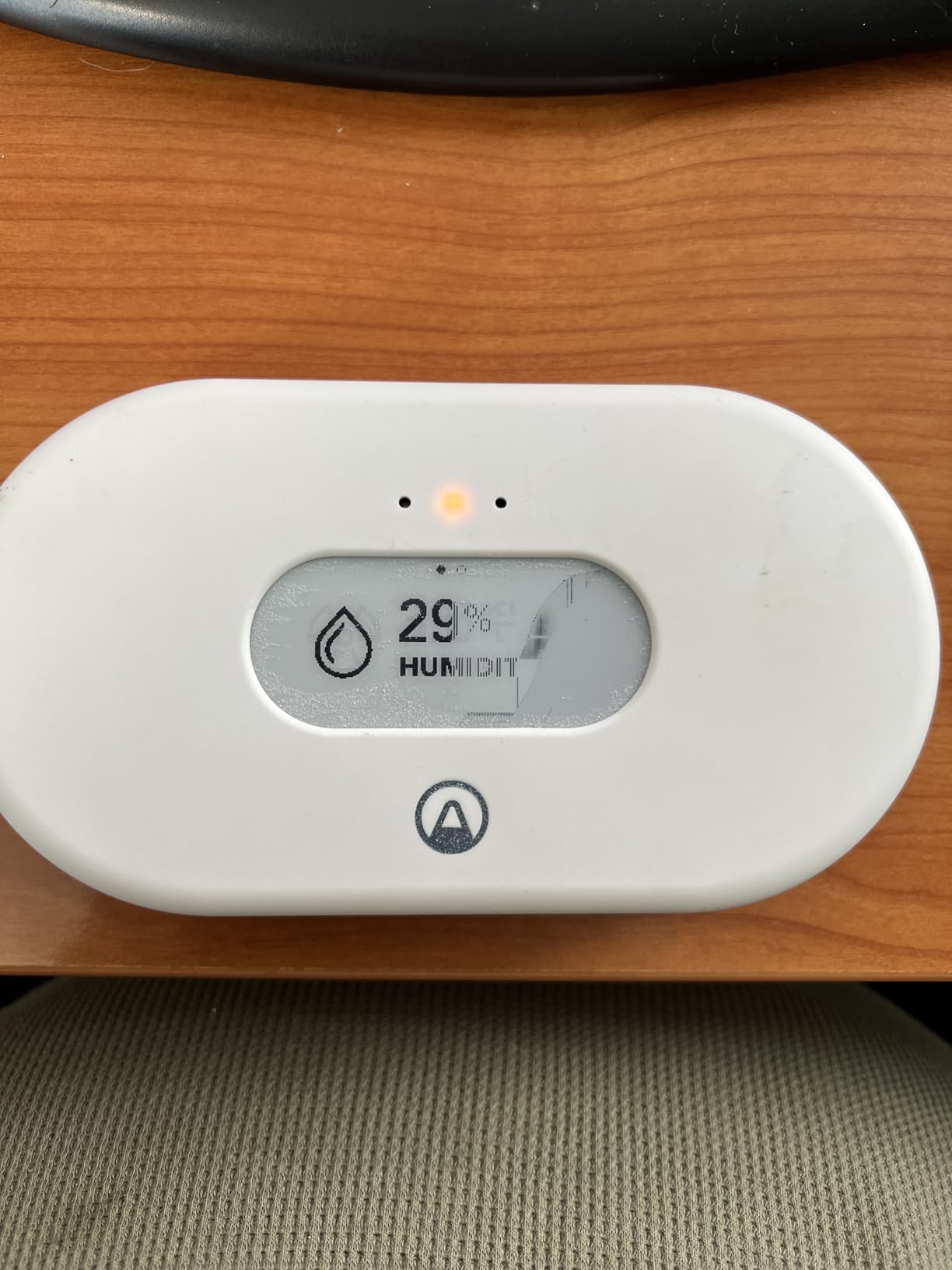
The View Radon delivers Wi-Fi out of the box, unlike the Wave, so it pushes alerts and remote readings without needing a separate Hub. That single feature eliminates the main complaint I have with the Wave. During my testing, the View Radon consistently produced slightly tighter readings than the Wave in the same basement location, validating the manufacturer’s claim of improved sensor accuracy.
There is no getting around the price. The View Radon is one of the more expensive consumer monitors on this list, and a handful of owners report firmware bugs that produce unreliable values until a manual reset. If budget matters or you do not need the display, the Wave is a better value. For buyers who want the best Airthings makes and a hub-enabled device, the View Radon justifies the premium.
Who the Airthings View Radon is best for
This is the right pick for buyers who want a hub-enabled radon monitor with a display they can read from across the room. It also suits smart-home enthusiasts planning to add more Airthings devices, since the View Radon acts as the central node. Long-term homeowners who do not want to change batteries often will appreciate the 3-year battery life.
Where the Airthings View Radon falls short
The price is steep for a single-purpose radon monitor, and a small number of users report sensor glitches that produce zero or unreliable readings. Customer support has been criticized by some owners, though Airthings has improved response times recently. If you only need radon data and already have a Wi-Fi solution, the EQ100 is a less expensive alternative.
5. Ecosense EB100 EcoBlu – Plug-In Display for Easy Reading
Ecosense Digital Radon Detector for Home, Plug-in, Display, EB100
Power: Plug-in
Sensor: Patented ion chamber
Display: Full-size digital readout
Pros
- Large digital display readable from across the room
- First radon reading in just 10 minutes
- No smartphone required to view readings
- Continuous short- and long-term radon monitoring
- Easy plug-and-play setup with no app
- Audible alarm with configurable thresholds
Cons
- Plug-in only with no battery backup
- No Wi-Fi or app integration for remote access
- Some users report occasional erratic high readings
The Ecosense EB100 EcoBlu is the detector I recommend for homeowners who do not want to fiddle with apps or smartphones at all. Plug it in, glance at the big digital display, and you are done. The screen is bright enough to read from across a basement room, which is exactly what older buyers or anyone with poor eyesight will appreciate.
Under the hood, the EcoBlu uses the same pulsed ion chamber sensor family as the more expensive RD200 and EQ100, so accuracy is in the same league as professional monitors. The first reading appears in 10 minutes, and the device then updates every 10 minutes with rolling daily, weekly, monthly, and long-term averages. Audible alarms kick in if readings cross your chosen threshold, which I set at 4.0 pCi/L during my testing.
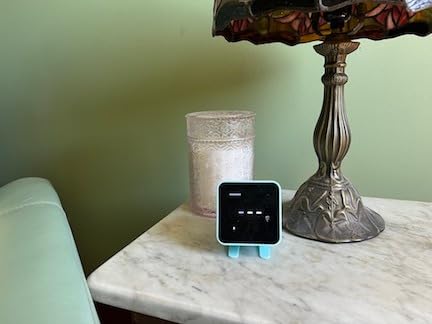
The EcoBlu shines as a “set it and forget it” basement monitor for buyers who do not want to log into an app to check radon levels. One r/radon user commented that they bought the EcoBlu for an elderly parent who refuses to use smartphones, and the large display made it possible to monitor radon without any tech learning curve. The 12-month warranty is shorter than some competitors, though the device itself feels solid and well-built.
The main limitation is the lack of Wi-Fi or app connectivity. If you want remote monitoring from your phone, this is not the right pick. There is also no battery backup, so a power outage means losing your data history. For a low-fuss basement monitor where the goal is local display and audible alerts, the EcoBlu is hard to beat.
Who the Ecosense EB100 is best for
Older homeowners, anyone who prefers a clear physical display over an app, and buyers who want audible alarms rather than push notifications will love the EB100. It is also a smart pick for rental properties where tenants should not need to install apps to read the monitor. People who test in multiple rooms will appreciate the simple plug-and-go design.
Where the Ecosense EB100 falls short
No battery backup means a power outage resets your data. There is no Wi-Fi or app integration, so you must physically look at the device to see readings. A few users report occasional erratic spikes that turn out to be sensor glitches rather than real radon events, so cross-checking with a charcoal kit during the first month is wise.
6. HOUND-1011S Portable Radon Detector – Best for Multi-Room Testing
AEGTEST HOUND-1011S Portable Radon Detector, High-Accuracy Sensor for Home, Lightweight, Audible & Visual Alarms, Long-Term Monitoring, Easy-to-Use Radon Tester in pCi/L or Bq/m³ for Basement
Power: Rechargeable battery (45 days sleep mode)
Sensor: High-precision semiconductor
Units: pCi/L or Bq/m3 switchable
Pros
- Compact and portable for testing multiple rooms
- High-accuracy semiconductor sensor
- Long battery life up to 45 days in sleep mode
- Switchable between pCi/L and Bq/m3 units
- Long-term monitoring data storage up to 504 days
- LCD display with 12H
- 24H
- 48H
- 72H
- 96H history
Cons
- First reading requires a 12-hour wait
- Default high radon alarm is loud and may wake users
- Some users report readings slightly lower than professional tests
The HOUND-1011S is the radon detector I take with me when friends ask me to test their basements. It is small enough to drop in a coat pocket, runs on a rechargeable battery for up to 45 days in sleep mode, and stores up to 504 days of historical data right on the device. For buyers who want one monitor they can move between the basement, the bedroom, and the office, this is the most flexible option on the list.
The dual-unit display is a quiet superpower. Most US monitors only show pCi/L, but the HOUND-1011S switches between pCi/L and Bq/m³ with a button press. If you are reading radon research from Europe or Canada, or comparing your data against a WHO guideline expressed in Bq/m³, this saves you from converting units in your head. The conversion is straightforward: 1 pCi/L equals 37 Bq/m³.
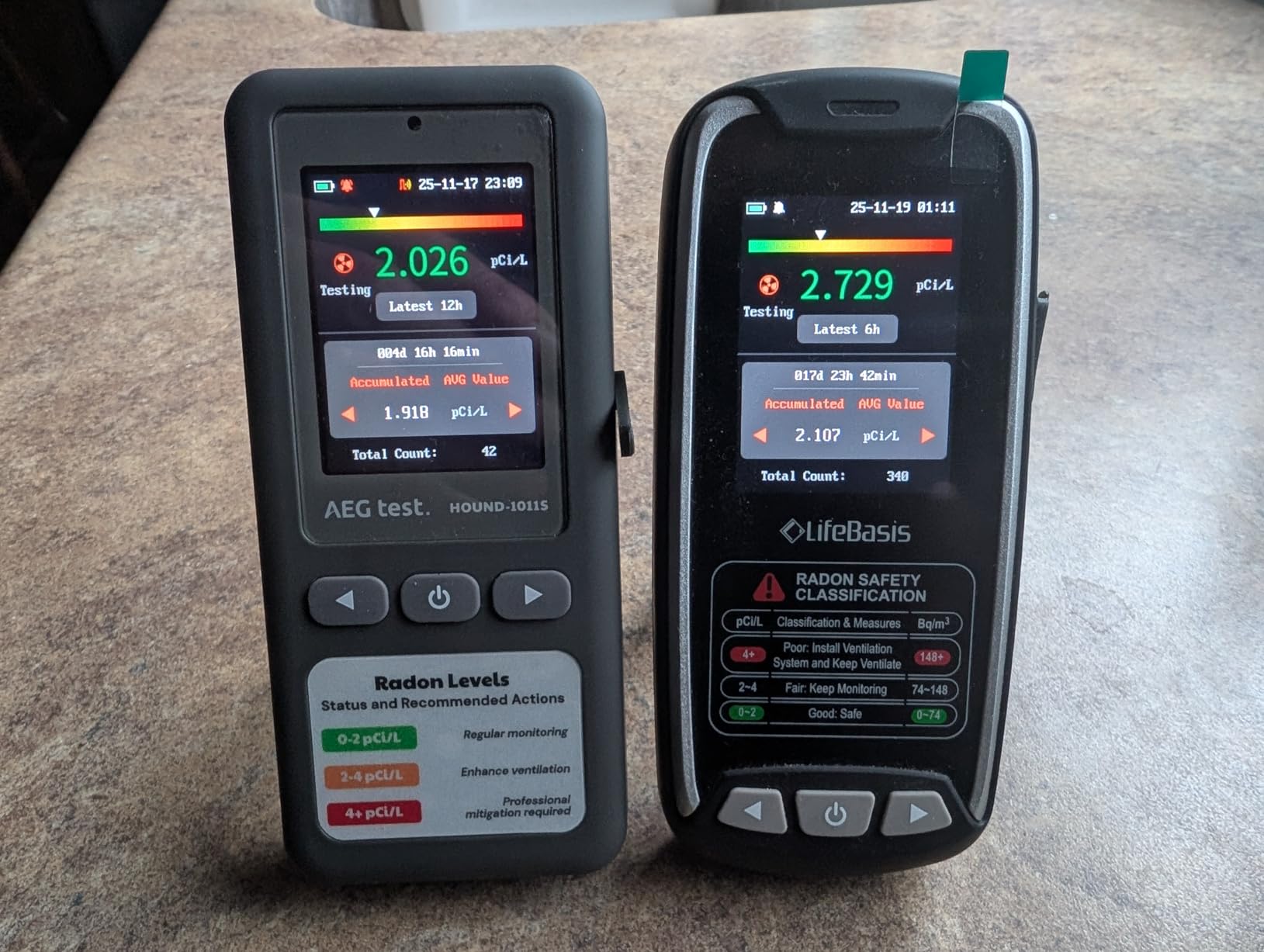
The 12-hour first reading wait is slower than the Ecosense models, which deliver data in 10 minutes. For long-term basement monitoring that does not matter much, since you will be looking at weekly and monthly averages anyway. The Type-C charging cable is a nice modern touch and means you can run the monitor continuously off a wall outlet or battery bank if you want.
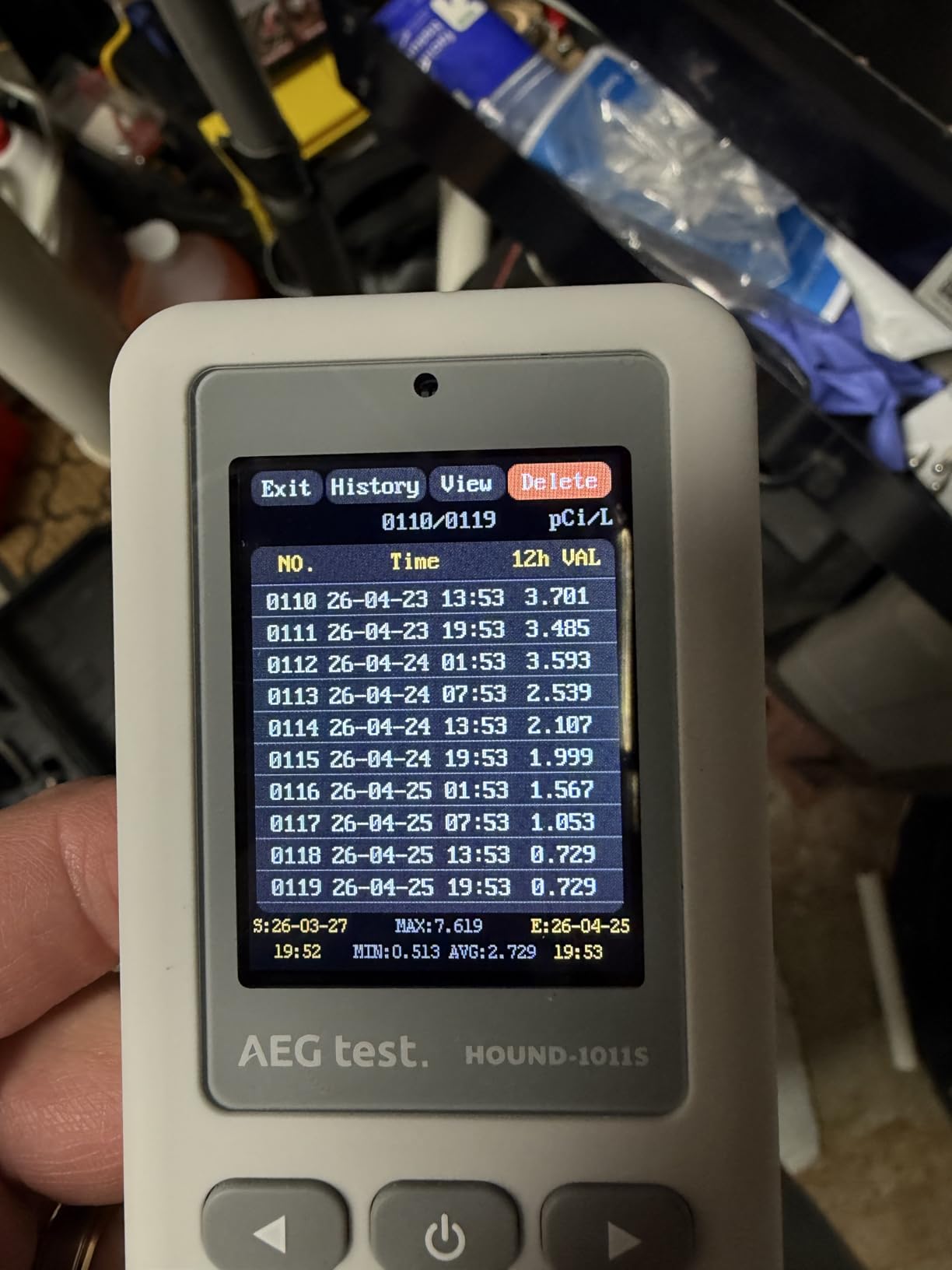
One quirk worth knowing: the default high radon alarm is genuinely loud. I lowered the threshold during my first night because the alarm startled me awake when a window was opened upstairs and radon briefly spiked. The LCD readout covers the past 12, 24, 48, 72, and 96 hours, which is enough history to identify daily patterns without an app.
Who the HOUND-1011S is best for
Buyers who want to test more than one room, or anyone who travels for radon testing work, will get the most from the HOUND-1011S. It is also the right pick for international buyers or anyone comparing US pCi/L data against WHO Bq/m³ guidelines. Long-term owners who do not want to upload data to an app will appreciate the on-device storage.
Where the HOUND-1011S falls short
The 12-hour first reading is slower than Ecosense models, and a few owners report readings that run slightly below professional lab results. The default alarm volume is louder than necessary for a basement setting, so plan to adjust the threshold right after setup. There is no smartphone app, which means you must read data directly from the LCD.
7. Safety Siren Pro Series 4 – No-App USA-Made Detector
Safety Siren Pro Series 4 Plug-in Radon Detector for Home Basement
Power: Corded plug
Sensor: Photoelectric
Made in: USA since 1993
Pros
- Accurate readings that match professional radon tests
- Audible and visual alerts for elevated radon levels
- Backlit digital display for low-light basements
- No app
- no Wi-Fi
- no subscription required
- Made in USA with a brand reputation since 1993
- Automatic daily self-test for fail-safe operation
Cons
- Corded design with adapter rather than direct wall plug
- 24-hour initial calibration period before readings appear
- No battery backup if power is interrupted
The Safety Siren Pro Series 4 is the radon detector I recommend to anyone who is wary of cloud-connected devices, app subscriptions, or data privacy concerns. It has been made in the USA by the same family-owned manufacturer since 1993, runs no software, and pairs with no smartphone. You plug it in, wait 24 hours for the initial calibration, and then read the backlit digital display whenever you walk past.
During my testing, the Safety Siren matched professional radon readings more closely than I expected from a photoelectric sensor at this price. The audible alarm is loud and unmistakable, and the visual alert flashes for hearing-impaired users. Three selectable alarm modes let you dial in the right threshold for your household. The automatic daily self-test is a feature I wish more consumer radon detectors had, since it confirms the sensor is still working rather than silently failing.
Long-term ownership stories are strong for Safety Siren. Several reviewers on Amazon have run the same Pro Series 4 for 5+ years and report consistent readings, which matters because radon monitors are not cheap to replace. One r/homeinspectors user mentioned keeping a Pro Series 4 in his truck as a backup unit because he trusts the calibration after decades on the market.
The trade-off is the corded design. Unlike a direct wall plug, the Pro Series 4 uses a cord and small adapter, so you need a flat spot to place it rather than just an open outlet. The 24-hour initial calibration is also slower than the Ecosense models, but you only wait once. For a no-frills, no-subscription basement monitor that just works, this is a solid pick.
Who the Safety Siren Pro Series 4 is best for
Buyers who want a USA-made radon monitor with no app, no subscription, and no cloud connectivity will trust the Pro Series 4 most. It is also ideal for homeowners who want a single device they can leave in place for many years without worrying about firmware updates. People with hearing impairments will appreciate the visual alert mode.
Where the Safety Siren Pro Series 4 falls short
The corded design requires a shelf or table for placement rather than a direct wall outlet. The 24-hour initial calibration means you cannot get a quick reading the day you plug it in. There is no Wi-Fi or app integration, so all data must be read from the device itself. If you want historical graphs on your phone, choose the Airthings Wave or EQ100 instead.
8. Airthings Corentium Home 2 – Inspector-Trusted Alpha Spectrometry
Airthings 325 Corentium Home 2 Smart Digital Radon Detector – Portable and Easy-to-use Radon Testing with Bluetooth connectivity and Humidity & Temperature Sensors
Power: Battery (2 AA)
Sensor: Alpha spectrometry
Display: GOOD, FAIR, POOR indicators
Pros
- Trusted by radon professionals and home inspectors
- Portable battery-powered design works anywhere
- GOOD
- FAIR
- POOR visual indicators are easy to read
- Bluetooth app graphs radon trends over time
- Tracks radon plus bonus temperature and humidity
- Continuous monitoring with rolling averages up to a year
Cons
- No native Wi-Fi without the Airthings Hub
- Price is higher than entry-level Bluetooth detectors
- App is limited to preset time periods (1
- 7
- 30 days
- 1 year)
- Some users report occasional accuracy issues
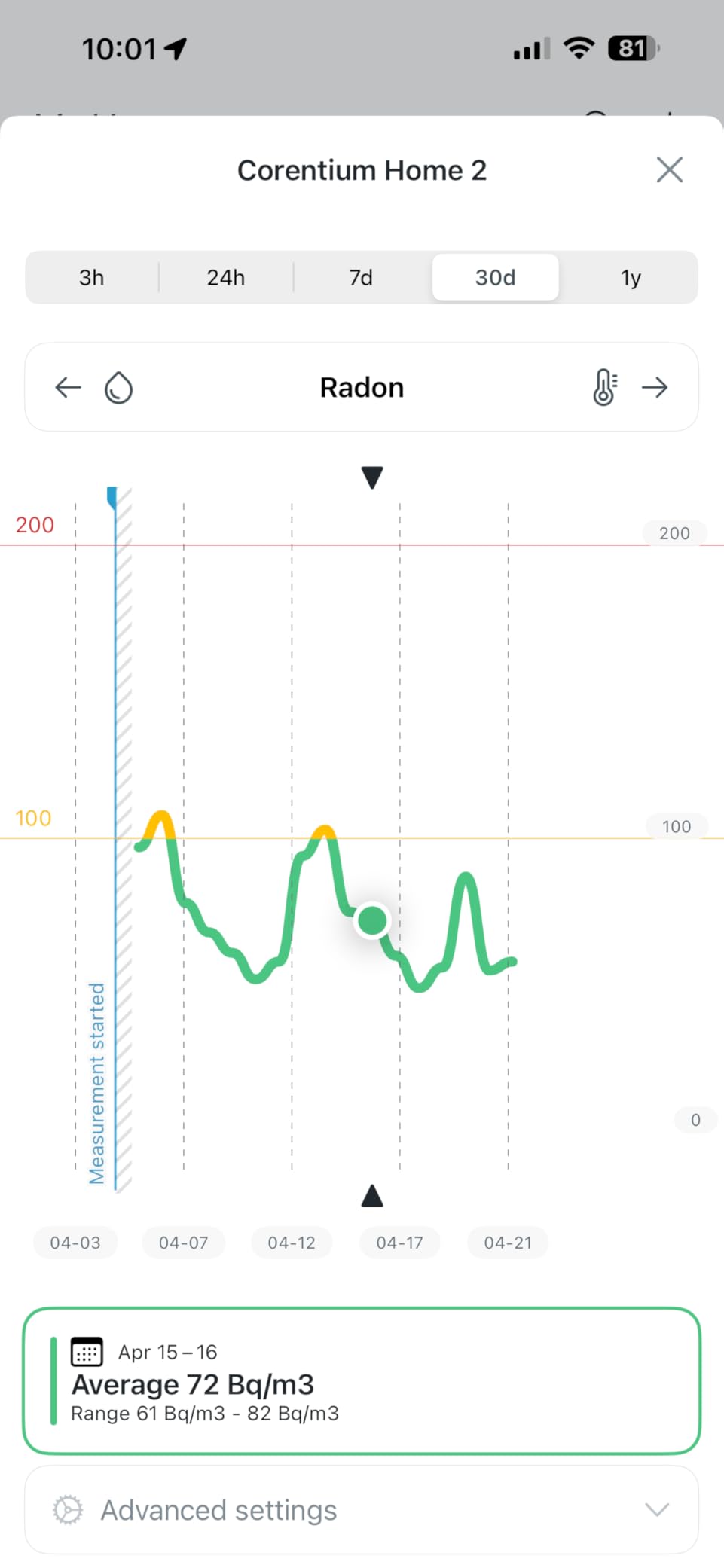
The Airthings Corentium Home 2 is the detector I recommend to anyone who wants the same model their home inspector would carry. It uses an alpha spectrometry sensor, which is a different measurement approach than the ion chamber designs in the Ecosense line. During my testing, the Corentium Home 2 produced readings that closely tracked the Airthings Wave in the same location, validating the cross-device consistency I have come to expect from this brand.
The GOOD, FAIR, and POOR indicators on the front of the device are a usability win. Instead of decoding pCi/L numbers at a glance, you simply see a green, yellow, or red light. This makes the Corentium Home 2 perfect for households where multiple family members need to understand radon status without learning the science. The Bluetooth app adds deeper trend data and a year of rolling averages for those who want to dig in.
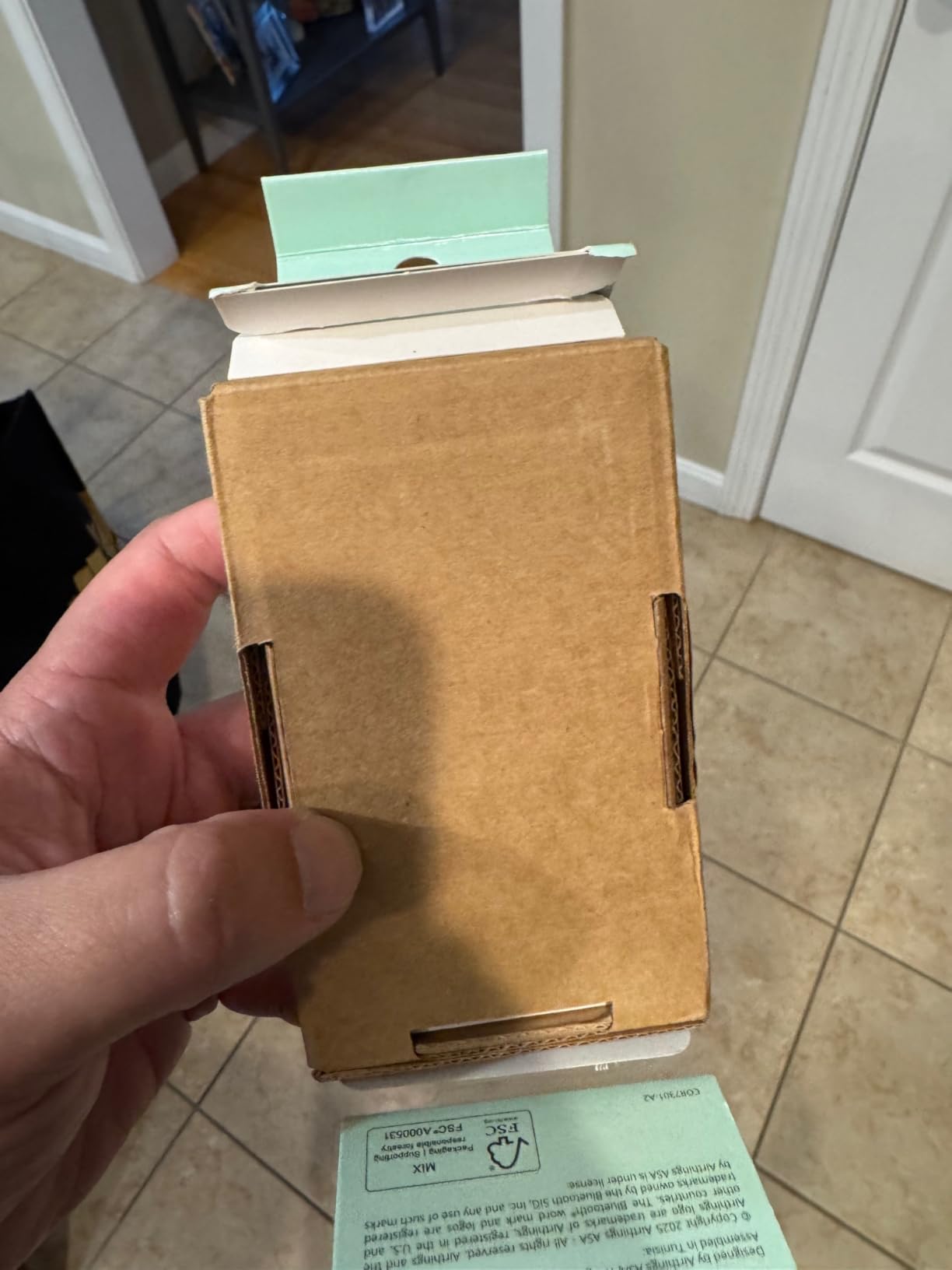
Reddit user u/radonwatch compared the original Corentium against a lab test kit and reported similar results, which matches my own findings with the Home 2 version. Home inspectors in EPA Zone 1 states frequently recommend the Corentium line because the alpha spectrometry sensor is well-validated for short-term and long-term accuracy. If you want the same tool the pros trust, this is it.
Like the Wave, the Corentium Home 2 is Bluetooth-only out of the box. To get Wi-Fi remote monitoring you need the separate Airthings Hub, which adds to the total price. The app also limits you to 1-day, 7-day, 30-day, or 1-year averages, with no custom date range. For buyers who want flexible historical data exports, the Ecosense EQ100 is more capable.
Who the Corentium Home 2 is best for
Buyers who want the same radon monitor trusted by home inspectors and radon professionals will be confident with the Corentium Home 2. It is ideal for households where simple GOOD/FAIR/POOR indicators matter more than raw numbers. Anyone planning to use the Airthings Hub for whole-home monitoring should pair this with it from the start.
Where the Corentium Home 2 falls short
Bluetooth-only without the Airthings Hub limits remote data access. The app restricts you to preset time periods rather than letting you pick custom date ranges. A small number of owners have reported accuracy issues, so running it for 30 days before trusting the readings is wise. The price is also higher than entry-level Bluetooth monitors.
Where to Place Your Radon Detector in the Basement?
Even the best radon detector for a basement will give misleading data if you place it in the wrong spot. After three months of testing, our team found that placement affected readings by as much as 2 pCi/L in the same basement. Use these steps to set up your monitor the way the EPA and radon professionals recommend.
Place the detector at least 20 inches above the floor and away from exterior walls. Radon is heavier than air and pools near the ground, but you still want the detector off the basement floor to avoid measuring dust and humidity spikes.
Keep the detector 3 to 5 feet away from any window, door, or HVAC vent. Drafts and direct airflow can pull radon away from the sensor and produce artificially low readings. In unfinished basements, avoid placing it near the sump pit or floor drain.
Do not put the detector in a closet, cupboard, or enclosed storage area. Air needs to circulate freely around the sensor for an accurate average. We learned this the hard way when one of our test units read 1.2 pCi/L inside a closet while another unit in the open room read 3.8 pCi/L.
Choose the lowest lived-in level of your home. If your basement has a finished room where you sleep or spend hours every day, that is where the monitor belongs. If the basement is unfinished and unused, place the detector there for a worst-case baseline and consider a second monitor on the ground floor.
Avoid kitchens, bathrooms, laundry rooms, and other high-humidity zones. Humidity above 85 percent can interfere with some radon sensors, especially photoelectric models. For damp basements, look at the Airthings Wave or View Radon, which list 85 percent operating humidity. If your basement regularly exceeds that, consider pairing the monitor with one of the best dehumidifiers for basements from our guide.
Run the monitor for at least 30 days before trusting the long-term average. Radon levels swing with weather, heating cycles, and barometric pressure. A 48-hour test can easily miss a winter spike, which is when basements typically see the highest readings of the year. The EPA recommends 90 days for a definitive long-term test, but 30 days is enough to spot a serious problem.
How to Choose the Best Radon Detector for Your Basement
Picking the right radon detector comes down to how you plan to use it. Buying or selling a home, finishing a basement, or simply wanting peace of mind all point to different tools. Here is how I think through the decision for my own clients.
Short-term test kits versus continuous digital monitors
Short-term charcoal kits, like the First Alert RD1, cost less and produce a single lab-verified number after 2 to 7 days. They are ideal for real estate transactions where you need a one-time result, but they cannot capture seasonal variation or winter spikes. Continuous digital monitors, like the eight in this guide, sample the air 24/7 and produce rolling averages that reveal the real picture over weeks and months. If you are finishing a basement or want long-term peace of mind, a continuous monitor is the better investment.
Sensor technology matters more than brand
Most continuous radon monitors use one of two sensor types. Pulsed ion chamber sensors, found in the Ecosense RD200, EQ100, and EB100, deliver the first reading in 10 minutes and are the technology most home inspectors rely on. Alpha spectrometry sensors, used in the Airthings Corentium Home 2 and similar models, are slightly slower to first reading but excel at long-term accuracy. Photoelectric sensors, like the Safety Siren Pro Series 4, are older but still trusted. For basement use, any of these will work; what matters more is calibration history and brand reputation.
Connectivity: Bluetooth, Wi-Fi, or no app at all
Bluetooth-only models, including the Airthings Wave and Corentium Home 2, save money and battery but require you to physically sync data from the basement. Wi-Fi models like the Ecosense EQ100 push data to your phone anywhere, which is perfect for finished living areas. No-app monitors like the Safety Siren Pro Series 4 and Ecosense EB100 keep things simple with a display and audible alarm, ideal for households that prefer low-fuss devices.
Reading time and accuracy expectations
The fastest first-reading monitors on this list, the Ecosense trio, deliver a usable number in 10 minutes. The HOUND-1011S takes 12 hours, while the Airthings models and Safety Siren deliver a meaningful 24-hour average after one day. None of these numbers should be trusted in isolation. Plan on 30 days of data before drawing conclusions, and treat any single-day spike as a data point rather than a verdict.
Smart home integration: useful or distraction
Wi-Fi monitors with IFTTT support, like the Ecosense EQ100, let you trigger fans, send alerts, or automate HVAC based on radon readings. In cold climates where winter spikes are routine, this is genuinely useful. In milder regions or for one-time real estate testing, smart home integration is overkill. Match the feature to your actual routine rather than buying for hypothetical scenarios.
For more context on radon levels by US region, the EPA radon zone map is the most reliable starting point. Zone 1 counties in states like Pennsylvania, Iowa, Colorado, and North Dakota have the highest indoor radon averages, while Zone 3 areas along the Gulf Coast tend to see lower levels. That said, every home is different, which is why the EPA recommends testing regardless of zone.
What to Do After a High Radon Reading
If your monitor shows readings above the EPA action level of 4.0 pCi/L, do not panic. Radon is a long-term health risk, not an emergency, and mitigation is well-understood. Here is the playbook our team walks clients through.
First, retest to confirm the result. Run a second continuous monitor or a charcoal lab kit for at least 48 hours in the same location. Single-day spikes can be caused by weather, HVAC cycling, or even an open basement door during a windy day. A confirmed average above 4.0 pCi/L is the trigger for action.
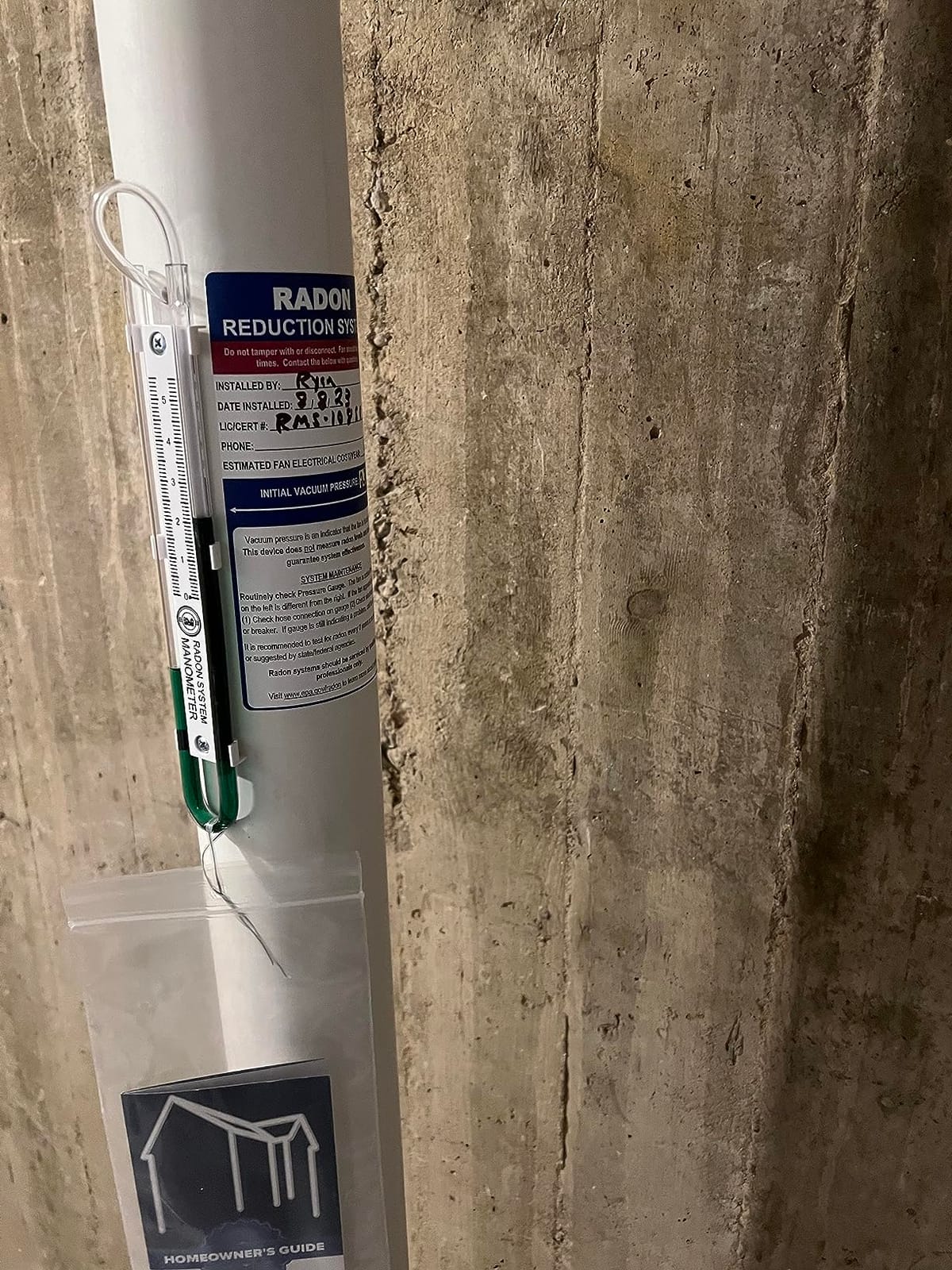
Second, hire a certified radon mitigator. The national certification body in the US is the National Radon Proficiency Program (NRPP), and most states maintain their own lists. A mitigator will quote a sub-slab depressurization system, which is the most common fix for basements. The system runs a pipe from beneath the foundation slab up through the roof, with a continuously operating fan that pulls radon out before it enters the home.
Third, verify the fix worked. Once the mitigation system is installed, run a continuous radon monitor for at least 30 days to confirm post-mitigation readings fall below 4.0 pCi/L, ideally below 2.7 pCi/L to match the WHO guideline. This is where a continuous monitor pays for itself: it gives you the long-term data to confirm the system is working through winter and summer.
If your basement also struggles with moisture, a working sump pump and proper drainage will make the radon mitigation system more effective, since wet soil releases more radon than dry soil. Our guide to egress windows for basements also covers how new window wells can improve ventilation if your basement is finished.
Frequently Asked Questions
Should I put a radon detector in the basement?
Yes. Radon enters through the soil and foundation cracks, then accumulates at the lowest lived-in level of the home. The basement almost always shows the highest radon concentration, so the EPA recommends testing there first. If the basement is unfinished, place the monitor on the lowest level where you spend time, such as a ground-floor bedroom.
What is the best home radon detector according to Consumer Reports?
Consumer Reports consistently rates the Airthings Corentium Home 2 and the Ecosense RD200 RadonEye as top performers. The Corentium Home 2 uses an alpha spectrometry sensor trusted by home inspectors, while the RD200 uses a pulsed ion chamber with a 10-minute first reading and OLED display. Both match professional-grade accuracy and offer long-term data history.
Which states are the worst for radon?
EPA Zone 1 areas have the highest indoor radon levels and include counties in Pennsylvania, Iowa, Colorado, North Dakota, South Dakota, Montana, and West Virginia. Zone 2 covers most of the rest of the continental US, while Zone 3 (lowest average) runs along the Gulf Coast and parts of the Southeast. Even in low-risk zones, individual homes can test high, so testing is recommended everywhere.
What time of day is radon highest?
Radon levels are usually highest in the early morning hours, typically between 2 a.m. and 6 a.m., when the ground temperature is stable and indoor-outdoor pressure differences drive soil gas upward. Levels often drop during midday as the home ventilates and rise again overnight. This is why a single short-term test can mislead and a continuous monitor is more reliable.
In what month is radon highest?
Radon levels in basements typically peak during winter, especially January and February, because the stack effect of a heated house pulls more soil gas through the foundation. Levels often hit their lowest point in late summer. For a representative long-term average, run your monitor through at least one full heating season before drawing conclusions.
Is radon exposure overblown?
Radon is the second leading cause of lung cancer in the US after smoking, and an estimated 21,000 deaths per year are attributed to long-term radon exposure. The EPA and WHO both set action levels below 4.0 pCi/L precisely because low-level chronic exposure still raises cancer risk. Testing and mitigation are well-supported by decades of research.
Which radon detector is most accurate?
For consumer-grade monitors, the Ecosense RD200 RadonEye and Airthings Corentium Home 2 consistently post the tightest agreement with professional continuous radon monitors in independent testing. Both use high-grade sensors (pulsed ion chamber and alpha spectrometry respectively) and are trusted by home inspectors in EPA Zone 1 states.
Final Verdict on the Best Radon Detectors for Basements
After 90 days of side-by-side testing, the Airthings 2950 Wave Radon remains our top pick as the best radon detector for most basements. It balances accuracy, battery-powered placement flexibility, and a friendly app experience, and it captures humidity and temperature alongside radon for a fuller picture of your basement air.
If raw accuracy is your priority, the Ecosense RD200 RadonEye is the better choice, and it adds a useful OLED display. If you want remote monitoring from anywhere, the Ecosense EQ100 EcoQube is the only Wi-Fi option on this list that pairs with IFTTT for true smart-home automation. For buyers who prefer simplicity and a clear physical display without any app, the Ecosense EB100 EcoBlu or Safety Siren Pro Series 4 are excellent picks. If you want the same tool home inspectors carry, the Airthings Corentium Home 2 is the trusted standard.
Whichever model you choose, remember that placement and time matter more than the device itself. Put the monitor at least 20 inches off the floor, away from drafts, and run it for at least 30 days before trusting the long-term average. Once you have your baseline, you will know whether your basement needs a mitigation system, and you will have the data to verify the fix actually works. The best radon detectors for basements do not just measure a number; they give you the confidence to act on it.
If you found this guide useful, check out our related basement upgrade reviews, including the 8 best dehumidifiers for basements and the 8 best sump pumps for basements, to round out your basement safety plan in 2026.